Browsing Tag

Alexander Art Gallery

When the World Looks Away

There is no witness so terrible and no accuser so powerful as conscience which dwells within us.” – Sophocles

Three years ago, I visited the Alexander Art Gallery for the first time. I had come to review Henk Pander’s The Ordeal, not knowing it would be his last solo exhibition before he died the next year. Paintings and drawings from across a lifetime depicted apocalyptic scenarios and narratives that referenced predominantly death and destruction. As I wrote at the time, “No matter how expertly painted, how creatively crafted, how defiantly clinging to beauty in all its visual instantiations, these paintings are about horror, that which is unleashed upon the world by evil forces, that which is experienced by the subjects of the painting, and that induced in us who view the cruelty on hand.”

The painter would have probably agreed that some of these sentiments apply to the work currently at the gallery. Sam Marroquin‘s exhibition When the World Looks Away is about the years of ongoing horror experienced by Palestinians in Gaza. The artist confronts us with depictions of humans under existential threat, their bodies and spirits under relentless assault, their culture and history intentionally eradicated, their grief more than a single generation can hold. As of this writing, there are now Israeli orders for even Doctors without Borders and other aid organizations to leave the strip by February, during ongoing mass displacement. This, and continued violence despite the cease fire agreements, will worsen the situation for the civilian population.

Alexander Art Gallery featuring Sam Marroquin

Henk would have been thrilled to see that there is a young artist at the beginning of her promising career taking up the mantle of bearing witness, and calling on us to do the same. This is pretty much where the comparison ends, though, given that he created huge oil paintings, and large pen-and-ink drawings thriving on the contrast between their size and the pristine executions of small strokes, thin lines and subtle markings. Marroquin’s, in contrast, are mixed media works, blind contour outlines drawn in charcoal, filled with acrylic paint, with added text for many of them.

I had seen a smaller subset of these intense paintings before, impressed by the use of her non-dominant hand to produce fluid impressions of scenes depicted on videos and print material of first hand experiences by Palestinians and other witnesses on site. At the time, the focus in conversations with the artist was on the selectivity of our media diets, connected to where we feel ideologically, or intellectually or “tribally” at home. Live witness accounts of the trauma are available, but never disseminated by most of the mass media, or are actively suppressed by factions on either side of the conflict. Marroquin felt compelled to step into the breach and expose us to the accounting, provide access to information that is not predetermined by the setting on our news channels and social media.

Sam Marroquin Despair (2024)

Seeing the body of work a second time, now in its entirety of over a hundred paintings, smartly curated by Kate Simmons, reinforced some of my earlier reactions and provoked additional observations. Unsurprisingly, my current (independent) reading also shifted the focus, and so will make an appearance here in a bit.

Sam Marroquin Starving (2024)

***

On a number of dimensions, Marroquin’s work reminds me of that of Charlotte Salomon, who was murdered in Auschwitz. The German artist’s paintings were fluid, influenced by graphic design, amounting to the impression of a graphic novel. They were narrating the autobiographical experiences, early life and later suffering of a Jewish woman who had to flee state violence and racist persecution, to no avail. Caught in France, she was shipped to the camps, her paintings survived in hiding. It was a large body of cumulative work, depicting multiple facets of life under existential threat on pieces of cheap paper, with whatever coloring materials could be secured in exile. She added text to amplify the universal meaning of individual experiences.

Charlotte Salomon  Life? Or Theater?  Excerpts (1941-1943)

When the World Looks Away shows a lot of stylistic visual resemblance, eschewing conventional painting for a more graphic style. Manga books come to my mind. The compulsive inclusion of every aspect of the narrative is also present. Marroquin refers to the loss of life and limb, the hunger, the bombings, the absence of medical care or the difficulty to obtain it. She depicts the attacks on select groups beyond Hamas terrorists, journalists, medical personnel and aid workers included, on top of the indiscriminate targeting of civilians. The painter describes the intentional destruction of cultural and educational institutions, the fate of political prisoners. She also refers to the international protests, and the treatment of protestors as criminals. The artist uses script often by doubling and superimposing words, creating an echo effect that resonates across time. Just like in Salomon’s work, witnessing is one of the through lines of Marroquin’s approach.

Sam Marroquin Goodbyes (2024)

Over and over the current paintings return to the children: innocents swallowed up into a maelstrom of violence and grief, at times specifically targeted, least able to defend themselves against the dangerous pressures of hunger, disease and cold. Irrespective of type of conflict, partisanship, country, from the Middle East to Syria, Ukraine, Sudan or the Republic of Congo, young non-actors who are most in need of protection are sacrificed to the ravages of war. Orphaned, disoriented, starving, burnt and maimed, they induce such a fright into the empathetic viewer that you want to turn away.

Sam Marroquin A Fine Line Between Life and Death (2024)

Sam Marroquin Where to? (2024)

Sam Marroquin Starved to Death (2025)

The artist bears witness – and tries to compel us to same – to the agony war unleashes onto humanity, regardless of who are the perpetrators, who are the victims, what cause can claim to be justified or what lessons of history are ignored. (Regarding the Gaza conflict, the International Court of Justice (ICJ) in the Hague is considering a case since late December 2023, claiming Israel was violating the Convention on the Prevention and Punishment of the Crime of Genocide through its actions in Gaza. It will likely take until 2028 to get a decision. Full arguments for the case from Israel are due next week, January 12th, 2026. If ICJ judges will find that both acts of genocide and incitement to genocide have taken place, their orders should bind states. However, there is really no mechanism to enforce international law, in particular international human rights law and international humanitarian law.)

Marroquin’s unflinching gaze on suffering, pain likely vicariously experienced when putting it into visual form across years of exposure, is remarkable. I would not have that in me. I can barely look at it for long amounts of time, which makes me ashamed.

Sam Marroquin To Grieve (2024)

***

It’s one thing to feel shame about not meeting your own standards. It is an uncomfortable feeling, and saddening. Emotions run even higher when I am told by others, “You should be ashamed of yourself!” But I am also mindful of the converse — when, for example, I find myself angry that others are not ashamed by their (often tacit) acceptance of actions or events I regard as vile. I certainly find myself enraged when the powerful act hideously and with no sense of shame.

Shame, and its counterpart shamelessness, deserve a closer examination, given that they are ubiquitous, and clearly provoking massive reactions. They are of importance in my own ways of approaching the world, obviously including the reception of art. They are also important in configuring the world I live in, often not for the better (just think of all the shaming around body image, or sexual victimizing on the internet, as just one example.) Two recently published and/or translated books are currently on my desk to help understand what’s at stake.

David Keen’s Shame: The Politics and Power of an Emotion just arrived, so I can only report on the introduction, but am already intrigued. Keen is a British political economist and Professor of Complex Emergencies at the London School of Economics. The core of the book tackles how shame can be instrumentalized, in politics, in war, in social hierarchies that assign (and reserve) a space to victims or for perpetrators. Shame can be loaded onto people, often with nefarious purposes, and in turn falsely promised to be lifted (often by the same actors who impose it in the first place.) In a social-media linked society where shame and shaming is increasingly prevalent, shamelessness itself can be sold as an attractive spectacle – a symbolic escape from shame, a taste of freedom, a flight from the constraints, disparagements, insults self-doubt and self-admonishments to which mere mortals are regularly subjected and subjecting themselves.”

Sam Marroquin Amputee (2025)

French philosopher Frédéric Gros’s A Philosophy of Shame approaches shame from the psychological perspective of the individual at the intersection with society, inextricably linked. Shame can be instilled by being assigned an inferior place in a hierarchy – there are plenty of “shame-generating frameworks” like stigmatisation, stereotyping, and inferiorisation by mechanisms of race, gender and class, or sexualized violence. We internalize that these relegations are our fault, and correspondingly feel shame rather than disgust for the perpetrators. In this sense, shame silences, subjugates and damages.

However, the philosopher also believes that there is an element of anger and rage in shame, which will, if we turn it against us, be very destructive. If I look at massacres of civilian populations, for example, I might be enraged, ashamed at my powerlessness to do anything about it. Often, and particularly if I am implicated by association with a perpetrating nation or group, that shame might convince me to close my eyes towards the cruelty committed in my name. It is simply too overwhelming to feel the shame, so I blind myself to the facts.

Yet, and this is the core message of the book, shame can also spark positive action. It might become an “ethical” shame where we project ourselves into a future reflecting on actions that would or would not shame us. Shame can be a stimulant, in other words, for imagining possible worlds and behaviors promoting desired outcomes. We live in a culture that ver much wants to distract us from assessing the ethical standards involved in the nation’s actions. The author’s prescription: “A proper response to shame has the potential to draw our attention to injustices or moral failings instead, and rouse us to resist and attack the status quo.”

Shame can rouse conscience in some way, then, just as Marroquin’s work does by relentlessly reflecting a reality that questions the morality of our actions, even as remote bystanders. We have choices: to look at suffering or not; to avoid complicated conversations or not; to support those in need or not; to make our voices heard or not.

To imagine a better world, or support the status quo.

If shame works as a catalyst toward defying shamelessness: bring it on!

***

‘When the World Looks Away’

Sam Marroquin
Jan. 5–Jan. 30, 2026

Monday-Friday, 9 a.m.-5 p.m. 

Artist Talk: Wednesday, January 14th from noon to 1pm.

Alexander Gallery is located in the Niemeyer Center at Clackamas
Community College.

19600 Molalla Avenue
Oregon City, Oregon 97045


Sam Marroquin World’s Child (2025)
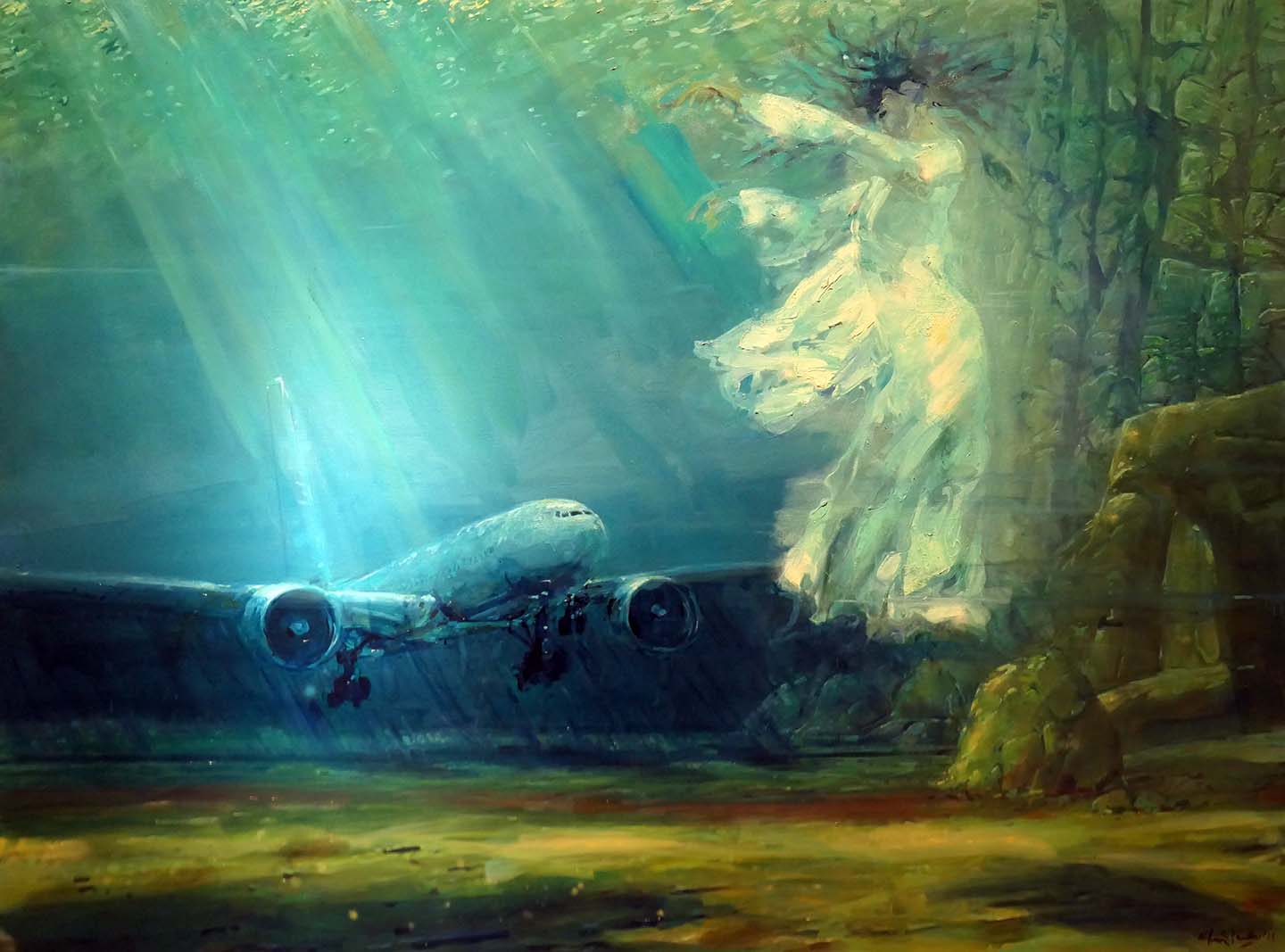
Henk Pander – The Ordeal

Ordeal: any extremely severe or trying test, experience, or trial. Synonyms: agony, anguish, calamity, distress, nightmare, torment, torture, trial, tribulation – Thesaurus.com

Here’s the funny thing: when you look up the definition of ordeal, the word judgment is entirely missing from the dictionary listing, and yet that is the etymological root of the term: in Old English it was ordāl, in Dutch oordeel, and in German Urteil.

Why do I care? So many thoughts emerged about the concept of judgement after visiting an exhibition, titled The Ordeal, of recent paintings by my friend Henk Pander in the Alexander Art Gallery at Clackamas Community College. Let’s disentangle them one by one.

First of all, as a friend I cannot objectively judge the artwork, but I can certainly describe my reactions and put them in a context of what I know about the artist, which might help to understand what propels the art. Then again, it might be pure speculation, but that is the bread and butter of the critic. I certainly hold with Oscar Wilde’s notion, expressed in his preface to his 1891 novella The Picture of Dorian Gray:

The critic is he who can translate into another manner or a new material his impression of beautiful things. The highest as the lowest form of criticism is a mode of autobiography.”

Henk Pander photographed by me in his studio in 2017 during a double portrait session

Experience first.

The college’s Alexander Art Gallery, located in the award-winning Niemeyer Center that opened several years ago, is a windowless, effectively lit space that reminds of a sheltered cove, an impression fostered by a brown, highly reflective floor which resembles the surface of water mirroring the paintings on the wall.

It is a place of calm, until you lift your eyes and look at the walls: then all hell breaks loose.

The power of fire and brimstone, skeletons, skulls and wrecks, mythological creatures bent on destruction and barely human figures dancing on the ruins, all in intensely saturated, vibrant colors momentarily takes your breath away.

Henk Pander Rising Water (2015)

I was familiar with many, perhaps the majority of these paintings, having encountered them in the artist’s studio. The effect of seeing them grouped together, undistracted by any other visual input, precisely and mindfully lit, sequenced in a way where all are directionally anchored in relationship to their neighbors, elevates the work to a whole different dimension.

The exhibition consists of 8 enormous oils on linen, and 6 large pen-and-ink drawings which thrive on the contrast between their size and the pristine executions of small strokes, thin lines and subtle markings.

They also provide material for teaching about artistic practice: some of them are studies or just alternate versions of the oil paintings. Here is one example (referencing Rembrandt’s Night Watch, linking to art history as well).

Henk Pander Dawn (2017)

Thoughts next.

What drives a life-long preoccupation with apocalyptic scenarios and mythological narratives that predominantly reference death and destruction? Why remind us of threats to nature, of plane disasters, with pilots deliberately drowning themselves and their plane’s human cargo, or warmongers shooting planes down? Why dwell on the violence of man killing man, or mythological creatures symbolizing sudden, inevitable harm? No matter how expertly painted, how creatively crafted, how defiantly clinging to beauty in all its visual instantiations, these paintings are about horror, that which is unleashed upon the world by evil forces, that which is experienced by the subjects of the painting, and that induced in us who view the cruelty on hand. Or so one thinks at first glance.

Henk Pander Abyss (2015)

A possible explanation could be guided by the very first painting in the round, if you start with a clock-wise exploration of the art on display. The canvas unveils an autobiographical scene from the artist’s childhood, being shipped off to a region of Holland where food was still available during the hunger years under Nazi occupation. The existential horrors of war and deprivation, imprinted on a young child that saw death on a daily basis and witnessed the fear, despair and other intense reactions from the adults in his life, might guide an artistic exploration of the topic. Given the continuing abundance of existential threats to individuals and/or our planet, the sensibilities of the adult artist might be used to draw parallels.

Henk Pander The Skipper’s Wife (2015)

I believe there is something else going on here, though. For one, Pander was raised in a rigidly Calvinistic culture, a religion he long left behind with his emigration to the United States so many decades ago. Dutch Calvinism might have embedded parts of its philosophy deeply enough to exert continuing influence, if only in explicit rejection. Secondly, the artist’s formative years were spent being educated by the premier art teachers of his time in the Dutch academy, infused with the tenets of Dutch art history starting with the Golden Age of the 17th century. These two factors interact, I want to argue, producing work that is not about the witnessing of horror per se, but the fragility of our existence, caught in the very moment where something irreversibly changes, never to be the same again, raging at the claimed inevitability of it all.

The Dutch have a name for that circumstantial reversal, staetveranderinge, a term derived from the Greek word peripeteia, and a concept embraced in Dutch paintings since the 1600s. The change could be in any direction – from anguish to praise, like in Rembrandt van Riijn’s versions of The Angel appearing to Hagar, but most often captured when circumstances shifted irrevocably to disaster, like Jan Steen’s Esther, Haman, and Ahasuerus.

Jan Steen, Esther, Haman, and Ahasuerus, c. 1668, Cleveland Museum of Art, Cleveland.

The preoccupation with “state change” corresponded with the rise of Calvinism, a religion that dominated the Dutch provinces and led to long religious wars against Catholic nations but also to boundless prosperity, shaping the evolution of commerce and empire.

Henk Pander Don’t Look (2015)

I’m obviously oversimplifying, but one of Calvinism’s tenets was about judgment and inevitability: the doctrine of predestination, which implied that G-d had already decided everyone’s eternal fate before he created the world. Some, then, were destined to thrive and find salvation, the rest were not. Election was by the grace of G-d, reprobation, on the other hand, the judgement of a G-d bent on just punishment. Calvin himself is cited: “The praise of salvation is claimed for G-d, whereas the blame of perdition is thrown upon those who of their own accord bring it upon themselves.” I will, to the end of my days, not understand this logic, somehow it’s our own fault if we are bad, all the while being predestined to end up in hell. Riddle me that. In any case, things were inevitably decided from the start.

Judgement didn’t stop with the authority on high. Calvinism had judicial assemblies composed of the church’s ruling elders and the pastor, who watched over, regulated and judged the issues of the congregation. In fact there are historians who claim that the social control of Calvinism reached all the way into the social lives of the Dutch: their windows, even on street level, have no curtains so that everyone can look in (a custom that disappeared only during the last few decades). The cultural quirk was rooted in the concept that a praiseworthy Christian had nothing to hide.

Henk Pander Harpy (2015)

Cherished protestant traits like hard work and frugality, and the eagerness to spread the gospel of Calvinism around the world, helped establish colonial empires (never mind resource extraction and slave labor and trade). The 17th century United East India Company (VOC – Vereenigde Oost-Indische Compagnie) prospered from the East Indies (Indonesia) to Ceylon (Sri Lanka) to the Cape of Good Hope (South Africa), bringing untold riches home to the Netherlands, as did its later sister company trading the Atlantic regions, the West India Company (WIC.)

That wealth spread among a relatively large new middle-class, highly educated and willing to spend some money on the arts – they had plenty of master painters to choose from. The philosopher G.W.F. Hegel lectured in his Ästhetik:

“The Dutch painters also brought a sense of honest and cheerful existence to objects in nature. All their paintings are executed meticulously and combine a supreme freedom of artistic composition with a fine feeling for incidentals. Their subjects are treated both freely and faithfully, and they obviously loved the ephemeral. Their view was fresh and they concentrated intensely on the tiniest and most limited of things.”

This was written 200 years ago, about painters from 200 years earlier still. Applies to Henk Pander’s work across various media as well, with the cheerfulness restricted to water colors of floral assemblies and landscapes, the focus on ephemera ubiquitous in his oil paintings. But he also captures the vision that his artistic forbears were so keen on, the point of no return when the plane drowns, the earth floods, violence arrives in its devilishly incarnation, the sharpness of the Minotaur’s skull echoed in the thrust of erection, the Harpy harbinger of the fall of towers.

Henk Pander The Minotaur (2015)

Is the depiction of all these ordeals and threats, over and over again across his artistic lifetime, a nod to the inevitability of our fate? Or are the paintings, in contrast to and in rejection of religious determinism, a warning? Do they imply the possibility that there are ways to prevent catastrophe, escape harm, make the world a less violent place if we abdicate our lust for power or our addiction to materialism? Is the work about agency rather than inevitability, the possibility of change rather than a set fate?

Are the increasingly thick slathering of paint and the choice of – yes – occasional garish colors signs of the artist’s smoldering rage at the futility of his warnings? An outcry that no-one heeds the predictions of yet another prescient artist putting the writing on the wall – or the marks on the canvas, as the case may be?

Henk Pander Excerpts from Native Soil (2015)

I do know that people tend to look away, despite the awards and accolades Pander has accrued across a lifetime, with works included in the collections of the Rijksmuseum (Amsterdam), Museum Henriette Polak (Zutphen, The Netherlands), City of Amsterdam, City of Portland, Jet Propulsion Laboratory (Pasadena), Portland Art Museum, Frye Art Museum (Seattle), Jordan Schnitzer Museum of Art (University of Oregon), and Hallie Ford Museum of Art (Willamette University), where a fifty-year retrospective exhibition of his work was shown in 2011.

The avoidance is not so much in judgment of the art, but likely an act of self preservation, not wanting to disturb our already fragile equilibrium. More agony, anguish, calamity, distress, nightmare, torment, torture, trial, tribulation? Bad news sells in the media. In the arts, not so much, unless they are a particular contemporary darling of the art world. Historically, art that defied the powers that be or let us in on their malfeasances was censored by church and state alike. These days, free market mechanisms are all it takes. If people are avoiding that which troubles them, commercial galleries or museums who depend on sales and visitor numbers, respectively, are not rushing to put us through the ordeal of witnessing. It’s a judgement call, they say, with varying justifications, but a clear view of the bottom line. More power to educational institutions, then, that provide access, in an environment that does the work justice.

You have a chance to judge for yourself. There is an urgency in the paintings that deserves our collective attention.

Henk Pander Excerpt from Water Rising (2015)

The exhibition is free and open to the public until the end of the month, with an artist reception this Thursday Jan. 19, 2023, noon-1 p.m. Henk Pander will speak about his work at 1 p.m. There is plenty of free parking in front of the ADA accessible building.

Niemeyer Center at Clackamas Community College,

19600 Molalla Ave.

Oregon City, Oregon 97045

Monday-Friday, 9 a.m.-5 p.m.

Here is another review from Oregon Arts Watch.