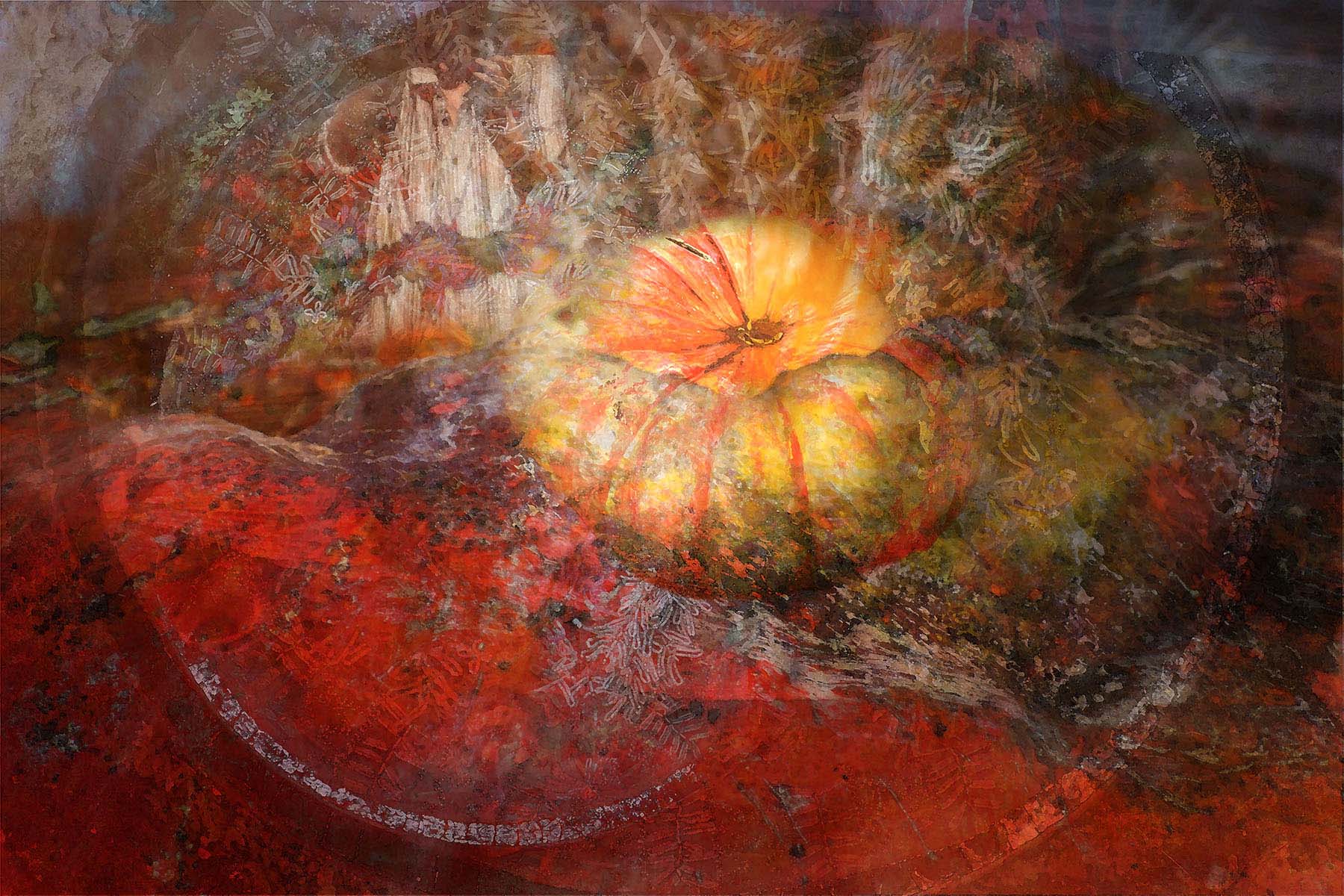

A two-and-a-half year-old of my acquaintance is by all reports besotted with pumpkins and other Halloween decorations. I have been sending her photographs of pumpkins and some considerations for how to explore different colors, since painting is another current cherished activity.
Today’s images, then, are the results of my trying to keep up with the creativity of my favorite toddler. They are also related to the poetry of Richard Brautigan, the master of observing everyday occurrences and putting them into innocent, childlike, anti-poetic words that can be grasped by everyone, exert an incredibly strong visual pull, and are deceptive in their simplicity.
—
The Pumpkin Tide
I saw thousands of pumpkins last night
come floating in on the tide,
bumping up against the rocks and
rolling up on the beaches;
it must be Halloween in the sea.

***
It is the time of year, where walks around the neighborhood are dominated by Halloween decorations. Plain, messy old pumpkins have been replaced by plastic ones, inflatable figures waste electricity, and attempts at humor compete with gruesome skeletons and jumping monster spiders.
How do you explain to a child what this is all about? Do you explain the pagan origins of Halloween, coming from the Celtic world of ancient Britain and Ireland? A celebration of the beginning winter period, a day where the souls of those who had died were believed to return, and those who had died in the preceding year were on their journey to the afterworld? With bonfires lit to frighten away evil spirits, and disguises and masks worn to not be recognized by the ghosts among us?

Or do you center the 7th century Christian attempts to supplant pagan rites with the introduction of Allhallotide, a three-day Christian triduum dedicated to remembering the dead that begins with Halloween (October 31- the evening before All Saints’ Day became a holy, or hallowed, eve, from which the word “Halloween” evolved,) and is followed by All Saints’ Day (November 1) and All Souls’ Day (November 2)? (Ref.)
Protestant Reformation, by the way, put an end to this for non-Catholics. Majority Catholic countries, like most of Mexico and South America, still celebrate, often happily and vividly, the Day of the Dead.
Or do you stress the notion of a now secular holiday, devoted to fun costumes and endless candy, if your parents let you….? So how to explain the ubiquitous skeletons?

***
These are the same questions I ask myself when thinking about fairy tales, or kids exposed to adults teaching them to take the bible as a literal document to be believed. Does it make a difference in how children learn about these things if and when the adults themselves believe in the tales they tell or not?
I suppose the function of fairy tales (or biblical lore) as instructions for how to understand the world, behave in the world and perhaps change a world that is unjust and menacing, is enhanced by a belief that the threats are for real. If you trust that you’ll end up eaten by the witch if you abscond to the woods, or fry in hell if you covet your neighbor’s possessions, you might be indeed more inclined to follow the rules.
Note, though, that it is not always about punitive actions. Fairy tales in particular often stress the positive outcomes of courage and risk taking, the questioning of hierarchical oppression, the power of empathy and reciprocal aid. And in modern versions, the Disneyfication of the old stories, if you will, evil powers and their reach have certainly been tamped down, compared to what the originals contained, stressing agency instead of assured victimhood.

The German fairy tales I heard as a child were assuredly different than the ones I read to my American children, more brutal and more inclined to stress the consequences of misbehavior. And fear was a palpable experience, in the absence of Halloween decorations, for a non-Catholic child in my catholic village during All Souls’ Day in the beginning of November. I have written about it before, but the flickering of remembrance candle lights on the graves of the local cemetery, breaking through the darkness of the flat, misty landscape of beet fields and meadows, gave me bone-deep shivers as a child. It was not about ghosts. It was about death. Death in the context of a too recent war, with evil at its roots.

Now, ignoring ghosts, specters, witches and all the other symbolic stand-ins, we are focused on the existence of evil again, in the context of war and in the vicinity of cease-fire agreements, in unadulterated crimes against humanity, as just one example picked for its sadistic timing. Could come up with uncountable more, all over the world, all sides.
How do you preserve the innocence of a young child, model courage and foster their fearlessness, provide them with a moral compass with a true north of all humanity in our current world? How do you celebrate the memory of the dead when we are all implicated in bringing about their demise, be it by action, indirect financing, or simple silence and averting our eyes?
Any answers out there?

I was thinking hard about what music to include today. There is the heavy, if beautiful piece by Ralph Vaughan Williams, Dona Nobis Pacem, Give us Peace. It is a war protest, and includes the Catholic Agnus Dei, three poems by Walt Whitman, a speech by Quaker politician John Bright, and excerpts from the Biblical book of Jeremiah.
But in the interest of lifting us all (and preserving a young child’s chance to listen to some really cool music!) I think I’ll recommend this. Maurice Ravel wrote this to commemorate friends and acquaintances who died in WW I, and was accused of doing it too light-hearted. His response: “The dead are sad enough, in their eternal silence.”
It is us, the living, who need this musical consolation. Music, painting pumpkins, watching kids blossom – creativity and connectedness help us to get through hard times in one piece. They are the tools to guard ourselves against the pain, the hopelessness, the fear at our doorsteps – feelings that surface way too often these days, at least for me.