Browsing Tag

Rebecca Solnit

During these Times

We have no other time than here and now
A time that's cheating us with half-filled bowls
We have to drink since refills are denied,
In front of our paradise
The sword already lurks, for which we, the heirs of lost sons 
driven from their land, were chosen
We grew old, before given a chance of ever being young
Our current life a state of not-yet-dying
We once arrived naively filled with faith
Into a century ravaged by storms
Our prior hopes replaced by stunned internal silence
Aid only possible for those who'd loudly cry
We furtively dream of woods and meadows
and a morsel of happiness thrown at our feet
But no tomorrow will restore the present day
we have no other time than here and now
We have no other time than here and now
We have no other time than here and now, here and now,
than here and now, here and now, here and now, here and now


by Mascha Kaléko

Jewish poet Mascha Kaléko’s later writing was suffused with the experience of exile. Moving from Poland to Germany, fleeing to the US during Nazi rule, eventually emigrating to Israel where a lack of Hebrew isolated her even more, she was a chronicler of hardship, crushed hopes, victims of displacement.

Little of her oeuvre is translated into English. I tried my hand on the verses above, fully aware I’m not a poet. I kept her punctuation, but was obviously unable to maintain the rhyming scheme. I was more interested in getting the meaning across, her acknowledgement of an inevitable fate and yet an insistence on agency, amidst the most dire circumstances.

During this week in particular I have been thinking about the fate of the displaced, in all the ongoing war zones, the fate of those for whom the sword is lurking, whose lives already are or will be exposed to existential threat.

The whole of Tuesday, after the early Presidential threats of exterminating an entire civilization, never to be restored again, I was in such a state of anticipatory anxiety that I could barely function. Then I woke up enraged this morning, feeling the emotional abuse of threatened violence, keeping a world holding its breath, manipulation only matched by that of the stock market. Those thousands killed, kids included, billions spent, our defensive arsenal depleted. Our reputation in the world in ruins, international transportation made more expensive, an oppressive Iranian regime more secured than ever. A people promised liberation offered obliteration on the turn of a dime, on the whim of either a madman or an intentional manipulator. And none of it providing the security that it won’t start again at any moment in time.

The poem reminded me to stay focused on the here and now, because that is all we have, and should not waste with fears about an unpredictable future. You can go further, though, beyond the “all we have.” WE HAVE the here and now, and as such we can make use of it, with something, anything, to affect what future will arise. Maybe we can render aid to those who are muted into silence, after all, not expecting them to shout for it. Maybe we can refill the bowls of the thirsty, in defiance of the rules.

And just maybe we can unite to rip the swords out of the hands of the bloodthirsty, sadistic monsters that destroy the world for power and riches. We are in a here and now where action is still possible.

We can refuse to join the cult of lemmings bent on self destruction, reverse direction – in the here and now.

A much more elegant and extended version of those thoughts expressed by Rebecca Solnit can be found here.

Here is the original version of the poem.

Shelter

You know that feeling when you think about something and all of sudden almost everything you read or see somewhat points in that direction? It’s some sort of semantic priming, and mine has been all week around the notion of shelter. How can we find shelter against the onslaught of bad news, the overabundance of worry, the intensity of stress in our personal as well as public lives?

First thing this morning, then, was a videoclip sent from Germany. Someone declared that the current mood, across the world, is like the weather: dark, stormy, and definitely cold. He then argued we all have to be like hats, or jackets, or felt-lined boots used for exactly that weather, offering shelter against what surrounds us, providing warmth for those next to us, out in the cold. I took to that mental image – you’ll be my jacket, I’ll be your hat. Protection found in mutual caring for each other, shelter in loving kindness or chesed, as it is known as a concept in Judaism.

Next thing in my inbox was this week’s Meditation in an Emergency, focused on the need for big tents, another form of shelter. Solnit argues that during emergencies like real world catastrophes people come together to support and protect each other regardless of political or religious differences that usually keep them apart, unless they reside at the absolute extreme ends of the spectrum. The same should happen during political upheavals the likes of which we are currently experiencing. There is value in alliances, then, rather than isolation, protection through coalitions, not undermined by scorn or accusations for previous mistakes. )Although some will always barred from my tent: Republican Darren Beattie, for example, appointed by Secretary of State Marco Rubio to be the acting undersecretary for public diplomacy and public affairs, a senior role that represents American foreign policy to the world. Beattie has called for the mass sterilization of “low IQ trash” and feral populations. “Could offer incentives (Air Jordans, etc.).” Nerd-Reich eugenics, anyone?)

Back to sheltering tents: Here is Solnit’s paragraph that registered most with me:

Many powerful forces–the rhetoric of mainstream politics, the framing of mainstream entertainment and news, the version of therapy that reinforces individualism as it tells us we’re here to care for ourselves, end of story–tell us we are consumers, not citizens (and here I mean citizens as members of civil society, regardless of legal citizenship status). That we are here just to meet our own needs and chase our personal desires, within the realms of private relationships and material comfort and security, and that we hardly exist beyond those small realms. It says on the one hand “go have all this stuff” while it quietly discourages us to have the other stuff that is public life, participation, and power. While pretending to point us toward abundance, it deprives us of the most expansive and idealistic versions of ourselves. And most of us really are that larger self, the version that cares about justice, human rights, democracy, equality (withering all that away is a clear part of the right’s agenda at least since Margaret Thatcher’s “There is no such thing as society”).

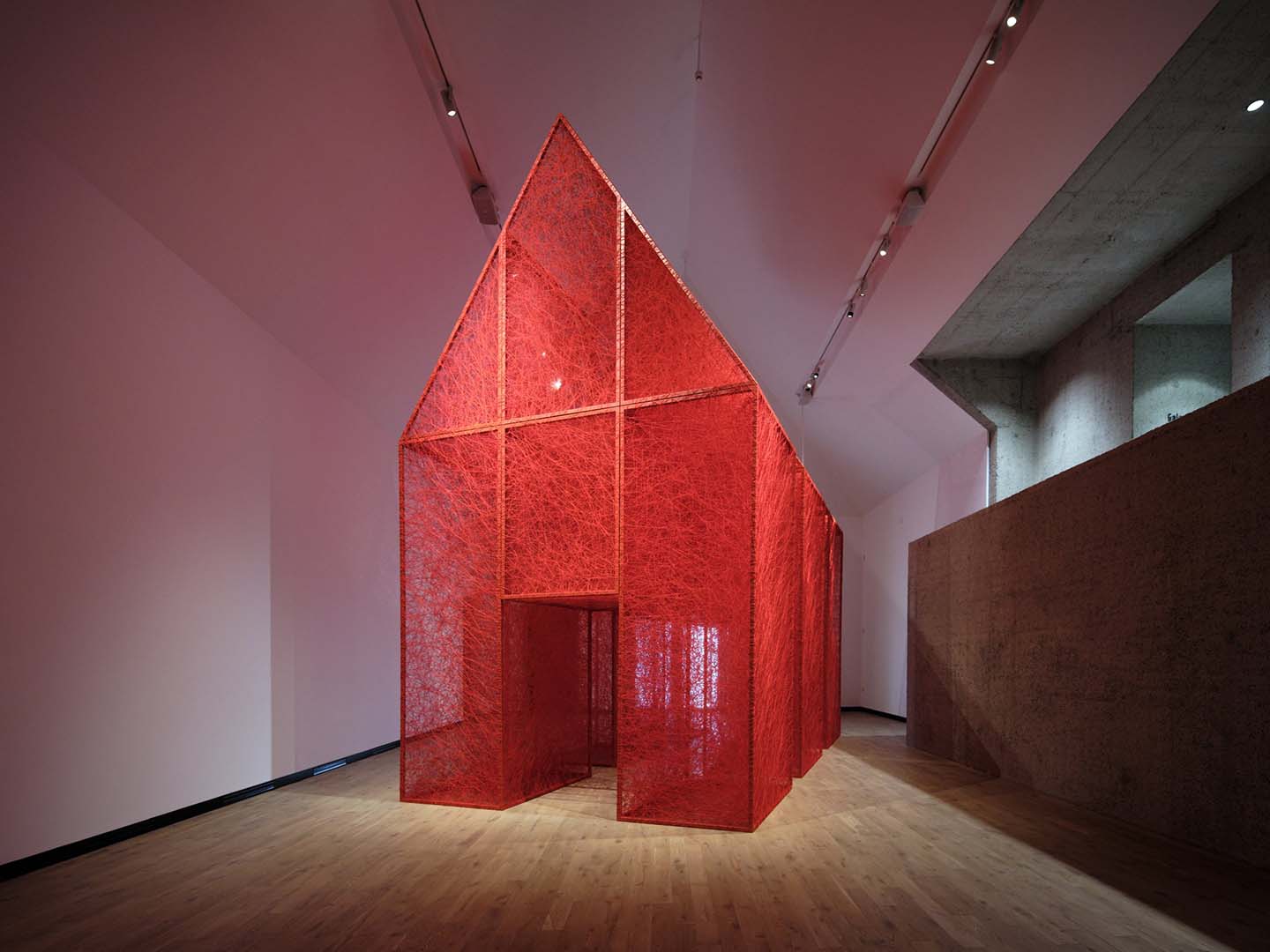
Chiharu Shiota The Network (2024) Musée du Pavillon de Vendôme; Musée des Tapisseries and Chapelle de la Visitation, Aix-en-Provence, France. Photocredir Philippe Biolatto, Ville d’Aix-en-Provence

And then I came across a mention on ArtNet about two current exhibitions of work by an artist who is everyone’s darling these days – not mine, admittedly. Chiharu Shiota’s work has been basically repeating itself for the last 25 years, and some of her installations borrow quite a bit from other people’s ideas. But honor where honor is due: She was one of the early sculptors who integrated fiber into her work, before we saw the explosion of fiber art across the last years. And the theme of interconnectedness has been a red thread (quite literally) throughout her career. (She reserves the black threads she uses for associations to the cosmos, fate, or other intangible things that surround us.) The idea of all of us being invisibly bound together by these webs made out of thousands of threads, and the visual experience of tent-like installations hanging above our heads certainly fit into the associations that came up around the notion of “shelter.” For an introduction to her work, here is an interview with the artist, a good starting point.

Chiharu Shiota Uncertain Journey (2024) Le Grand Palais, Paris, France

Photo credit: Didier Plowy

Here are selective exhibitions still on view:

until 19.03.2025
The Soul Trembles, solo show, Le Grand Palais, Paris, France [touring exhibition]

until 20.04.2025
Between Worlds, solo show, Istanbul Museum of Modern Art, Istanbul, Turkey

until 28.04.2025
The Unsettled Soul, solo show, Kunsthalle Praha, Prague, Czech Republic

Chiharu Shiota The Silent Concert (2024) – Kunsthalle Praha, Prague, Czech Republic

Photocredit: Vojtěch Veškrna

until 27.06.2025
The Soul’s Journey, solo show, Fundacion Calosa, Irapuato, Mexico

As I said, she is surely en vogue. Lots of soul in the titles, lots of wool in the air. Clearly resonating with a large, international public. Maybe it is people’s fascination with the nature of webs, strong and fragile at once. Or the rudimentary desire for cocooning. Or respect for the tremendous amount of coordinated work going into these creations. Or humans’ insatiable desire for spectacle, the bigger the better. All not mutually exclusive.

I encountered her work for the first time at the Hammer museum in L.A., when she was the inaugural artist featured in the Hammer’s redesigned lobby, for the Hammer Projects 2023.

Here is an installation in a gallery in Brussels from 9 years ago, that somehow reminded me of a painting by George Tooker, the way my brain works…

Chiharu Shiota Sleeping is like Death (2016) Installation View, photo credit Gallery Daniel Templon

George Tooker Sleep II (1959)

Last year Shiota was invited to show at the Chapel of the Visitation during the Aix-en-Provence Biennial; her installation included letters from people asked to write about their experience with gratitude (does that remind you of Yoko Ono’s installations of trees and letters for peace?)

Beyond Consciousness de Chiharu Shiota - Journal Ventilo

Chiharu Shiota Beyond Consciousness (2024) Photo credit: Pierre-Nicolas Bounakoff

Maybe the idea of gratitude is another way to find shelter: a focus on what we have that is positive. It might just insulate us, if only for short moments, from the fear and disquiet instilled by the news.

Gimme Shelter, indeed… the Stones knew.

Cheating

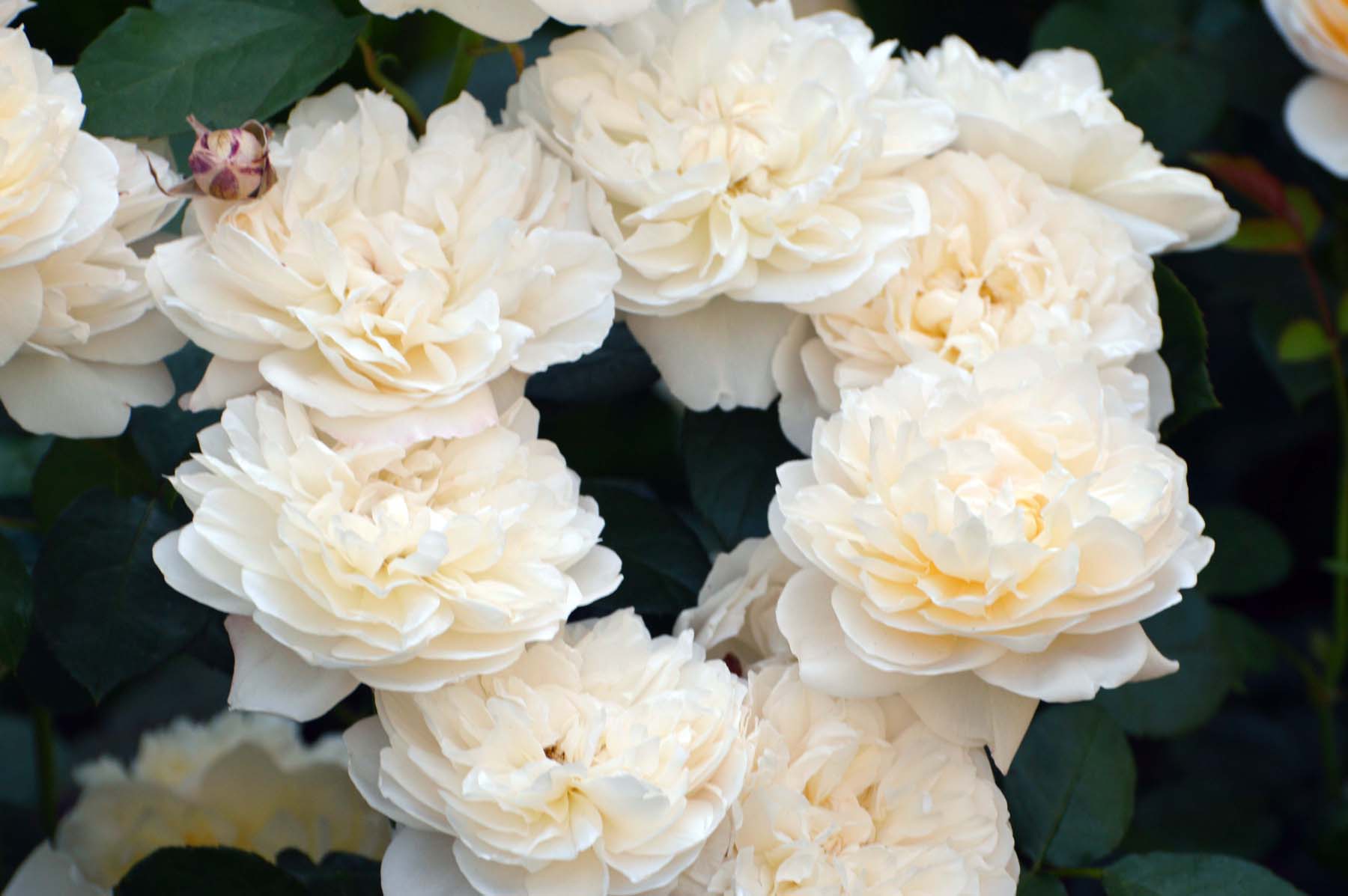
I am knee-deep in several independent writing projects and so, this once (or once again?) I will cheat and put someone else’s review of a book (Orwell’s Roses) I recommend up here, instead of my own. You still get the photographs of last week’s wonders in the mystery garden, though. And, in case you missed it, here are my own thoughts on Orwell, gardening and the disappearance of marital labor, from some time back.

Here is the link to the review of Rebecca Solnit’s Orwell’s Roses by Gaby Hinsliff. I am attaching the full text below for those who do not have access to The Guardian where it was published last year. If you have read it already, you might also be interested in the 2022 winner, announced yesterday, of The Orwell Society‘s Political Writing award: Sally Hayden’s My Fourth Time, We Drowned. Here is a review from March.


Orwell’s Roses by Rebecca Solnit review – deadheading with the writer and thinker

Inspired by George Orwell’s love of gardening, Solnit’s suitably rambling book should appeal to the green-fingered and the politically committed alike

The roses are in dire need of pruning. My rambler in particular is getting very tangled; too many whipping tendrils snaking out haphazardly at all angles. But it’s so pretty it’s hard to be properly brutal with it, even though it would probably benefit from some judicious thinning. And yes, it is the experience of reading Rebecca Solnit’s Orwell’s Roses that has jogged my memory.

The book simultaneously is and isn’t about George Orwell, just as it is and isn’t about roses. It belongs in a whimsical category of its own, meandering elegantly enough through lots of subjects loosely connected to one or the other; more of a wildly overgrown essay, from which side shoots constantly emerge to snag the attention, than a book. But at its root is the fact that in 1936, the writer and political thinker planted some roses in his Hertfordshire garden. And when Solnit turns up on the doorstep more than eight decades later, she finds the rose bushes (or at least what she takes to be the same rose bushes) still flowering, a living connection between past and present.

From this blooms the most enjoyable part of the book – a reflection on what gardening may have meant to Orwell, but also what it means to gardeners everywhere; beauty for today, hope for tomorrow, and a desire to create something for those who come after – all of which find an echo in the best of politics.

To make a garden is to feel, in Solnit’s words, more “agrarian, settled, to bet on a future in which the roses and trees would bloom for years and the latter would bear fruit in decades to come”. By the time Orwell’s roses flowered that summer, the Spanish civil war had broken out. As they grew, Europe spiralled closer to conflict. But the buds would still swell and the petals would still fall, and in the midst of death there would be new life, a cycle that helps explain why gardens and nature more generally have been such a comfort to so many through the grief and loss of the pandemic.

But roses, in Solnit’s story, don’t merely symbolise the eternal. They also symbolise joy, frivolity and a kind of sensual pleasure not always associated with Orwell, so often presented as a rather dour and austere figure; a chronicler of hardship in his writings on the low-paid and exploited, and in his fiction a prophet of doom, warning against the evils of totalitarianism. By choosing to focus on the gardens he planted – in Hertfordshire and, later, on the farm he bought on the Scottish island of Jura – and the happiness they brought him, Solnit restores something often missing not only from Orwell but from the political tradition of which he is part.

But not all the branching diversions of this book are so successful. A chapter on coal, which ends by arguing that Orwell’s planting of a garden half a century before climate change entered the public consciousness could be interpreted as the nurturing of “a few more carbon-sequestering, oxygen-producing organisms”, feels at best tortuously grafted on to the rest. I could have happily taken the secateurs to Solnit’s musings on the coincidence between being served Jaffa Cakes on her British Air [sic] flight to Britain and then reading an article about Palestinian children visiting the beach at Jaffa – an anecdote that tells the reader nothing of any significance about either.

But then into every garden a little bindweed creeps. The green-fingered and the politically committed alike will want to curl up with this book as the gardening year draws to a close and we reflect on a time during which nature has been more of a solace than usual. It’s been a good year for the roses, at least.

“A rose is a rose is a rose,” said Gertrude Stein. Well here is a musical bouquet of a rose and a rose and a rose. Fauré, Schubert in a Fritz Wunderlich performance, and Berlioz.