Browsing Category

Nature

Safe Keeping in Stone

The last installment in this week on stones is an article about a storage site that holds millions of packages of seeds – a stronghold, or so the scientists thought, to protect humanity from losses of its most important crops.

The idea is, of course, brilliant. Put all of the world’s food seeds into a stone bunker in the depth of permafrost, deep in a mountain, in Spitsbergen, Norway, and know they will be safe from many, if not most, forms of destruction.

Except, the idea relies on the condition of permafrost – which, as we all know, is beginning to thaw.  Melting water, then,  managed to seep into the entrance of the seed vault.  No harm done, so far.  The floods did not reach the inner sanctum. But climate change is obviously forcing many projects to reconsider if and how they can be maintained.

https://www.theguardian.com/environment/2017/may/19/arctic-stronghold-of-worlds-seeds-flooded-after-permafrost-melts

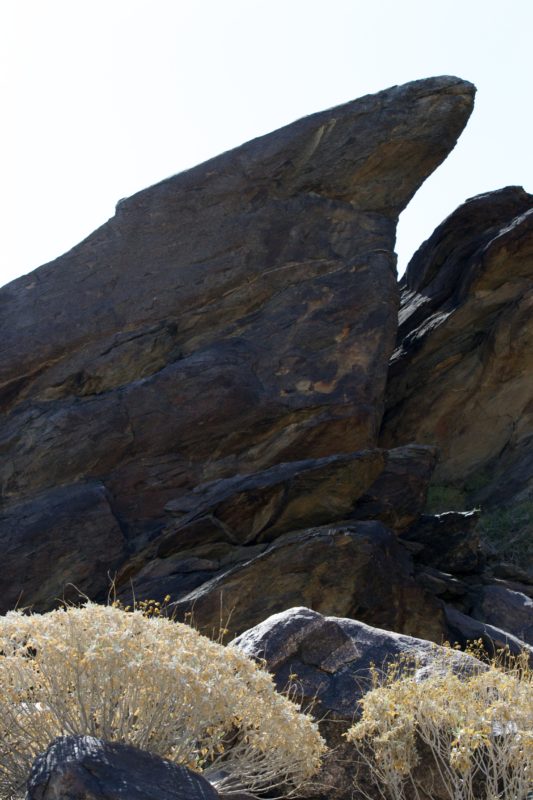
Photographs are of stones/rocks in Indian Canyon near Palm Springs, CA.


Heart of Stone

As cold as stone, a heart of stone, trying to squeeze blood out of a stone – so many phrases come to mind when reading about the Trump administration’s plans and strategies. But just like developmental psychologist Alison Gopnick, our esteemed colleague at Berkeley, argued that comparing Trump to a 4-year old was an insult to children, I find that these catchy phrases are an insult to stones – some of the most beautiful sights to be found on this planet.


(Click on picture to open Gopnick’s NYT op-ed.)

During this week, then, I will offer stories that describe social and political issues that are related to hearts of stone or, alternatively, prove that there are always people who rock. They will be juxtaposed with photographs of stone in various forms and guises.

Let’s start with an interesting analysis how the GOP is using its anti- abortion rights playbook to further its voting rights agenda.  The key legal issue that can and will be applied to the suppression of voting rights are so called TRAP laws – something that enabled antiabortion forces to undermine the rights granted by Roe vs Wade. TRAP stands for Targeted regulation of abortion providers, and emerged from legal reasoning that claimed “Medical uncertainty underlying a statute is for resolution by legislatures, not the courts.” Claim some, any scientific uncertainty and the state can swoop in and legislate. The essay below spells out how that transfers to gerrymandering…..

https://thinkprogress.org/gop-anti-abortion-playbook-voting-rights-aa0ccac3304e

The photographs are from Enchanted Rock National landmark in Llano County, Texas.

Status: In Flight

I figured we can all use some lift by proxy at the end of this very week. So here are some birds in flight. Given my amateur equipment, it is hard to get far away, moving birds in focus, but I lucked out with at least some of these shots. They were collected over the last couple of years in my favorite haunts: Sauvie Island, Steigerwald Bird Sanctuary, Tualatin River National Wildlife Refuge, Finley Refuge, Ankeny Refuge and Fernhill wetlands. All except Finley are less than an hour’s drive from Portland and none charges fees.


Flying today are geese, cranes, egrets, swans, hawks, ospreys and eagles. You might find it interesting – I certainly did – how eagles are put to work in our modern times. Rather than train them to hunt small pray, they are now made to hunt drones. One can imagine all kinds of applications….. and here we thought drug sniffing dogs were (custom)men’s best friend.


This next photograph was taken in pouring rain, a harrier hawk attacking a red tail hawk.  Fuzzy but quite the sight then and there.

https://www.washingtonpost.com/news/worldviews/wp/2016/02/01/trained-eagle-destroys-drone-in-dutch-police-video/?utm_term=.1e5709a0d3cd


Ardeidae

Ardeidae is the family name of those long legged waterbirds: herons, egrets and bitterns. Herons are beautiful birds. They come in different colors and sizes but all have amazing plumage. Their movements are elegant, on land and in flight, with an economy to their motion, an ease and fluidity. When the light hits just right they are almost iridescent. And they are pretty peaceful, quite unflappable.

To wit, here’s an encounter I photographed last week while standing on a shaded bridge in the woods.  The red-winged blackbird was sitting on the log, probably close to the reeds where his mate is nesting. When the heron decided to join him, the blackbird wouldn’t have it. He flew wildly around, eventually pecking at the heron, then in exasperation sitting next to him for a while as if he could prevent him to move. Eventually the heron gave up and stepped into the pond, searching for lunch.


Unfazed, as I said. Regal in their indifference. Beautiful.


Except when they open their mouth, or their beak, as the case may be.

Taken in the evening, low light made it hazy…..

Have you ever heard a heron’s voice? It is as ugly as their appearance is pretty. Squawks of such shrill and loud discordance will want you to cover your ears if you are close by. The mismatch between what you expect to hear and what fills your hearing reminded me of this.  Enjoy!


Shore Birds

Will it surprise you, dear Reader, to hear that I sometimes have a vivid imagination? Most of the time, to be honest? It happened again last Sunday when I wandered, by myself, along the coastline of Ft. Stevens.

The Fort, and its adjacent hundreds of acres of National park, guards the spot where the mighty Columbia river enters the Pacific. It was constructed in the 1860s to provide a defense for the Oregon Territories. After the Civil War, the Army Corps of Engineers took over to improve the Columbia River Channel; around 1900 the building of a true defense installation began; luckily the soldiers at the Fort never engaged in active combat even when shelled by a Japanese submarine gun in June 1942 – since they incurred no damage they decided not to fire back. Wise men. (Won’t point out the contrast to you know who.)

History

So here I stood on land that was the sea when Lewis&Clark arrived in 1805 or so. The building of a long jetty had helped to wrestle almost a mile of land from the ocean. Behind that dike now lie salty marshes, ideal breeding ground for shore birds.

On the jetty itself sea gulls, crows, and, astonishingly, swallows jostle for the best space.

There are so many old, decaying wooden structures left from the heyday of the Fort that the swallows have an ideal breeding ground.

Numerous species of ducks, cormorants and other sea birds swim in the ocean, sand pipers roam the beach and sanderlings flit about.


My imagination? I saw the birds as merry carriers of the many souls lost at that very spot: the dangerous waters where ocean meets river provided one of the largest grave yards of the Pacific – more than 200 ships went down there with few lives rescued. The birds, however, soar and float and careen above the watery graves, looping through shimmering rain and eventual some rays of sun.


My heart shed some weight.


PS: On a practical note: The park is only an hour and 40 minutes from Portland. It has a museum, lakes to swim in, various beaches, an old shipwreck and perfect hiking paths for day trips. One MUST, however, bring sturdy boots because climbing around the jetty is extremely slippery. In the summer, insect repellant is also essential or you get eaten alive in the woods there.

For the birds

Kirtland Warbler, photo source on the web

This week is dedicated to some of the birds I recently photographed and stories and questions they brought to mind.

We will start with a report I heard on the radio yesterday, a re-broadcast of an old NPR radiolab piece about a threatened species, the Kirtland warbler. The basics of the story as I remember them are as follows.

Happy little warbler in Michigan disappears. Wildlife services try to figure out why and pinpoint the nasty cow bird, a non-native species. Cowbirds, like cuckoos,  surreptitiously place their ow egg in the warblers’ nest, throwing one of the old eggs out to make space. When chick hatches, it grows at 4 times the speed than the warbler hatchlings, and so commands more room, throwing another chick out and gets all the food, since the parents feed the noisiest one first.

(These photos from the internet.)

A killing of cowbird commences to save the warblers. Traps are set, birds are killed by hand. 12ooo dead cowbirds later, the warbler population seems not to improve. So they figure that it was really also the absence of young trees, because wildfires have not been allowed to happen to protect humans. Wildlife services decide to try controlled burns. With few resources, few firefighters etc, burn gets out of control and ravages 20.000 acres in a blink, killing in its way a young wildlife technician who was eager to save the birds.

The question that many ask is: is saving a species worth a human life? After all there are some 50 species of warblers alive and well? Is putting so many resources into species protection, killing so many other birds worth the warbler continuity? If you decide to forgo saving one species, what about the next and the next and the next?

In some important way, the premise is wrong. The young man was killed due to circumstances in the process of protection, not because of the protection. The species is disappearing because of land use issues, interrupting the natural cycle of things.

Framing issues as human interest stories were emotions are roused when you hear the sad family, are dangerous in times where the Endanger Species Act is under assault by a reckless administration. ( Knew I would get there somehow….)

Photographs of warblers in the Columbia Gorge last week.)

http://www.radiolab.org/story/91723-weighing-good-intentions/


Flying

In an airplane, I just point my iPhone to things that look interesting, through the usually smudged and wet windows. (These images are from approaching SFO and put through a watercolor filter.)

Not so for someone with a passion for photography while flying. And with a passion for a cause: the environmental destruction happening across the globe in the pursuit of riches. I thought this was a timely topic given the impending retraction of protected national monuments and parks so the earth can be depleted some more. And I was impressed by someone who makes it possible for himself to travel to all these different countries that he photographed to warn us.

Let me introduce a man who is steering us all towards awareness of the hidden cost of consumerism. Henry Fair photographs the industrial scars of diverse countries while flying over them.  The resulting images are almost too beautiful to believe, particularly when thinking about the ugliness of what they represent. So I am breaking my rule of showing only my own photos (oh the freedom of blogging!) and present some of his. They are all contained in the link below:

http://www.spiegel.de/fotostrecke/industrial-scars-fotoband-zeigt-umweltsuenden-fotostrecke-146647.html

CANADYS, SOUTH CAROLINA, USA. When ash comes into contact with water, contaminants including arsenic, lead, mercury, selenium and others can migrate into groundwater, lakes and streams. This plant (since closed) was cited by the US Environmental Protection Agency (EPA) in 2011 as a âproven caseâ of environmental damage. It is know to have contaminated groundwater with arsenic, and is one of the largest emitters of sulphur dioxide in the USA.

GRAMERCY, LOUISIANA, USA. Red mud waste material is pumped onto the upper surface of a massive waste impoundment in a water slurry. The impoundments are essentially very large shallow bowls, engineered to de-water the slurry through evaporation and an internal drainage system fed by an arrangement of funnel-like decant points where water collects in pools.

SPRINGVILLE, PENNSYLVANIA, USA. Collection pit for drilling waste containing ground rock, drilling muds (the lubricants and chemicals used during drilling), and in some cases radioactive material existing in the target shale layer. The overspray at the top is a violation and a danger to any water bodies downhill.

LAUSITZ, GERMANY. The earth and rock overburden covering the coal is excavated and moved aside by conveyor to allow access to the coal. The conveyor feeds the overburden to a machine with a long, swinging arm which distributes the material by oscillating back and forth as it pours. When the mine is depleted, the overburden is used to partially fill the remaining pit.

KIRUNA, SWEDEN. Waste impoundment at Kiruna Iron Mine. The fine waste material is mixed with water and pumped in a slurry through long systems of pipes, or âlaundersâ, to tailings impoundments where the water runs off and is collected in ponds.


How can poison, waste and destruction look so beautiful? Abstract paintings are shallow echoes of these natural occurring patterns. And yet the images make me itch to pick up a paintbrush again…..Next life.


Seeking the Light

On a Friday in spring what better than branching out – we had jokes at the beginning of the week, might as well end the week with a(n imitation) Dr. Seuss tale.  Uplifting it shall be, just as the branches lift themselves into the light.  Happy spring, everyone!


To be read in the Dr. Seuss cadence!


In a land where the states are united, they claim,
In a sky-scraping tower adorned with his name,
Lived a terrible, horrible, devious chump,
The bright orange miscreant known as the Trump.

This Trump he was mean, such a mean little man,
With the tiniest heart and two tinier hands,
And a thin set of lips etched in permanent curl,
And a sneer and a scowl and contempt for the world.

He looked down from his perch, and he grinned ear to ear,
And he thought, “I could steal the election this year!
It’d be rather simple, it’s so easily won,
I’ll just make them believe that their best days are done!
Yes, I’ll make them believe that it’s all gone to Hell,
And I’ll be the Messiah, and their souls they will sell.

And I’ll use lots of words disconnected from truth,
But I’ll say them with style, so they won’t ask for proof.
I’ll toss out vague platitudes, phrases, and such.
They’re so used to fake news that it won’t matter much!
They won’t question the how, the what, why, or when,
I will make their America great once again!”

The Trump told them to fear, they should fear he would say,
“They’ve all come for your jobs, they’ll all take them away.
You should fear every Muslim and Mexican too,
Every brown, black, and tan one, everyone who votes blue.”

And he fooled all the Christians, he fooled them indeed,
He just trotted out Jesus, that’s all Jesus-folk need.
And celebrity preachers, they all crowned him as king,
Tripping over themselves just to kiss the Trump’s ring.

And he spoke only lies, just as if they were true,
Until they believed that the lies were true too.
He repeated and Tweeted, and he blustered and spit,
And he misled and fibbed—and he just made up shit.

And the media laughed, but they printed each line,
Thinking “He’ll never win, in the end we’ll be fine.”
So they chased every headline, bold-typed every claim,
‘Till the fake news and real news, they looked just the same.

And the scared folks who listened, they devoured each word,
Yes, they ate it all up, every word that they heard,
Fearing their status was under attack,
Trusting the Trump to take their America back.
From the gays and from ISIS, he’d take it all back,
Take it back from the Democrats, fat cats, and blacks.
So hook, line, and sinker they all took the bait,
All of his lies about making America great.

Now the Pant-suited One she was smart and prepared,
She was brilliant and steady, but none of them cared.
They cared not to see all the work that she’d done,
Or the fact that the Trump had not yet done Thing One.
They could only shout “Emails!”, yes “Emails!” they’d shout,
Because Fox News had told them—and Fox News had clout.
And the Pant-suited One, she was slandered no end,
And lies became truths she could never defend.
And the Trump watched it all go according to plan—
A strong woman eclipsed by an insecure man.

And November the 8th arrived, finally it came,
Like a slow-moving storm, but it came just the same.
And Tuesday became Wednesday, as those days will do,
And the night turned to morning, and the nightmare came true,
With millions of non-voters still in their beds,
Yes, the Trump, he had done it, just like he had said.

And the Trumpers they trumped, how they trumped when he won,
All the racists and bigots, deplorable ones,
They crawled out from the woodwork, came out to raise Hell,
They came out to be hateful and hurtful as well.
With slurs and with road signs, with spray paint and Tweets,
With death threats to neighbors and taunts on the street.
And the grossest of grossness they hurled on their peers,
While the Trump, he said zilch—for the first time in years.

But he Tweeted at Hamilton, he Tweeted the Times,
And he trolled Alec Baldwin a few hundred times,
And he pouted a pout like a petulant kid,
Thinking this is what Presidents actually did,
Thinking he could still be a perpetual jerk,
Terrified to learn he had to actually work,
Work for every American, not just for a few,
Not just for the white ones—there was much more to do.
He now worked for the Muslims and Mexicans too,
For the brown, black, and tan ones, and the ones who vote blue.
They were all now his bosses, now they all had a say,
And those nasty pant-suited ones were still here to stay.

And the Trump, he soon realized that he didn’t win,

He had gotten the prize—and the prize now had him.

And it turned out the Trump was a little too late,
For America was already more than quite great,
Not because of the sameness, the opposite’s true,
It’s greatness far more than just red, white, and blue,
It’s straight, gay, and female—it’s Gentile and Jew,
It’s Transgender and Christian and Atheist too.
It’s Asians, Caucasians of all different kinds,
The disabled and abled, the deaf and the blind,
It’s immigrants, Muslims, and brave refugees,
It’s Liberals with bleeding hearts fixed to their sleeves.
And we are all staying, we’re staying right here,
And we’ll be the great bane of the Trump for four years.
And we’ll be twice as loud as the loudness of hate,
Be the greatness that makes our America great.
And the Trump’s loudest boasts, they won’t ever obscure:

Nearly three million more of us—voted for her.

Written by H. Blair, a teacher in Bellevue, WA; edited by R. Green and A.Vizinho

Make America Sane Again.

And here is the last of the Fruehlingslieder…. https://www.youtube.com/watch?v=MHmzzu4FAnM

Poetic Flora or Modest Bloom?

An April Thursday delights the eye with modest treasures – small blossoms, peeking out from here or there.

Back home, on the computer screen, a cornucopia of all kinds of plants lights up: a new book that catalogues and beautifully illustrates the botanicals used by Shakespeare in his writings – all 175 them!


The plant drawings are set next to excerpts of the verses they inhabit, what a grandiose idea! Gardener friends, you know what you’ll find on your birthday table.


A Compendium of Shakespeare’s Plants, from Juliet’s Rose to Ophelia’s Bouquet


Much reason, then, to bellow this today:https://www.youtube.com/watch?v=vwzwmgdYZJY


Nesting

On a spring Tuesday I am hunting for nests.  Mostly so I can recite this poem….

For every Bird a Nest—
Wherefore in timid quest
Some little Wren goes seeking round—

Wherefore when boughs are free—
Households in every tree—
Pilgrim be found?

Perhaps a home too high—
Ah Aristocracy!
The little Wren desires—

Perhaps of twig so fine—
Of twine e’en superfine,
Her pride aspires—

The Lark is not ashamed
To build upon the ground
Her modest house—

Yet who of all the throng
Dancing around the sun
Does so rejoice?

Of course I found neither wrens nor larks, but was rewarded by the humming bird nest!
And the heron rookery
another osprey
If there are no nests there are holes in the tree
 And if that fails there are nesting boxes  from which you can sing to this: