My father died 16 years ago in June. I have been thinking about him a lot lately because I coincidentally came across articles or TED talks that featured amputees who publicly discussed the choices they made in life after the assaults on their bodies. They also publicly display their protheses, which are streamlined, light, robotic looking extensions that allow for a lot of movement.
In 1942 when my father lost both of his legs in the war, just turning 20 years old, it was a different story. There was shame attached to having the protheses visible; equally important, the artificial limbs were made first of wood, then some heavy plastic, all of which needed to be carried and tied on with a heavy leather cone with multiple belt buckles, that was hellishly hot and air tight. The things made noise, too, squeaking and grinding, increasing the embarassment. Amputees were often shunned in a country that tried to forget about its history and the war, for which they were visible reminders.
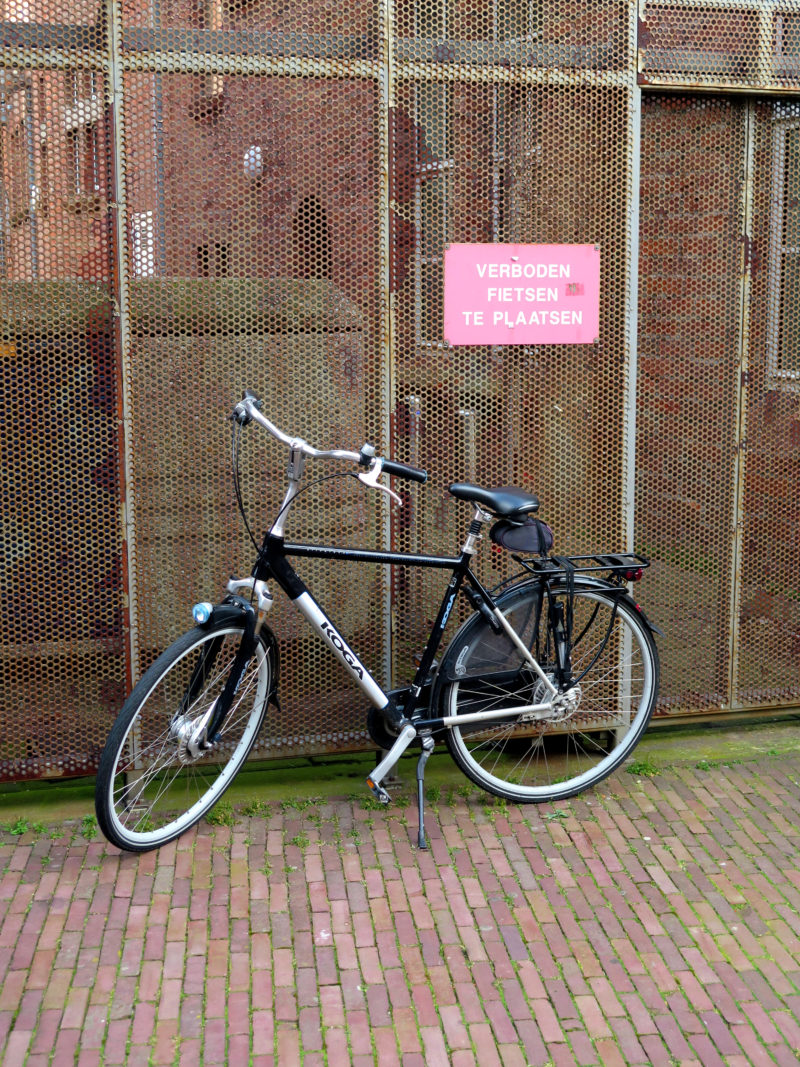
Standing all day at a lab bench early in his career as a chemist was in itself an athletic feat, one for which he paid dearly with nightly blisters on the parts of his legs that attached to the protheses. But he would not be stopped. He had been in a major league handball team before the war. Physical activity had to be continued – and so he figured out what he could do. I learned to play table tennis from my father. I saw him horseback riding, and later, when we would spend winters skiing in Switzerland, he would actually go curling. A SPORT WHERE YOU HAVE TO WALK/RUN/CROUCH ON ICE. In summers in Holland he would go before dawn to the North Sea and swim, before anyone could see him putting the wooden legs off and on. And he rode his bike. Determined. Unstoppable.
Nowadays there are at least possibilities for those who went through these traumas to receive help, or find and work with those who share the experience. If a team like the one described below had existed in the 1950s my father would have probably joined.
The physical consequences of the amputations and the decades of pain meds needed to be able to function on a daily basis made his last years particularly difficult, independent of the PTSD. I wish he had had someone at his side like the palliative care physician featured in the TED talk below. It would have made a difference, I believe.
It is only with hindsight that I am able to understand the full extent of courage it took to lead the life he led without ever becoming hard. I try to remember that every time I become upset over some little chickenshit, as they say in polite company….
Photographs are bikes in Alkmaar and Bergen aan Zee, NL.
You might think I am referring to this in our last entry to a week of colors:
Which would not be a bad guess in general, but today the color RED is brought to you by LOVE. My love for humanity in general
and my love for one human being in particular who was born just this week 30 years ago.
He introduced me to Zbigniew Herbert and one of my favorite poems of his expresses the idea of moral necessity as perfectly as the concept is embraced by my incredible 30-year-old. Happy almost Birthday, mein Süssen!!!! Keep the spark alive.
for the golden fleece of nothingness your last prize
go upright among those who are on their knees
among those with their backs turned and those toppled in the dust
you were saved not in order to live
you have little time you must give testimony
be courageous when the mind deceives you be courageous
in the final account only this is important
and let your helpless Anger be like the sea
whenever you hear the voice of the insulted and beaten
let your sister Scorn not leave you
for the informers executioners cowards—they will win
they will go to your funeral and with relief will throw a lump of earth
the woodborer will write your smoothed-over biography
and do not forgive truly it is not in your power
to forgive in the name of those betrayed at dawn
beware however of unnecessary pride
keep looking at your clown’s face in the mirror
repeat: I was called—weren’t there better ones than I
beware of dryness of heart love the morning spring
the bird with an unknown name the winter oak
light on a wall the splendour of the sky
they don’t need your warm breath
they are there to say: no one will console you
be vigilant—when the light on the mountains gives the sign—arise and go
as long as blood turns in the breast your dark star
repeat old incantations of humanity fables and legends
because this is how you will attain the good you will not attain
repeat great words repeat them stubbornly
like those crossing the desert who perished in the sand
and they will reward you with what they have at hand
with the whip of laughter with murder on a garbage heap
go because only in this way will you be admitted to the company of cold skulls
to the company of your ancestors: Gilgamesh Hector Roland
the defenders of the kingdom without limit and the city of ashes
Be faithful Go
Zbigniew Herbert, “The Envoy of Mr. Cogito,” translated by Bogdana and John Carpenter, from Selected Poems of Zbigniew Herbert. Used by permission of Oxford University Press, Ltd.
Sometimes I wonder if there is a correlation between drab times and the amount of colored cream or powder humanity applies to its faces. I sure found a lot of pink when walking through PDX and approaching these young beauties with requests for photographs. I was also aware last time I visited NYC how many young men were dripping with mascara.
No drab times for the make-up industry though, which has finally figured out a way to make half of the population which was so far unreachable become consumers of beautification products. Check out the short video below and see for yourself how young men are starting to buy and apply make-up.
It would have been amusing were it not for the prejudiced protestations of the protagonist that he was not gay, just into make-up, and for my fear that the peddling of useless goods is just another way of emptying people’s pockets, now young boys’.
For someone whose currency of felt appreciation has changed across the years from being smiled and whistled at to the number of replies to a blog segment, make-up plays no longer any role. But I understand the need of youth to soothe self doubts and insecurity. I have certainly nothing against gender equality, going in both directions.
I just hope that the horrific pressure towards being normatively beautiful that girls have experienced forever, is not going to be there for boys now as well.
One day you worry about pimples, the next day you feel too fat. And body image troubles have now reached young men in frightening numbers as well.
In the United States, 20 million women and 10 million men will suffer from a clinically significant eating disorder at some time in their life, including anorexia nervosa, bulimia nervosa, binge eating disorder, or EDNOS [EDNOS is now recognized as OSFED, other specified feeding or eating disorder, per the DSM-5] (Wade, Keski-Rahkonen, & Hudson, 2011).
Worries about a focus on external beauty today has been brought to you by the color PINK.
For a year now we have seen a governmental strategy of “Facts be damned, let falsehoods do the job.” Last week’s debate around the Ryan/Nunes memo was just another instance of this political manipulation.
Psychologist have long asked why it is that rumors and innuendo, selective presentation of facts and cherry picking are so phenomenally successful in lodging in people’s brains and influencing their beliefs. There are many reasons. One key reason, though, is that we don’t interpret pieces of information independently. Instead, we form an impression based on the first info, use that to guide how we think about the second piece of info, which often strengthens our initial view. We then use that as a guide in thinking about the next piece of info which again strengthens our views and around and around we go.
As a result our ideas are sticky. And in particular this pattern means that you will easily accept any news, no matter how thin, if it fits with your view. But you get our your hammer and your magnifying glass and are ready to beat up any piece of info that challenges your view.
The link below is one of the best comprehensive articles on the issue (full text can be downloaded as PDF) spelling out how we are influenced and also suggesting mechanisms how to disrupt this influence.
The authors, highly respected in the field of cognitive psychology, suggest the following remedy:
Technocognition: the idea that we should use what we know about psychology to design technology in a way that minimizes the impact of misinformation. By improving how people communicate, they hope, we can improve the quality of the information shared.
Here is a summary of the approach from a Guardian article linked to below.
“The authors propose a number of ideas to help bring an end the post-truth era. One key idea involves the establishment of an international non-governmental organization that would create a rating system for disinformation. There are already some similar examples in existence – Climate Feedback consults climate scientists to rate the accuracy of media articles on climate change, and Snopes is a widely-respected fact checker. The challenge would of course be to convince conservatives to accept a neutral arbiter of facts, and continue accepting it when information they want to believe is ruled inaccurate.
These independent rulings could then be conveyed via technology. For example, Facebook could flag an article that’s based on false information as an unreliable source, and Google could give more weight in returning factually accurate news and information at the top of its search results lists.
The study authors also suggest that inoculation theory techniques could help dislodge misinformation after it first takes hold. This involves explaining the logical fallacy underpinning a myth. People don’t like being tricked, and research has shown that when they learn that an ideologically-friendly article has misinformed them by using fake experts, for example, they’re more likely to reject the misinformation. The authors also encourage teaching people – particularly students – how to identify misinformation techniques and the other strategies used to create the partisan echo chamber. Younger Americans are already less susceptible to the conservative media bubble. The median age of primetime Fox News viewers is 68, and Alabamans under the age of 45 voted for Roy Moore’s opponent Doug Jones by a 23-point margin. Teaching them how to identify misinformation techniques will help inoculate younger Americans against the corrosive effects of the partisan media bubble.”
Alas, this approach will NOT work if other things do not change. For one, the current tribalism has its own exclusionary panorama of news sources. If I only watch station X and that news outlet refuses to participate in some weighted information stream, nothing will change. More importantly, though, even if we were able to get the facts across, and have them accepted by a wider public regardless of political leanings, they might not change policy and decision making of governmental agencies if going against the interest of the economic elites. People show their true colors, then, when it comes to profit.
Today brought to you by YELLOW, my closest approximation to capitalist gold….
A new group of interdisciplinary researchers from Kings College, the London School of Economics and Political Science, and The University of the Arts, London have embarked on a project that looks at the role of art in reconciliation. They state that “although billions of pounds internationally have been invested in post-conflict reconciliation projects involving aspects of justice and the creative arts, there has been no study of this phenomenon as such…. the interdisciplinary project will investigate post- conflict reconciliation to address this major gap.
Here are some of the efforts they investigate. If you click the Project profile Link below, you get detailed information about each.
What I found most interesting – and I will surely be following this group’s research efforts – was their reiterations of their first insights, as if they, too, were surprised by this:
These are questions I have not asked myself, and wonder why. I just blindly assumed reconciliation is a good thing, if not always possible to achieve.
Perhaps that’s because when we come across media reports, they are often the more uplifting stories that seem to indicate human suffering, (and our own guilt in inflicting it) can somehow be turned into something positive. Stories like this one:
Imagine you are accused of having committed a horrible crime. You are convicted despite your protestations of innocence. You serve your sentence in one of the more inhumane prisons in the country for over a decade. At that point DNA evidence and other material evidence reveals that you were indeed not the perpetrator. You are released, exonerated, given $5000 (for 10 years of your life) and then you meet up with the victim of the crime, whose eyewitness identification of you was the basis for your conviction.
How do you reconcile? In the specific case I have in mind, these two became friends; they are now on a lecture circuit warning against the dangers of reliance on often fallible eyewitness identification procedures. The ability to forgive on his part boggles my mind. The ability on her part to forgive herself and become a close friend even though she still saw his face in flashbacks of the rape for the longest time, leaves me speechless. Somehow they found a constructive way to integrate the tragedy they shared in different roles.
It does not always work that way, though. In a current case in Colorado a wrongfully convicted man is suing ex-DA Morissey and the city of Denver and various other defendants for compensation. The lawyers argue that “Mr. Moses-EL was wrongfully convicted and imprisoned for more than 28 years in the Colorado Department of Corrections (DOC). He always maintained his innocence. But shoddy investigation, the willful destruction of exculpatory biological evidence and prosecutors blinded by the desire to obtain and maintain convictions regardless of the truth left Mr. Moses-EL in the cross-hairs of a powerful criminal-justice system that would fail him time and time again.”
I’d say. Imagine being convicted on the basis of your purported victim’s dreams and visions (she claims she’s always had visions that turned out to be true in her life), since she could not see anything in the dark when the horrible rape happened. Imagine having a judge vacate that sentence after 28 years because someone else confessed to the crime, and then have the DA re-try you, except now the jury acquits you. http://www.westword.com/news/clarence-moses-el-sues-denver-over-wrongful-28-year-imprisonment-9794307
His demand for $1.9 million compensation is refused by the current Denver DA because:“his acquittal through a jury does not mean he is innocent. There was just not enough evidence beyond reasonable doubt to convict him….”
I opened yesterday with the fact that I have only questions and no real answers when it comes to reconciliation between parties where one wronged the other. That has not changed.
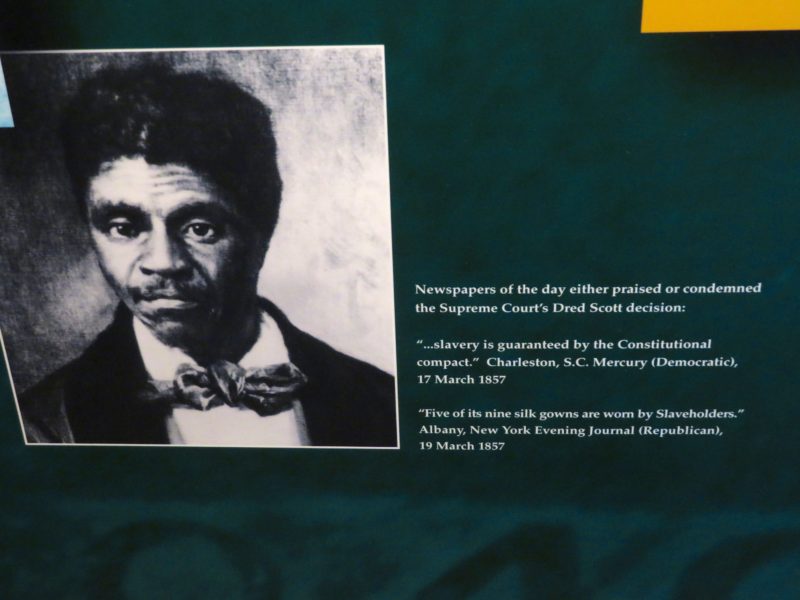
For today I picked a podcast that brings together descendants on both side of the Dred Scott decision, generally seen as the worst decision by any US Supreme Court in history. Dred Scott, a slave, sued for his freedom across all instances, ending up in the Supreme Court, (Dred Scott v. Sandford, 60 U.S. (19 How.) 393 (1857,) which came down in a 7-2 landmark decision on the side of those who considered Blacks inferior: all people of African ancestry — slaves as well as those who were free — could never become citizens of the United States and therefore could not sue in federal court. The court also declared the Missouri Compromise of 1820 (legislation that restricted slaveholding in some territories) as unconstitutional. Well, what would you expect from 9 justices, seven of whom had been appointed by pro-slavery presidents from the South, and of these, five were from slave-holding families.
Scott was bought by the man who had supported him financially and morally throughout the legal proceedings, and then set free. He died 9 months later.
Here is the conversation between Scott’s descendants and those of Chief Justice Taney who wrote the decision. Is this what you consider reconciliation?
No wonder then, that there is actually talk about reissuing the Green-Book….which helped Black motorists to traverse the US as safely as they could, particularly with regard to naming locations where no food or restroom or hotel rooms should be requested. Driving while Black is not a new phenomenon. http://www.history.com/news/the-green-book-the-black-travelers-guide-to-jim-crow-america
This week is devoted to the topic of reconciliation. I have only questions, no answers when thinking about reconciliation in numerous contexts. In this regard I seem to be in the company of minds smarter than mine and outside of the realm of souls more generous than mine. I will try and present conflicts that are between people, between groups, and within a single person. As far as I can tell, all of the conflicts I picked have a monumental structural component.
Since January 27, last Saturday, was International Holocaust Remembrance Day, I’ll ask if reconciliation between Germans and Jews is possible when antisemitism is not only alive and well, but on the rise in both frequency and intensity of acts that attack and hurt Jews. Let me add right at the start, that antisemitism expressed by Muslim migrants and refugees in Germany is part of the story, but that 90% of the factual crimes are committed by Germans, as government statistics show.
I will report what I read in my daily dose of German news on 1/27.
On this day you found Angela Merkel expound on the shame that Jewish institutions, be they synagogues, kindergartens, community centers or schools in today’s Germany need constant police protection. She warned against rising antisemitism and xenophobia and announced the creation of a bureaucratic office in the new administration that is going to be in charge of these issues. It fell to Charlotte Knobloch, the past president of the Zentralrat der Juden, to point to the fact that the third largest elected party in that administration not only tolerates antisemitism and historical revisionism among its members, but encourages racism, rightwing extremism and populist nationalism.
A commentary in one of the largest daily’s on 1/27 was titled: What happened to us? It pointed to the fact that from early on Germans lacked the courage to address justice: of the 70.000 concentration camp SS personnel only 1650 received punishment by the courts after the war, often ridiculously small sentences with probation granted. And today’s acceptance of genocide across the world and of hate speech and violence within our own societies indicts us as having learned nothing from the Shoah.
Also on 1/27 a left-leaning daily interviewed Michel Friedman, member of Merkel’s conservative party, lawyer and TV moderator, who lost large parts of his family in Auschwitz. I found two of his arguments particularly resonant: Most Germans condemned the endpoint, the final solution, after 1945, but continued to be silent on what happened in the beginning. Millions of Germans were enmeshed in the looting, the destruction of synagogues and stores, the turning a blind eye to deportations. Do we find echoes of that silence in our own times?
Secondly, he argues that we need to educate the next generation to know how to engage in conflict. Rather than being silent in the presence of mental arson, as he calls it, latent or expressed antisemitism and xenophobia, people need to speak up and argue to avoid becoming a collaborator. Verbal sparrings solidify your own orientation, your political point of view, they need to be practiced in schools and at home, acknowledged as valuable tools against conformism.
I can only think of what Adorno wrote in 1959 when trying to point to the difficulty of internalizing the horror associated with German guilt (in my mind a prerequisite for reconciliation.) Loosely translated: You want to leave the past behind: rightfully so, since it is impossible to live under its dark shadow, and because the horror is unending …. wrongfully so, because the past you want to escape is quite alive and well.
Finally here is a new documentary that looks at the relationship between Germans and Jews. It can be seen in full on the web with registration or a small price at iTunes.
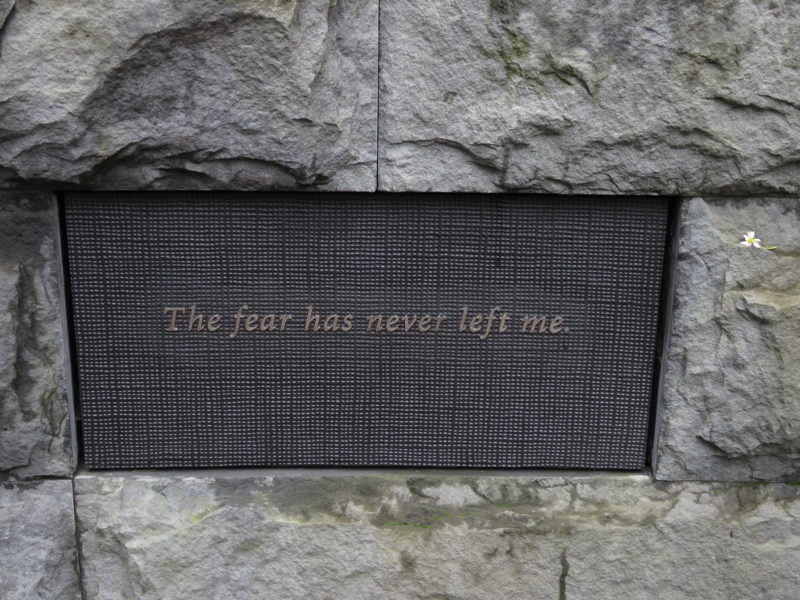
Photographs are from last Friday at the Portland Holocaust Memorial which is a strange beast, but obviously visited; I found freshly picked flowers stuck into the spaces in the wall.
I meant that title: decisions can be reversed; what lasts are the possibilities to choose from. Or more precisely, what lasts is the fact that there always are more possibilities, as long as we are not risk averse.
The reason this is on my mind has to do with my stumbling over a decades-old, short correspondence with Masha Gessen. Many of you know Gessen as a Russian/American journalist, queer activist and writer who documented the evolving political landscape under Putin’s regime and is highly critical of the Trump presidency.
After having left Russia in 2013 for the second time, likely endangered by being a critical voice in particular for LGTB issues, Gessen now teaches as a visiting professor at Amherst College and contributes regularly in the New Yorker, the NYT, and many other publications and is a recipient of a Guggenheim, an Andrew Carnegie and a Nieman Fellowship.
As a Russian (the parents emigrated with a young Masha) and a Jew, Gessen tackled issues of (not)belonging since a young age. As someone who had inherited genes predisposing of serious cancer, a decision to take preventative measures to fight the disease was on order some 14 years ago, given that many relatives had died of the scourge. Here we were two complete strangers and yet writing about the pro’s and con’s of preventative ovary removal, something I championed, something Gessen, who also already had children) declined, until just recently when it became unavoidable.
I have, I believe, managed to avoid pronouns up until this point because Masha Gessen, who used to be a woman, is now in transition to becoming a man. And rarely have I read a more eloquent and thoughtful description of the tackling of choices – from emigration to medical decisions to sex change – than in a recent article by him in the New York Review of Books.
The way he seeks out the world as an expanding universe that might hold a promise of belonging when one is open for change stands in stark contrast to what I believe underlies the populist, nativist movements of our time. I have written about it here last October, when discussing Heinrich Mann’s Der Untertan in the context of the German elections. (Germany, by the way, STILL has no government since the parties seem to be unable to form workable coalitions.)
If you look at it closely, populist movements are against anything that represents pluralism – the coexistence of multiple options. Diversity is not only not desired, it is actively feared. To have too many options is seen as overwhelming; there is a longing for simplicity, redux, a singular structure that is preferred to the complexities of gender, nationality, culture and political movements.
Unfortunately such preference is not only voiced by those who lost status due to an increase in societal diversity and might regain it, but also by many who will be hurt if such a revisionist dream becomes once again reality. Clarity and structural regimentation are seen as antidotes to the chaos of an evolving world where national, cultural and gender boundaries are but in flux.
I hope the fact that so many fought for so long and so hard to implement changes means they won’t easily yield to the other half that wants to return to the old ways, (good old ways only in their imagination, if you ask me.) To have people like Gessen model the courage to radically reinvent ourselves gives me hope.
Photographs are of some of the many paths one could choose.
“Empty, hollow, thud,” is a phrase frequently heard in this household, muttered by various members of the family. It is meant to describe one’s emotional status (among other things after listening to the news.) The words originated in a classic 1970s paper in psychology titled On being Sane in Insane Places. Which would also describe the state after listening to the news, don’t you think? Details of the Rosenhan study, placing sane people into psychiatric hospitals with only those words (heard by fictional voices) offered as presenting complaint, and seeing how the fakers would be (in)correctly diagnosed, are described in the link below.
Since the phrase was prominently heard after last week’s tax vote and the decision to remove the US from the UN global compact on migration, I decided that I’ll dedicate this week to beauty wherever I can find it, and if I can’t find beauty I’ll make do with whimsey. Anything to cheer us up.
Now you might think that the last place to look for cheer is a cemetery, but you’d be mistaken. Cemeteries contain tons of beautiful details and many surprises. I was first alerted to this in the 1960s, when adorning myself like all other weekend hippies with lots of bead jewelry. A friend made me bracelets of tiny, tiny glass beads in an array of muted pastel colors in blues, purple, greens. Turns out, she was a grave robber. No joking, either, she took those beads from French cemeteries where they were lying around the disintegrating Imortelles, faded by the impact of the weather.
What is an Imortelle, you ask? They were extremely elaborate weavings of beads and wires that were put on the graves as funeral wreaths that lasted. At least lasted longer than real flowers. Here is what how it’s described on the web:
The art of making flowers out of beads is many centuries old. Although there is very little documentation on the development of this art, research has shown that the first primitive bead flowers may have been made as early as the 1300’s in Germany, when steel needles and wire were developed ….. One of the reasons that flowers are associated with churches has to do with beads. In the thirteenth century a form of prayer using a string of beads was instituted by St. Dominic. The string, called a rosary, consisted at that time of 15 units of beads. Each unit contained 10 small beads, preceded by one larger one. A prayer was recited at every bead. The word “bede” (sp) is Middle English for “prayer.” Because of the length of the original rosary, it became customary to pay someone, usually a resident of an almshouse, to recite the prayers. These people were referred to as bede women or men, and it was they who made the first bead flowers. ….The French used bead flowers as funeral wreaths. These wreaths were called “Immortelles,” and ranged from 3 feet to 4 feet in height. They would be left at the grave of the deceased. Since they were made on metal wire and were exposed to the weather, most of these items were destroyed within a year, but a few examples remain today. … Not only are there bead flowers mounted on the frame of the Immortelle, but the frame wires are wrapped in beaded wire as well. Wires strung with beads might have been coiled or braided as well before wrapping onto the piece. The whole surface of the Immortelle would be wrapped over with wire strung with thousands and thousands of beads.
My current take on cemetery flowers focusses more on the porcelain ones that you also find in France (today’s photographs – the other option would have been the flowers made out of fabric and plastic, but I like these better). My take on bead jewelry has changed as well. Still supplied by a friend, albeit a different one, but much improved in provenance – check her work out at http://www.jewelryatoz.net/, it’s delightful.
Note, on many of these flowers, nature is taking over in form of moss and little plants – the perfect mix.