 April 13, 2026
“Although I am enthusiastic about Venice, and though I’ve started a few canvases, I’m afraid I will only bring back beginnings that will be nothing else but souvenirs for me”.
Claude Monet, letter to Gaston Bernheim. Fondation Monet.
***
In the early 1980s you could sneak into a Forbes exhibition of Fabergé eggs in New York City for free. I went there during my lunch breaks at the New School, across the street on 5th Ave, entering windowless, dark rooms with glass vitrines lit by invisible sources. Inside, the ornate concoctions nestled in dark blue or black velvet, each prettier than the next, gold and pastel colors. As long as you didn’t think about the way the Russian peasantry’s blood and toil enabled the Tsar to acquire such luxury items, you could revel in their beauty.
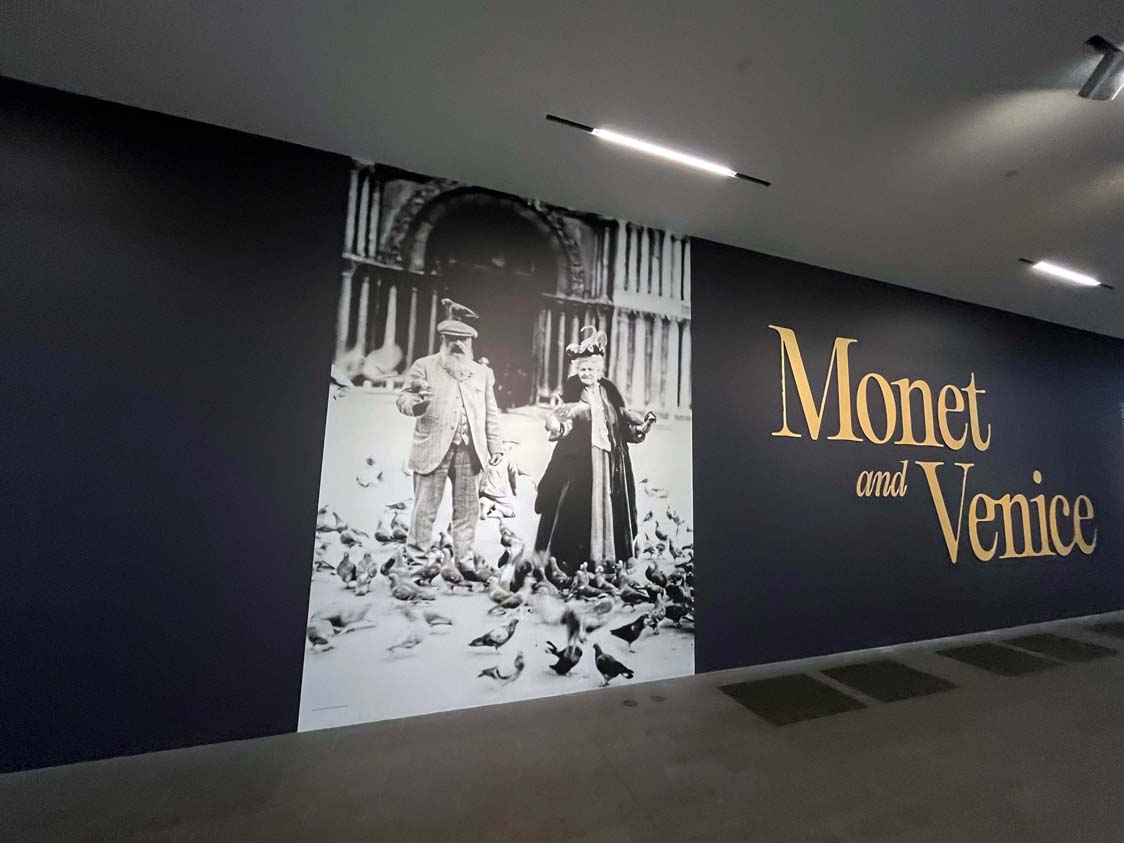
These associations popped up when I visited the de Young museum’s current exhibition, Monet and Venice, in San Francisco. Dark, windowless rooms, painted in velvety blue, contain numerous gold-framed, jewel-toned showpieces, each as pleasant and precious as a Fabergé egg, albeit rectangular. Fetching, exquisitely crafted, decorative. First impressions, of course, for someone who has never been much of a fan of Monet, and is wary of the through-line of decorative focus expressed by much of his work.

Claude Monet Palazzo Ducale (1908)
Second impression was admiration for how the entire exhibition was set up. The stellar collection of some 30 plus Venice paintings from the artist’s 10 week visit in 1908 (many executed from sketches, likely photographs, and surely memory in the ensuing 4 years back at home) is smartly framed by additional materials. Visitors get exposed to historic photographs of the city, as well as of the Monet couple visiting, and are provided with lots of quotations from the artist about his approach to art, process and subject. First shown at the Brooklyn Museum last fall, the exhibition was co-curated by Lisa Small, senior curator of European art at the Brooklyn Museum, and Melissa Buron, director of collections and chief curator of the Victoria and Albert Museum. A truly successful collaboration.

Carlo Ponti Piazza San Marco ca 1860-1870

Importantly, some works of other artist fascinated by Venice, among them Turner, Sargent and Canaletto, are interspersed with Monet’s cityscapes. (By all reports, he was hesitant to visit the city in the first place because so many admired colleagues had painted it, and the trip was planned by his wife Alice as a recuperative sojourn only, for the aging and cataract-plagued painter. But paint he did, barely arrived.)

Giovanni Canaletto Venice, the Grand Canal looking East, with Santa Maria della Salute, (1749-1750)

Michele Giovanni Marieschi Views of Venice (1741)

John Ruskin The South Side of the Basilica de San Marco, from the Loggia of the Palazzo Ducale, ca 1850.
Give me a Turner, any time.

J.M.W. Turner The Campanile and Piazza of San Marco, Venice (1840)

J.M.W. Turner Boats at the Entrance to the Canale della Giudecca, Venice, off Santa Maria della Salute and the Dogana (maybe 1840)
That said, the shimmering Adriatic light of the Venice lagoon was spectacularly captured in Monet’s paintings on display, but it (or any other bright light) was sorely missing from the surround. The contrast between the dark walls and the relatively small, bright canvasses made the latter into somewhat confined objects, constrained instead of unfolding into their surround.

Claude Monet San Giorgio Maggiore at Dusk (1908)
The only thing viscerally reminiscent of Venice were the crowds – here as there, amorphous units wafted from painting to painting, location to location, nowhere more dense that in the final room where large water lily paintings hung. The lure of the familiar, I guess. (This, by the way, despite timed entry slots for the exhibition. Lucky I was double masked.) The contrast could not have been more pronounced: the small cityscapes felt like glorified postcards compared to the immersion effect provided by the large pond canvasses, any given visual angle across the room still enveloping the viewer into the depictions.

Claude Monet Water Lilies (1914-1917)
The works themselves were pleasing in the impressionistic way, but for me became interesting at second glance, if and when I had a chance to break through the cordon of visitors bulging in front of each painting. They are, in some sense, studies of a given subject – this or that Palazzo – from slightly different perspectives (often just a minimally extended surround included) and under different lighting conditions that change the hue of the pastel tones applied. But they are also often horizontally bifurcated – with the top half devoted to depiction, however impressionistic, of a given architectural structure, and the bottom half a laboratory of ever more abstract painting of water.

Claude Monet The Grand Canal, Venice (1908)
The proportions of water to shore (large over small) seemed different from my memory of the canals (narrower in relation). I first thought that maybe we were seeing the psychological effect of boundary extension. This concept refers to remembering a previously viewed scene as containing a larger extent of the background than was actually present, and information that was likely present just outside the boundaries of that view is often incorporated into the representation of that scene. But here we are confronted with the reverse: it is the foreground, the water, that is larger (and also emptier, rid of most of the water traffic surely present in 1908 as well,) than the likely objective perspective. Lots of canvas space to develop abstraction rather than depicting optical impressions, uninhibited by the need to represent anything, perhaps. Have to give Monet that – always exploring, even towards the end of his by then illustrious career, at the height of his renown.

Claude Monet The Church of San Giorgio Maggiore (1908)


Some sentence I picked up at the Marmottan in Paris at a previous visit had stuck with me: “The artist invites universal thoughts of peaceful contemplation.” I wondered how this could come from a man, who was, in his own ways, politically engaged. He was a friend of Emile Zola’s and joined him and other liberals in their belief that Dreyfus was innocent, during the times of the Dreyfus Affair. He was drawn to Courbet, a radical leftist at the time. Prime minister Clemenceau was his friend, and during WW I Monet saw it as his patriotic duty to support the war effort with a victory garden and donations of his paintings to raise funds for victims and the wounded. I scoffed at the notion of art => peaceful contemplation, thinking of it as placating, rather than depicting the world as it is, moving us to remedy what’s wrong.
Goes to show that I am as thoughtless as the next person, if biased about a source. The same invitation to slow down, contemplate and introspect from a different corner – the curator of this year’s Venice Biennale – seemed like just the ticket. Then again, maybe it is not the act of contemplation, but the subject that irked me: Monet hoped for the restorative effect of contemplating the aesthetics of fleetingness in nature, the light, the atmospherics, major keys beauty. Which brings me to Venice 2026, more precisely the 61st Biennale which is about to open in early May. Here we are asked to focus on the “minor keys, the overlooked, disguised, fervently guarded spaces reserved for human dignity.”
(And yes, to all of you who frown, “What’s wrong with restorative beauty?” Nothing at all. It, as any consoling work of art, certainly has a prominent role for anguished souls. I just feel that time is running through our – my – hands like sand, urging a use of art to focus on the most important issues of our world to save what can be saved. Art as the canary in the coal mine. To put it bluntly, the beauty of water lilies or Venice will be a mute topic, once the ponds are dried out, the city drowned.)

Claude Monet Water Lilies (1907)
***
In refusing the spectacle of horror, the time has come to listen to the minor keys, to tune in sotto voce to the whispers, to the lower frequencies; to find the oases, the islands, where the dignity of all living beings is safeguarded.
—Curatorial statement by Koyo Kouoh, “In Minor Keys,” 2025
***
The 61st International Art Exhibition of La Biennale di Venezia, In Minor Keys, will run from Saturday 9 May to Sunday 22 November 2026. It has seen its share of tragedy and upheaval long before it started. Curator Koyo Kouoh, highly respected in the art world, died suddenly late last year, leaving her team scrambling to consolidate and materialize her vision for this year’s exhibition. Another death struck, with Henrike Naumann, who was to represent the German pavilion, succumbing to cancer at age 41.
Then South Africa canceled its pavilion. The South African minister of culture had taken political issue with the work of Gabrielle Goliath, who had been unanimously selected by committee. “Elegy” was a decade-long project, a performance and video series that honors women, gay, and trans people who have been victims of violent killings. The new iteration at Venice was to include a tribute to Hiba Abu Nada, a Palestinian poet killed in an Israeli airstrike, as well as the tens of thousands of women and children who have died in Gaza since October 2023. Government and artist tied up in law suits over this perceived censorship move, until the state declared final refusal to be represented this year in Venice at all in February.
The U.S. was not far behind. We will have a Pavilion, but the final choice of representative is highly controversial. For the first time ever, the State Department took on the selection process, sidelining the NEA with budget cuts. Applicants had to pass the “Trump test” that proposals must not “operate any programs promoting diversity, equity and inclusion.” Apparently, the almost unknown artist Robert Lazzarini had initially been selected before being nixed by the State Department, to be dropped for “bureaucratic rather than ideological reasons,” as later reported. Other artists came on with proposals, among them Andres Serrano and Curtis Yarvin.
Who was finally picked? An American born sculptor, living in Mexico, who never applied to show at the Biennale in the first place. Alma Allen has only once been included in a major exhibition in the States, the 2014 Whitney Biennial. Last year some of his sculptures could be seen adjacent to NYC’s Park Avenue. Compare that to the standing of his Biennale predecessors: including Robert Rauschenberg, Ed Ruscha, Jenny Holzer, Jasper Johns, Martin Puryear, Simone Leigh and Jeffrey Gibson, among others. He is currently not represented by any gallery. This was his commentary in the NYT: his galleries, Mendes Wood and Olney Gleason, asked him not to accept the Venice Biennale commission and dropped him when he did. Both galleries confirmed that they were no longer working with him, but declined to explain why, making the entire nomination and the obscure process behind it even more controversial.
I learned that “organizing the pavilion this year is commissioner Jenni Parido, founder of a pet food company and now executive director of the mysterious American Arts Conservancy (AAC), a new Florida-based nonprofit established this September with a mission to advance American visual art through diplomacy, education and cultural legacy. As its website states, it was “founded on the belief that art is a foundational element of a thriving democracy.” (Ref.) All in line, one presumes, with what curator Jeffrey Uslip highlights as “Allen’s alchemical transformation of matter explore the concept of ‘elevation,’ both as a physical manifestation of form and as a symbol of collective optimism and self-realization, furthering the Trump Administration’s focus on showcasing American excellence.”
***
Pavilions unfilled, pavilions filled with murky selection processes, and now pavilions demanded to be removed: many artists sent out an urgent call to ban outright or relocate national representation of countries engaged in warfare or genocidal action, including Russia, Israel, and the United States. There are precedents: the Russian and South African pavilions had been previously excluded, and there was political reaction to Pinochet’s takeover in Chile in 1974, with all national pavilions closed.
Not exactly minor keys, but a loud cacophony of conflict preceding the opening of this important touchstone in our contemporary art world. More Shostakovich’s 7th in C major than a Schumann concerto in A minor. I will report later how it all unfolds after the opening.
In the meantime, pay the De Young a visit if you are in San Francisco. It is a treat to see the accumulated art works in the current exhibition.
Here is my musical choice, to no-one’s surprise .

Claude Monet The Palazzo Contarini (1908)


Sara Lee Silberman
This posting is interesting/stimulating/provocative in so many particulars!
The SF show – despite the crowds and the dark walls – seems to have been wonderful. Appreciate your sharing it with us deprived East Coasters.
Sad to learn that the Trump stench has reached the Biennale, too….
Carol Shults
Many thanks, Fridericke. Fascinating thoughts on the art scene. Always illuminating!