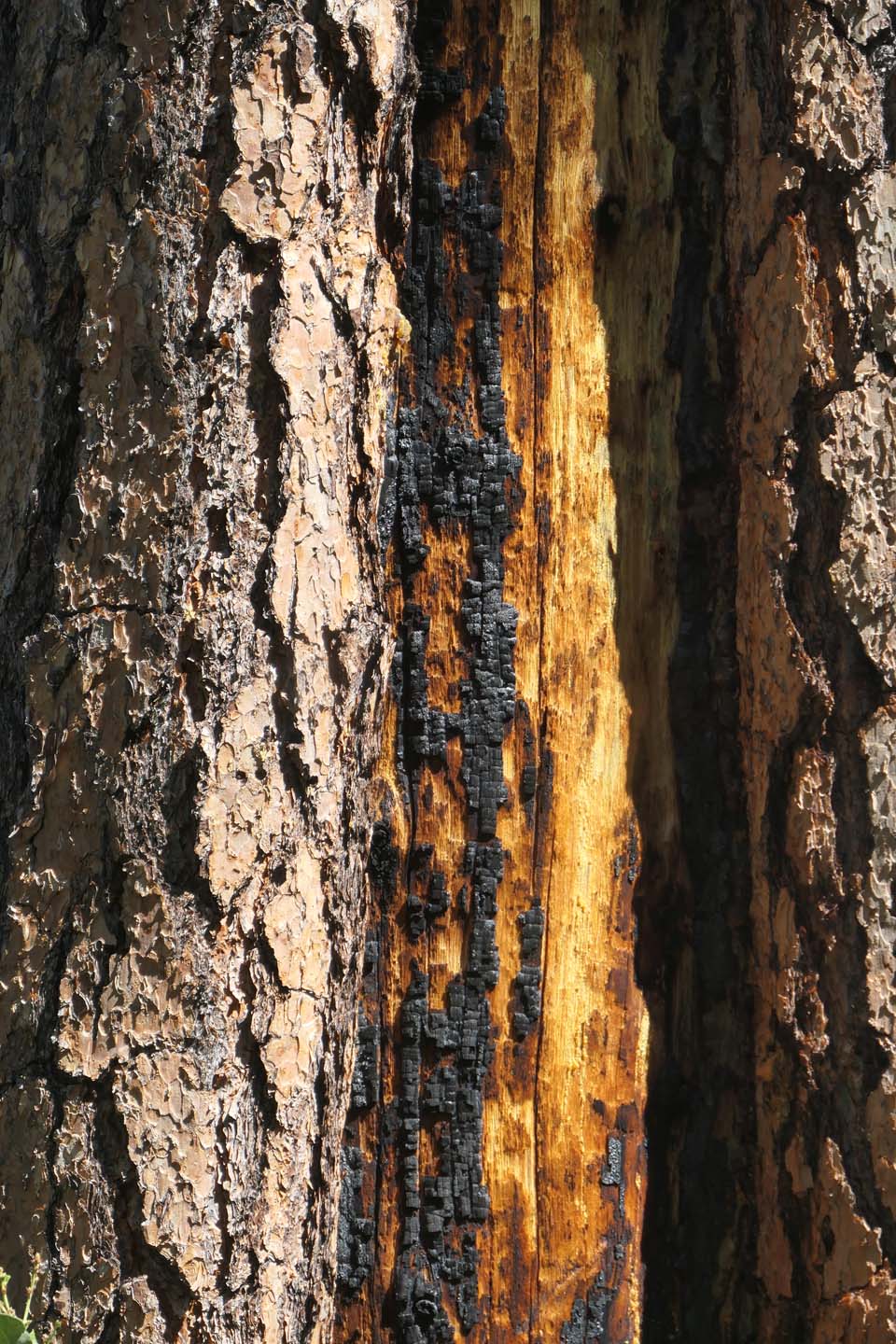
I am off for a short road trip to visit with artists in Eastern Oregon and get my annual dose of smelling the pines of the High Desert.
In the meantime I leave you with an essay that can serve as a follow-up to my own post last week on what is happening in Europe, this week’s thoughts on what gets remembered in this country, and my posts here and here some years back specifically on memory culture. Where I confined myself last week to talk about the German election in the small state of Saxony-Anhalt, Seth Cotlar’s essay is providing wider comparisons in much more in depth. He is a historian who is a professor at Willamette University, currently teaching abroad, in Strasbourg.
Cotlar conveys historical and current political facts, but also guides us to the differences in memorial culture between European nations and our own. He addresses pivotal moments in history, the way things change, often unpredictably, and how we seem to ignore the lessons about how to forstall disruptive and destructive change. It is a learned analysis, as would be expected from a historian, but also an astute, empathetic capture of the moment, with smidgens of optimism. And very cool photographs. Much recommended read. Every time I open Rightlandia, Cotlar’s blog since 2025, I certainly learn something new.
Or should I once again (mis)quote: History is written by the ones in power?
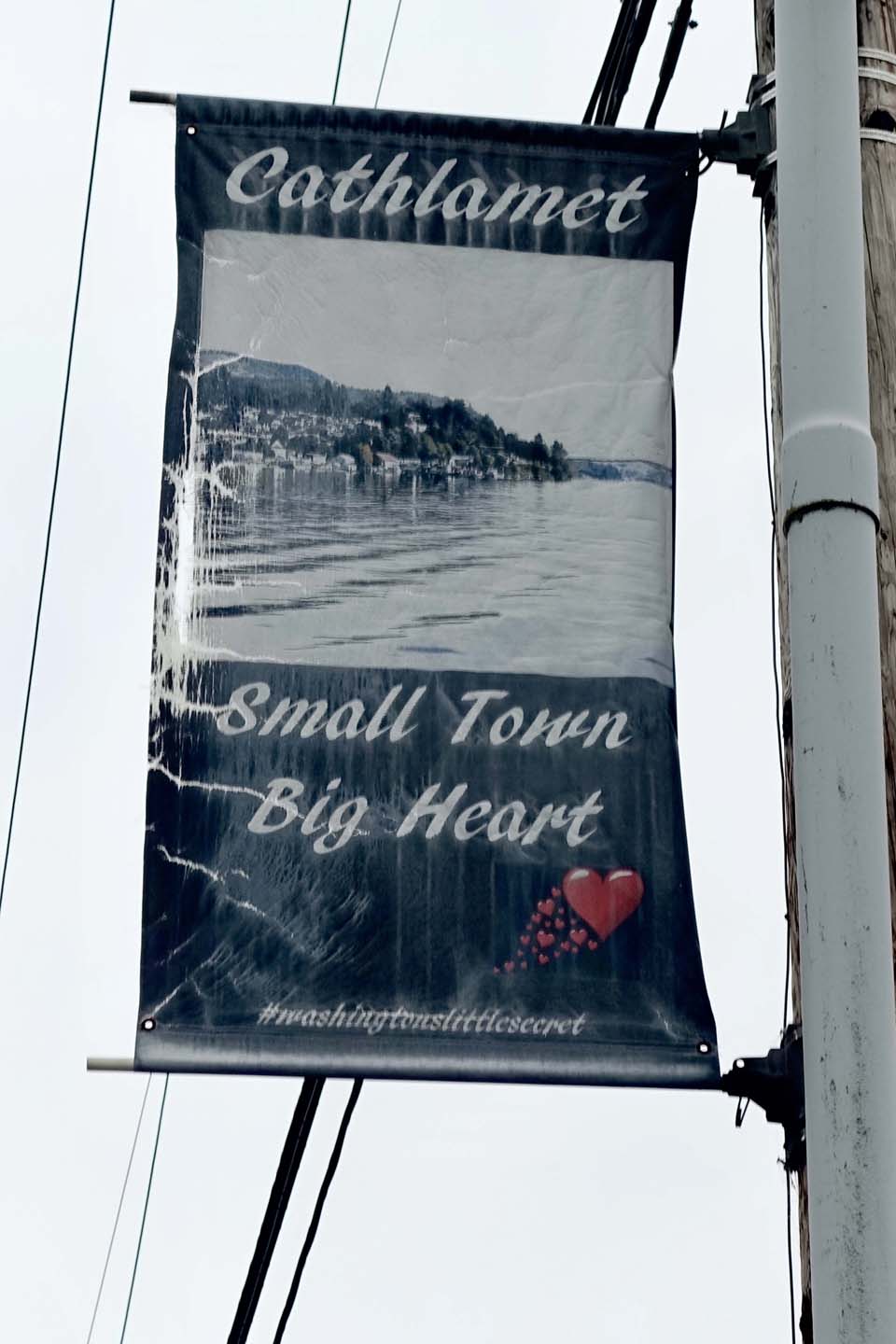
Last week I visited a small historic town,Cathlamet, WA, located on a similarly named channel of the Columbia River. About an hour-and-a-half’s drive north west of Portland, through beautiful landscape once you hit the western edge of Washington State.
Old pilings from Douglas Fir trees used in the sorting and rafting process in 19th century logging.
It has a small marina for boating and fishing, some industrial tug boats still working in the harbor, and 19th century buildings that are well preserved.
The place was settled by early pioneers in 1846 and the Washington Territorial Legislature established Wahkiakum County in 1854, naming it after the native people who had for centuries lived along the river (some 6000 still by1820, the combined population of the Wahkiakums, Cathlamets, and Clatsops and Chinooks.) They had been decimated by the arrival of earlier explorers who brought small pox, observed by the Lewis&Clark expedition, but nothing like the epidemic to follow: in 1830 some 90 percent of the tribal populations got wiped out but what historians believe to be malaria.
Settlers arrived and took over the land, and, equally important, the river. Logging and fishing industries blossomed after 1870, with the majority of homesteaders now coming from Scandinavia, where hunger and poverty drove scores of people to emigrate. These settlers, and later large companies drawn by the riches of the temperate rain forest, cut millions of trees, and drained the wetlands, ignoring their importance for a flourishing ecosystem. The Nordic immigrants were expert fishermen, but also brought a lot of knowledge about dairy farming and organizing as cooperatives to stay in business that became quite competitive. Puget Island, in the middle of the river across from Cathlamet, was even called “little Norway.”
There is a lot written about these early settlers, their hardship, their skills. These days, the major companies who absorbed their labor, logging forests to make paper, have left the region. The fish are gone as well, at least in the numbers that sustained whole communities. Overfishing, environmental degradation in general, ever further pushes of the urban boundary into spawning grounds, and, most importantly, building endless dams upriver, have had severe impacts.
The small town now relies on tourism, providing a marina for fishing boats, or just generell water sports. Many people commute to larger cities to find work, or take on jobs as fishermen on trawlers that fish in Alaska, being gone for months on end.
When I say many people, let’s face that the entire population of the town is 520 people, as of the last census I could find. About 95 percent of them are White with a median annual income of $35.000 or so, a high poverty rate, and about 60% of them are voting for the Republican party.
***
There is a lovingly preserved church, a courthouse, a few memorial markers for tribal populations, or citizens who were killed in world wars.
There is also a small museum, which has historical logging and farming equipment outside and a boat that served as a hub for decades, teaching young men to fish for salmon, sturgeon, silverbacks and all the other species running the Columbia River. (I did not venture inside, if it was open at all, since I forgot my mask in the car.)
Nowhere to be found was a trace of remembrance of the Chinese pioneers who contributed so much to the Pacific Northwest.
At least not what I saw, might have missed it?
We know that in Astoria, OR, some 45 minutes west of Cathlamet, they brought the railroad, they built the river walls and the jetties, they put in the sewer system and worked in the canneries or other fish processing jobs long before the Scandinavians arrived. Some 22% of the population was Chinese at the time. There they are remembered in The Garden of Surging Waves.
We know the cannery industry boomed in the 1870s along Wahkiakum’s Columbia River shoreline as well. We know that Chinese immigrants comprised a high percentage of the workforce. By 1880 there were 500 Chinese workers located in Wahkiakum County as well (today there are 5 (yes, five) Asians counted in the census of 520 inhabitants of Cathlamet.) They were first hired as butchering crews for the local canneries. In Cathlamet they lived in what was called The China House located next to the cannery. (Ref.)
And then? Wherever you look, you find sentences like: “few remained after that.”
Once again, you have to figure out history on your own, when it comes to dealing with violent parts of the evolution of this country. What happened is not just the racist treatment of Chinese migrants, their literal killing and maiming in so many townships on the West Coast across the centuries. There was specifically the Chinese Exclusion Act of 1882.
“U.S. federal law that was the first and only major federal legislation to explicitly suspend immigration for a specific nationality. The basic exclusion law prohibited Chinese labourers—defined as “both skilled and unskilled laborers and Chinese employed in mining”—from entering the country. Subsequent amendments to the law prevented Chinese labourers who had left the UnitedStates from returning. The passage of the act represented the outcome of years of racial hostility and anti-immigrant agitation by white Americans, set the precedent for later restrictions against immigration of other nationalities, and started a new era in which the United States changed from a country that welcomed almost all immigrants to a gatekeeping one.”
If you read the entire entry on the act (in the link above) you’ll learn that it was repealed and amended in 1943. Here is the thing, though: two months ago, the Trump administration published a 162-page report in which it defended the 1882 Chinese Exclusion Act as a necessary tool for protecting American workers and sovereignty. It did so in the context of trying to force our cultural institutions, like the Smithsonian and other museums, to revise their narratives about the supremacist bend of exclusion laws. It explicitly wants to eliminate all mention of historical oppression. I guess it has to order the Library of Congress as well… here is their entry on the plight of Chinese migrants:
“Even as they struggled to find work, Chinese immigrants were also fighting for their lives. During their first few decades in the United States, they endured an “epidemic of violent racist attacks, a campaign of persecution and murder that today seems shocking. From Seattle to Los Angeles, from Wyoming to the small towns of California, immigrants from China were forced out of business, run out of town, beaten, tortured, lynched, and massacred, usually with little hope of help from the law. Racial hatred, an uncertain economy, and weak government in the new territories all contributed to this climate of terror and bloodshed. The perpetrators of these crimes, which included Americans from many segments of society, largely went unpunished. Exact statistics for this period are difficult to come by, but a case can be made that Chinese immigrants suffered worse treatment than any other group that came voluntarily to the U.S.”
It is, of course, not just versions of history that can be shaped by those in power. It is the ongoing attempt to manipulate who gets to live and work in this country that was founded by immigrants. The Trump Administration has now floated a $100,000 fee for Optional Practical Training (OPT), aiming to deter international students from working in the U.S. post-graduation. As Forbes reported,
“This proposal faces opposition from educators, economists and businesses, who highlight students’ contributions to innovation and the economy. Critics also question its legality, especially after a federal judge recently struck down a similar $100,000 H-1B fee, deeming it an unconstitutional tax. Research shows international students on OPT do not harm American job prospects but rather boost employment and innovation. Such a fee would likely harm U.S. competitiveness and drive talent to other countries. The policy’s future remains uncertain.”
China, as of 2024, had the second highest number of International students, some 277.000, in the US, only topped by India. Think of all that talent, all that potential for scientific research lost, should the proposal gain traction and would be considered legal.
It is mind boggling.
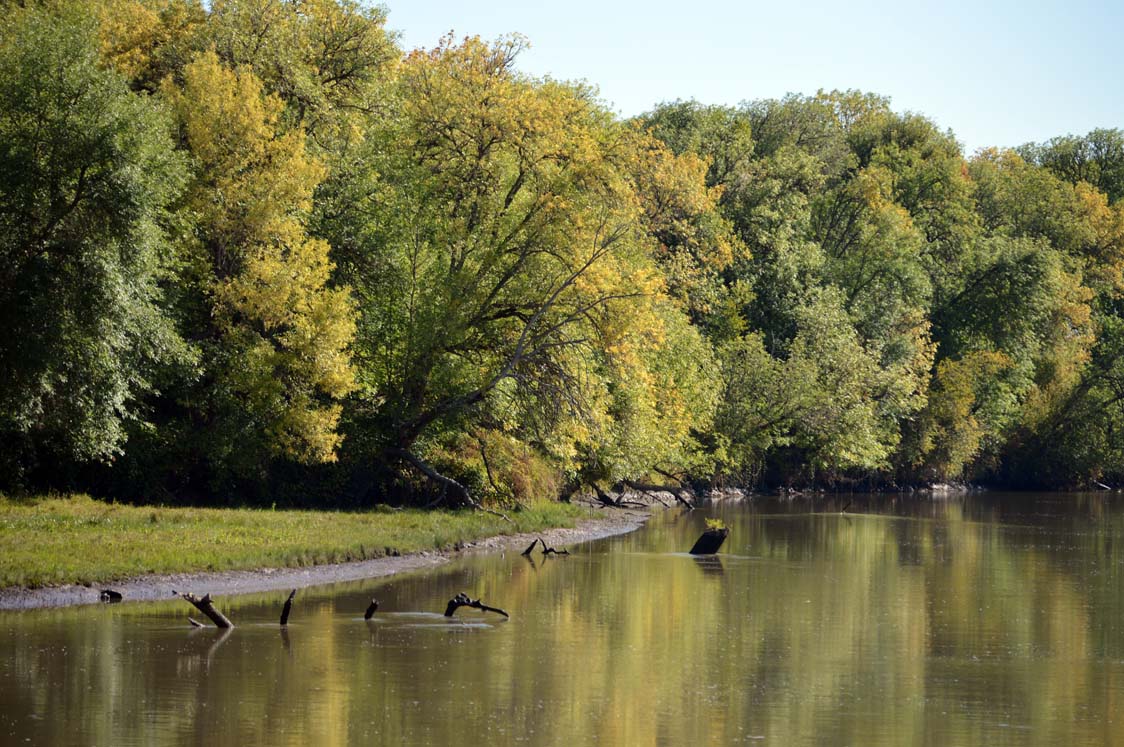
So was the view along the river, the green once again soothing a brain boiling with irritation. The kingfisher did his tricks, the clouds slowly lifted. It was still warm, a hint of rain in the air.
We live in a spectacular place. Why on earth won’t we share it?
We live in a complicated world, and are, of course, not the only ones who have a complicated history. Music today is also complicated, but mesmerizing.
Walk with me. It is still a warm day, but the trees are tinged with yellow.
The path meanders along a small channel, a tributary to the Willamette river.
Occasionally it veers off into the woods,
where trees chose to air out their roots,
or, better still, hug themselves.
The water is quiet, and extremely low.
Eventually I reach what is supposed to be a lake, but now only mud flats after this dry summer. I am thinking about the Jewish New Year that starts for us tomorrow. About the joys that the last year brought, the challenges, the losses, all making my personal life rich and complicated at once. Nothing but gratitude for that. Add to that sorrow for a world at the brink, with wars, natural catastrophes, potential dangers from technologies, anti-science policies, racist policing and vigilante violence all vying for first place in the destruction game.
I spook an osprey, it’s flying away, catching my eye, before I turn to the view up North.
Mount St. Helens is in glorious view, with some pelicans parked in front of it, echoing the white of the snow cap. Hard to square this peaceful view with the violent eruption of this volcano in 1980. 57 people were killed and 200 homes, 47 bridges, 15 miles (24 km) of railways, and 185 miles (298 km) of highway were destroyed. A massive debris avalanche, triggered by a magnitude 5.1 earthquake, caused a lateral eruption. I did not live in Portland then, but know people who to this day tell stories of the ashes covering their gardens, 57 miles to the South.
I can’t help but think about how we know there is danger around, but can’t predict when it becomes lethal. How we remember situations that were unspeakably destructive (particularly if there are still eyewitnesses around to tell the story) and yet we blindly ignore the signs that they are likely on repeat. In fact, through our willful ignorance or indifference make them more likely to occur again.
I am, of course, thinking about the fall of the fire wall against fascism, an event that happened in a German state election 5 days ago, with the help of over half a million people voting for a a party that is extremely right wing, infused with Nazi ideology and personell connections to actual neo-Nazi organizations. An election victory happily praised by the US President, the Vice President and Elon Musk, who has been shaping and guiding the Alternative for Germany (AfD) for several years now. It is a party that preaches hate, pursues the removal of long fought-for rights of many different populations, is willing to undermine the constitution, and showered citizens with promises that are all but impossible to keep. It achieved 44% of the vote and will be able to govern if only three more people jump ship in the five remaining other parties, and join the extremists.
Since around 2010 they built a movement embracing the grievances and siege mentality of East Germans (and now those in the West as well) who felt betrayed by the government, worried about the economy, fearful of crime, at a loss with the speed that technology unfolded, likely to threaten an already precarious status quo. Add to that a sense of betrayal that they believed to be treated as second class citizens by their Western counterparts, who swooped in and took what wasn’t nailed down after the fall of the actual wall.
Never mind the facts: crime rates in Saxony-Anhalt went down by 46% across the last ten years. Unemployment decreased by over 7%. Net income rose by 137%. Life expectancy rose by 5 years, overall. The percentage of non-German in the state is around 7%. Also the facts, for balanced reporting: rents have increased, education is getting worse, mass transportation, particularly the railway, is in a sad state and infrastructure is crumbling. The conservative national government is threatening to reduce many of the welfare state offerings everyone was used to, wants to increase the retirement age and is spending massive amounts on re-armament instead, in view of the belligerent threats of an Eastern neighbor.
As always, when fears grow, and insecurity festers, people who offer simple solutions for complex problems seem to score. They do so particularly if anger and resentment against a current government and an ever widening gap between the rich and everyone else, is not met with open ears, willingness to listen, or, most importantly, alternative proposals that have more realistic ways of implementation and tackle the rich rather than squeezing out more from the middle- and working class. There is a lot of rage around, and it has been ignored.
The AfD swooped in with promises, including visions of decreased rent and increased wages, and neighborhood emptied of “faces that don’t belong.” The party has two wings, an economic one and an ideologically extremist one. The first one takes care of the rich Germans, the other takes care of a German Reich. (The German version, by social critic and author Francesco Garita) is a clever wordplay: Der eine Flügel kümmert sich um reiche Deutsche, der andere um das Deutsche Reich.) Their economic policies align with oligarchs (see their support from Musk or, it is reported, Putin) – they want to increase free market competition, weaken the welfare state and deregulate big business. They discuss a departure from the EU, a return to a national currency, thus endangering the European project as a whole.
Their political wing provides convenient enemies to create in-group/outgroup cohesion and division, respectively, stoking hatred and existing prejudices in the population. Refugees, migrants, queer people, the poor, even women, all serve as scape goats and reminders that the fear of status loss is justified. The party stands for a revival of the hierarchies of the past, particularly for men. Men with German blood – as they publicly proclaim. They promise nationalism instead of justice, revenge instead of integration, authoritarian shortcuts instead of democracy. Importantly, they revive racist concepts of the past, allowing many people to voice them freely, or through permanent dogwhistles, be it agains Jews or Muslims, or Blacks. (It has only been a few years since a synagogue was attacked and two people killed in Halle, the second largest city in Saxony Anhalt. Even after this hate crime the local administration has been complaining about the cost for protecting the synagogue. They will be left on their own under the new regime.)
One of the main AfD promises are acts of “Remigration” – throwing people out of the country regardless of their immigration status. Something in other contexts more familiarly known as ethnic cleansing. Not mentioned: the annual cost of migration is around 50 million Euros. Migrants contribute about 706 million Euros to the economy – 14 times the cost and about 1/6 of the total gross domestic product. The current Chancellor, Merz, the biggest loser of these state elections, now accuses the AfD of unconstitutional moves. I will not get into the details of how much his party has bend to the populist right and normalized their programs, debating them over and over in “civilized settings”, making them socially acceptable, moving the Overton window to the right – or my head will explode.
***
On my walks, I saw egrets lining up, catching some warmth in the sun.
They reminded me of school children, standing in line, waiting to be called up in gym class or some such. Kids, then, shall be an example for a typical AfD program to bring us back to a brown past. (And in case you think associations to Nazis are far fetched – a legal opinion by the Society for Civil Liberties (Gesellschaft Für Freiheitsrechte) sees good chances of a successful AfD ban procedure before the Federal Constitutional Court. The report comes to the “clear conclusion that the AfD is unconstitutional, “showing parallels to national socialistic, racist ideology and programs. (The Society for Civil Liberties is a non-profit association founded in 2015 and based in Berlin. It aims to achieve the preservation and expansion of fundamental and human rights through strategic litigation. The GFF was founded as an association of lawyers and Internet politicians and cooperates with other non-governmental organizations in its lawsuits.)
Kids:
The AfD in Saxony Anhalt wants to do away with the general obligation to attend public or accredited private school and allow anyone to homeschool without any supervisory control.
Children of immigrants and refugees are to be separated from “German” children into different schools where they are to be “prepared for repatriation.” They want this even for kids who were born in Germany and/or have lived in the country for many years.
Kids living with disabilities are no longer to be mainstreamed. They are to be educated in special schools, isolated from the public schools. The quality of that education is of course likely to be different, and smart kids, perhaps wheelchair bound, will not have a chance to unfold their intellectual potential. (This is, by the way, illegal according to United Nation conventions for people with disabilities….)
AfD: we protect your (blond) children (with Hitler Gruss, if necessary, just look at the arms!)
Mt. Adams visible, still on my list of places I have to visit.
Nature tries to divert my visions of “brown” (even though the AfD chose light blue as their trademark color, claiming it symbolizes a new beginning…). Green, green, green nature shouts – and the occasional egret decides to move on, suggesting I’d do the same.
Tiny little asters everywhere. I try to absorb the beauty of it all, calming my nerves so rattled by what’s happening in the world.
Let us not be discouraged, withdraw, shut up – or they have won.
There is still much left for us to cherish on a daily basis, here, now, filling us with strength and determination.
L’Shanah Tovah – Happy New Year 5787
(My first act in the new year shall be to remind you all to deliver your ballots to a collection box, vote early. Just vote and drop it in the box! It would be negligent to entrust them to the post office!!!!)
Music today is an album by Hourloupe, Last Lost Words. I still have a few words left…..
Four years ago I wrote a post about disaster porn, contemplating how we react to disaster movies and how we are prepared by them for what is happening in real life. It was one of my most clicked posts of all times – the word porn must have had a magnetic effect… – but I doubt that it was one of the most read ones, given its analytical rather than pornographic content.
I had meant to get back to the topic after watching a wildly successful Norwegian disaster film from 2016, The Wave, that eerily sketches a scenario we have now observed in real life. A mountain crumbling (in Nepal and Tibet a glacier melting that led to tectonic shifts and a rockslide), causing a catastrophic movement of water, a mudslide in real life, a tsunami in the movie. The unstoppable wave took everything in its path.
What happened in the Himalayas is in detail described here by folks who monitor and assess geological risks. Nepal is calling for climate compensation, as a moral obligation for India, China and the US who are world’s top industrial emitters of carbon dioxide. Their acceleration of climate change makes countries who are far less contributing to the world’s warming far more likely to be harmed by its effects. Thousands have died in the August Rasuwa flood, and more than 6000 are still missing. That is not counting all those who were physically harmed, or the loss of possession, physical structures, and economic disruption.
The disaster movie keeps us in the dark about how many people were killed by the environmental catastrophe. It focuses on human connections – on heroic people and people less so, who happen to meet “just ends” for their failures. The film is overall splendidly done, visually enticing, at the right level of narrative speed, some real scary action shots, sympathetic and talented actors
It drove me nuts, though, in its function to seed thoughts that good people, those you identify with from the beginning, almost always survive. Minimal outline: smart scientist and his family about to leave a touristy village where he worked in risk assessment as a geologist. He senses something is wrong when his team ignores data, partially afraid that a false alarm might disturb the village’s summer income from all those visitors. When the intuited catastrophe hits, he and his 7 year-old daughter miraculously survive the tsunami. Much focus on communal mutual aid during the escape scenes, and one or another peripheral character dies. Hero’s wife and their older son are trapped in the bomb shelter of the hotel where she works. He goes in to rescue them – after some drama, happy ending for the nuclear family.
The message here? If only they had heeded the warning, more could have escaped. (Wake-up call: in real life, those warnings often don’t exist, or the means to distribute them are absent, or escape routes are unavailable.) Catastrophes occur, but there will always be survivors! (This is true, but gives the false hope that you must be among them, through identification with the narrators through whose eyes you see the story unfold.) Good guys get rewarded, bad guys get their just desserts. (Not how life works.) Each one of those messages undermines our willingness to tackle the causes of disaster, climate change in particular, before it is too late.
***
Well, today’s focus is now on an entirely different wave, a destructive force of a different kind. A small German state had an election yesterday, with almost 78% of the voters casting a ballot (up from 60% 4 years ago.) The right-wing extremist party AfD (Alternative for Deutschland) got almost 44% of the vote, 3 seats short of a majority government in that state. For the remaining parties to be able to gain the majority for governing, all 5 would have to unite, which is incomprehensible given their ideologically differences.
It was a shock, if not a surprise. The most conservative party that currently leads the country with chancellor Merz, got absolutely trashed, despite their political maneuvering of adapting to, if not plain adopting some of the topics of AfD during the election campaigns, with ever increasing hatred towards immigrants and culturally “woke” populations. Calls for a prohibition of the AfD were ignored or seen as counter productive.
Here is the deal: In contrast to the United States, Germany has restrictions of what people can say and do, if those things undermine the democratic constituents of our legal order, endanger democracy itself. This was the hard won lesson from having succumbed to fascism (with Sachsen Anhalt, that same state, by the way, also electing the Nazis with 44% in 1933.) Never again was written all over these constitutional restrictions. In fact, people tried to prohibit a Nazi-aligned party, the NPD, under these guidelines, which the German Constitutional Court (our Supreme Court) denied. The core idea is that we cannot allow a majority vote for something that in turn establishes anti-democratic rule, no matter how many people buy into the authoritarian ideology and would be happy to give up their democratic rights if only their other needs – economic, psychological, tribal – are met.
I will attempt to describe the AfD party program in detail in my next blog, including their false promises and their copycat talking points containing Nazi benchmarks. I’ll also try to understand why so many people contributed to this brown wave, in a country that lived through the horrors of the first one, not so long ago. For now, I just need respond to the many messages I got last night, with people wondering about the parallels between here and there, the seeming rise of an authoritarian Right across the globe, now in a country that, of all of them, should know better.
Music today by Telemann who was born in what is today Sachsen Anhalt.
Here is a Poem for my German readers –
Bei Hitlers brennt noch Licht. Es ist nie ganz erloschen, nur eine kurze, ruhige Zeit war’s Fenster fest verschlossen. Nur ab und zu, ganz schüchtern fast, kaum hörbar, ein Gewisper… Man nahm’s kaum wahr und dachte sich: „Was soll’s? Da ist noch Licht an.“ Bei Hitlers brennt noch Licht – Jetzt treten sie ans Fenster. Jetzt sieht man sie, jetzt hört man sie … das sind keine Gespenster. Ganz stolz und lautstark steh’n sie da, entzünden und krakeelen. Und ihre Drohung ist ganz klar: „WIR GEHEN WIEDER WÄHLEN!“ Bei Hitlers brennt noch Licht. Vernunft wo bist Du? Wo? Komm‘ raus und hilf … und schalt‘ es aus. … sonst brennt es lichterloh.
Simon Pearce or Erich Kästner – debates about origins….
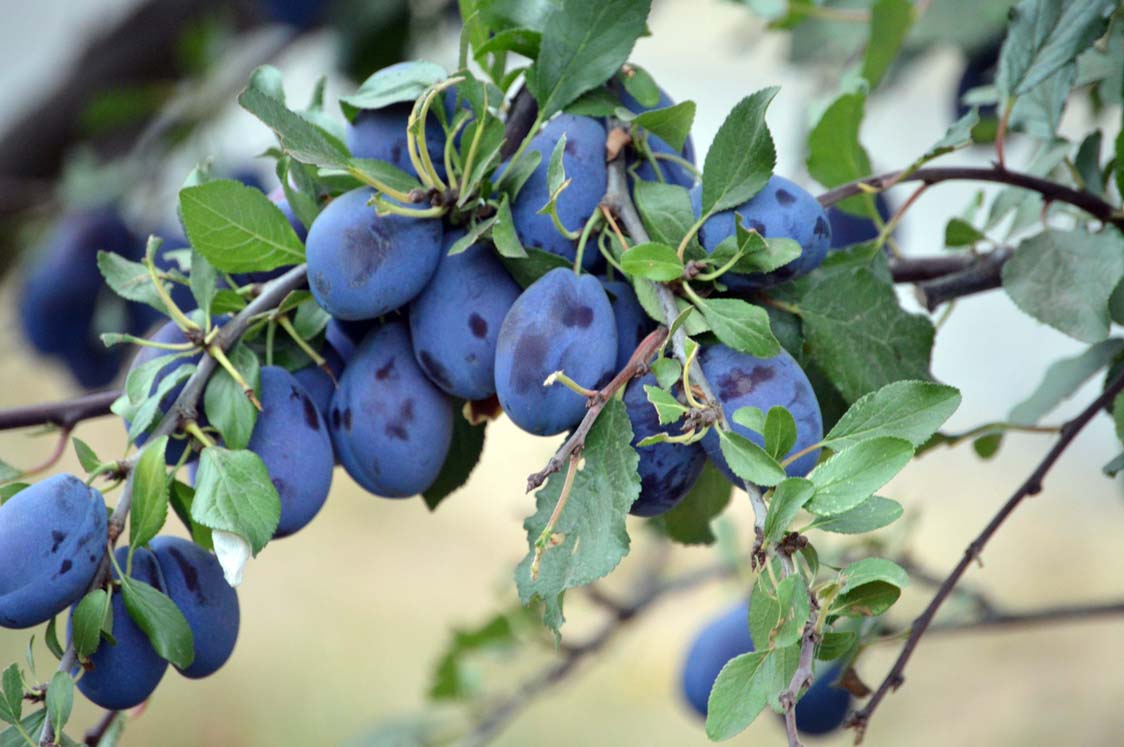
We went plum picking this week before the rains set in. An afternoon as good as it gets – with a happy three-year old bouncing around the orchard,
a happy baker filling her bags with ripe, juicy fruit,
a happy photographer relishing saturated colors, happy bees and wasps providing constant noise in the background, late summer sounds.
Some of the fruit trees not so happy, alas, the heavy load ripping branches right off the stem. What got flung into the nearby grass looked like late season Easter eggs.
Plums are one of the earliest fruit domesticated by humans, over 2000 years ago in both China and Eastern Europe. They can be dried and thus kept for lean times. Both fresh and dried plums have enormous nutritional value and are helpful for digestion. They are filled with antioxidants which helps combat inflammation in the body and also protects against cancer. They contain quercetin, a type of polyphenol that can improve heart health and brain function related to memory. They are also packed with potassium which helps bone health. A study of postmenopausal women who had prunes in their daily diet found lower rates of bone loss and improved overall bone health. Plums against osteoporosis! They do contain a lot of sugar, but apparently also a chemical that prevents sugar spikes in your blood.
And, of course, their beauty provided models for painter throughout the ages, as you can see below.
Lest you think I have changed and stick to the happy stuff – here are some thoughts that occurred to me after our outing, elicited by an article in Vox that I’ll summarize below.
The urge to eat locally produced food – and what is more local than U-pick farms? – has increased, given the many food-borne illnesses we have witnessed blossoming under the Trump Administration. There isn’t a day where there is not another food recall. Since May, the United States has seen more than 17,000 lab-confirmed cyclosporiasis cases, likely a huge undercount of what is happening in the general population. People have died from listeria infection brought on by cottage cheese, salmonella outbreaks originated in eggs and jalapeños. Frozen blueberries have been contaminated with e-coli, leading to highest warning level recall last week. Alfalfa sprout sickened people, contaminated with salmonella AND e-coli.
There are several factors contributing to these outbreaks, not just the administration’s decision to sharply curtail its ability to monitor for and respond to these outbreaks. Between the FDA and the US Department of Agriculture, which also oversees food safety, and several related agencies, more than 11,000 workers have been lost. The CDC, which helps respond to outbreaks once they start, has lost about a quarter of its workforce from January 2025 to October 2025. The federal government also shut down several national monitoring programs for foodborne illness in 2025—including for the cyclospora parasite specifically. The state and local agencies that surveil for and respond to food outbreaks have also faced staff cuts because they depend on the federal government for their funding.
The more general factors for the increase in illnesses we are seeing, are related to climate change, however, and the fact that we rely on globalized food chains. Warming temperatures across the globe increase humidity which helps both salmonella and e coli to thrive. Cyclospora has historically been found in subtropical climates, but now it grows inside the US as well. With warmer temperatures in more northern regions, it is likely to become epidemic here.
In addition, “the sometimes international trip from the farm to the store for a bagged salad kit offers multiple moments for potential contamination, including tainted irrigation water, local wildlife excrement, and poor storage practices, making it possible for dangerous pathogens to take hold before a person even buys their groceries.”
Carefully choose where you get your lettuce from, then, and buy full heads. Better still, get your vitamins with grilled vegetables, with heat putting an end to the offensive buggers. Best: live on prunes! Oh, I wish we could.
Jacob van Hulsdonk Still life with grapes, apricots and plums 17th Century
William Henry Hunt (1790 – 1864) Plums Date unknown by me
HENRY ARCHIBALD MAJOR Plums 1883
Jean-Simeon Chardin Still Life with Plums (1730)
Louise Moillon Still Life with Plums 17th Century
Unknown Early 20th century
Sasja Wagenaar Plums (2022)
Postcard from Provence
Music today is by Dvorak, celebrating natural beauty.
Here’s something truly astonishing: I recently found out that Emily Dickinson inserted the same lines over and over into a variety of poems that she sent as condolence letters to grieving family or friends. Almost like a form letter – a core message about the unknowability of death and what follows included in words addressing the particulars of each loss.
I cannot, for the life of me, imagine that I’d write the same thing to mourners I love, or am friends with. Which, in this year of manifold losses, has been particularly true. Each case so different, hitting home, sometimes intensely, sometimes less so, with different feelings and reactions. Each requiring a specific reply that honors them, not my own concerns, as I suspect the poet did.
Maybe those short lines were really meant as reminders for herself, incantations to ward off the emptiness or fear elicited by yet another death in her vicinity. In a letter to Charles Clark after the death of Charles Wadsworth (1883), she put those 5 lines (bolded below by me) at the end of the poem. Not exactly words of condolence. More a quest for what will be, acknowledging we’ll never know it. Can’t peek behind that gate, until you’ve passed through it. But could be something good waiting for you…
Maybe her world was used to Dickinson’s style of writing, able to decipher all these complicated words and hidden meanings. I am reduced to a simpler approach: my heart goes out to yet another friend enduring the loss of a child, another senseless death of one too young. My thoughts go out to those mourning the victims of war in Gaza, Ukraine, countless African nations, the dead of climate catastrophes in Nepal, earthquakes in South America, the fires and floods unleashed onto this planet by our carbon emissions. The next catastrophe around the corner at this very moment.
Senseless deaths breaking the fabric of time. A hoped for future lost, thoughts confined to revisiting the past, over and over, memory all that’s left.
"These thoughts disquiet me, and the great friend is gone, who could solace them—Do they disturb you?"

  The Spirit lasts—but in what mode—
  Below, the Body speaks,
  But as the Spirit furnishes—
  Apart, it never talks—
  The Music in the Violin
  Does not emerge alone
  But Arm in Arm with Touch, yet Touch
  Alone—is not a Tune—
  The Spirit lurks within the Flesh
  Like Tides within the Sea
  That makes the Water live, estranged
  What would the Either be?
  Does that know—now—or does it cease—
  That which to this is done,
  Resuming at a mutual date
  With every future one?
  Instinct pursues the Adamant,
  Exacting this Reply,
  Adversity if it may be, or wild Prosperity,
  The Rumor's Gate was shut so tight
  Before my Mind was sown,
  Not even a Prognosticator's Push
  Could make a Dent thereon—
Please join me for the opening reception of Fragility, a series of photomontages in dialogue with Lacing Communities Together at the Columbia Gorge Museum.
The Lace project celebrates both, the heritage art form of lacemaking and a community of people dedicated to preserving traditional skills and/or elevating them to new forms fit for this century. Under the auspices of Australian artist Maggie Hensel-Brown, lace guilds in the PNW, and the engaged team at the Columbia Gorge Museum, a lace installation will be revealed in September.
People from all over the world have sent lace triangles to be included in a huge compilation – as of this point, there are over 380 of them to be sewn together…. Local libraries in WA have offered workshops and get-togethers, for people to learn the art form and find community with others around them. Details can be found here.
My contribution to this communal effort, other than a wonky little triangle,
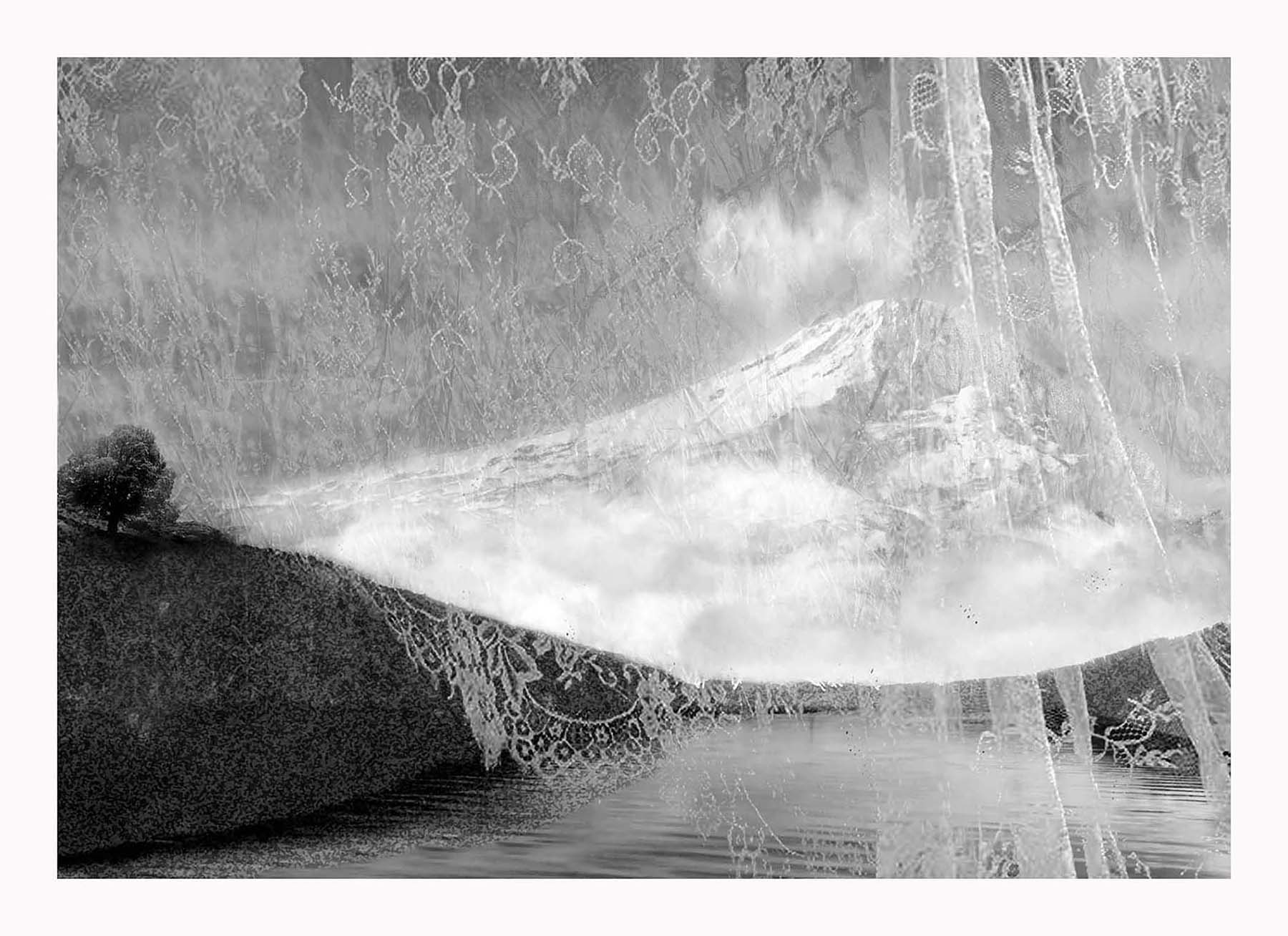
was the inclusion of lace of all kinds into photographs of landscapes.
“Fragility: This 2025 series of photomontages grew out of ongoing concern about insufficient environmental protection. Fauna and flora in these landscapes – photographed predominantly in the Pacific Northwest – are endangered. Climate change and the renewed threat of industrial extraction of resources, forests and minerals alike, will do irreparable harm. I thought the ephemeral nature of clouds and the fragility of lace were fitting symbols for why we need step up in our efforts to turn things around.”
The photographic exhibition is on view now, ongoing through late fall.
The joint opening reception with the Lacing Project will be
Friday September 11, 2026 5:30 – 7:30 pm.
Columbia Gorge Museum
990 SW Rock Creek Dr, Stevenson, WA 98648 (near Skamania Lodge)
When the honey, fruit and flowery tablecloth were whisked from the table in one sweep, it flew off with a start. Entangled in the suffocating smoke of the curtains, it buzzed for a long time. At last it reached the window. It beat its weakening body repeatedly against the cold, solid air of the pane. In the last flutter of its wings drowsed the faith that the body’s unrest can awaken a wind carrying us to longed-for worlds.
You who stood under the window of your beloved, who saw your happiness in a shop window – do you know how to take away the sting of this death?
Imagine entering a small garden, overgrown paths lined with lungwort. A humongous fig tree granting shade, a few vegetable beds exploding with the smell of ripe tomatoes. Sun dappled verdant corners, whimsical ceramics catching the light here or there.
Red calla lilies shining like little lamps eager for attention, chicken contentedly clucking in a coop next to the persimmons, fruit still green.
Your eye is caught by the plum trees, laden with fruit, some ripe on the ground, the purple skin of Italian prunes encasing glimpses of gold where the fruit has split open.
A feast for wasps, and wasps were what I came for.
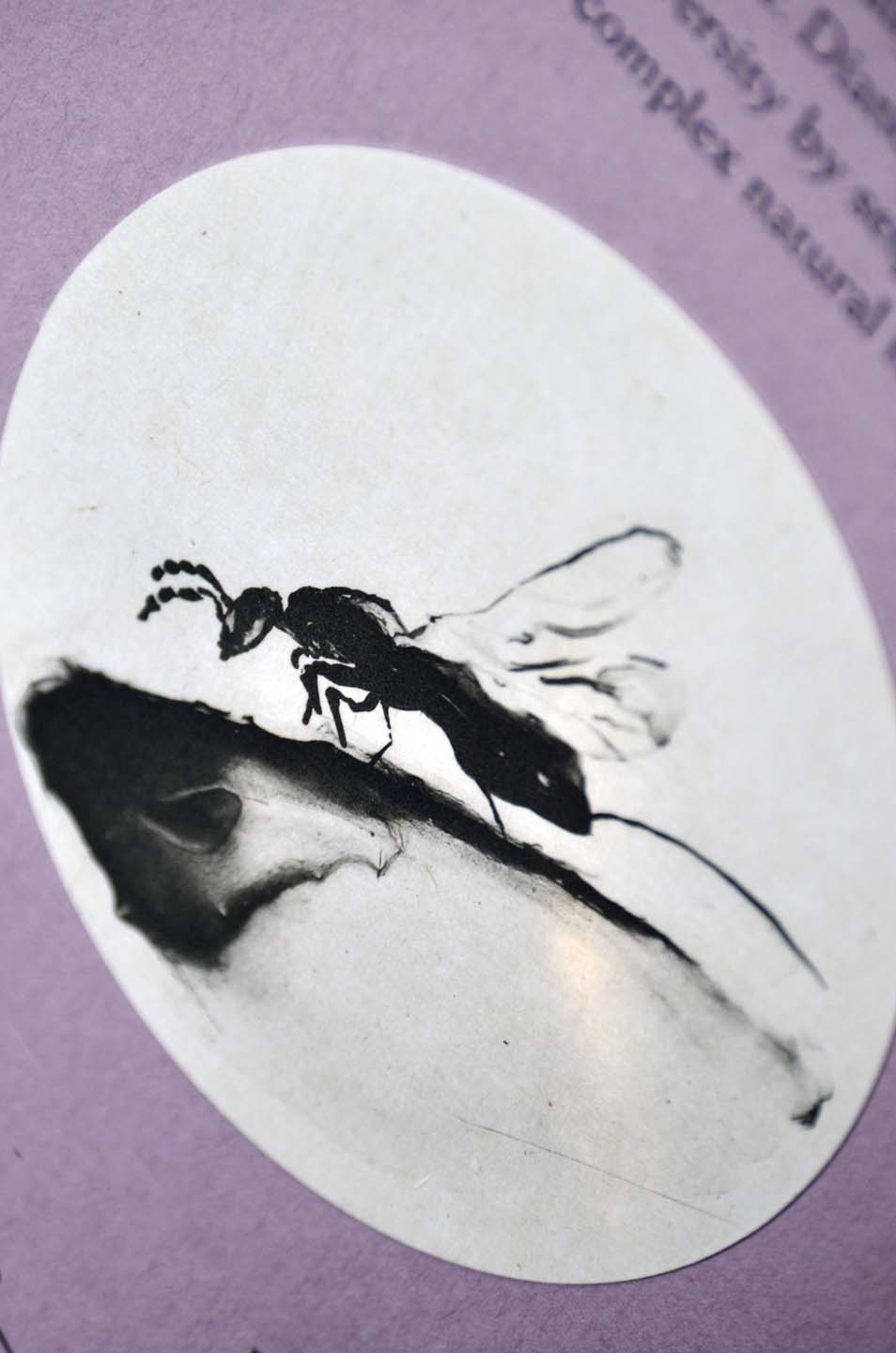
An art book about wasps, to be precise.
Let me hazard a guess: your first reaction upon hearing the word “wasp” was not entirely positive. Pesky yellow jackets interfering with your labor day picnic, stings that not too infrequently hurt like hell or even lead to anaphylactic shock, visions of angrily buzzing swarms of insects building their dreaded nests too close to the eves of your house.
Wasp nest, displayed in the artist’s studio.
You would not be alone in this assessment, and surely not the first one. Already in 300 bc, Aristotle insisted ‘Hornets and wasps … are devoid of the extraordinary features which characterize bees; this we should expect, for they have nothing divine about them as the bees have.’
A recent scientific study published in the Royal Entomological Society, found that people across 46 countries really had it in for wasps. They are universally disliked much more than bees or other insects. The public associates them with negative terms like angry, painful, dangerous, scary, and those sentiments map onto relative research efforts: wasps are significantly under-studied. Across 40 plus years of thousands of papers published in entomological journals, more than 80% cover bees, and not even 20% wasps.
Paper fold drawing our attention to common reactions.
Consequently what we know is relatively little, and what little we know is not communicated sufficiently to open people’s eyes to the utility of wasps for humans as well as their general importance for ecosystems as a whole.
From the studio collections.
Just a few facts: the wasps that bug us – the yellow jackets, the hornets – represent less than 1% of the stinging wasps, the species Vespines. Wasps belong either to social or to solitary species – the latter containing many more species, in fact hundreds of thousands of them, who do not sting and live quite separate from human contact areas.
Folded paper telling a story.
Wasps have several functions. Like bees, they pollinate our crops (although to a lesser extent.) They excel, though, in helping get rid of parasites. They regulate populations of arthropod pests and vectors of disease, decompose organic matter and improve soils. Important contributors to maintaining biodiversity, then, and now severely threatened, just like bees. Agricultural practices (use of genetically modified seeds, pesticides, etc.) habitat loss due to encroaching urbanization, and climate change all contribute to endangering these guardians of our ecosystems.
Eco prints of plants frequented by wasps.
Our implicit bias against wasps can only be remedied, if we change the rhetoric of fear to a rhetoric of love. For that to happen, we need to be familiarized with what there is to love: the beauty, the amazing survival mechanisms, the intricacies of wasp life cycles, and last but not least the tremendous ecological services these insects render. Which brings me to the owner of the enchanted garden described above, artist Diane Jacobs who has just finished creating a book celebrating all things wasp, the culmination of years of study and creative exploration of the subject.
***
Jacobs received an MFA in printmaking from San Francisco State University in 1996. and was awarded multiple prizes, fellowships and residencies in the years since. Her work – prints, sculptures and folio books – can be found in museums (The Portland Art Museum, the San Francisco Museum of Modern Art, the De Young Fine Arts Museum,), and educational institutions (The New York Public Library, the Library of Congress, Savannah College of Art and Design, University of Alberta, University of Chicago Library, University of Miami, Corcoran School of the Arts & Design, Yale, and Stanford among them.)
Artist Diane Jacobs.
Her newest book intends to educate us about wasps and show the intrinsic beauty of Apocrita, those narrow waisted insects that populate pretty much our entire planet. Wasps and their environments are represented in stunning detail and through a plethora of artistic processes. The deeply serious intent to help us overcome our antipathies by getting to know the various species and their quirks, is often softened by using more whimsical means to do so.
Pop-up structures vie for attention,
Pop-ups.
paper layers inviting hands-on folding and unfolding to reveal ever more details are hidden in various pouches along the folios.
Paper folding for multi-surface info presentation.
Miniature sculptures made of natural and artificial materials expose the delicateness of wasps’ body parts, and also point to means of helping identification.
Beads and plant materials (thorns from a defunct dragon tree) sculpted into antennae.
The work evolved through Jacobs’ friendship with naturalist and photographer Kate Taormina, their shared interest and separate expertise cross-pollinating a successful collaboration. The joint project started in earnest during Jacobs’ 2024 residency at PLAYA, located in extremely remote Lake County in Oregon. The prestigious PLAYA residencies foster interaction between international artists and scientists, true to the belief of the organizers (and many of the rest of us who happen to have a foot in each of those camps!) that interdisciplinary exchange helps shape new ways of seeing the world, ultimately enhancing our approach to conservation. The concept of the book evolved over time. Now each page affords glimpses into a different universe, some pleasantly playful, others creating a sense of awe given nature’s diversity.
Whatever I learned about wasps, I learned even more about what can happen when an artist puts their mind to a singular pursuit of topic, but is open to embracing a huge number of different representational processes. Some of them surely needed to be acquired long after formal education had run its course.
Woodcuts in paper windows.
Just look a the list of processes and materials that the artist provided, all used to create the 16 hand-made copies of this book – one already snapped up by Yale University.
” Materials and printmaking techniques for this project include reduction woodcuts, wood engravings, mono print, lithography, photogravure etching, stitching, beading, hand painting, pressure printing, collage, polymer plates, book cloth, ceramic wasp, beech wood, unique eco print, and glass petri dish. Papers include Kitakata, handmade abaca, kozo, Gampi, mino washi, masa, Rives Lightweight, rayon, and Tyvek. All text on pages is handset and letterpress printed. Some booklets are letterpress printedfrom polymer plates and some are handset.”
So many artists who have had a successful 30 year career really stick to the tried and true, their developed expertise, even their general subjects. To embark on new fields of learning, as well as new processes that require tolerance of potential imperfection, takes courage. Jacobs, for example, was introduced to photogravure etching only 3 years ago, during a workshop at Mullowney Printing. Also fairly recently she learned how to do wood engraving. For Wasp Love alone the artist was going to carve 8 little wood engraving blocks. “It took me a bit to get in the groove.”
Wood engraving.
Yes, it takes courage, or at least an absence of vanity in pursuit of a greater goal. In this case helping nature to survive human indifference, or, worse, capitalism’s endless extractive exploitation, by deconstructing one stereotype after another.
Jacobs’ book Wasp Love is a marvel, not least in the way it balances education with art to be appreciated in its own right, independent of the book’s subject. Pacific NW audiences will be able to see and explore a show copy next February at The Patricia Reser Center for the Arts. It will be shown together with her wasp-related sculptural work and a series of her eco prints, as well as installations and paintings by Susan Murrell and my photomontages, in the context of Collective Effervescence. The exhibition is dedicated to our love of and fear for nature.
Pop-up folio.
***
Replacing the rhetoric of hate with the rhetoric of love – not an easy task. One of the obstacles lies in the psychological nature of hate, compared to love. For hate all you need is a simple, stereotyped target. There is “the enemy,” out to get us, in a zero-sum game of one side wins, when the other side loses. “Wasps are aggressive and hurtful.” Simplistic ideas like that are much more easily communicated and adhered to, than more complex ones.
It’s more difficult to convey the many aspects of multidimensional targets – endless species of wasps, a variety of functional advantages outweighing the occasional sting by a minority of Vespines. Complex concepts defy our desire to stereotype by means of their sheer diversity. You need to learn and integrate so many different facts. Which is made even more difficult by the reality that our old feelings were negative and now need to be recalibrated (in comparison to just sticking to your culturally transmitted biases that ruled the world across time.)
Wood engraved plates.
Art is enormously useful here. It can try and break the cycle of negative stereotyping in many different ways.
There is poetry. If we go back to the beginning of this post, you have Zbiegniew Herbert’s poem that subtly reminds us of the similarity of wasps and humans, not elevating one species over another. Rather than showering us with facts, and patronizing demands to let go of prejudice, its symbolism offers something that speaks to our emotions. Are we not all familiar with the feeling of being trapped in certain realms of our existence? Are we not all hoping against hope, to the last breath, that moving forward at all cost will bring us to a longed-for future, no matter how much we bang our heads against the wall? Because we look in the mirror, the observed death causes a premonition, a sting that cannot be resolved. Could it be that wasps are us?
Paper fold in book pocket.
Then there is literature. What comes to mind are Ursula LeGuin’s brilliant musings published some 40 years ago in The New Yorker. We are told that a woman is un-naming all members of creation, a woman who we later learn is Eve, about to leave Adam and the garden of Eden, unhappy with having been named in certain ways. The idea is that a name usually allows for categorization and/or stereotyping. Its absence will lead to equality not impeded by artificially drawn hierarchies.
“The insects parted with their names in vast clouds and swarms of ephemeral syllables buzzing and stinging and humming and flitting and crawling and tunnelling away.
…
None were left now to unname, and yet how close I felt to them when I saw one of them swim or fly or trot or crawl across my way or over my skin, or stalk me in the night, or go along beside me for a while in the day. They seemed far closer than when their names had stood between myself and them like a clear barrier: so close that my fear of them and their fear of me became one same fear. “
The merging of equals, affiliating through emotion, becoming extremely close: could it be love? As always with LeGuin, of course, there’s an undercurrent of brusqueness below the witty narration, pointing to the power naming has for those on top of social or gendered hierarchies.
Trial paper folding in the studio.
And finally, there is visual art. Jacobs’ book radiates joyfulness, in its colorfulness, playfulness with hidden and revealed shapes, its use of surprise perspectives. You cannot help but find these folios emotionally rousing, no matter how concept-driven and filled with scientific facts they are. The book might not manage to induce love, admittedly. But surely it ignites strong admiration for a life form that is so much more complex than we had known. A first step away from hate or fear.
It’s funny how memory works. Even those of us who have studied and researched the mechanisms of remembering for decades, can be hit over the head by factors that trigger certain memories when we least expect it.
Yesterday was one such occasion. I was out on a walk through the wetlands, dried out and dusty for the most part. Noticing a lot of white.
White thistle down.
Meadows filled with white Queen Anne’s Lace, wilting with the drought.
White candle-shaped weeds, rimming the path and attracting the bees.
Horse chamomile,
bindweed,
dandelions.
And, just around the corner, some egrets preening, in the last pond holding some water.
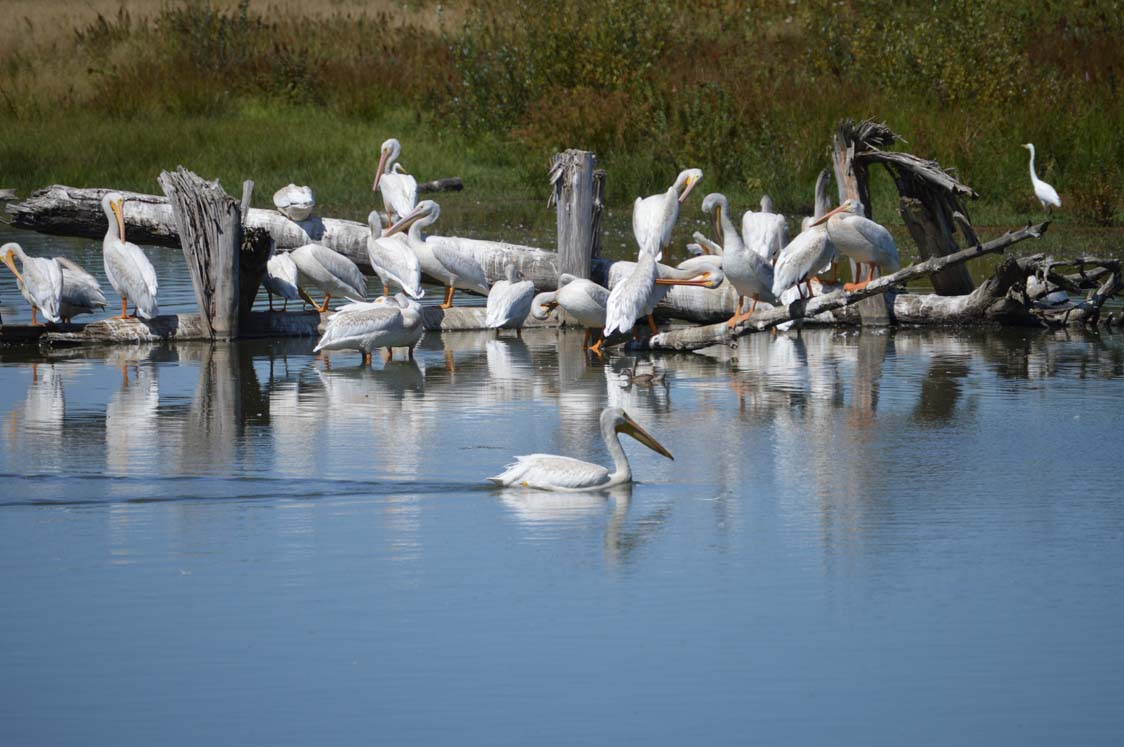
A pond visited by a fleet of pelicans, glaringly white, elegant, and beautiful against the sunlit landscape.
I suddenly remembered hearing about a white dress, made of silk. When I finally arrived in Germany a few days after my mom’s sudden, unexpected death, I was told that she had bought it recently and raved about it. They found it in her closet and put it on her for the coffin. Why did my mother, then in her 50ies, buy a silk dress in November? White, no less? She was never much into clothes (in contrast to her daughters) and usually seen in utilitarian dress that could endure her gardening passion, ready to touch dirt.
Why did a friend of her’s know about purchases, although she, too, had no idea about the reason for this fancy? Why were they told what kind of funeral my mom desired, when I wasn’t? A funeral as unbefitting for a gardener as one can imagine – ashes thrown into the sea. At the time, hot dismay competed with the icy numbness of the sudden grief. The anger of a child (albeit a grown one) of realizing the independence of a mother, vast parts unknowable from now on. And that was before I found instructions in a letter addressed to me, to destroy a cache of letters and papers unread – instructions that I honored.
Seeing white on my walk triggered an emotional memory, but it was grief that led to the specific remembrance of another time of mourning. Grief for my friend who recently died, mourning for a beloved mother, missed since 1983. There were multiple sources – the color, the current feeling – spreading activation to a node that called up an associated memory.
There are a lot of people dear to me who are currently in mourning. I wish I could convey that being triggered by environmental or state-dependent cues will never stop, but the quality of the emotional reaction will. I still miss my mother, 43 years hence, but I now think about that mysterious white dress with pleasure, happy that she was willing to spend on herself, grab some beauty. I think of all the love and connectivity she left me with, rather than fuming about what I wasn’t afforded. I think about the “gift” of her early death in the sense that I learned as a young person that grief will not hurt intensely forever, and so have an easier time now, knowing current pain WILL abate.
White is the color of mourning in multiple cultures; apparently Western aristocracy, Mary Queen of Scots and Queen Victoria among them, adopted it both as mourning dress, and parts of her funeral, respectively. In Eastern religions white symbolizes hope and rebirth.
Yesterday, all I saw was brilliant white, or dainty, translucent white, or the white of strong feathers of birds at rest during migration. Nature. Impervious to feeling itself, but making me feel strongly.
Grateful for memories, but more grateful for being surrounded by brightness in the here and now, reminding me that there is light at the end of the tunnel.
Letter to the Person Who Carved His Initials into the Oldest Living Longleaf Pine in North America —Southern Pines, NC
Tell me what it’s like to live without curiosity, without awe. To sail on clear water, rolling your eyes at the kelp reefs swaying beneath you, ignoring the flicker of mermaid scales in the mist, looking at the world and feeling only boredom. To stand on the precipice of some wild valley, the eagles circling, a herd of caribou booming below, and to yawn with indifference. To discover something primordial and holy. To have the smell of the earth welcome you to everywhere. To take it all in and then, to reach for your knife.
If your first reaction to this poem resembles mine, you’d be thinking about vandalism, or ignorance, or a vile belief system that sets man above nature. Enraged about the continued thoughtlessness and indifference of people uselessly harming trees, or anything else out there in nature.
Some second thoughts, though. What do we know about tree carvings? Turns out that there are reports of arborglyphs (or dendroglyphs or sylvaglyphs, however you want to call them) since ancient times. Both Callimachus and Virgil wrote about lovers commemorating the presumed longevity of their feelings by carving the bark of trees with their initials. Shakespeare followed centuries later.
People around the world, not just couples, have carved patterns for communication, expressions of cultural significance, scientific pointers (astronomy) or spiritual appeals into trees. Some were maps or way markers, some related to burial customs. Here in the US, the Chumash tribe used tree carving to relate astronomical movement of the planets. Shepherds in the Southwest, many of them of European origin, carved into aspen trees, including drawings and poems. We have more than 20,000 documented tree carvings across California, Nevada, and Oregon, dating from the early 1900s. Who knows, of course, how many are left after the fires.
Does carving hurt a tree? Potentially (and often) yes, if it is too deep.
Does it make sense to “engrave” important local, or scientific information into trees presumed to be around for a long time to help tribal movement and information sharing before technological means of communication? I’d say yes to that, too.
And was promptly reminded of another way of communication that conveyed not necessarily pragmatic instruction, but instead psychological resilience: the Kilroy Was Here meme found throughout the battlefields of WW II, left by the Allies to indicate presence, power, the might to invade deep behind enemy lines. It boosted morale during times fraught with killing and dying. Of course, it also used every available surface, from beach sands to fences, to bombs or lavatory walls that literally confounded the likes of humorless Hitler and Stalin, respectively. But I digress.
What is the psychological motivation, though, for individuals to leave their marks on trees, marks that have no informational value, e.g. plain initials?
For lovers, it might be a spell-like, wishful thinking that nothing will part them in the future. Alas, sealing your love that way might indeed seal the fate of that tree.
And maybe, for individuals like the poem’s villain, it has to do with our shared fear of mortality. Maybe we can ward off that sense of discontinuity, triggered by a landscape that signals eternal presence, historic continuity, a landscape in which we are but a temporary speck?
So we assert ourselves, leaving a legacy, however destructive, that will remind others and ourselves that we existed (well, someone with those initials, at least.) A cheaper, if equally perverse, version of gilded triumph arches in Washington, D.C. ….
I tend to believe that views of majestic, or even just beautiful natural landscapes often conjure thoughts of past and future, and thus instill a sense of temporality. How many millennia did it take to carve a gorge into mountains of basalt? How many centuries to grow trees of this size? Will these meadows survive the droughts ahead of them, with snowcaps no longer sufficient in providing runoffs? Will these streams run dry during our life time?
It is a short jump to mull our own life span, or the possibilities of being remembered, the next best thing if we can’t be around ourselves. Most people hope that they can influence that remembrance through their achievements, or their sharing of their story, their generosity, or through their children’s recollection.
Here is what I remember: my father showing me the tree he marked with his initials as a 10-year old in a forest that later lived through WW II, bombs and all. I was in awe when I saw it at approximately the same age. And so he lives in my memory. (As he would have without that tree-endangering carving….) Was it a villainous act?
And some people will live on in collective memory through their destructiveness, their cruelty, their indifference. Like it or not. Anything that makes them feel big, rather than enduring a sense of insignificance. Having a future beyond the grave. That includes, of course, arsonists. Those who commit arson by starting fires, and those who omit to engage in environmental protection, leaving us with ever increasing risks from climate change, burning the planet. Much more “efficient” than carving and destroying just a single tree.
Trees serve well as symbols of a future. They are strong, long-lasting, easily imagined to survive, and thus carry a message from (eventually) the past. That assumption is now, of course, likely to be burnt to crisp, alongside its subject. The ever growing fires are making sure of that.
General ideas about the future and our place in it are changing as well. Here is a gift article from the NYT that I strongly recommend for your perusal. Ivan Krastev is the chairman of the Center for Liberal Strategies in Sofia, Bulgaria, a permanent fellow at the Institute for Human Sciences in Vienna and a Financial Times contributing editor.
“We are living in a world very different from the world of the Cold War. Probably our very idea of governance will change. Some of the changes we witness are really radical. Imagine for a moment that some of our most fundamental assumptions have been challenged. We disagree on many things, but we have tended to believe that the future will be better than today and that individuals are mortals but nations are immortals, and we continue living through our children, our sacrifices for the nation, our books. Now some individuals — particularly in Silicon Valley, but also including people like Putin — are starting to genuinely hope that they will not die, some nations are starting to genuinely believe that they will die, and many young people for different reasons have decided not to have children. This political world cannot be understood or explained in the language of the 20th century. This is why neither awakening the utopian energies nor simply defending institutions will be enough to deal with the current crisis.
This is where this sense of vertigo comes from. In politics vertigo is when you see the abyss, but you are not sure: Is this the past or the future?”
What we see from here is, literally, smoke and ashes.
Music today is a fascinating concept album picturing Alexander von Humboldt’s trek to explore nature and cultures on a continent different from his own. Last Lost Words.