Browsing Tag

Maryhill Museum

Exquisite Gorge II – Pattern Masters and Master Patterns

Mightily wove they the web of fate, While Bralund’s towns were trembling all; And there the golden threads they wove, And in the moon’s hall fast they made them. ”  – Poetic Edda (Helgakviða Hundingsbana I)

*

Why on earth was I thinking about a bit of Norse poetry while visiting with Mexican artists Laura and Francisco Bautista? Not as far fetched as one might think when you consider I was standing in a studio filled with spinning wheel and looms: the three Norns in Norse mythology are spinning and weaving the thread of life, deciding your good or bad fate and the length of your existence irrevocably at birth.

My vivid imagination as a German child, with Richard Wagner’s Norns singing in the Ring of the Nibelungen as a frequent backdrop, had not served me well. Thread of life, perhaps short, being banged by a beater on the loom? Goosebumps ensued. Luckily for me, that negative association disappeared while looking at the art in front of me and encountering the warmth and sensibilities of the contemporary weavers who had invited me into their home. Their weaving is nourishing souls, rather than crushing them.

Francisco and Laura Bautista

This was my second studio visit for the Exquisite Gorge II project, offered by Maryhill Museum of Art. To repeat, thirteen fabric artists, in collaboration with community partners, will portray an assigned section of the Columbia river in three dimensional form on frames. The sections will be linked in the end, forming an “Exquisite Corpse” during a public outdoor celebration at the museum in August.

———————–

THE EXQUISITE GORGE PROJECT II

“…a collaborative fiber arts project featuring 13 artists working with communities along a 220-mile stretch of the Columbia River from the Willamette River confluence to the Snake River confluence. The project, again initiated by Maryhill Museum of Art and following the original one by printmakers in 2019, takes inspiration from the Surrealist art practice known as exquisite corpse. In the most well-known exquisite corpse drawing game, participants took turns creating sections of a body on a piece of paper folded to hide each successive contribution. When unfolded, the whole body is revealed. In the case of The Exquisite Gorge Project II, the Columbia River will become the ‘body’ that unifies the collaboration between artists and communities, revealing a flowing 66-foot work that tells 10 conceptual stories of the Columbia River and its people.”

———————–

Laura and Francisco Bautista came to the U.S. in 2003, from a small town near Oaxaca, Teotitlán del Valle, a center for traditional weaving to this day. The valley was home to the Zapotec (one of the largest indigenous groups), weavers since 300 B.C.E. Archeological evidence from Mesoamerica suggests that weavers used backstrap looms as early as 1500 B.C.E.

Wool—in Zapotec quicha pecoxilla or quichaxilla – sheep and treadle looms were introduced by the Spanish conquistadores during the 16th century, at the same time that they brought devastating disease, decimating the indigenous ethnicities by horrifying numbers. The wool was spun with indigenous spindles, or a manually turned wheel. Other fibers that had been used included the Agave-based fiber Ixtle (quéeche in Zapotec), cotton (in Zapotec xilla) and in rare cases, silk.

All natural dyestuff dyed wool

The area developed a distinctive weaving tradition, which is claimed to be among the finest and most dynamic form of tapestry art in contemporary Latin America. (Many of today’s facts were learned from this book.) There appear to be a number of technical features that distinguish Teotitlán weavings from other Mexican tapestries. These features include the woolen warp, the two bundled warps at each selvage, the warp ends twisted together in groups, and the warp ends left uncut at one end of the web. (Honestly, I have no clue what that would look like, but I thought the community of readers who weave or are interested in weaving history might appreciate the detail.) What I do understand is the effects of historical developments on traditional practices, since the good and the bad often combine, for many mediums alike.

Tension on the loom is the secret to successful weaving

Until the 1950s, the Bautistas’ village had an economy based on subsistence agriculture. Weavings were produced for the local markets and for personal use. Enormous change happened with two external events: for one, the PanAmerican Highway was completed and tourism started to flow into Oaxaca and the surrounding regions, and with it an insatiable appetite for artifacts to bring home as a souvenir. Secondly, the U.S. Bracero program allowed millions of Mexican men to work legally in the United States on short-term labor contracts, between 1942 and 1964, an exploitation of cheap labor for the States, but a chance to send some direly needed funds home for the migrant workers. The tourist demand for weavings encouraged many of the people staying at home to start weaving full time.

The good part about these developments was that it helped centuries of knowledge and specific patterns to be handed down hereditary lines, encouraging families to engage ever more with the craft, since weavers were now in short supply given the rising demand. The not so good part was the introduction of more commercial demands in terms of mass production, leading to a drop in quality for many products, and, in particular, the use of synthetic dyes, since it was too costly and time-consuming to stick with the plant-based dye techniques. Even that, in some ways, might have been a change for the good because it created economic opportunities for whole towns and villages that had been previously foreclosed, in a state that is the poorest in all of Mexico and suffered much with increasing drought, deforestation, overgrazing and soil erosion in terms of agricultural earnings.

***

The three nordic Norns called Urd, Verdandi and Skuld, represent the past, the present and the future, respectively, holding the world’s collective memories according to legend. Laura and Francisco Bautista live and work in the present, but honor the past in their treatment of the materials and the weaving techniques they apply.

The right post of the loom, which was brought with them from Mexico, has all the locations named where they have taken it for exhibits, fairs, and teaching occasions.

The wool is washed and then dyed with exclusively natural colorants. The remarkable biodiversity of the Bautistas’ homeland is reflected in the many plants and other natural dyestuffs that is used for dyeing the wool. The couple uses Marigold, Tansy weed, black and green walnuts, and Indigo, among others, all available here. In general, many of the ancient dyestuffs relied on plants found in tropical regions. Yellow, oranges, purple, browns were all collected from species that we don’t necessarily find in our own latitudes. Blue is derived from an indigo plant called Indigofera suffructicosa, native to the Americas (in Europe blue was derived from woad.) Families would hand down their secrets about useful plants for developing special shades. Marigold petals, añil, pomegranate zest, seed pods, moss and pecan could be looked together, and slight manipulation of pH values would generate different colors.

Some of the botanical species used for dyeing.

Red was, as it turns out, of utmost importance. It was and still is most often extracted from the cochineal insect that lives on the opuntia cactus. The coloring agent is carminic acid, a hydroxyanthraquinone. It produces a bright red liquid and was a prized commodity (red gold!), exported by New Spain to Europe as a profitable trade for the conquistadores. Until the 19th century, that is, when Spain prohibited further imports of cochineal in order to protect their own newly established production farms in Spain. The economy of the Oaxaca region suffered a hard blow.

Someone else looking for cochineal…wrong cactus, alas.

These days there are a few ranches in the Mexican region that grow the insects, providing the colorants for weavers and to international importers who use it to color food. (In case you wondered: here is where all of us are regularly ingesting the output of these critters: products containing cochineal extract include Ocean Spray Cranberry Juice, Dole Diced Peaches, Strawberry Gel Fruit Bowl, Sobe Lizard Fuel, Tropicana Orange Strawberry Juice with Calcium, and Robitussin Honey Calmers Natural Throat Drops. (Ref.)

If acidic liquid is added to the cochineal fragments, the red dye appears. Add some base, and the pH value changes, turning it in this case purple.

There is an embrace of the past, then, in preserving the recipes for and application of these colorants. There is also the preservation of patterns, a flourish of traditional designs and motifs, often with mythical references or other symbolism referring to the Zapotec’s folkloric tradition. There is in addition the pride in being part of a generational chain of hereditary weavers. Francisco Bautista is a fourth generation artisan, now teaching the fifth: his two teenage children, Cinthya and David, who have taken to the looms with curiosity, passion and talent. Cultural identity is successfully transmitted. The family is tightly knit, and they often sit together to brainstorm about new designs or ways to capture their desired expression in woven tapestry.

The Bautista “signature” is 4 dots – they symbolize the seeds of life, 4 generations of hereditary weavers, and drops of water.

Classic weaving pattern with grecas stripes and the “eye of God” in center, the configuration often compared to butterflies symbolizing souls.

Francisco Bautista is a patient man. His temperament allows him to work figuratively (extremely complex pattern weaving) and also makes him a highly successful teacher.

iPhone photo of his last workshop for beginning weavers -with a group of very proud students

Fringe work done with manual rolling for every single piece.

Shaving the weaving with a blade; Lou Palermo, Maryhill’s Curator of Education, discussing the Exquisite Gorge II lay-out with the artist.

Laura Bautista, by her own words always seeking novelty and pursuing diverse approaches favoring highly mathematical, geometric motifs, is in herself an emblem of the future. Until about 50 years ago or so, the Zapotec women of the region were not allowed to weave. They were involved in the task of washing, preparing, carding and spinning the wool, as well as running the households, while the men stood at the loom, introducing their male heirs to all things related to the art from an early age. With the exodus of men migrating North, women were slowly integrated into the weaving world. By now there are all female cooperatives of women who are widowed, divorced, single or otherwise interested in doing collaborative work, who have become part of the artisan landscape of the Oaxaca valley.

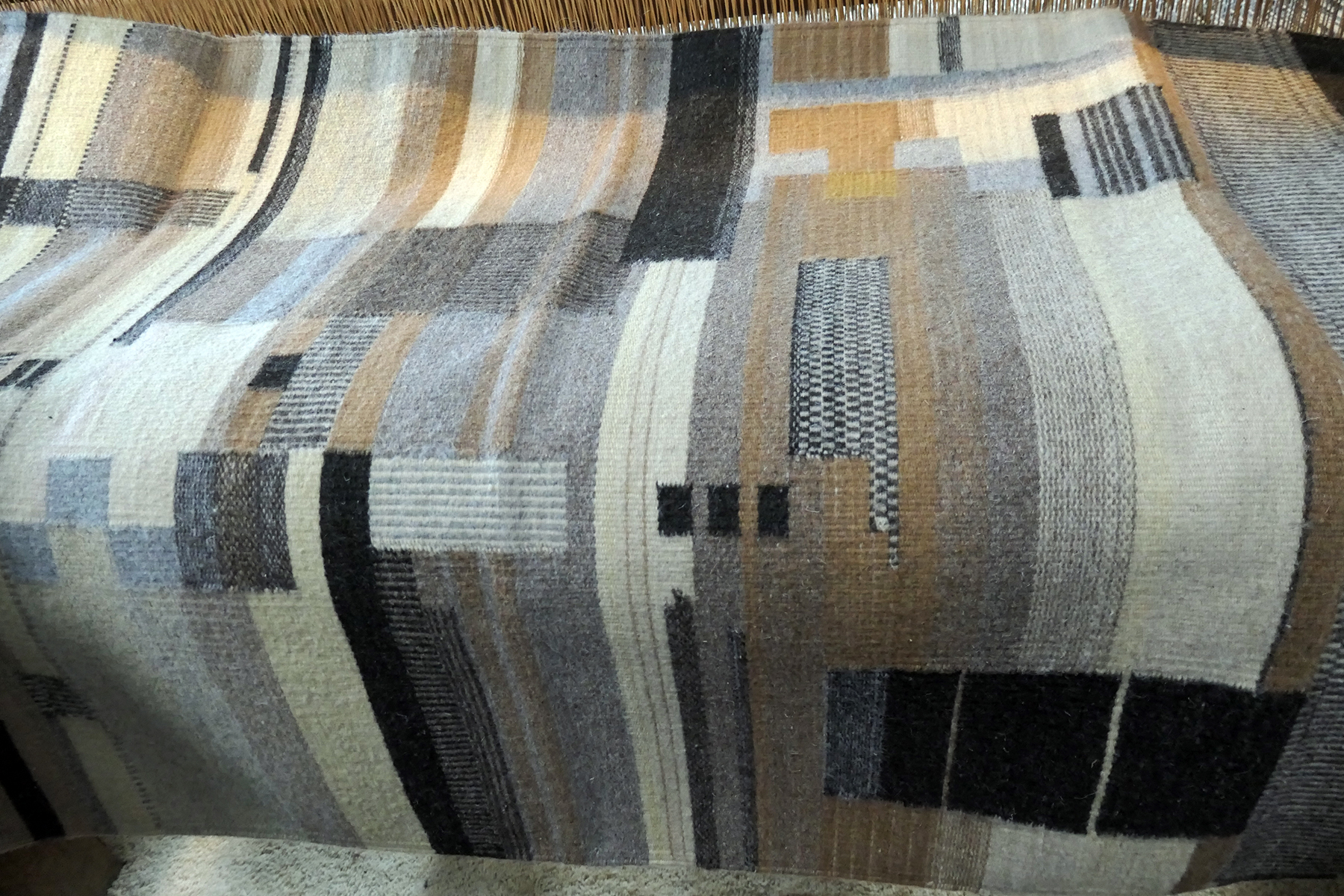
One of Laura’s favorite pillow casings – note how saturated and more pastel colors seamlessly flow into each other.

Laura is thrilled that she learned how to weave, since the full time job these days allows her to stay at home, be there for her children, assign her own working hours and listen to music while weaving which she loves. During the last seven years the couple has developed a style that is reminiscent of the 1920’s Bauhaus weaving that was equally innovative at its time. A friend pointed out similarities to an art movement they had never heard of, and provided books to prove how beauty self-generates across generations and geographies, patterns not necessarily culturally defined.

In some funny twist, of course, the Bauhaus weaving department was meant to absorb women students and keep them away from the other, traditionally male dominated domains including painting, in contrast to the exclusion of Zapotec women from the craft. Some of the Bauhaus women signed up grudgingly, thinking it was an inferior domain, but swiftly realized the possibilities of the medium. Here is a link to one of the most successful students, Anni Albers, from a recent retrospective at the Tate Modern.

And here is a short summary of the career of master weaver Gunta Stölzl, who headed the Bauhaus weaving department.  

Possibly no other form of (artistic) craftwork requires as much concentration, mathematical skills and strength in intuition as weaving.”

Thinking once more about the Norns: they were interpreted, certainly in the Ring cycle, as a form of intuitive and visionary awareness. The same can be said for the Bautistas’ work. They intuitively reposition the familiar into something creative new vision.

The artists are pattern masters, willing to experiment, pursuing reinterpretation of old patterns into new visions, developing designs with both, new motifs and modern color combinations that express their own, individual artistry. They don’t adhere to a master pattern that governs strict preservation of the past and prohibits change. Traditions have continually evolved in Zapotec history, and luckily that continues to be the case.

A tapestry for the American Embassy in Mexico City, I believe

***

I was driving back from their studio to Portland during late afternoon, light slowly diminishing. The Bautistas’ house is situated in the middle of expansive tree farms near Sandy, OR, then lit by a low sun, greens popping as so often at dusk. The endless rows of trees, geometric parallels, reminded me of the striped weavings. The little conical shapes of small conifers, interspersing the rows, or forming rows themselves, looked like a pattern of dots, strewn to the horizon. The weavers seem to live in a natural tapestry, some higher order pattern-master’s sleight of hand. So much beauty, in studio and surround alike. My heart sang. Norns, you may chime in!

Here is an OPB video of the artists at work.

And here are the Norns singing.
Exquisite Gorge II: Ariadne’s Thread

“A labyrinth is a symbolic journey . . . but it is a map we can really walk on, blurring the difference between map and world.” – Rebecca Solnit, Wanderlust: A History of Walking

Remember Ariadne? The labyrinth? The Minotaur, half man, half bull? Vague memories of vengeful Cretan king, Athenian hero, lovestruck princess and a ball of yarn? I could not help but thinking of the myth during my first artist visit for this year’s Exquisite Gorge II project, offered by Maryhill Museum of Art. Thirteen fabric artists, in collaboration with community partners, will portray an assigned section of the Columbia river in three dimensional form on frames. The sections will be linked in the end, forming an “Exquisite Corpse” during a public outdoor celebration at the museum in August. I hope to introduce all of them and their work with individual portraits during the next few months.

———————–

THE EXQUISITE GORGE PROJECT II

“…a collaborative fiber arts project featuring 13 artists working with communities along a 220-mile stretch of the Columbia River from the Willamette River confluence to the Snake River confluence. The project, again initiated by Maryhill Museum of Art and following the original one by printmakers in 2019, takes inspiration from the Surrealist art practice known as exquisite corpse. In the most well-known exquisite corpse drawing game, participants took turns creating sections of a body on a piece of paper folded to hide each successive contribution. When unfolded, the whole body is revealed. In the case of The Exquisite Gorge Project II, the Columbia River will become the ‘body’ that unifies the collaboration between artists and communities, revealing a flowing 66-foot work that tells 10 conceptual stories of the Columbia River and its people.”

———————–


So much to take in at Kristy Kún‘s studio in Ashland, OR. So many associations to the Ariadne myth.

A short refresher: Vengeful Cretan king subdues Athenians in war, extracts human sacrifice ever so often, feeding the youth to his hungry Minotaur, a monster conceived by the queen and an angry God because the king betrayed him with a cheap sacrifice. Half bull, half man, the creature is conveniently stashed out of sight in a labyrinth built by clever engineer Daedalus. Athenian hero Theseus vows to slay the beast. Clever daughter of the king, Ariadne, helps Theseus by providing a spun, woolen thread that allows him to navigate the steps through the maze for his return after the bloody deed is done. He takes her, as promised, away on his ship as his bride, but then dumps her on the Island of Naxos, as instructed by Goddess Athena in a dream. Marries Ariadne’s sister, no less. Depending on who you read (or listen to, lots of opera material!) and in which century, Ariadne either hangs herself out of despondence, or marries a God, Dionysus. Oh, no one lives happily after. Just saying.

Rising Sand 2018 46″ x 26” x 4″ Details below

There were labyrinthine works hanging on Kún’s studio walls or spread on surfaces, pathways ebbing and flowing with no discernible entry or exit.

There were threads pulled from materials, threads criss-crossing layers to be felted, threads waiting in skeins of wool to be pummeled.

There was instance after instance of the application of Ariadne’s thread, a problem solving method – by definition, a logical method that traces steps or takes point by point a series of found truths in a contingent, ordered search that reaches an end position. You solve a problem by multiple means, keeping a record so you can see where you dead-ended or progressed.

It might sound strange to introduce artistic work with a focus on problem solving, but the work at hand requires so many steps, so many intricate levels of processing, so much, indeed, engineering, that a logical, even mathematical mind is required.

The result, flowing, extravagant, holistic beauty belies the tight construction that goes into the creations.

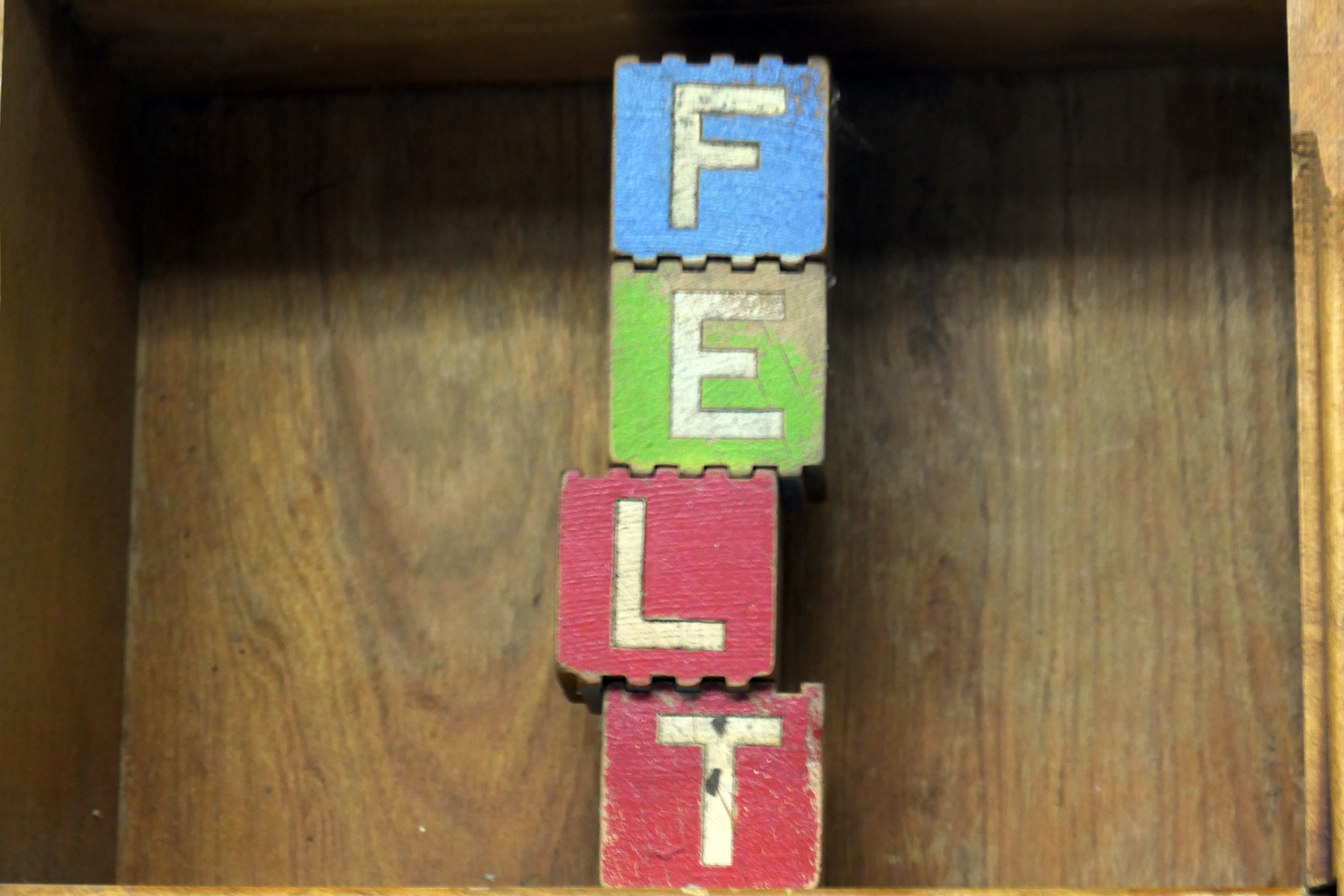
Kún works with felt. Makes felt. Shapes felt. Compiles and arranges felt, with a brain trained as an engineer and the eye of a visual artist.

The matted fabric we call felt is created by binding protein fibers (wool from animals like sheep, goat, yak or alpaca) to each other in a process that involves the physical tangling of the fibers by means of special needles, or by using water and agitation that pummels the raw materials. Ever accidentally shrunk your favorite sweater by 2 sizes in the washer/dryer? That is wet felting…. the hair in the wool consists of shafts that are covered by protein scales. The water and detergents open up the scales and the agitation in the rotating drum, or rolling and rubbing and tossing, binds them together, shrinking them up to 40%.

Dry felting involves barbed needles that you stick into the raw material over and over, weaving the fiber strands together. It can be done by hand or by machine, when large projects are involved.

Felting has been around since at least the 6th century B.C., predating spinning and weaving. It likely originated with nomadic peoples in Asia, and remnants were discovered in burial places all across Siberia and Northern Europe. It was essential for shelter (think Mongolian yurts!) warmth and durability in clothing and boots, and protection from saddle burn for animals carrying loads. Ornamental uses have found their way into beautiful blankets and carpets, now extending to 2-D or 3-D sculpture.

The fabrication of today’s materials has come a long way from being coarse, wet wool stomped by camels, or pummeled by the hoofs of horses. Kún, for example, varies the kinds of fibers going into the felt. The selection involves the density of wool – wool is measured in microns, which describe the diameter of a wool fiber, the smaller the micron the finer the wool.

Micron 23

The artist also uses materials like silk that get entangled into the pressed fibers, dying the silks herself to achieve desired color gradations.

Layered wool and silk get run through the needling machine up to 6 times, then cut into strips, or fins, by a power cutter, wet felt aligned with cheese cloth, worked on surfaces that allow to pool the water.

Eventually the materials get shaped. That includes insane detail work of pulling threads out of the sides by hand to achieve a chenille-like effect that adds to the beauty.

Individual elements are stitched on, wet felt fibers shaved or torched to achieve the desired smoothness.

And then it’s time to finish the design, long planned and recorded to the tiniest detail. Some of the pieces are huge.

Photograph by Kristy Kún.

———————–

The artist with the clear face, beautiful eyes half hidden behind her glasses, is the descendent of Hungarian immigrants who settled in the Mid-West, establishing Presbyterian churches in and around Ely, Iowa, working hard to feed large families. She certainly has inherited that incessant, laser-focussed work ethic, a red thread like Ariadne’s throughout the many changes along her professional path. Trained as a construction engineer at the University of Nebraska, Omaha, she found her first real calling in wood working and furniture making. She settled in Northern California, interned and worked and learned the craft. A marriage to a fellow craftsman dissolved swiftly, leaving her as a single mother to a young daughter, trying to eke out a living in a male-dominated domain.

A side line of supplying crafts materials to her daughter’s Waldorf School led to an import business of Italian wool, selling it to spinners and felters. She got increasingly drawn into the fiber arts world, attending bi-annual workshops and camps for craft artists, the Frogwood Collective among them. Inspired by artists like Janice Arnold and Jenne Giles, Kún turned to felting in a serious way in the last decade, shifting from roles as supplier to that of artist.

It did not make her economic existence less precarious. Now located in Portland, OR, she was trying to support her family, while struggling with the illness of her new partner, who she lost to cancer in a painful battle to the end. Two years ago she moved to Ashland, leaving the familiarity and friendship network of PDX behind, to start a new life with a new love and a new studio, all during pandemic woes.

Life has felted Kristy Kún – my take, expressed with admiration. The various analogues of pummeling and stabbing, prodding and stomping have produced a tough, resistant core combined with (intellectual and emotional) flexibility like the fabric counterpart. Loose threads of flickering temper and intense empathy stick out here and there. Like the matted material absorbs water, she absorbs ideas and visions, turning amorphous input into shaped Gestalt. In addition to her raw talent, her persistence and technical skill have registered with the art world. Her work will be shown at this year’s Smithsonian Craft Show, Future Focus, and large commissions from collectors and designers across the world are regularly received.

—————————

While Kún and Lou Palermo, Maryhill Museum’s Director of Education, brainstormed over technical details of construction and placement of the frames – now stashed in her show room – within the Exquisite Corpse design, my thoughts wandered back to the tale of Ariadne, Theseus and the Minotaur. The myth has inspired countless works of art, from tellings by Catullus 64 and Ovid’s Heroides 10 in the first century B.C., to paintings spanning over 1000 years (here is a link that provides 73 of them!), to musical compositions, Monteverdi in the Baroque period, and Richard Strauss in 1916. And let’s not forget the modern version of myth telling – most recently seen in Dark, the German sci-fi thriller available on Netflix, that makes heavy use of Ariadne’s story and symbolism. A smart review of Dark in the NYT pointed out the particular theme’s relevance to contemporary history.

One of the reasons for its ongoing popularity, I believe, is that one can apply so many different perspectives to any one of the characters or actions involved. Across time you can see how interpretations of Ariadne focussed first on her passivity, her abandonment by yet another fickle male, then on her possible emancipation, her cunning in helping her lover, her ruthlessness in sacrificing a half-brother to a hero she saw as her ticket off the island – you name it. All links to shifting perceptions of gender roles.

Theseus has had his share of fans and critics too, understood as a self-sacrificing hero, or simply power-hungry. His wandering in the labyrinth has been appropriated by psychodynamic approaches in psychology, an archetypal representation of the psyche and a path to individuation, the authenticity you reach when you’ve made your way through the convoluted maze of feelings.

Comparisons to creativity have been offered as well. Serpentine windings to a goal without knowing the way, many a dead end, unclear what fates await – you get the idea. It looks to me that Kún’s creativity has not at all been impeded by labyrinthine obstacles. If anything, her work has blossomed from tightly constructed, somewhat rigid, representational beginnings to more freely flowing abstractions of natural forms that are willing to stand on their own. To link back to Rebecca Solnit’s quote at the beginning: Kún has created a bridge between map and world, walking along in its folds.

This leaves us with one final contemplation, how shifts in perspective define the Minotaur. The creature could either be seen as a bloodthirsty monster, depraved and deserving of slaughter, or as someone who in his deformity had to be hidden away as to not offend the sensibilities of the viewer(s.) Is he an enemy to the outside world? Or is his confinement an act of brutality against him? Do we project our fears of power, aggression, rage, disability and death onto this misshapen creature? Avoid the Other? Classic takes rejoiced forever in his slaying.

There were a few compassionate voices, Polish poet Zbigniew Herbert’s among them, expressed in a post-humosly published volume of essays, Labyrinth on the Sea, which described his visit to Crete in 1964. Elaborated in a later prose poem, The history of the Minotaur (1974), he sees the misshapen prince as a victim of those who insist on political, social and religious norms as defining who does and does not belong. Which – and yes, we were getting there eventually! – also applies to women and textile art.

I will talk about the history and politics of textile arts in depth at a later point in this series of essays. Let me just say here the very basics: not only were the arts and crafts divided into domains, with gender roles assigned, for centuries. Different arts were also linked to different values – male painters and sculptors scored higher than their female counterparts, the latter for the most part chained to their textile universe behind the embroidery frame. Hidden away in a maze, for all intents and purposes, forever invisible and unnamed even if they created stunning woks of art – just think Bayeux tapestries. Only in the last 40 years has textile art been given a platform, previously reserved for the male dominated, traditional fine arts field. With the help of some pioneers in the early 1920s who opened the flood gates, women have emerged to show the world how true art is independent of medium and how neglected media add novelty to the traditional canon in ways that are intensely beautiful.

Kristy Kún has to be counted among them.

It was a cold night in Ashland, sky shimmering with stars. I would not have found the Corona Borealis even if it had been present (I looked it up, it appears in July) – I barely can locate the Big Dipper. The small constellation of stars is said to represent the crown (corona) that Dionysos gave to Ariadne after she had been abandoned. It comforted me to think that, even if connected to a consolation prize, a woman with a thread is visibly remembered.

Here’s an alternative outcome!

This is Maryhill Museum

· The Exquisite Gorge Project ·

Woodblock print by Ken Spiering (Detail)

“Only in community with others has each individual the means of cultivating his gifts in all directions; only in the community, therefore, is personal freedom possible.” Karl Marx The German Ideology (1846)

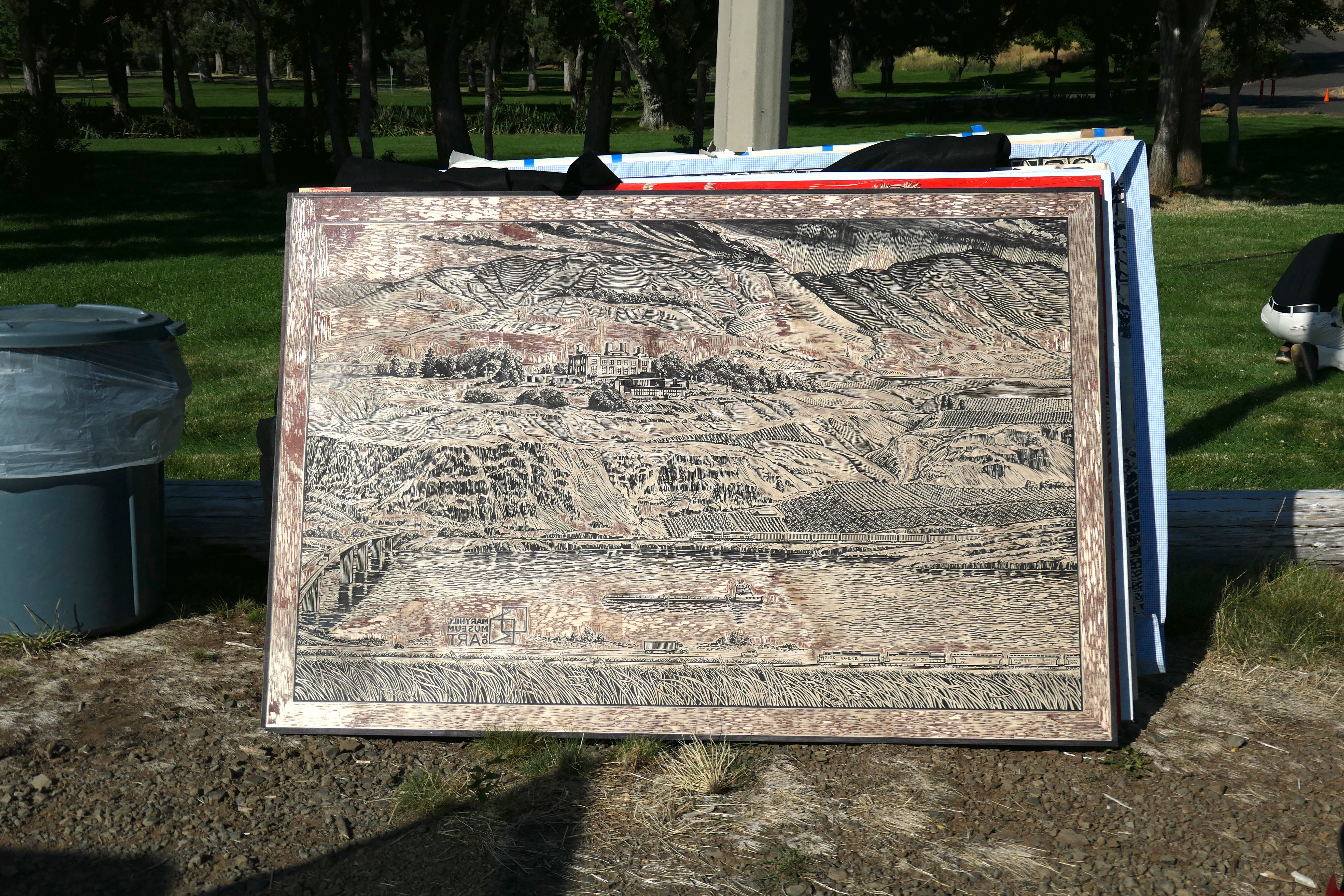
It was Print Day at Maryhill Museum. Eleven wondrous woodcuts, each sized 6×4 ft, were inked, aligned in a row and printed by a steam roller, producing the largest contiguous woodcut print that we know of. They depict the length of the Columbia River flowing through The Gorge, with geographic precision regarding the river, and imaginative representation for everything else.

The scaffold is ready, early morning
So is the steamroller
At the end of the day all boards are aligned

*

August 24th, 2019 turned out to be a memorable day beyond creating a gigantic work of art: it was proof positive that institutions like this museum (under the direction of Colleen Schafroth who was a happy woman greeting the hundreds of attendees) enrich our civic lives.

Colleen Schafroth, Museum Director

It was proof positive that initiatives of individuals can blossom into something larger (Louise Palermo, Curator of Education, was the driving force behind the project, both figuratively and literally.)

Lou Palermo, Curator of Education

And, importantly, it was proof positive that collective actions both create and benefit community. Institution, artists, community partners, sponsors, volunteers and those of us observing from the periphery all gained from each others’ engagement, enriched the creative output and – ideally – will carry something into the future that will be decisively constructive.

Left to Right front: Sarah Finger, Drew Cameron, Mike McGovern, Roger Peet, Steven Munoz.
In the back: Lou Palermo, Neal Harrington, Jane Pagliarulo, Molly Gaston Johnson, Greg Archuleto surrounded by his collaborators, Dylan McManus.

There was a lot of work to prepare for the printing itself. The boards came out, tools were readied, ink and rollers saw action, paper was aligned.

Lou Palermo, driving carts, driving steamrollers, driving ideas
Stabilizing the ink surface
Dylan McManus, starting to apply the ink to a board
Neal and Tammy Harrington (herself an accomplished printmaker), Steven Munoz, Jane Pagliarulo, Mike McGovern

In a group effort, the boards were aligned, nailed down, the felt, or other covers applied, the paper affixed.

And then: the run!

People worked hand in hand, got to know each other, improvised, cheered on by the many spectators who had come, filled with curiosity.

Lisa Commander, Director of the Columbia Gorge Veterans Museum, and her lovely parents.

Press was there, drones and all.

Kids could make art and get involved themselves.

Others explored better viewing opportunities:

In addition to everything else the museum offers, they have terrific climbing trees in their park.

The enthusiasm and joy was palpable and evenly distributed.

*

The “common good” refers to those facilities—whether material, cultural or institutional—that the members of a community provide to all members in order to fulfill a relational obligation they all have to care for certain interests that they have in common. Stanford Encyclopedia of Philosophy.

Maryhill Museum is an institution that preserves the past, educates about the present and works to provide access to art for future generations. The artists’ wood blocks, as different as they were stylistically, shared with the institution and among each other a similar commitment to the common good. They focussed, in varying degrees of explicitness, on the obligations that we have towards the community at large: to protect and preserve the environment, to honor the lessons of the past, and to use art as a vehicle to reach hearts, brains and souls of all who can help with these tasks.

Frontispiece by Ken Spiering
Sculptor and printmaker Spiering holds an MFA from the University of Idaho and is known for numerous public art commissions in the Northwest and across the US.

Here are the boards, not necessarily in the order they were aligned to represent contiguous parts of the Gorge:

Work by Greg Archuleta and his team
Work by Tammy Wilson, Matt Johnston and the L&C group
Work by Molly Gaston Johnson, New Jersey
Work by Mike McGovern
Work by Neal Harrington, Arkansa
Work by Roger Peet
Work by Steven Munoz, Washington DC
Work by Sarah Finger, Bellingham WA
Work by Janet Pagliarulo
Work by Drew Cameron, Iowa

And this is how the prints unfolded after the paper was peeled off the boards:

Work by Molly Gaston Johnson
Work by Drew Cameron and Mike McGovern with the indefatigable Tammy Harrington in action.
Work by Neal Harrington
Work by Roger Peet
Work by Sarah Finger

*

The project reminds us that we need institutions like Maryhill Museum to initiate efforts on this scale and see them through, being uniquely placed to access both the world of artists and the people in the region, who benefit from the resulting vision. These institutions cannot go it alone, however. They need our – renewed or continuing – support, our advocacy and commitment, even or particularly if they are located in remote areas that deprive them of walk-in visitors and hamper visibility of their continual accomplishments. Lend them a hand.

Work by Drew Cameron

The project also makes clear that small regional studios, like LittleBearHill under the tutelage of Dylan McManus, artistic director of the Exquisite Gorge project, provide an important hub for regional and national artists with residencies and opportunities for creative exchange, much of which affected the final artworks.

Work by Mike McGovern

The project as a whole, made possible by Maryhill, produced more than an unusual piece of art. Importantly, it brought people together who had not known each other before, bridged divides among groups that had often contradictory views and created a national network of artists that now consider themselves as part of a team. It brought attention to the issues of environmental decline, economic hazards, climate disaster and, above all, a sense of shared love and admiration of this precious piece of land we inhabit, understanding that we cannot delegate its protection, no matter where we come from or how we relate to it.

View East from Maryhill Museum

Let me end with a quote from another NorthWest treasure, the late Ursula LeGuin:

We live in capitalism. Its power seems inescapable. So did the divine right of kings. Any human power can be resisted and changed by human beings. Resistance and change often begin in art, and very often in our art – the art of words.” 
— Speech at the National Book Awards upon receiving the US National Book Foundation’s media for distinguished contribution to American Letters on 19 November 2014.

Join me in cheering the museum, the arts, courageous words and all those who stand up, as a community, for change necessary to serve the common good.

The print will be open for viewing from September 3rd to the 25th, 2019 at Maryhill Museum. Maybe by then I will have learned to drive this thing…..

Fabric on Stage

· How fabric makes movement more beautiful ·

IMG_3181 copy

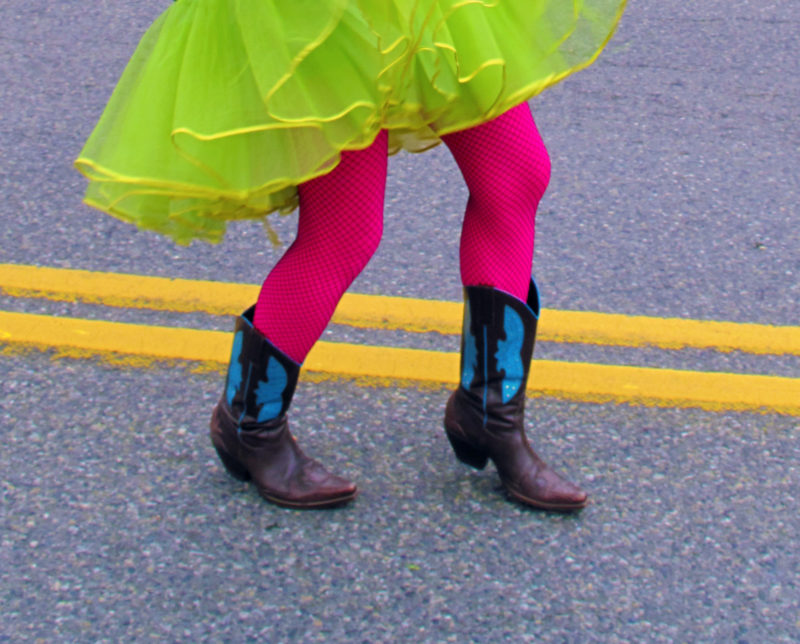
Whether you see someone doing a little jig on the street or you watch the most amazing ballet performance, the appreciation of  people’s movements is often enhanced by the costumes they are wearing. In addition to providing warmth and protection, fabrics have been used throughout centuries to augment certain aspects of human performance, be it on stage, or in the boudoir, on the sports- or the battle-field, in uniform, tribal colors or under one’s flag.
IMG_2674 copy

The dance aspect was driven home to me last summer at the Philadelphia Art Museum which presented a nifty little exhibit on Dance – Movement/Rhythm/Spectacle. Paintings, lithographs and photographs about dance from the museum’s collection depicted costumes and dresses that caught my attention. The cross section below ranges from Toulouse-Lautrec from the portfolio Le Café Concert, Carlos Mérida Dance of the Quetzals, Leon Bakst The Pilgrim for the Ballet Russe’s performance of Le Dieu Bleu; one of the represented photographers was Barbara Morgan who photographed Martha Graham’s company at length.

IMG_2680 copy


IMG_2678 copy
IMG_2683

And then there was Loîe Fuller, who knew how to make fabric fly – I just learned about her from indispensable dance critic Martha Ullman West who keeps me on my toes. The short clip below is a marvel.

https://www.youtube.com/watch?v=O8soP3ry9y0

Fuller was partly responsible for the creation of one of the great treasures of WA, the Maryhill Museum.  I will devote another essay to that jewel eventually. For now, here is a clip of the fabulous 1946 exhibit that is now in their permanent collection, of French fashion on small mannequins, all the fashion I am willing to mention in the  context of fabrics. I cannot recommend a visit of the museum strongly enough. Eclectic only begins to describe it. http://www.maryhillmuseum.org/visit/exhibitions/ongoing-exhibitions/theatre-de-la-mode