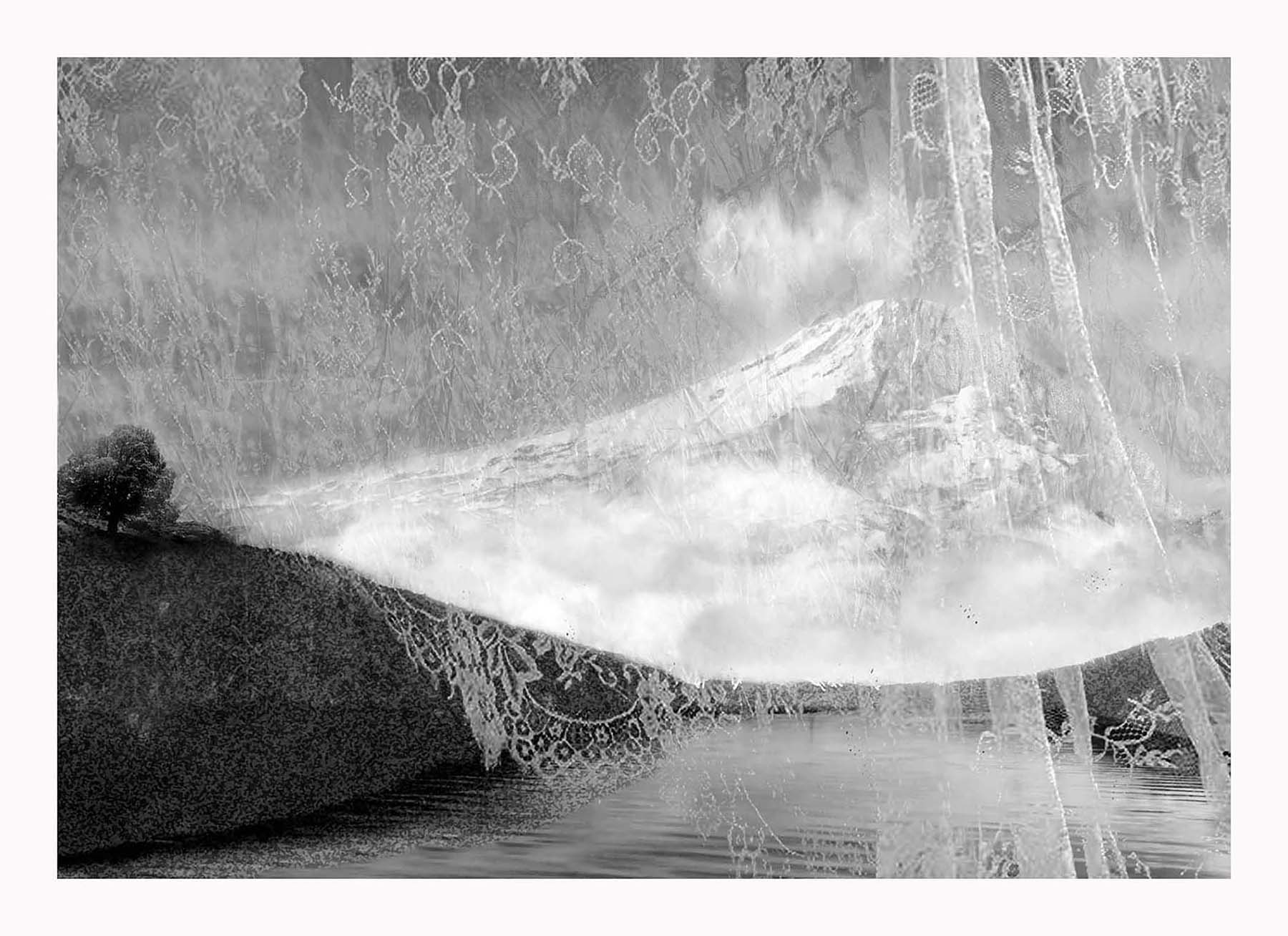
Please join me for the opening reception of Fragility, a series of photomontages in dialogue with Lacing Communities Together at the Columbia Gorge Museum.
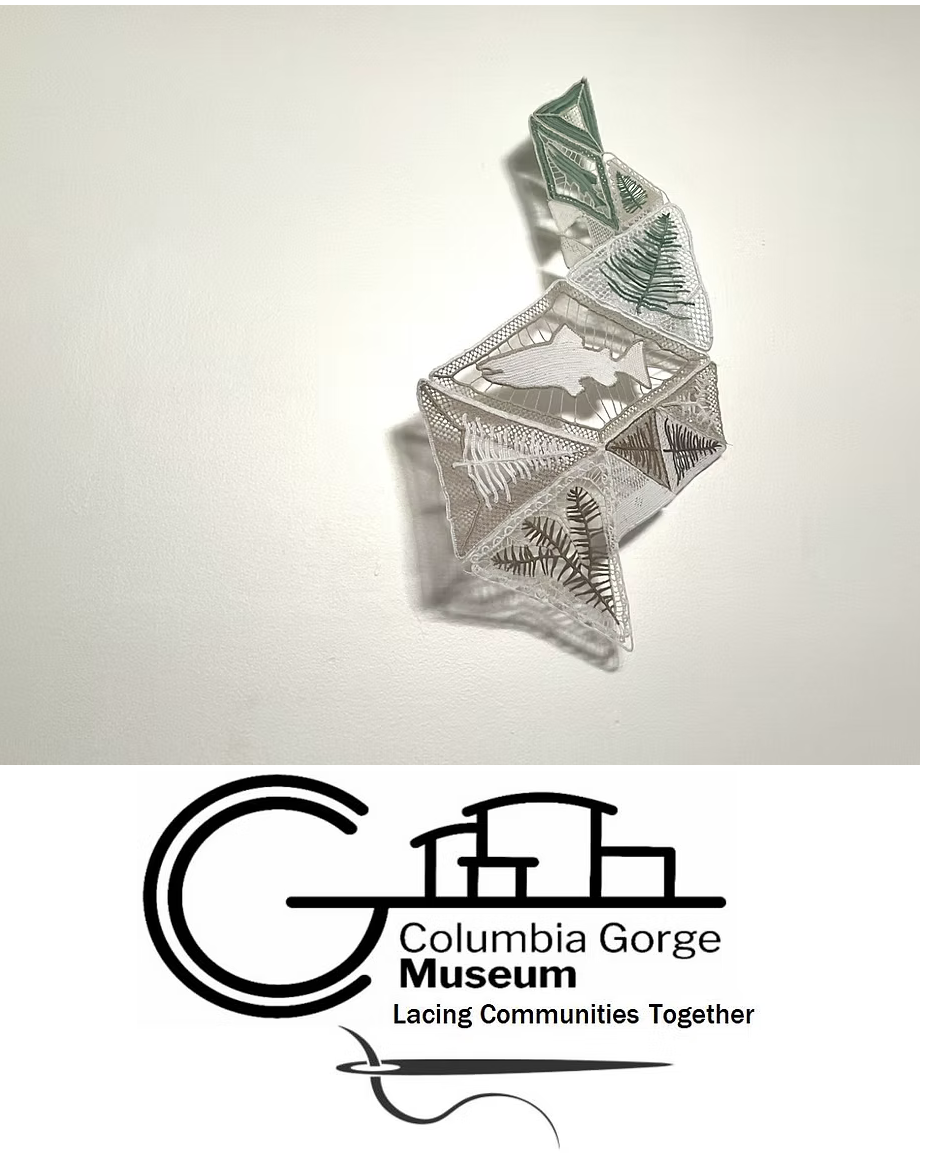
The Lace project celebrates both, the heritage art form of lacemaking and a community of people dedicated to preserving traditional skills and/or elevating them to new forms fit for this century. Under the auspices of Australian artist Maggie Hensel-Brown, lace guilds in the PNW, and the engaged team at the Columbia Gorge Museum, a lace installation will be revealed in September.
People from all over the world have sent lace triangles to be included in a huge compilation – as of this point, there are over 380 of them to be sewn together…. Local libraries in WA have offered workshops and get-togethers, for people to learn the art form and find community with others around them. Details can be found here.
My contribution to this communal effort, other than a wonky little triangle,
was the inclusion of lace of all kinds into photographs of landscapes.
“Fragility: This 2025 series of photomontages grew out of ongoing concern about insufficient environmental protection. Fauna and flora in these landscapes – photographed predominantly in the Pacific Northwest – are endangered. Climate change and the renewed threat of industrial extraction of resources, forests and minerals alike, will do irreparable harm. I thought the ephemeral nature of clouds and the fragility of lace were fitting symbols for why we need step up in our efforts to turn things around.”
The photographic exhibition is on view now, ongoing through late fall.
The joint opening reception with the Lacing Project will be
Friday September 11, 2026 5:30 – 7:30 pm.
Columbia Gorge Museum
990 SW Rock Creek Dr, Stevenson, WA 98648 (near Skamania Lodge)
A lot of eggs popped up last week. First a nest with duck eggs right off the footpath – unclear who was more startled, the duck who sat on them when I walked by, or I, when the duck flew up in a panic, practically fluttering into my face. (If s/he does that every time someone walks by, I predict there will be zero ducklings hatched…)
Next I saw a number of eggs or egg-shaped forms of various materials arranged in the house of a friend. A ceramic artist herself, she creates beauty with whatever she finds.
We shared the excitement of seeing bushtit parents flying in and out of a nest next to her kitchen window. Alas, the very next day the nest was destroyed by predators. Another generation lost.
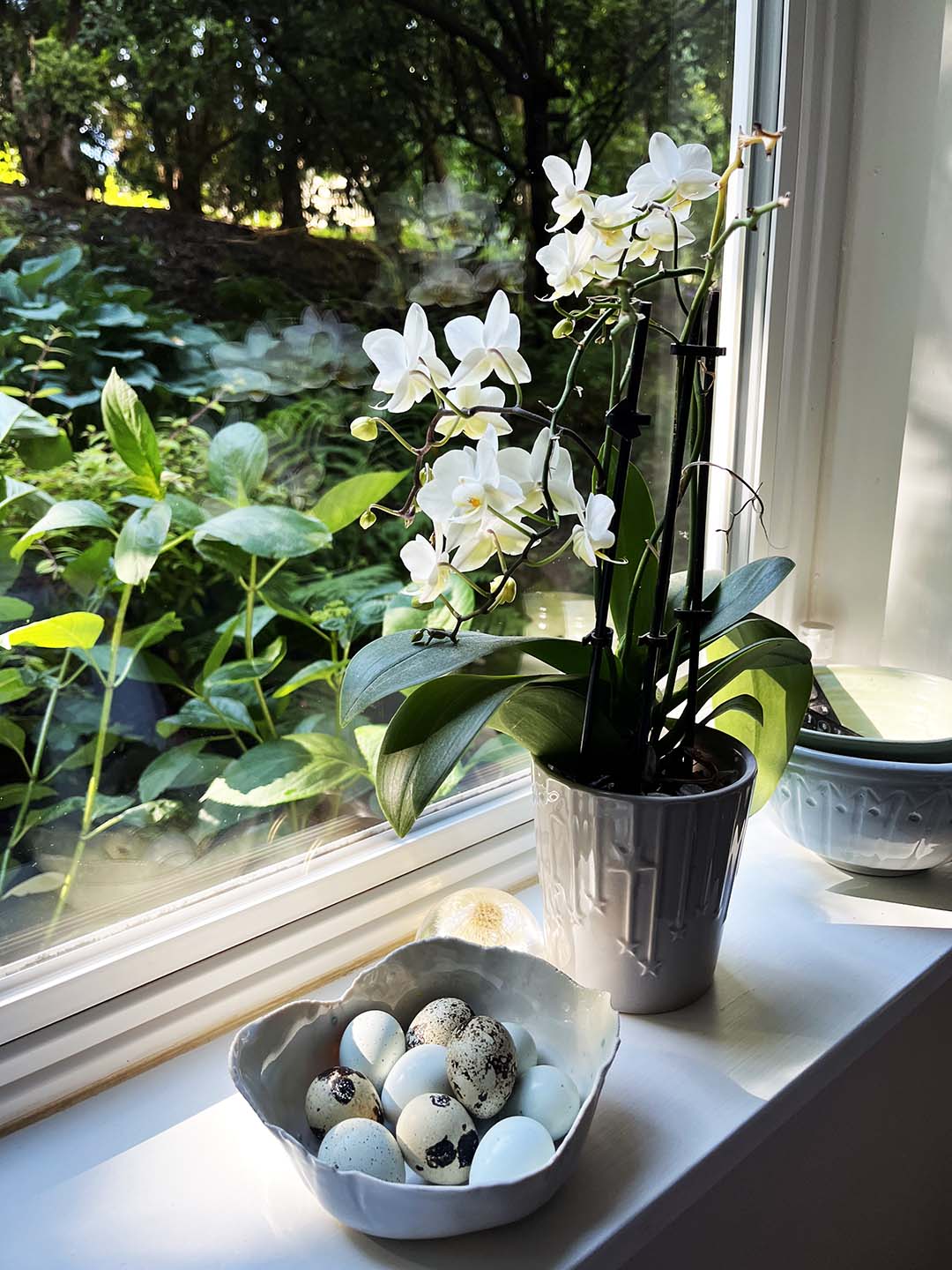
My friend sent me home with a bag of quail eggs which are now on my windowsill until they, predictably, rot and start to smell up the kitchen. The eggs, in turn, triggered thoughts about genetics, since I had just read Brian Klaas’ fascinating essay about research into genetics and the question who owns your genome. If researchers discover information about our genome that contradicts everything we believe to be true about ourselves, should we be allowed to interfere with publication of that knowledge? Should they be allowed to withhold that information from us? And how are those questions linked to potential abuse by people with racist agendas? If you find the introduction below of interest, here is the link to the whole piece:
“…..Thus began a descent down a fascinating rabbit hole into the thorny philosophical debates that define modern research into population genetics. What happens when longstanding historical narratives of identity collide with hard genetic evidence? Should DNA scientists always publish findings that could destroy a population’s sense of itself? And, if not, who gets to decide which kinds of scientific research are too sensitive to release?”
Science caught my eye, or my brain, as the case may be. But so did poetry – again related to stories of origin, linkage to tribal membership as juxtaposed to “others,” and, of course, quail eggs. The lines below were published in 2022 (link in the title.)
1. Seventeen months after I moved off the reservation, I traveled to London to promote my first internationally published book.
2. A Native American in England! I imagined the last Indian in England was Maria Tall Chief, the Osage ballerina who was once married to Balanchine. An Indian married to Balanchine!
3. My publishers put me in a quaint little hotel near the Tate Gallery. I didn’t go into the Tate. Back then, I was afraid of paintings of and by white men. I think I’m still afraid of paintings of and by white men.
4. This was long before I had a cell phone, so I stopped at payphones to call my wife. I miss the intensity of a conversation measured by a dwindling stack of quarters.
5. No quarters in England, though, and I don’t remember what the equivalent British coin was called.
6. As with every other country I’ve visited, nobody thought I was Indian. This made me lonely.
7. Lonely enough to cry in my hotel bed one night as I kept thinking, “I am the only Indian in this country right now. I’m the only Indian within a five-thousand-mile circle.”
8. But I wasn’t the only Indian; I wasn’t even the only Spokane Indian.
9. On the payphone, my mother told me that a childhood friend from the reservation was working at a London pub. So I wrote down the address and took a taxi driven by one of those London cabdrivers with extrasensory memory.
10. When I entered the pub, I sat in a corner, and waited for my friend to discover me. When he saw me, he leapt over the bar and hugged me. “I thought I was the only Indian in England,” he said.
11. His name was Aaron and he died of cancer last spring. I’d rushed to see him in his last moments, but he passed before I could reach him. Only minutes gone, his skin was still warm. I held his hand, kissed his forehead, and said, “England.”
12. “England,” in our tribal language, now means, “Aren’t we a miracle?” and “Goodbye.”
13. In my strange little hotel near the Tate, I had to wear my suit coat to eat breakfast in the lobby restaurant. Every morning, I ordered eggs and toast. Everywhere in the world, bread is bread, but my eggs were impossibly small. “What bird is this?” I asked the waiter. “That would be quail,” he said. On the first morning, I could not eat the quail eggs. On the second morning, I only took a taste. On the third day, I ate two and ordered two more.
14. A gathering of quail is called a bevy. A gathering of Indians is called a tribe. When quails speak, they call it a song. When Indians sing, the air is heavy with grief. When quails grieve, they lie down next to their dead. When Indians die, the quails speak.
(Alexie has acknowledged sexual misconduct allegations in 2018, and apologized. Many of his prizes and fellowships were rescinded or renamed. I do not know if he has written a novel since then, but his short writings appear on his substack. As always, we can debate if you can separate the person from the work, but I often go back to reading his words.)
May the quails be silent this weekend, and may lots of eggs hatch….
***
Speaking of hatching: PLEASE SAVE THE DATES:
I have two exhibitions coming up. One will hang at the Columbia Gorge Museum in Stvenson, WA, starting June 24, 2026 with a reception on September 11th, 2026 ( a combined celebration of lace artist Maggi Hensel Brown and community lace makers and my photographic work.)
Fragilityis a 2025 series of photomontages that grew out of ongoing concern about insufficient environmental protection. Fauna and flora in the depicted landscapes – photographed mostly around the Pacific Northwest – are endangered. Climate change and the renewed threat of industrial extraction of resources, forests and minerals alike, will do irreparable harm. I thought the ephemeral nature of clouds and the fragility of lace (superimposed on the landscapes) were fitting symbols for why we need step up in our efforts to turn things around.
Collective Effervescence brings together the work of Diane Jacobs, Susan Murrell and my own to explore our evolving relationship with the natural world. Rooted in shared energy, connection, and interdependence, the exhibition examines how human actions shape and destabilize the landscapes we inhabit. Through painting, photography, printmaking, and mixed media, we create environments that are at once familiar and altered. Together, we invite viewers to look closely, to explore and perhaps share the artists’ fervent belief that we can have a positive impact on preserving nature, once we shift from individual awareness to shared responsibility, and from observation to action. My contributions come from a new series When We Broke the World.
I will post more detailed information closer to the dates – just put them in your calendars for now!
Music today is from all around the world, I guess every shared gene pool! A collection of modernized folksongs. A beautiful album by Marisa Anderson.
Sometimes, when you look back, you can point to a time when your world shifts and heads in another direction. In lace reading this is called the “still point.”
The words above come from a recent novel where a particular make of lace plays a key role in the plot. (Historical murder and mayhem, inter-generational strife, an imaginative, fun, and occasionally overwrought romp.)
The first part of the quote felt timely in describing a turning point in the world, this March of 2026. The second part referred to something that sprung from the author’s imagination: descendants of the Salem witches divining the future from lace. So not a real thing – lace reading – that I naively assumed did exist. After all, people read tea leaves, crystal balls or cowry shells, why not lace? A “still point” seemed such an intuitive concept.
Our world is shifting and heading in another direction, though, isn’t it? So why do I turn to the topic of lace today, and not to other alternatives? I could think through how we should deal psychologically with our worries and fears, or how to seek community as to not face a crumbling world alone?
As you will see, lace, as introduced today, will speak to all of it.
Burratto Lace Grapevine Motif Italy 17th C
Lace is going to be at the center of this summer’s exhibition and activities at the Columbia Gorge museum. Executive Director Lou Palermo builds on the ideas and successes of previous projects for which she was instrumental during her time at Maryhill Museum. As I reported then, the Exquisite Gorge I and II programs collected the works of PNW printmakers and fabric artists, respectively. All of them celebrated aspects of the Columbia Gorge associated with a particular region. They were eventually displayed on the museum grounds in installations that preserved the geography of the river and its surrounds.
One of the most exciting part of these enterprises were the ways community was involved – community partners were called, and answered with extreme generosity, creativity, in-kind and financial support for all that was happening. Workshops involved library and schools, field trips allowed other artists to learn during master classes, people donated materials, opened their studios. From kids to grown-ups, participation was key – from learning to make prints, to how to weave, or do silk screenings; from studying natural dyes collected from native plants, bee keeping, to learning about Native-American symbols and history associated with the Columbia Gorge.
It was this aspect that Palermo and her great team at the Columbia Gorge Museum wanted to make central in this year’s adventure: lacing communities together. They are encouraging engagement with a heritage art form that will create samplers devoted to core aspects of the region, the trees and the salmon. Under the guidance of a remarkable contemporary lace artist, Maggie Hensel-Brown, everyone who is interested can learn and contribute, not just select artists. By the end of August, the museum will have collected regionally, nationally and internationally stitched lace samplers that will be arranged into beautiful installations reminding us of the value and beauty of the landscape surrounding us.
Czech Lace Emilie Palickova (Detail) mid-1900
Multiple organizations have already pledged their collaboration. From Skamania Lodge, multiple library districts, the History Museum of Hood River County, to several lace and fiber arts-oriented organizations, like the Columbia Fiber Guild, Portland Lace Society, Lacemakers of Puget Sound and not least, the Arts in Education of the Gorge, all will help this project along. Local libraries will even hand out kits with all the necessary materials for making a small lace triangle to contribute to the installation to those interested.
Flanders Lace (Detail) 1700 – 1750
Are you among the many currently grieving the dissolution of the social fabric? That will be counterbalanced by fabric, holes and all, that was produced by a diverse community united in the hope they could deliver a thing of beauty, or at least an attempt to get there – you should see my first needle stitches. Not to worry, Hensel-Brown absolutely encourages imperfection, as long as you have fun trying. Huge relief, if you ask me.
She also provides step-by-step instructions for those new to the art form, both on video and as PDFs. She explains how you can gather the simple materials needed, and what to be on the lookout for, or practice with care. Her instructions are easy to follow, which does not mean that the first steps into needle lacing are a breeze. The needle work requires serious attention. I consider that one of the best ways to distract yourself from other thoughts, mind you. I am grateful for any half hour these days when I am not thinking about what is going on in the world, and strict attention protects my thoughts from straying.
I also found that the repetitive motions, once you have learned the one simple stitch involved in it all, can be extremely meditative. The kind of meditation that stills you and silences the worries for a while in this world that has shifted to yet another war. Check it out – you might find yourself as a part of a community that is learning and connecting while celebrating nature. Just what so many of us currently need.
Here are all the instructions helping with the Community Lace-Along.
Lace has had a complex history, influenced by diverse cultural backgrounds, and dependent on how it was created. Needle lace was started in the 15th century, made by women in Europe, popularized for the next 200 years. That lace is made entirely with a needle using a single thread on a temporary backing, wich is later removed. I love its name: Punto in Aria, stitches in the air. Angry at the world? Stab the air… a peaceful and productive way of letting off steam.
Lace can also be made with bobbins, a technique derived from braiding, developed pretty much in parallel to needle lace, using multiple threads. You can also create lace patterns with crocheting or knitting, but none as fine as the traditional techniques.
The art form and geographically refined patterns spread from Italy to Spain, France, Flanders and England. Lace makers fleeing religious conflicts often settled in other lace producing regions, interchanging patterns and techniques. Lace was a time-consuming art form, much prized as a status symbol for aristocrats or rich merchants. It certainly drew the attention of European painters of the Golden Age who left us with detailed examples of what their patrons wore. In fact, when I hear the word “lace,” it is these paintings that come to mind, long before thinking of fancy underwear, or bridal veils, or prayer mantillas, all commonly associated with the fabric.
Thomas Gainsborough Portrait of Mary Countess Howe (1760) Detail.
Eventually machines took over the jobs. The manual production knowledge might as well have died out with the professional lace makers after the industrial revolution, had it not been for artists who picked up on lace, and designers who saw its potential. Since the 1970s, there has been an explosion of interest in contemporary lace making, with societies founded to celebrate and educate about lace, museums established to preserve the history, and exhibitions devoted to many aspects of lace production, not least last year’s DesignBiennial in Venice.
How things are depicted changed with ever improved or altered techniques. What it is that was expressed in lace changed as well. Earlier simple geometric designs gave way to representations of nature. (The many gorgeous examples of trees shown on lace were of particular interest to Palermo, given the intended celebration of nature found in the Gorge.) Depictions of nature gave way to whole narratives, with human figures in cultural or political contexts, entire stories implied on small lace tableaus.
***
Here are just two striking examples of contemporary perspectives – Maggie Hensel-Brown‘s work and that of Agnes Herczeg which I find equally thought-provoking.
Some three years ago, Hensel-Brown gathered community to create an incredibly beautiful accumulation of leaves that were then conjoined. Over 400 participants, some 700 leaves, instilling a sense of fragility and resilience at the same time.
The artist’s individual work is characterized by story telling. She takes everyday scenes and infuses them with magic, via a pattern defined by negative space, all with a needle and a single thread. The portraits capture emotions, anchoring those universals in the specifics of our Covid- or Internet-driven times. Details abound, asking us to explore deeper and deeper into the fray.
Maggie Hensel-Brown Quarantine Self Portrait I (2020) (all images from her website)
Maggie Hensel-Brown Sheets (2022)
Maggie Hensel-Brown Not useful, not beautiful (2023)
Maggie Hensel-Brown January 24th (2024)
I cannot wait to see her work in person.
***
Herczeg is a Hungarian artist who combines lace creations with branches and sticks she finds along the local beaches of the river Danube.
The juxtaposition of the airiness of the lace and the hardness of the wood creates a sculptural effect, with each medium competing for attention, yet emerging as an organic whole. I am particularly drawn to her hand coloring of the lace once the needle work is done. It provides additional depth to the configurations, further strengthening the sense of sculpture.
Agnes Herczeg: The resting place, 2019, 5 cm high, Needle lace with silk thread and thin wire contour combined with poplar branch, hand-painted
Agnes Herczeg: The tree, 2019, 9 cm high, Needle lace with silk and juta thread with thin wire contour, combined with beech bark, hand-painted. (Source)
We’ve come along way since the 14hundreds. It is glorious to think that the heritage is preserved and continues to be handed down to each next generation, with ever new twists and turns, not only of needles. Much to look forward to this summer, when the Columbia Gorge Museum will display lace variations and a renowned artist available on location.