One of my favorite short poems as a child was by a poet with the pen name Joachim Ringelnatz (a.k.a. Hans Bötticher.) A contemporary of George Grosz and Otto Dix, his work was declared degenerate by the Nazis. He died in 1934, so was spared to see the horrors unfolding further, but his writings and cabaret performances were prescient and subversive. Many of his poems rhymed and so are difficult to translate – in fact I have found nothing but really bad translations.
The poem in question described two ants who decided to travel to Australia, starting in Hamburg and realizing that their legs hurt in Altona, then an adjacent town, now an integrated neighborhood of the larger city in Northern Germany. Aching legs made the ants “wisely decide that they should forgo the rest of the trip.”
He concludes: one often desires and rarely succeeds, perfectly happy to let go in those cases.

Die Ameisen
In Hamburg lebten zwei Ameisen,
die wollten nach Australien reisen.
Bei Altona auf der Chaussee
da taten ihnen die Beine weh,
und da verzichteten sie weise
dann auf den letzten Rest der Reise.
So will man oft und kann doch nicht
und leistet dann recht gern Verzicht.
Hier is the most frequently cited translation:
There once were two ants in Westphalia
Who wanted to go to Australia.
But cursing their feet
In a Belgian street
They gave up the trip as a failya.
Man. Hamburg is not in the state of Westphalia, and rhyming must be found elsewhere. They didn’t curse their feet, and were nowhere near Belgium, – the hole point was about walking a distance of a mile or less – and actually welcomed the end of the trip. The translator ignored the last two “moral of the tale” – lines altogether. — Failya.

The last lines ignored here as well. I wonder if it has to do with the fact that they are not exactly the approved moral in a protestant work-ethic country that urges us to strive regardless, forever.
—
Detour: another German poet with work much comparable to the linguistic mischief of Ringelnatz’ hast just been translated into English in a superb volume of collected poems. Max Knight translated Christian Morgenstern‘s The Gallow Songs with wit and the skill of a preservationist, wherever he could.
If you don’t want to splurge on the book, here is a treat for free: Ogden Nash reads an earlier translation of the poems on the Internet Archives.
—
Back to the Ringelnatz ants: a commissioned, supersized sculpture of those two travelers was created by sculptor Peter Schröder and unveiled in Altona at the (Elb)chaussee in 2014. Made from bronze, and attached to an 150-year old copperplate rescued fron the roof of a church, on which part of the poem was engraved (they again left out the “moral”,) the sculptor soon attracted thieves, out to glean metal. A replacement version was erected in April 2022 and stolen in September 2022. In 2023 they anchored the latest replacement into a wall of the guest house of the foundation who had it commissioned in the first place.
“So will man doch und kann oft nicht…..” you can’t always have what you want!


—
In any case, why am I reporting on German nonsense verse? Well, ants, of course.
Not only is a poem remembered, the cold weather is driving them into bathrooms and kitchens to the dismay of the human inhabitants. More importantly, I learned a new fact about ants that blew my mind.
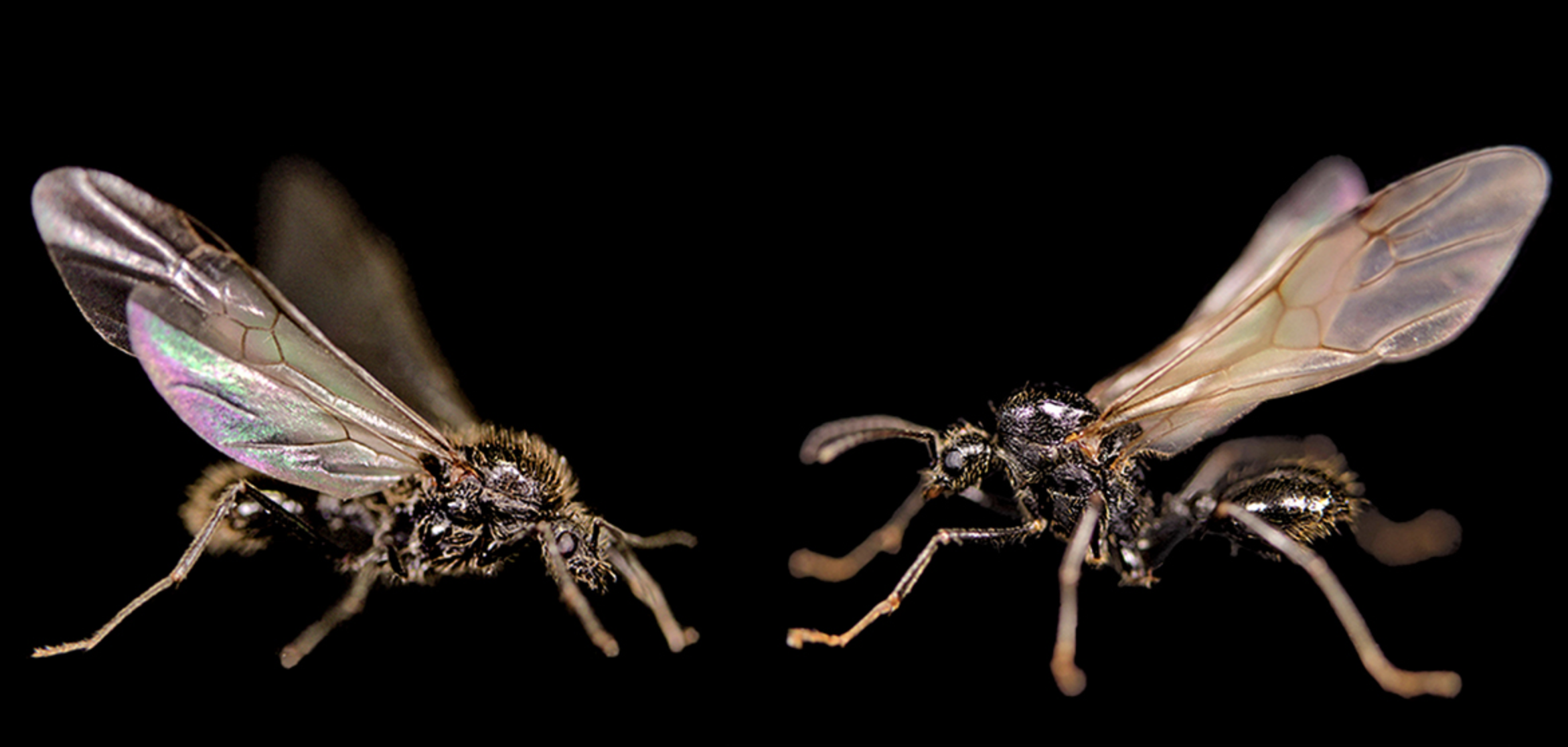
It turns out that Iberian Harvester queen ants of the species Messor ibericus produce offspring that is either their own species, or a totally different one.

Two brothers of different species, produced by the same mother: Messor ibericus (left) and Messor structor (right). Jonathan Romiguier
“Scientists recently discovered that Iberian harvester ant queens (Messor ibericus) mate with males of another species, the builder harvester ant (Messor structor). When they do, the M. ibericus queens store the M. structor male’s sperm, then use it to fertilize some of the eggs they lay. Researchers think the M. ibericus queens remove their own genetic material from the eggs’ nuclei, so that when those eggs hatch, they effectively turn out to be M. structor male clones.
The queens produce males of both M. ibericus and M. structor, and all the worker ants in M. ibericus colonies are female hybrids of the two species.” (Ref.)
That defies a fundmental principle of biology, or the way we have been defining what a species is. It is also particularly strange in evolutionary terms, since the two species diverged more than five million years ago. It is, as someone said, as if a woman gave birth to both, a human child and an Orang-Utan baby.
The scientists had their work cut out for them. Trying to find males and analyzing their DNA was not easy. They dug up multiple nests in France with ten of thousands of ants and found only 132 males, which turned out to be indeed M. ibericus AND M. structor. (Maybe ants are far advanced relative to our own society – where we hear non-stop argumentation about women replacing men these days – just read “How Women destroyed the West” from yesterday’s NYT…. oh well, I did try to stay away from politics. My bad.)

According to the article in Nature, the researchers had to come up with a new term to describe the behavior exhibited by M. ibericus queens: “xenoparity,” which essentially means “foreign birth.” All useful citizens of the great ant nation, one presumes, since there must be some adaptive value to this.
M.structors make for good builders, and their own colonies are in a very specific, remote locale. So traveling with their sperm for further use across Southern Europe might help spread their DNA and allows M. Ibericus queens to choose their own timing and locale to produce builders.
Anyhow – you now have totally disconnected and non-essential new bits of knowledge to fill up your brain. 1o minutes of distraction from our world, though, producing wonder. Hopefully appreciated.

Alternatively, we can go right back to an “undercurrent of anxiety, themes of decay, consumption, or overwhelming infestation” – all of which were implied by art reviews assessing Dali’s painting below. Hm, I just see some shiny ants happily feasting.
M.Structor or M. Ibericus?

Salvador Dali The Ants (1936-37)
Music today by one of Hamburg’s famous sons: Brahms‘ string quartet No. 1 in C minor.

Photographs of leaves today in honor of leaf cutter ants.
There is some interesting work done with and about them by artist Catherine Chalmers who filmed and photographed them at work, ending up with “collages.” Here is a fun clip documenting her approach with wild ants in Central America.