
By chance I encountered three artists across the last weeks who I was completely unfamiliar with. One lived in the 16th century, and two worked mostly in the 20th century. I had been researching portraiture for a potential project of mine, discovering that art historians seem to draw parallels between selfies on Instagram in 2025 and commissioned portraits during the Renaissance. Huh?
You probably know this already, but I had to be reminded that once portraiture was no longer purely religiously motivated, it became something else all together. It was not simply about likeness, but displayed a very distinct desire to convey something else via the chosen props, clothing, surrounds. Self-representation, or self-staging, if you will. Dress-code, jewelry, coats of arms and inscriptions all signaled rank and social status, descriptive of contemporary norms and expectations. Replace coat of arms with make of handbag, watch, or car, and the rest fits perfectly well with what we see on social media from people who yearn to be noticed and remembered.
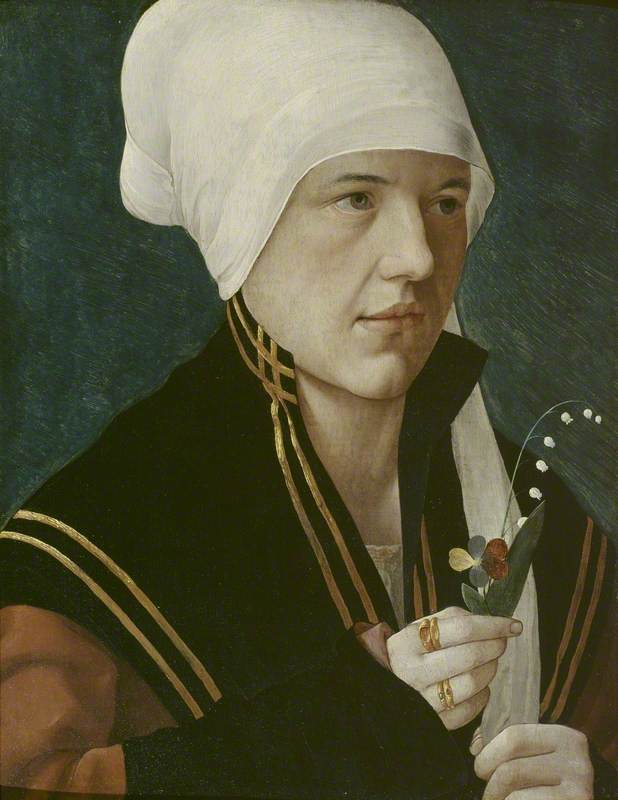
Marx Reichlich‘s gorgeous portrait of a woman holding flowers caught my eye first.

Marx Reichlich A Woman Holding a Lily-of-the-Valley and a Pansy (c.1510–1520)
I was struck by the androgyny of the face, the defiance in the lips, the silken headdress, the parallel gold appliqué on the dress matching the parallel gold of the rings, two pairs for good measure. The background might as well have been painted by an impressionist. The symbolic meaning of the May bells as they are know in German, was often one of modesty and spiritual purity during that time period. The juxtaposition with the abundance of rings, a focus on prosperity, is vexing. La Fête du Muguet, which honors the lily of the valley as a harbinger of spring and fortuity was only established a half century later. King Charles IX founded this custom in 1561 after receiving the flower as an emblem of prosperity. Reichlich, in any case, wasn’t French but Austrian, a citizen of Salzburg since 1494, and much sought after as a portraitist, although he also did commissioned altar pieces. His most famous portrait is a large painting of Canon Gregor Angrer of Brixen.

Marx Reichlich Gregor Angrer (1509)
Look at the physiognomy of that face, a mouth and forehead stylized to match the slope and crease of the red biretta, the Canons’ hat. The hint of a double chin points to being well fed and also echoes the double layers of the vestiges below. Those clothes: gold thread shimmering in the satin coat, vest underneath that looks like embossed leather, another layer, likelt a cassock, (it sure was cold in Tyrolean churches) and then a lace shirt, with what could be seen as two rings as fasteners! The red of hell’s flame in the background in case all this vanity gets too intense? What’s your first reaction when you look at him, though?
Some days later, my attention was drawn to a lovely portrait of a woman taking a quick nap, cat on her lap. She did not even bother to take off her satin slippers, she wears patterned silk stockings and her lipstick and necklace make it pretty obvious she is not the maid – she can afford a siesta in the middle of the day, as indicated by the light outside the curtains. I had never heard of the painter, ORAZI, a frenchman who insisted on capitalizing his name. When I looked him up, I could find few portraits, but an incredible evolution of styles across his life span – man, nothing he didn’t try. Actually admirable.

Orazio ORAZI Siesta (1934)
Let’s move on to Felice Casorati – someone posted the girl on a red carpet on Instagram and it felt creepy but also enticing.

In between girl- and womanhood, judging by the toys and more teen-appropriate props, the figure, pet dog and paraphernalia are sort of compacted at the lower end of the painting, leaving room for the massive, sun streaked carpet to expand like the future for this adolescent. It might be a bright one, with her endlessly long legs and alabaster skin, never mind a sizable dowry, judging from the riches poured casually on the floor in front of her. (Yes, dowry – 1912 still a year where girls were expected to marry, after all.)
From what I learned, Casorati’s most famous painting is the neoclassicist portrait of Silvana Cenni, apparently referencing the Madonna Of Mercy by Piero della Francesca. (I had no clue. Below is what I found.) (Casorati also abandoned intensely progressive political leanings after he was arrested for a short stint, turning seemingly apolitical which did not hurt his career…. what else is new.)


I guess one can find parallels. But here is something that struck me as more interesting, and in need of further confirmation. If you look at all the paintings I posted today, the woman have something in common, in contrast to the male: they do not look directly at you. Ok, one is snoozing, so how could she. But the others are either looking sideways, or closing their eyes, no direct invitation to the viewer to establish eye contact, while the Canon is sternly gazing directly at you with whatever message contained in those icy eyes. I wonder how much was just coincidence, given that so few pictures were chosen by me, or if there is a pattern when you compare male vs female portraiture at least before modern times. Suggestions?
Here is an exception, pointing to the freedom experienced once you have reached the life stage of crone, and do no longer need to signal modesty, pliability, deference, submission with the averted gaze – all these attitudes that the contemporary rejection of feminism, spearheaded by the Right, is so keen on reestablishing.
Here is (at least some of) us looking straight at you – dedicated to all my own comrades in aging….

Felice Casorati The Old Comrades (Le Vecchie Comari) (1908).
Music today about Lily of the valley by Jun Miyake. Apparently used for a well-known Pina Bausch ballet. The other piece I like (and the composer is new to me too, just like the painters,) is this.