It is Tuesday morning after the debacle in IOWA. We don’t know the caucus results yet, but the delay and the mistrust after the screw up with the data transmission hurts the potential frontrunners and helps the laggers. Make of that what you will. More frighteningly, it has given rise to tons of conspiracy theories, and adds worry to scenarios where technology is all we have in the election – not the paper trail that is still there to count in IA. Most frighteningly, the voter turnout, by the information we have at this time, was not as high as expected. If that translates into the general election, we have reason to be fearful. Clouds hanging over us.
Sunday morning’s walk at the riverfront took place with the clouds coming in. Or going out, who knows in this crazy weather world anymore.
The mood expressed by the graffiti was dark as well.
Some fearful:
Some angry.
Knowing how I could go home to a dry house, a filled pantry, a privileged life, made me feel ashamed while thinking about the youth or whoever it is who express their rage and fear for us to see, mostly unheard. Watching the homeless shuffle along the Esplanade, trying to keep warm, caused a sense of continued helplessness.
Thinking about how many people I know who feel for those who suffer, but also increasingly express compassion fatigue, when they deal with the detritus or the shootings at night or the dangers of garbage fires. There was a moment there, on that walk, where I just longed for peace. For all. Which is, of course, unobtainable without justice. So we must be allies in the struggle. Thoughts just in time for the beginning of Black History Month as well.
Here is a text poem by Jamaican born Claudia Rankine, echoing the sentiment,
Mahalia Jackson is a genius. Or Mahalia Jackson has genius. The man I am with is trying to make a distinction. I am uncomfortable with his need to make this distinction because his inquiry begins to approach subtle shades of racism, classism, or sexism. It is hard to know which. Mahalia Jackson never finished the eighth grade, or Mahalia’s genius is based on the collision of her voice with her spirituality. True spirituality is its own force. I am not sure how to respond to all this. I change the subject instead.
We have just seen George Wein’s documentary, Louis Armstrong at Newport, 1971. In the auditorium a room full of strangers listened to Mahalia Jackson sing “Let There Be Peace on Earth” and stood up and gave a standing ovation to a movie screen. Her clarity of vision crosses thirty years to address intimately each of us. It is as if her voice has always been dormant within us, waiting to be awakened, even though “it had to go through its own lack of answers, through terrifying silence, (and) through the thousand darknesses of murderous speech.”
Perhaps Mahalia, like Paul Celan, has already lived all our lives for us. Perhaps that is the definition of genius. Hegel says, “Each man hopes and believes he is better than the world which is his, but the man who is better merely expresses this same world better than the others.” Mahalia Jackson sings as if it is the last thing she intends to do. And even though the lyrics of the song are, “Let there be peace on earth and let it begin with me,” I am hearing, Let it begin in me.
Let’s start this week on a quiet note. Like really quiet, preparing for silence in space – quiet. Not a random choice of metaphor, either, since I learned that astronauts are sent by NASA to an anechoic chamber at the Orfield Laboratories in Minnesota where they practice being in environments where sound does not reverberate.
“An anechoic chamber is a room designed to completely absorb reflections of either sound or electromagnetic waves. They are also often isolated from waves entering from their surroundings.” It turns out that you cannot stand being in one of those chambers for very long – 45 minute has been the longest someone endured before fearing they would go insane. When you hear nothing else, you start hearing the noises that your own body makes, “you become the sound.”
All this came up when, as so often, I randomly ran across a poem that caught my attention.
Anechoic
George Foy stayed in the anechoic chamber for 45 minutes and nearly went mad. He could hear the blood rushing in his veins and began to wonder if he was hallucinating. He had been to a monastery, an American Indian sweat lodge, and a nickel mine two kilometers underground. In the anechoic chamber, the floor’s design eliminates the sound of footsteps. NASA trains astronauts in anechoic chambers to cope with the silence of space. Without echo, in the quietest place on earth, what else can we hold onto? What replaces sound in concert with what you see? The human voice, the timber when a person says kamsahamnida or yes, please, or fuerte, is 25 to 35 decibels. Hearing damage can start around 115 decibels. Metallica, front row, possible damage albeit possible love. The Who, 126 decibels. A Boeing jet, 165 decibels. The whale, low rumble frequency and all, 188 decibels, can be heard for hundreds of miles underwater. I once walked around inside a whale heart, which is the size of a small car. The sound was like Brian Doyle’s heart that gave out at 60 after he wrote my favorite essay about the joyas voladoras and the humming bird heart, the whale heart, and the human heart. Glass can break at 163 decibels. Hearing is the last sense to leave us. Some say that upon death, our vision, our taste, our touch, and our smell might leave us, but some have been pronounced dead and by all indication are, but they can hear. In this moment, when the doctor pronounces the time or when the handgun pumps once more, what light arrives? What sounds, the angels? The Ultrasonic Weapon is used for crowd control or to combat riots—as too many humans gathered in one place for a unified purpose can threaten the state. The state permits gatherings if the flag waves. Sound can be weaponized or made into art. It can kill. It can heal a wound. It is a navigation device and can help determine if the woman has a second heart inside of her now, the beating heart of a baby on the ultrasound, a boy or a girl, making a new music in the body of another body, a chorus, a concert, a hush.
by Lee Herrick from Scar and Flower, Word Poetry, 2019.
To tell the truth, I was not particularly taken by this poem as a whole. Little things, the list -like quality of researched facts (I mean who knows all those decibel numbers….) or the discussion of hearing being the last sense to go (after he cued in on hearing all along,) and then wondering “which light will arrive,” they irritate me. Or the tale of walking inside a whale’s heart and affixing the sound to the memory of a favorite author’s writing – I was in one of those last summer (they have them as plastic reproductions in all kinds of science museums, and all you hear is the delightful screaming of young visitors around you. Nitpicky, I know. Not granting generous artistic license. Guilty as charged. Perhaps it would help to know more of his work, apparently often preoccupied with hearing, but also quite political. Herrick, of Korean descent, was the poet laureate of Fresno, 4 years ago, teaches at college there. Here is a review.
But one line stuck, and made it worth slogging through all those facts he lines up: Sound can be weaponized or made into art. It can kill. It can heal a wound.
Think of how sound was used to manipulate you when you were a child. Ok, when I was a child, sent off, sickly still, to boarding school. Being yelled at loudly was pretty upsetting. Worse, though, was when punitive words came out really quietly, almost whispered, ominous as can be.
Sounds could be frightening, the pillow-muffled homesick sobs, my own included, of the new arrivals. Sounds could be disturbing, the penetrating school bell that cut time into slices. Sounds could be shaming – the snickering of the girls behind your back. The tsk tsk of a revered teacher, handing back insufficient work, not even worth a verbal assessment, just those devaluing sounds. The screeching of the coach on the sports field, egging you on to run even faster, until your lungs hurt so badly that you were ready to collapse. Sounds that were missing hurt as well: my childhood background chorus of lowing cows and songbirds, the farmer’s peacock.
Sounds could be healing. A hummed melody of a (forbidden) pop song as a reminder that there was still a world out there beyond the dormitory walls. The clinking of the silverware when 120 places were laid for breakfast, the only edible meal, really, of the day. The sounds of the gentle river waves of the Neckar, when you were allowed twice weekly to leave the walled estate, for an hour’s walk. Or being assigned an empty quiet classroom to practice your cello or piano, day after day escaping the noises of overcrowded, restless adolescent girls. Add the music, however incompetently, scratchily executed, with a blueprint in mind of the beauty of the real thing, and you were ready to tackle the next day. Healing, indeed. (My most played piece during those horrid years was this, (Khatchaturian’s Toccata ) allowing rage to flow into the fingers as well. It’s not as hard as it sounds, particularly if you play it slower like the older Russian recordings.)
What counts as healing, though, is in the ear of the beholder. Just a few centuries back the Church accepted only a limited number of intervals assume to please G-d, and that is why Gregorian chants are as they are. And the Church expressly forbade some intervals, including the tri-tone, composed of three adjacent whole tones, because they were thought to be the devil’s interval. Don’t ask me why. Times have, of course, changed.
Wagner used the tri-tone in Tristan and Isolde, to convey forbidden love and longing.
So did Leonard Bernstein’s Westside Story.
Beautiful. Unsettling. I guess it won’t be a quiet Monday morning after all. But one where I made you forget about sham trials and deadly viruses for at least 10 minutes!
Today I offer some insights brazenly stolen from a list found in The Nation, a useful reminder that there are points of hope.
Optimistic we can keep the ball rolling
Good stuff that happened this year:
Legal Victories for the Activists Fighting for Families on the Border
Continued Progressive Investment in the Work of Stacey Abrams
The Supreme Court Saves the Census
Optimistic we’ll find the right role models
Louisiana Reelects a Democratic Governor
Democrats Take Control in Virginia
We Finally Get Closer to Passing the Equal Rights Amendment
The 1619 Project (a wide-ranging editorial package including essays, images, and reported stories, and a radical challenge to the idea that “slavery was a long time ago”; it firmly roots the United States’ societal problems and inequalities in its treatment of black people. )
Optimistic we’ll stand our ground
The Continuation of the Demographic Revolution
Pelosi Retakes the Speaker’s Gavel
Trump Is Impeached
Optimistic we can look beyond ourselves
To read details about these hopeful signals, go here.
Optimistic we’ll see beyond black&white
Or just read or listen to Amanda Gorman, who was chosen the National Youth Poet Laureate in 2017. I’m optimistic: the kids will save us. (And in honor of her being from L.A., today’s photographs were taken there, at The Broad, with an eye on optimism…)
Optimistic we can preserve Little Red Riding Hoods’s resistance
— An original poem written for the inaugural reading of Poet Laureate Tracy K. Smith at the Library of Congress.
There’s a poem in this place— in the footfalls in the halls in the quiet beat of the seats. It is here, at the curtain of day, where America writes a lyric you must whisper to say.
There’s a poem in this place— in the heavy grace, the lined face of this noble building, collections burned and reborn twice.
There’s a poem in Boston’s Copley Square where protest chants tear through the air like sheets of rain, where love of the many swallows hatred of the few.
There’s a poem in Charlottesville where tiki torches string a ring of flame tight round the wrist of night where men so white they gleam blue— seem like statues where men heap that long wax burning ever higher where Heather Heyer blooms forever in a meadow of resistance.
There’s a poem in the great sleeping giant of Lake Michigan, defiantly raising its big blue head to Milwaukee and Chicago— a poem begun long ago, blazed into frozen soil, strutting upward and aglow.
There’s a poem in Florida, in East Texas where streets swell into a nexus of rivers, cows afloat like mottled buoys in the brown, where courage is now so common that 23-year-old Jesus Contreras rescues people from floodwaters.
There’s a poem in Los Angeles yawning wide as the Pacific tide where a single mother swelters in a windowless classroom, teaching black and brown students in Watts to spell out their thoughts so her daughter might write this poem for you.
There’s a lyric in California where thousands of students march for blocks, undocumented and unafraid; where my friend Rosa finds the power to blossom in deadlock, her spirit the bedrock of her community. She knows hope is like a stubborn ship gripping a dock, a truth: that you can’t stop a dreamer or knock down a dream.
How could this not be her city su nación our country our America, our American lyric to write— a poem by the people, the poor, the Protestant, the Muslim, the Jew, the native, the immigrant, the black, the brown, the blind, the brave, the undocumented and undeterred, the woman, the man, the nonbinary, the white, the trans, the ally to all of the above and more?
Tyrants fear the poet. Now that we know it we can’t blow it. We owe it to show it not slow it although it hurts to sew it when the world skirts below it.
Hope— we must bestow it like a wick in the poet so it can grow, lit, bringing with it stories to rewrite— the story of a Texas city depleted but not defeated a history written that need not be repeated a nation composed but not yet completed.
There’s a poem in this place— a poem in America a poet in every American who rewrites this nation, who tells a story worthy of being told on this minnow of an earth to breathe hope into a palimpsest of time— a poet in every American who sees that our poem penned doesn’t mean our poem’s end.
There’s a place where this poem dwells— it is here, it is now, in the yellow song of dawn’s bell where we write an American lyric we are just beginning to tell.
Optimistic we can stretch our sense of proportion beyond the electoral college….
Enjoy someone else’s perpetual optimism… I’m signing off for a week’s break. See you in January after I’ve restocked the archives!
Optimistic I’ll catch footage in some unexpected places…
Leave it to me, to serve you up with a snarky poem by Master Brecht on Christmas Day. The way I see it, if you are feeling elated, grateful, happy or content, then you have the leeway to think about those less fortunate than you (and the promises kept or broken by religion.) If you, on the other hand, feel lousy, there’s always downward comparison – your woes (hopefully) pale compared to those of people dying from exposure to cold.
The real topic for today, though, is not poetic musings about poverty, but how to approach getting rid of it. We might as well start with a quote from social reformer Johann Heinrich Pestalozzi, a contemporary of the French Revolution:
“Charity is the drowning of rights in the cesspit of compassion.”
I read this quote in an essay by Thomas Gebauer who is managing director of the socio-medical human rights aid organization “medico international”. He explains that poverty and social exclusion need to be targeted at their roots, which are often of a political nature, rather than having charity, both private and public, simply treat the symptoms.
You can read the long one yourself, but here is the short version: Alleviating the symptoms of poverty and hardship helps people in the short run. Securing the establishment of social and economic human rights will shift things in the long run, no longer relying on individual charitable aid (which can dry up at whim or be unevenly distributed.) A just and guaranteed distribution of social resources will counteract increasing social inequality, unfair trade relations and the absence of social security services. Access to social resources, social security and a decent standard of living should be put on legal footing, guaranteed by public socio-political institutions. For my German readers, here is an interview with him speaking to the same issue in German.
Something to be thought through. I still believe that the direct act of charity from one human to another, the dollar changing hands while the gaze and smile exchanged between eyes, matters enormously for any one individual, giver AND receiver, a reminder that we share this world.
Yes, I know, complicated musings on Christmas morning. So just sit back and let Bertold Brecht’s poem sink in. And save me a cookie – a charity guaranteed to be appreciated and not undermining world peace….. Merry Christmas!
Christmas Legend
1 On Christmas Eve today All of us poor people stay Huddled in this chilly stack The wind blows in through every crack. Dear Jesus, come to us, now see How sorely we have need of thee.
2 Here today we huddle tight As the darkest heathens might The snow falls chilly on our skin The snow is forcing its way in. Hush, snow, come in with us to dwell: We were thrown out by Heaven as well.
3 The wine we’re mulling is strong and old It’s good for keeping out the cold The wine is hot, the door is shut Some fat beast’s snuffling round the hut. Then come in, beast, out of the snow Beasts too have nowhere warm to go.
4 We’ll toss our coats on to the fire Then we’ll all be warm as flames leap higher Then the roof will almost catch alight We shan’t freeze to death till we’re through the night. Come in, dear wind, and be our guest You too have neither home nor rest.
(1923)
Here is a different, more academic translation. I think Brecht himself would have preferred the one above I chose instead, even though I could not find who translated it. Sorry for not being able to acknowledge them.
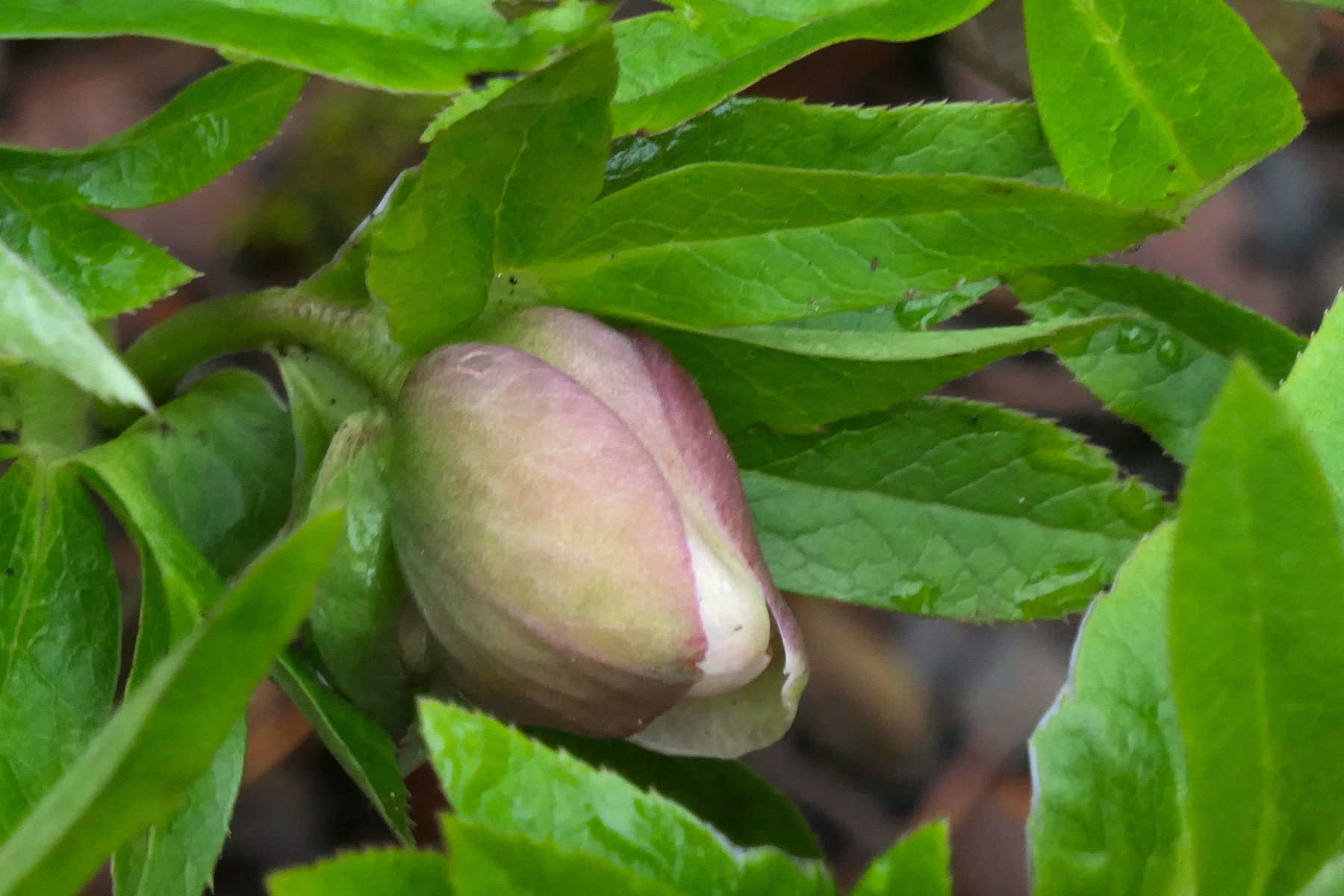
Photographs today are of budding Helebores (called Christ’s Roses in German) and other tidbits from the winter garden.
Music is the Christmas gift that keeps on giving. I think last year I posted the Harnoncourt version – today it’s Fasolis: one of the happiest, most energetic rendition of Bach’s Oratorio that you can find. It’ll counterbalance thinking about hard stuff……..
Yes, Happy Hanukah and yes, it involved a miracle, although it is a minor Jewish holiday, really, and one that grew out of civil war between factions of Jews, conveniently not too often mentioned.
The miracle of the title refers to a poem, though, by the granddaughter of Holocaust survivors. Her debut collection of poetry, Eyes, Stones, was selected as the winner of the 2011 Walt Whitman Award from the Academy of American Poets, she has a new book coming out in 2020, and she currently teaches poetry at Juilliard.
Her small first poetry volume addresses the Israeli Palestinian conflict, by all reports from all perspectives, acknowledging the horrors lived then and now, Jewish and Palestinian; those poems were written a decade or more ago, I wonder how she feels now. Probably longing for a miracle of a different kind. Aren’t we all.
I chose today’s poem because it values connectedness. There are so many people out there suffering more than usual during the Christmas and Hanukah season from loneliness, isolation or simply the winter blues. A good reminder to ramp up efforts to reach out. It makes a difference.
What else to call the way the bare branches I’d bought at the neighborhood bodega came back to life that winter. I’d carried them home — dry, wrapped in paper — stuck them in the square vase, and, as an afterthought, filled it with water.
I don’t know when I noticed the pale pink shoots sprouting from the submerged ends: wild, reaching roots, like ginseng, or the hair on an old woman’s chin. Then tiny green leaves began to appear at the tips, curling over themselves with the sheer effort of growing.
I’d thought they were dead.
And now I recall being in the choke of a fog I did not have a name for and didn’t think I’d survive. I could try to describe it for you now: the nights I woke with my pulse pounding through, the heaviness of each breath, how the effort of being inside my body felt like burning —
But what I really want to tell you is this: how, in the parch of that long drought, the people I loved kept bringing me water.
Water.
Though I turned my back, and did not answer to my name, though I flung the cup away —
Let me say it plain: I wanted to die. But something in me, some tiny bulb still alive under all that rotted wood, kept drinking, kept right on drinking.
Earlier this week I wrote about metaphors as a subtle way of manipulating people into supporting or refusing certain actions. Today, for our last bit on language, I want to look at metaphors that appear in poems, directly or indirectly influencing how you appreciate a text – IF you understand the metaphors, that is.
The reason I am interested in this is, in some ways, selfish. I use a lot of metaphors in my own visual art, and am often called on to explain what I mean. I always wonder if the images themselves are not strong enough for appreciation, but need spelling out – and if and how that will alter the way people perceive them. I also worry that all my esoteric bits of knowledge just need a space to play, completely confusing the hell out of an image, never mind the people who view it. (Which reminds me: My calendar for next year, using the metaphor of whaling as a warning of the consequences of ruthless environmental exploitation, can still be ordered. All proceeds ($30) go to Street Roots. It might not arrive in time for the holidays, but definitely in time for January 1st.)
*
I am sure, there is a whole literature on metaphoric use in poetry; I have not read it. I realize, however, that for most poems I read, I do NOT get the myriad clues of higher learning or meaning strewn about. It is almost like they are messages for a group of the initiated, who pride themselves of being clever enough to get all the hints. The rest of us can just enjoy the language or a general mood. Here is an example (the link gets you to the original German version. I offer my translation below – the original is in rhyme which I could not capture in English.)
The Game is over
The poem was published in 1956 by Ingeborg Bachmann, a darling of the post-war literary scene, who tragically died in her late 40s when, while smoking and falling asleep in bed, she accidentally set herself on fire. She was the young token female poetess in the German-speaking landscape, coming to early fame with her poetry, even though her 2 prose books were substantively stronger.
So what do I get out of the poem? A sister speaking to her brother, conjuring up childhood games and enchantments, images and memories of times at play. For every positive thing, there is a warning of impending loss or doom. No choice, either, we “have to go to sleep, the game is over -” childhood ends. Glimpses of joy soon turning to a sense of sadness. Fond elicitation of how we all used to play, back there in the 1950s before we had to grow up. A bitter taste in your mouth that dangers abound and magic childhood words will be forgotten.
And what did I miss? Man, about everything of importance. The floating on a raft through the sky bit turns out to be a reference to the Isis and Osiris myth, the ancient narrative of sibling incest and undying love. The tents in the desert, the sand in your hair refer back to both, Bachman’s own figment of a novel, Franza, that deals with secretive sibling love, ending badly in Egypt, and also to Paul Celan’s poetry – he was her lover on and off, with the doomed affair not able to bridge the chasm between her parent’s Nazi past and his parents death in the camps. Never mind his marriage, and his desperation, leading to early suicide.
The petal alighting on her seal? Turns out the seal (Siegel) is a different name for a word describing the female sexual organs of plants – I leave the rest to your imagination, and your attention drawn to the fact that darling brother becomes Darling in the last stanza, with the parents aghast. Don’t have to be a psychoanalyst for that one.
Does this added knowledge enhance your reading of the piece? Or complicate it? Does our lack of the relevant education which would unlock the metaphors mean we’ll never “get” poetry? Is it enough to just look at the “pictures” presented by the metaphors?
Well, someone made pictures out of them (which is where I got to thinking about this poem in the first place and then spending hours as a detective trying to get the bits and pieces of the puzzles from various sources.) Anselm Kiefer created a whole cycle of paintings, dedicated to Bachman, some including snippets from her poems, in our case the lines “your and my age, the age of the world” written next to or on the depicted pyramids. If you had never heard of the poem you would not get the hints in the painting either…..
In the end it comes down to this, I think: if you want to communicate with everyone, use the words and the images that are common good. Enough of them around. If you want to impress the learned set, go right ahead and make it complicated. Leave clues that only the initiated know how to decipher, upon which they feel victorious and in turn judge you to be a precious artist. And now let me go to make a really straightforward montage. How about an apple and a snake?
*
Photographs are from THE coolest exhibit of a model train set at the Washington State Historical Society in Tacoma. As a sister without brothers I never had the pleasure of that toy. Then again, the boys I knew were really not allowed to play much with them either – an honor reserved for their fathers…..
Music today is a childhood favorite – Ravel’s fairy tales for children….
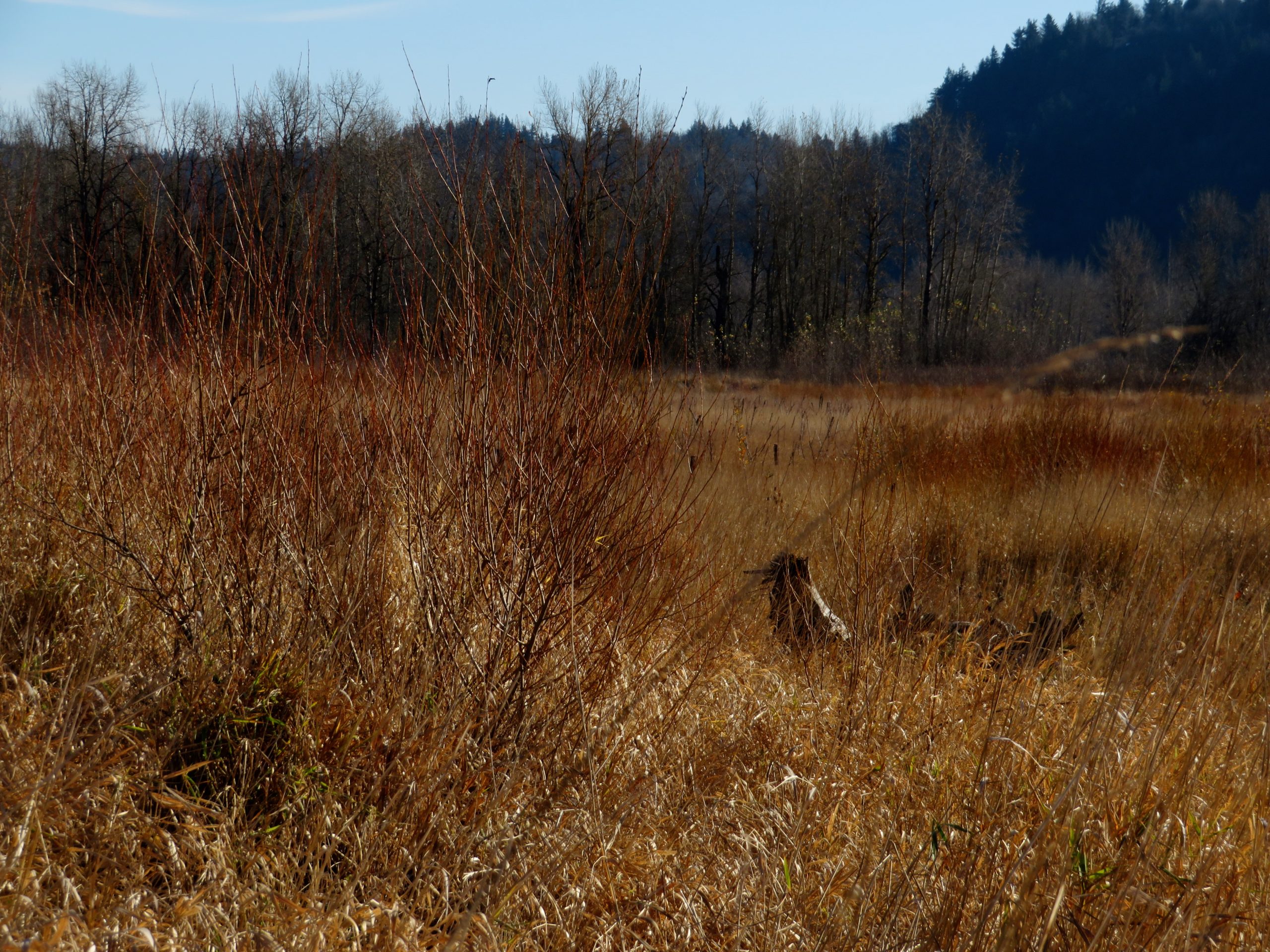
Just so you see the rest of my week’s ambling, here are photographs of yesterday’s walk at the Sandy River Delta, a half hour’s drive from Portland.
Not a cloud in the sky, thin, cool air, the mountain visible and the dog happy. The human too. Color palette went from red to gold to blue, reflecting sun off the water. Hard, clear November light.
I am pairing this with a poem by Thomas Hood (1799–1845) titled No! or alternatively November about this month. Unless you think he saw into a future where global warming has brought dystopia on all of us, here is a hint.
Hood wrote from London, a city heated by coal during the first cold waves of November. The sulphuric smog, paired with fog rolling in, obscured everything, made it hard to breathe, and blocked out traffic, including movement of needed goods.
November
No shade throwing on my part – just a reminder, sensed during every minute of that walk, that we still inhabit a beautiful world an need to fight hard to keep it.
Music today is about the last of the falling leaves.
So ok, I was muttering. Venting, really. Blabbering. One of those days when everything that could irritate did irritate. R e a l l y irritate.
No, I was muttering: like unintelligible speech, multitudinous murmurs, mysterious tongues – a living, walking Longfellow oak in human form…. might as well go for a walk and join my brethren.
Eliot’s Oak
by Henry Wadsworth Longfellow
Thou ancient oak! whose myriad leaves are loud With sounds of unintelligible speech, Sounds as of surges on a shingly beach, Or multitudinous murmurs of a crowd; With some mysterious gift of tongues endowed, Thou speakest a different dialect to each; To me a language that no man can teach, Of a lost race, long vanished like a cloud. For underneath thy shade, in days remote, Seated like Abraham at eventide Beneath the oaks of Mamre, the unknown Apostle of the Indians, Eliot, wrote His Bible in a language that hath died And is forgotten, save by thee alone.
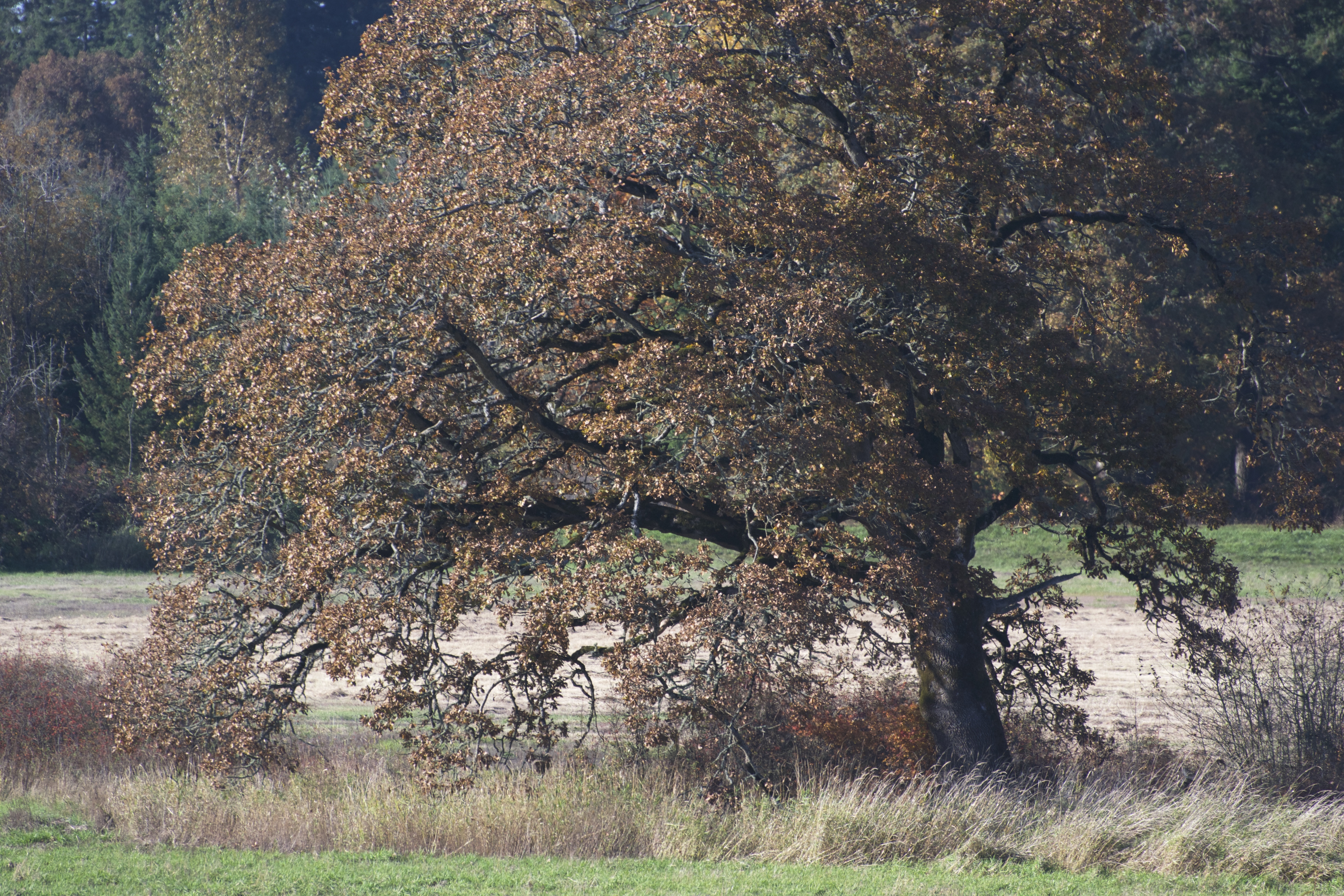
Photographs, then, of today’s oak trees in Tualatin, where I didn’t care that I have no clue who the Eliot is in this poem that I dimly remembered.
I stopped muttering, when the birds took over with their various honking, trilling, whistling, or whatever bird sounds come out of sparrows, flickers, waxwings, shrub jays, bald eagles and geese. Let’s just all agree on mysterious tongues….
Well, and then, of course, I went home and had to look it up. Who was this Eliot?
“Plant explorer Ernest Henry Wilson (1876-1930) also photographed many famous North American oaks, such as the Eliot Oak. The Eliot Oak stands “a few rods east of the Unitarian Church in S. Natick [Massachusetts].” It is a very old white oak that possibly dates to at least the 1650s, and according to one legend that gives rise to its name, the Reverend John Eliot (1603-1690) preached to Indians beneath its canopy. Professor Stowe, in an address on the 200th anniversary of the town of Natick, described Eliot as “a man of great versatility, and very superior intellectual power. Doubtless he had his equals, but never a superior in Christian zeal and goodness.”
The famous poet Henry Wadsworth Longfellow (1807–1882) personified and commemorated this oak in his “Sonnet on Eliot’s Oak” (1877). These verses emphasize the human traits of the oak, as its leaves murmur loudly with “sounds of unintelligible speech,” that nonetheless communicate the word of God and the wonders of his natural world just as the preacher Eliot presumably did. Also, the final lines acknowledge Eliot’s authorship of the Algonquin Bible, the first Bible printed in America and written in the Algonquin language.” (Source: arboretum/Harvard/edu)
Season of mists and mellow fruitfulness, Close bosom-friend of the maturing sun; Conspiring with him how to load and bless With fruit the vines that round the thatch-eves run; To bend with apples the moss’d cottage-trees, And fill all fruit with ripeness to the core; To swell the gourd, and plump the hazel shells With a sweet kernel; to set budding more, And still more, later flowers for the bees, Until they think warm days will never cease, For summer has o’er-brimm’d their clammy cells.
Who hath not seen thee oft amid thy store? Sometimes whoever seeks abroad may find Thee sitting careless on a granary floor, Thy hair soft-lifted by the winnowing wind; Or on a half-reap’d furrow sound asleep, Drowsed with the fume of poppies, while thy hook Spares the next swath and all its twined flowers: And sometimes like a gleaner thou dost keep Steady thy laden head across a brook; Or by a cider-press, with patient look, Thou watchest the last oozings, hours by hours.
Where are the songs of Spring? Ay, where are they? Think not of them, thou hast thy music too,– While barred clouds bloom the soft-dying day, And touch the stubble-plains with rosy hue; Then in a wailful choir the small gnats mourn Among the river sallows, borne aloft Or sinking as the light wind lives or dies; And full-grown lambs loud bleat from hilly bourn; Hedge-crickets sing; and now with treble soft The redbreast whistles from a garden-croft, And gathering swallows twitter in the skies.
Written September 19, 1819; first published in 1820. This poem is in the public domain.
And here is, in addition to the bounty, to the wistfulness of October…..
My work is loving the world. Here the sunflowers, there the hummingbird – equal seekers of sweetness. Here the quickening yeast; there the blue plums. Here the clam deep in the speckled sand.
Are my boots old? Is my coat torn? Am I no longer young and still not half-perfect? Let me keep my mind on what matters, which is my work,
which is mostly standing still and learning to be astonished. The phoebe, the delphinium. The sheep in the pasture, and the pasture. Which is mostly rejoicing, since all ingredients are here,
Which is gratitude, to be given a mind and a heart and these body-clothes, a mouth with which to give shouts of joy to the moth and the wren, to the sleepy dug-up clam, telling them all, over and over, how it is that we live forever.
This is the first poem in Mary Oliver‘s collection Thirst, titled, “The Messenger.
I encountered it at a writing workshop for houseless vendors at StreetRoots this week. Mary Oliver had been previously introduced to me by the workshop leader who continually excels in expanding my horizons and I took to this poem in no time. Hey, gratitude for nature! Up my alley. Loving the world? A familiar task. Mouth shouting joy – my readers are my witness!
And then a participant pointed out, with anguish bordering on rage, that it was not their job to love the world. A world that mistreated them, rejected them, punished them, tortured them, deprived them and excluded them. A world where safety was non-existent, food unreliable, pain untreated. Where admiration of nature was not exactly high on the list when you could but fear the elements. Where the very idea of living forever is blacked out by the worry about living for another day.
You know that feeling when heat creeps up your neck, into your cheeks, the blushing that interferes with breathing? That was me: caught in my bubble of middle-class existence, originally not even tangentially aware how gratitude of the kind the poet references is linked to privilege. The privilege to have time to notice, room to appreciate, means to express and capacity to love nature within my safe surroundings.
I am not saying that homelessness precludes gratitude. On the contrary, I am often floored when seeing the generosity of spirit expressed by the folks I’ve gotten to know. I am more concerned with the demand characteristic or the taking for granted in my own head that the world is to be loved.
Mary Oliver’s work might have been to love the world. (She died this January – a remembrance from the New Yorker is in the link.) My work right now is to become more aware of how automatically we apply standards that seem self-evident to us – gratitude for nature! – but which are wholly inappropriate for those whose very existence is under attack. And then my work is to fight the causes for the differences in standard. Actually: the work of all of us. 38.000 houseless people in our city deserve that.
Photographs today are from another habitable building making room for another luxury hotel in downtown Portland.
Music today is from an interesting cross-over album Now and Then Music from the Great Depression(s) 2010/1929 ( to which we might add 2020, I gather.)