Browsing Category

Art

Books about and by women artists

Lesendes Mädchen (1828) Gustav Adolph Henning

A dear friend gave me a German magazine that is devoted to books – a special edition that dealt with women and literature. The photographs of paintings of reading women are taken from it. It made me think about artists and literature and so I thought I’ll recommend some books about fictional artists and some by real artists that were impressive enough that I remember them.

The one that moved me most is A Blazing World (2014) by Siri Hustvedt. Her protagonist deals with issues of aging and trying to make it as a woman in a male-dominated art world. She resolves to take her revenge, in a way that exerts an incredible emotional toll. My admiration for the novel can be traced to the fact that it brilliantly describes suffering, but then balances it out with hope, all the while challenging you intellectually to rethink all the issues of gender wars, specifically located in the arts.

Junge Frau mit Buch (1934)  Alexander Deineka

Virginia Woolf’s classic To the Lighthouse (1927) is probably one we all read as teenagers when trying to find our role in the emergent feminist movement. Her heroine Lily Briscoe struggles with the notions that women can neither paint nor write.

Hotel Room (1931) Edward Hopper

I am also a devoted fan of Margaret Atwood. Her novel Cats Eye (1989) describes an artist’s attempt to sublimate unsavory or painful memories by including them in her paintings. I actually did not enjoy reading that book, several of the issues being too close to home, but I could not forget it.

Lesendes Mädchen (1851) Franz Eybl

Both Possession (1990) and The Children’s Book (2009) by A.S.Byatt contain vividly drawn realizations of artists – poets and writers. The novels are really about the layers of various social interactions and the way secrets can shape lives; both are deep, fascinating and not exactly beach reading.

The two books by female artists that made an impact were Boundaries (2000) by Maya Ying Lin and Hold Still (2015) by Sally Mann.  The former describes the creative processes used for her designs, the most famous of which is the Vietnam Veterans Memorial in Washington, D.C.  The latter is an autobiography by the controversial photographer. Her thoughts on the possibility that taking photographs destroys memory resonate with every photographer I know.

Elegant Women in a Library (no date) Edouard Gelhay

And last but not least there is Emma Reyes. The link below gives you the details.  Happy reading in the rainy days ahead!

http://www.npr.org/2017/08/09/542061880/in-emma-reyes-life-through-a-childs-clear-eyes

If reading is not your thing, here is a fascinating slideshow….

https://www.thecut.com/2016/09/the-moma-is-republishing-its-first-female-focused-book.html

Jove Decadent (1899)  Ramon Casa i Carbó

Art and Politics (2)

Yesterday I mused about museums; today I’m thinking about artists. There is so much written about how artists engage in the political process that it is hard to choose what to highlight. In the end, I’ve decided to focus not so much on the making of art with political content, but the ways artists actually influence politics by entering into the public sphere.

My earliest awareness of artists’s political actions was in the 1960’s and 70’s around the persona of Joseph Beuys who taught and worked close to where I then lived. Among other things he was a co-founder of the Green Party, and his lectures focused on the need for space for creative thought which would help bring about structural change in society. His vision of the artist as a social actor has been enormously influential.

Here are some examples of others following later: As mayor of Tirana, Albania, Edi Rama, a former painter, decided to change the city with color (as well as a huge project of planting new green spaces.) The TED talk below has a short video on the project, and it is amazing. It changed the urban, the social and eventually the political landscape, quite literally. https://www.ted.com/talks/edi_rama_take_back_your_city_with_paint

Then there is Tania Bruguera, who announced that she would run for President of Cuba in 2018. Never mind that you can’t run for that office in Cuba…it is the political gesture of entering the public sphere as an artist to promote change. The link below gives an interesting overview of a life devoted to political rebellion.

http://www.aljazeera.com/indepth/features/2016/10/tania-bruguera-cuban-artist-fights-free-expression-160930124023219.html

An important support network for artists as activist is provided by the Creative Time Summits, annual conventions that gather international artists, writers, philosophers and political activists for thematically structured conferences. Their goal is to promote social change through art activism. Last year they met in D.C. before the election, inviting input to the theme Occupy the Future from citizens and grass root movements working within as well as disrupting the electoral process.  This year they met in Toronto to discuss Of Homelands and Revolutions, with a particular focus on indigenous people leading ongoing movements across continents.

The link gives a programmatic overview http://creativetime.org/summit/toronto-2017/

Here is one of their (timely) projects that caught my attention. It’s called Pledges of Allegiance – a serialized commission of sixteen flags, each created by an acclaimed artist. “We realized we needed a space to resist that was defined not in opposition to a symbol, but in support of one, and so we created a permanent space. The flag seemed an ideal form to build that space around both practically and symbolically,” says Creative Time Artistic Director Nato Thompson. Each flag points to an issue the artist is passionate about, a cause they believe is worth fighting for, and speaks to how we might move forward collectively. Conceived in response to the current political climate, Pledges of Allegiance aims to inspire a sense of community among cultural institutions, and begin articulating the urgent response our political moment demands.   
Pledges of Allegiance officially launched on Flag Day, June 14th. Each month a new flag will be raised on a flagpole atop Creative Time’s headquarters at 59 East 4th Street, and at partner sites nationwide. Here you can see the different flags so far and learn about the contributing artists:

http://creativetime.org/projects/pledgesofallegiance/


Art and Politics (1)

Wouldn’t you know it. I thought I knew every major museum in NYC after having lived there for years and visited for many more. Turns out, I don’t – I have never been to the Queens art museum. This is a particularly regrettable fact given that the director of the museum is a woman of courage and deeply held convictions.

http://www.queensmuseum.org

Unlike almost all of her contemporary counterparts she is willing to engage in open politics – more power to her. The link attached below describes the role she has played in the last years and the causes she has fought for since Trump’s inauguration, the plight of the DACA recipients in particular. She is clearly paying a price for her outspoken involvement; although her Board seems to support her, various City councilmen are out to have her removed.

.https://www.nytimes.com/2017/10/08/arts/design/queens-museum-laura-raicovich-daca.html?_r=0

I know of only one other group of museums who were willing to step up and question the artificial separation between art and reality; see link below.

http://www.latimes.com/entertainment/la-et-entertainment-news-updates-march-museum-directors-react-to-proposed-1489682884-htmlstory.html

One can debate if the role of museums should be one of neutrality, as many insist, particularly the folks at the Smithsonian. The argument for taking the long view, letting art speak for itself rather than the museum speaking for or against political causes seems empty to me, when almost all museums show this or that work of political artists anyhow. If you curate shows that have political content, you might as well be open about where you stand regarding those contents. The viewers are smart enough to form their own assessments, as long as the opportunity to be exposed to differing points of view exist.

There will always be pressure from interest groups to have art suppressed – that has been true for as long as art exists. Just ask around Jewish museums in this country or in Germany, as one example. Or the Guggenheim, recently.

http://www.chicagotribune.com/news/nationworld/chi-spertus_21jun21-story.html

What we need now, in times where the role of art is undermined by those who have lots to loose with a more educated public, is individuals who stand up and speak truth; truth through the selection of what they are willing to show, as well as through directly addressing the relevant issues. Laura Raicovich is one of them.

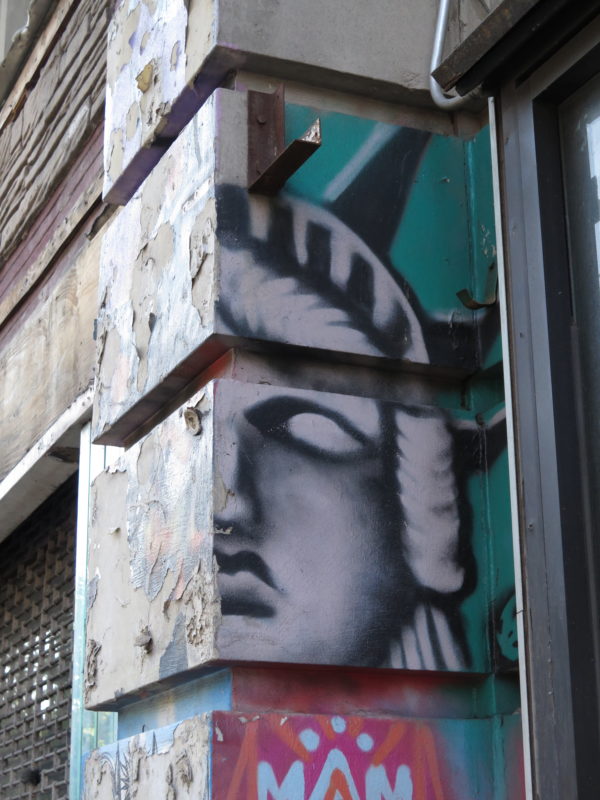
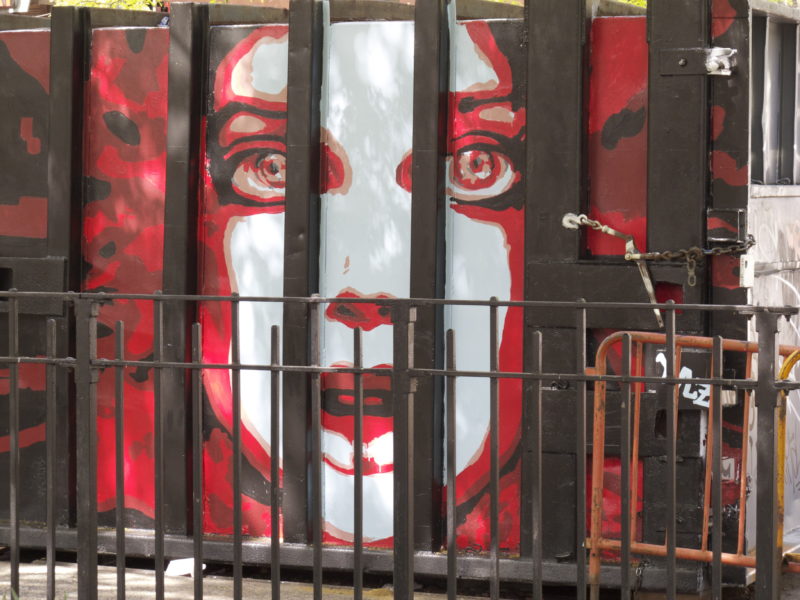
Photographs are of street art found in various boroughs in NYC, most Bed-Stuy.


The Rev. Billy and the Stop Shopping Choir

Show me someone’s blog that opens with an Emma Goldman quote, consider me hooked. If that quote refers to small communal interactions forming the kernel of possible societal change, consider me sold. Let me introduce you to the Reverend Billy and his Stop Shopping Choir.

Who am I talking about? A group of activists/artists who do both concert stage performances and agitprop actions to raise awareness of how we are mistreating our planet and our neighbors. They fight for earth justice, against consumerism, for first amendment rights and much more. Their recent visit to Portland was once again a coup by Boom Arts – bringing progressive artistry to an audience that is in need of and grateful for cutting edge theatre.

The NYC-based troupe is led by Billy Talen, an actor who uses comic theatre and music to get out the message – in ways that often risk persecution by the powers that be who are quite aware of how he lifts the veil on capital’s agenda. The link spells it out in more detail:

https://www.theguardian.com/business/2015/nov/27/reverend-billy-church-of-stop-shopping-black-friday

On Sunday night the artists met with members of our community, including Portland Resistance and Portland Tenants United for a community supper.

And since this week’s blog is dedicated to women’s issues, let’s focus on the women I encountered.

There were young women of the choir who managed to travel across time zones with infants and toddlers, putting in full performances, and still had the energy to meet new folks; young women who sang with beautiful voices.


There was the director of the company, who writes beautifully and provides organization and structure. There was her daughter who clearly shared her mother’s fierceness as well as the theatrical brilliance of her father.

http://www.revbilly.com/about_savitri_d

There were the Portland activists who lead the cause;

There were the folks from Boom Arts who surprise me every year with procuring ever better acts; doing their magic in getting people to return, fostering relationships, helping to keep the company afloat –  a special welcome here to the recent NYC transplant!

And then there was the kind of woman who models for all of us how to bring more peace and justice to the world in everyday life, managing the Sunnyside Community Center. She was celebrated and shown expressions of gratitude that her kind deserves and yet so infrequently receives.

It was an evening that conveyed energy, activism, community and above all hope – so direly needed in these times.

The troupe is off to England for their next adventure – friends over there, be on the look-out. These are performances you might not want to miss.

ArtsWatch

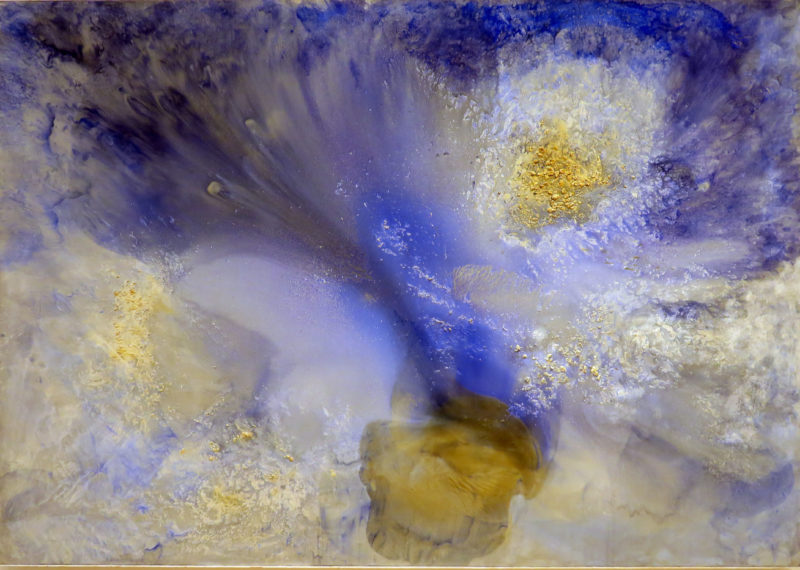
A recent encounter with a stranger yielded a gift. She had perused my art website, found it to her liking and saw parallels in choice of topics to a favorite artist of her’s, Holocaust survivor Samuel Bak. She gave me a catalogue of his recent show in Boston, Just Is, that pretty much blew my mind. The gallery website below contains biographical and artistic information.

https://www.puckergallery.com/artists/#/samuel-bak/

I had, of course, never heard of the guy. Nor had I heard of any of the women painters focussed on abstract work that I was able to see at a different exhibit in Boston two weeks ago. Today’s photographs give you a pretty accurate description of the range  – from boring to fascinating, traditional to truly inventive. The ones that had an implied narrative stuck with me for the longest – it is just easier for most of us to remember a story than to recall a pattern, no matter how beautiful.

Given the sheer number of people able to make art these days, and the number of real and electronic outlets available to bring the work to the public, it is of course not surprising that even people who are keen on painting or other forms of art know only a minuscule percentage of what is out there. Which brings us to a local treasure, Oregon ArtsWatchan invaluable source of information when it comes to being better informed about art.

Beverly Hallam, Crossed Rock, 1966

About 6 years ago a group of the smartest journalists in town decided to fight the attrition of art news that went hand in hand with the downfall of local print journalism. Single handedly, without serious financial backing at the time, and for all I know around a kitchen table, they started publishing a nonprofit online arts journal,  orartswatch.org

Lest you think that a business model á la The Little Art Critics that Could is doomed, marvel at their success: the group has posted more than 3,000 stories that attract tens of thousands of readers every month. They have sponsorship agreements with more than 40 arts and education organizations, content-sharing partnerships with TravelPortland and Artslandia, more than 200 individual donors (most of them sustaining, annual donors), and an active social media presence.

Barbara Takenaga,  Tremolo, 2005

Writing is done by a diverse set of free lancers of whom 30 or so regularly contribute. Diverse indeed: the organization aspires to offer view points from a variety of writers in terms of age, educational background, active or passive involvement in the arts and political orientation. The only constant element is the quality of the writing. The founders focus on identifying contributors of younger generations and mentor them in what could otherwise be yet another endangered species: smart art criticism.

Meg Brown Payson, Drift, 2006

I learn much from them, beyond staying informed as to what’s going on around town. The essays make me think about my own approach to making art, my difficulties within the art scene, my desire to combine my political reasoning with my creativity as a photographer and writer. I am friends with some of them, owe all of them.

Christin Baker, Diaphanous Leverage, 2016

Do yourself a favor and sign up to their website http://www.orartswatch.org

or Fb  page https://www.facebook.com/ArtsWatch/.

Do all of us a favor by supporting them, if you can, financially, since every $$ comes back to all of us in added value of knowledge about art at a time when art education has dropped from the agenda. Nonprofits like this are never out of the woods – they need us, almost as much as we need them!


Monumental

The earliest three-dimensional art was probably carvings, shortly followed by pottery. Ritualistic and functional purposes found artistic expression. Soon 3-D became large, representing religious ideals and worldly egos by its size – just think of the tomb carvings in Mesopotamia and the statues attached to Egyptian pyramids. The Greeks matched their sculptures to their view of the centrality of man – it had to be the perfect body…..

Early Christianity was hampered by one of the commandments forbidding the use imagery. Once they found a way around that by claiming this prohibition only referred to idolatry, the dam broke. Just look at the ubiquitous carvings, statues, reliefs in Christian churches – I will need a whole other month to blog about the beauty found there. Eventually.

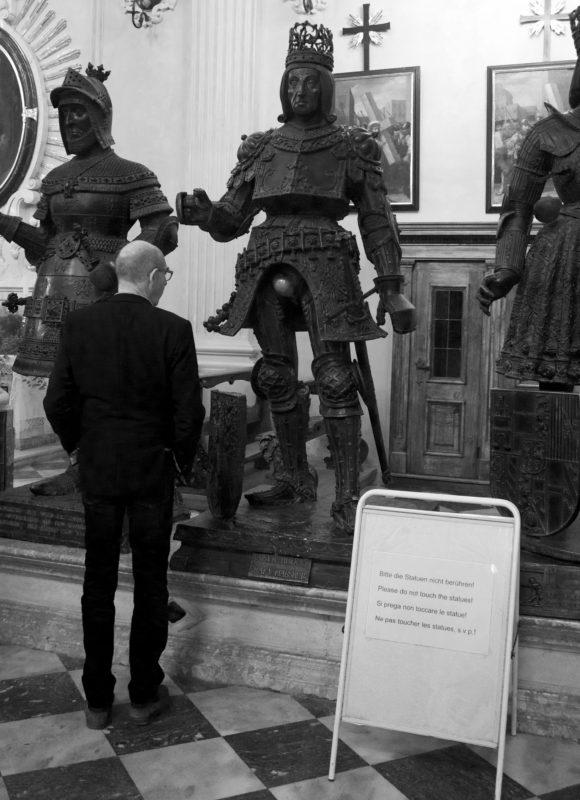
Today I want to focus on the ways sculptures are used as monuments, specifically memorializing power. (Which reminds me I could also do a week on war monuments and comparative sites of unspeakable horror. Maybe.)  Today’s example was found in Innsbruck, Austria. My friends and travel companions who know e v e r y t h i n g about cool historical sites guided me to the Hofkirche, the church and (empty) burial site of emperor Maximilian I, surrounded by 28 of his favorite relatives…

Imagine: on his deathbed, in 1519, this guy expresses a wish to be sepulchered in some chapel, surrounded by 40 larger-than- life statues made of bronze. Well, the 28 who are eventually completed are too heavy for the chapel. So his grandchild Ferdinand builds a new church, the Imperial Court Church, puts a cenotaph (empty grave) into it, and flanks it by the “black men” as they are known. Never mind that about half of them are women. I am not kidding you.

Think how it must feel to come to services every Sunday being surrounded by this wealth, this overwhelming imagery, this size of those who rule you.

Attached link is a video of the church.


Here is another example of monumental expression, with a (from my perspective) lovely political twist. I have never seen the terra-cotta soldiers protecting the grave of China’s first emperor, Qin Shi Huang Di. He, too, had plenty of company for his eternal rest. But I did see a feminist take on this army in Paris, some years back. Prune Nourry, with the help of artisan copyists from Xi’an, created an army of 108 girls, the Terra Cotta daughters, to question gender selection with a bias towards boys in China.  They went on a world tour before they were buried at a secret location in China. I was so lucky to be at the right place at the right time. Looking at all these girls’ faces was a powerful reminder of how selective abortion preempts female lives.

http://www.prunenourry.com/en/projects/terracotta-daughters

And last but not least here is a monument to the photographer, which concludes this week on sculpture.


Grounds for Sculpture

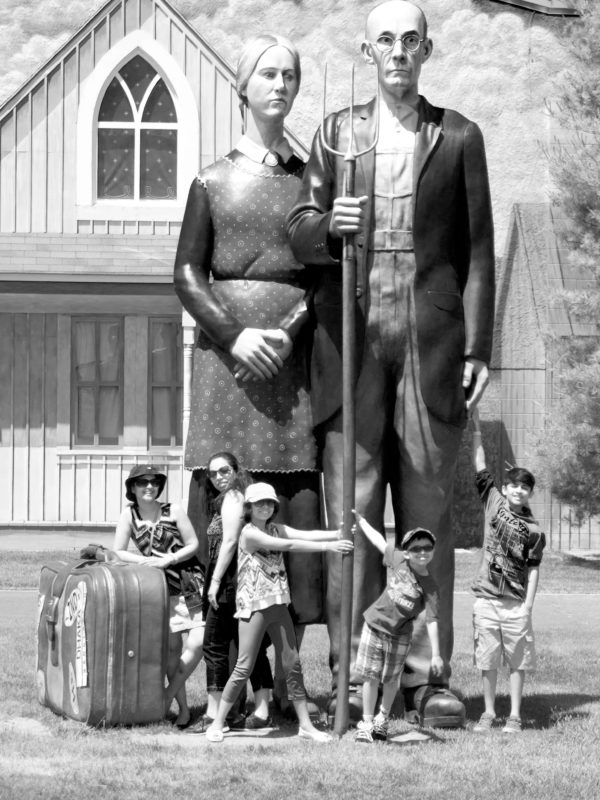
If you ever want to go tripping without ingesting chemical substances into your body, travel to the hidden depths of Hamilton, New Jersey.  You’ll find a sculpture park there that immediately puts you into a state of altered reality, fake poppies included. Disney world for the arts, for lack of a better description.

Originally old Fair Grounds, the 42 acres were purchased by Seward Johnson, heir to the Johnson&Johnson medical fortunes and now a sculptor himself (having majored in poultry husbandry in college…) If you want to laugh today, read this NYT article about him; his biography in some way resembles the feelings you get in his park: larger than life, weirdly concocted, slightly off-color, hard to believe and at its core exhilarating for the sheer force of it.

This is said about his art:”Mainline art critics have not been kind to Mr. Johnson, whom they see as a rich guy who bought his way into the club. ”Kitsch,” ”Hallmark” and ”Norman Rockwell,” are barbs frequently hurled by those who feel that art should be cool, collected and at arm’s length. ”Johnson’s work is chocolate-box rubbish,” said the art critic and author Robert Hughes. ”It has no imaginative component that I can see and apparently appeals to dull corporate minds like his own — the sort of people who run American motels and malls.”

http://www.nytimes.com/2002/06/30/nyregion/seward-s-follies.html?mcubz=0

It actually appeals to those average people visiting the park, as the photographs of interactions with the sculptures show. It has elements of fun and accessibility that are inclusive rather than reserved for elites who “know about art.” They might mock it as Seward’s Follies – I’d say, more power to him!

Grounds for Sculpture was planted from scratch with thousands of trees and tens of thousands of plants, delicate grasses included. The collection, other than Johnson’s own work, is varied; it sure is large, though, and the only thing lacking is subtlety.

Actually, I had a fun visit there. Once you overcome the shock of being in this strange environment you cannot help but admire the chutzpah of the people putting it all together, combining serious three dimensional art with skyscraper-sized figures of Marylin Monroe in full skirt-lift mode. I also could not but marvel at the largesse of Johnson’s philanthropy which surely matches the size of his sculptures. I mostly read up on the sites I visit after I’ve been there, so that my eyes are open without being influenced when I first experience the art. But reading about the people who initiate these ventures as private persons gives me direly needed hope in humanity: there are folks out there who care, who are generous, who want to share their passion. The rest of us are grateful beneficiaries. And in Hamilton, New Jersey, getting high.


Blown

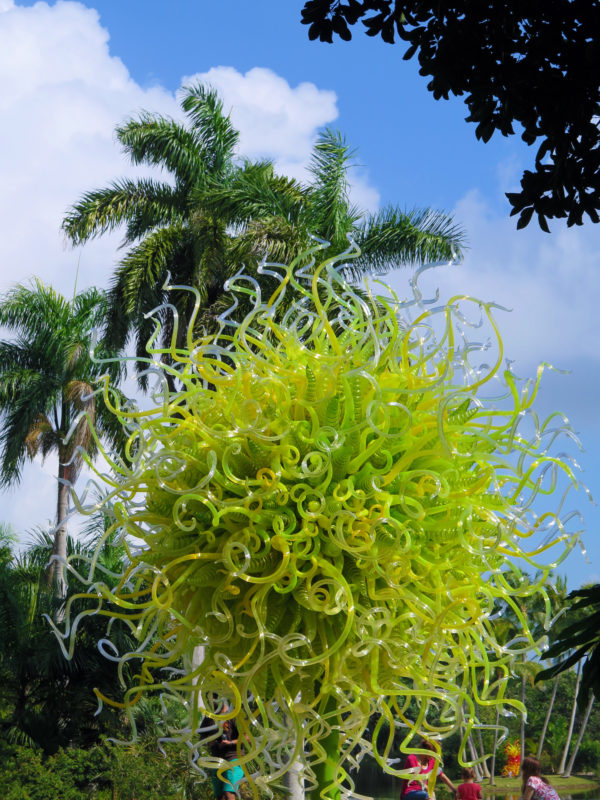
Blown. or should I say: blown and blown. I am referring to the sculptural art I am describing today and the hurricane that blew across it. All of this can be visited at Fairchild Tropical Botanic Garden near Miami, FL. Or rather, can’t be visited right now, since they are trying to clean up after the damage, with hordes of volunteers expected tomorrow to pick up the plant debris.

I really wonder what they do with the glass sculptures during natural catastrophes like Irma. The installations are too big, for the most part, to be moved easily. Maybe they have containers that settle around them, anchored in some fashion?

Fairchild is a truly beautiful garden, with humongous cacti and palm tree collections; it contains a large number of pieces of Chihuly’s work. Or at least work that has his name on it – there are now intense questions, accusations and law suits swirling around, claiming that he exploited his assistants, plagiarized them, stole from them ideas and revenue. This kind of conflict is not new when it comes to work made by groups of people when no single person can pull it off solo.

I read somewhere that Henry Moore, for example, did the drawings and small models for his sculptures, then had others execute the large versions we see in the museums. Ideas over craftsmanship, I guess. Except that ideas are shared when you co-produce, too.

http://www.tampabay.com/things-to-do/visualarts/who-is-really-making-chihuly-art/2334662

I visited the garden three years ago and had my usual mixed feelings when I encounter these larger-than-life explosions of Chihuly glass. They did something magical to the landscape, or echoed its magic. They deliver intense color and amorphous forms, cascading at times in ways that are really impressive regarding the skill of their construction. But a hint of gaudy always makes me step back, and all the talk in the world about how Chihuly bridges the gap between the decorative and art is not convincing me to think of it as predominantly the latter. This is of course the person speaking who vastly prefers Biedermeier over Rococo, something elegant but plain over something elaborately ornate.

My Pacific Northwest readers can easily judge for themselves – Seattle has an entire glass garden devoted to Chihuly, and the glass museum in Tacoma has him prominently in their permanent collection.

With all that said, I had a splendid day at Fairchild – walking around corners and discovering these pieces hidden or not so hidden in the vegetation instilled a sense of whimsey.

Almost enough to forget my annoyance that the insanely high admission prices prohibit your average-income family to visit and thus secure a mini paradise for the elites. Which is now blown.

Master of Reflection

I could not believe my luck when I realized the Lincoln, MA sculpture park had a Gormley sculpture in its permanent collection. He is my absolute favorite of the contemporary sculptural artists (although closely followed by Emily Young.)

You can find a good sampling at their respective websites: http://www.antonygormley.com  –  http://www.emilyyoung.com.

Gormley has a knack for site specific installations and quite often they involve reflection. They can be small, like the one in Lincoln, or huge, like the one in Hamburg, Germany, that I visited in 2012 ( faithful readers have gotten their share of those photographs before…. but it’s worth the repetition.)

The former is the form of a man who seemingly looks into a pane of glass and sees his reflection. In reality and very quickly visible, these are two identical sculptures, mirror image reversed, that are facing each other, divided by said glass. The acquisition of this piece was guided by a commitment to showing sculpture both inside the de Cordova and outside in their magnificent park. Or so says the website….

The latter – Horizon Fields –  was located in a former market hall in Hamburg, that has become a place for changing art exhibits. The hall was filled with a platform suspended from the roof across the entire length and width of the building. The top of the platform was a mirror, walking on it (in your socks, once you had overcome the embarrassment of potential holes in them) was not for the faint of heart. The reflections were disorienting, and the suspension of the platform made the hole thing swing lightly. But, oh, the views! The sense of a manipulation in space with you at some difficult-to-assess spatial point right in it was truly exhilarating.

http://deichtorhallen.de/index.php?id=257&L=1

Last year Gormley showed his political colors in a show that featured 600 cast-iron human skyscrapers, expressing his anger about London’s testosterone-fuelled corporate expansion.  “We are living in a really strange time,” Gormley said. “Yet we are all sleepwalking through it. And it is urgent we wake up. We are sort of aware the centre cannot hold, that 250 years of industrial activity has undermined and fundamentally disturbed our world – yet we feel somehow not responsible.” He called Sleeping Fields “manic, but incredible good fun.

Seems like the fun ended, though, when 3 months ago another one of his projects was altered by some unknown artist, or vandal, depending on your point of view. His series of figures at Crosby Beach in England acquired some polka dot bikinis and the like.

Attached is a video of the installation. It give you a taste of the full scope of the installation.

https://www.theguardian.com/artanddesign/2017/jun/22/antony-gormley-crosby-beach-sculptures-vandalised-bikini

This reminds me of my friend Steve Tilden whose large metal horse sculpture in North Portland was “decorated” with a lot of knitted and crocheted garments, time and again.  Maybe someone thought the horse was cold…..


Sculptures

my trip to the East Coast last week I visited a sculpture park in Lincoln, MA. It was founded by a tea merchant of Jamaican descent, Julian de Cordova, who poured his riches into traveling the world and collecting art that he brought home to his mansion – a hobbit-like structure on steroids. After his death in 1945 it all became a museum. His own collection was sold for lack of artistic value, but his generosity enabled a focus on modern art, and eventually sculpture. Details can be found here:

https://decordova.org

The museum and grounds are a spectacular setting for some 60 pieces of art ranging from figurative to abstract to can’t-be-defined by your’s truly but made for a great play ground.


Luckily things are explained to the clueless.

A centerpiece is an area called Alice’s Garden, which contains figurative work that echoes Caroll’s fantasy world, Alice included.

I could not quite understand why a disembodied head of a little black girl was included – I would have placed it next to another figurative bust by Jaume Plensa at the other side of the park.


The works in Alice’s Garden impressed with a variety of materials: wood,

metal that reflected the environment,

plastic casts,

stone and as many ideas.

I think my favorite here was Terrence Koh’s sculpture Children of the Corn – Totempole. A title borrowed from a horror story by Stephen King, by a Chinese-Canadian artist who runs around dressed in white and often donning bunny ears seemed a fitting reference to the state of our world. This self-named asianpunkboy is now represented in major museums of the world, including MoMa, the Schirn, the Whitney, Tate Modern etc.  Here is a clip with his good friend Lady Gaga.

The strongest piece in the collection, for my taste anyways, will be described tomorrow. Until then, let the whimsey seep into your day, if only a little bit.