Browsing Category

Art

Sound Art

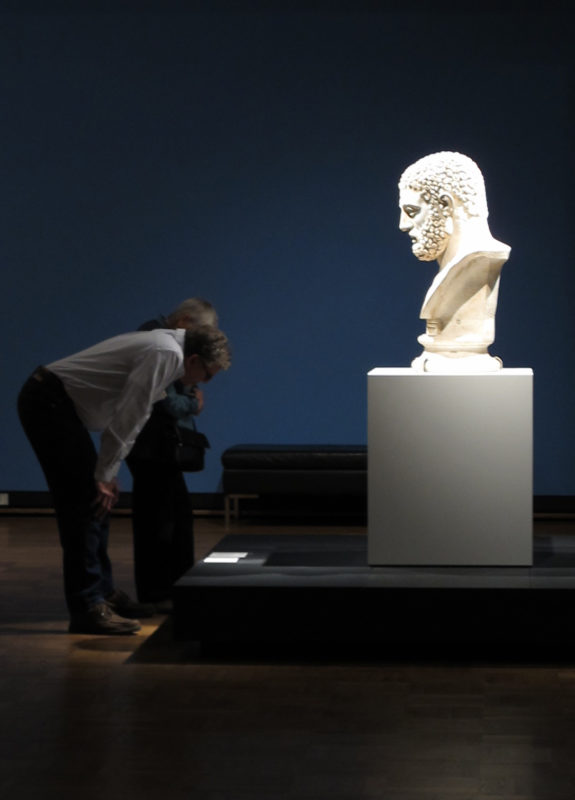
My internet is out and I am sitting at a local Starbucks to get WiFi. Blasted by their version of (Musak)jazz while trying to think back to the subtle sounds of Reverberations: Art and Sound, an exhibit I recently saw, is irritatingly difficult.

And it is made harder by the fact that I, despite some musical training, really have to scramble for words to describe what sound art is all about. In case you are curious, here is an essay that does know what it’s talking about, explaining sound art as shown in NYC.

http://www.3quarksdaily.com/3quarksdaily/2015/05/on-the-sight-of-sound.html

One thing is clear, it is NOT about music. Rather artists create installations that use sound to represent. Representations cover anything from noise and silence of urban landscapes, reflections on history, politics, to language as a code. The acoustic element is the focus – silence can be added through visual representations, but it is all about what you hear.

Here is a short blurb on the show I saw – http://www.aptglobal.org/en/Exhibition/56842/Reverberations-Art-and-Sound-in-the-MUAC-collections, 

It was a group of some 30 artists exhibiting over 60 pieces of varying degree of interest and/or appeal. They were all a challenge to someone like me who is a visual artist, trying to understand a new form of art that in some ways is singularly apt for our age of chatter and installations.

It was fun, though, to see cleverness – a whole rack of machetes, for example, that sounded like peaceful, soothing wind chimes – quite a substantive contrast. And it was a good intellectual exercise to photograph in ways that tried to match the singularity of sound I experienced.

I will certainly be on the look-out for shows like this when coming East. Much to learn.

And now I have to flee Starbucks, although, much to the consternation of my tribe, I actually like their coffee.

Against the ODDS and at the WHIM of others

Odd and whim – I sort of had those synonyms for quirks to get into the stories I wanted to relate today. The stories are both about professional activities that could not be further from my repertoire of skills and capabilities.
One is related to art restoration, but as the film clip will show you, requiring such an amount of patience and sleuthing that I would go insane before the first week was over on the project.  The short version: some years back someone found an old rag stuffed into a chimney flue to prevent drafts. Turns out it was a priceless treasure of a medieval map that guided seafaring Dutchmen. It is now in the hands of a museum restaurateur and the painstaking work of reconstruction inspires awe.

http://www.slate.com/articles/video/video/2017/05/a_scottish_chimney_rag_turns_out_to_be_a_17th_century_map_of_the_world.html

Not as much awe, though, as the situation depicted in the second link below. Here we learn about the assignment of women prisoners, upon arrival at prison, to fight California wildfires. No training, not much safety instruction, put onto the bus, hiked for hour and miles up steep hillsides to the inferno and then thrown to the flames, or at them, or whatever.  I would faint at the first bend in the hike. The hidden slave labor in our prison system(s) is worth a whole other blog, but suffice it for today to hear this brave report.

I figured ships needing maps and wood that burns would be appropriate imagery.

Referencing

Tilden/Giorgio de Chirico

This week will be governed by the fact that I am leaving for a funeral in Germany. I will write when I can, but things will be in flux.

Understandably, my thought has been about relationships, how much meaning they give to life. That is, of course, not just true for friendship, but also to how one relates to the rest of the world, particularly within one’s specialized sphere of interest.

Celaya/The Calling 2009

I found this echoed in the article linked below, about a nifty, 6 year old program at the Phillips Collection. They have an annual show called One-on- One which encourages a painter to choose a piece or several from their collection and juxtapose them to their own to be exhibited work. Last year they showed Carol Brown Goldberg paired with Henri Matisse. This year it is Celaya who chose Albert Pinkham Ryder, a 19th century painter.

Ryder/Dead Bird ca 1879

Both reference literature, Kierkegaard for Celaya, Shakespeare for Ryder, both use darkness, in particular tar, as a medium, both are masters of simplicity and  veer into mysticism. Celaya, by the way, came to art through science:  He studied Applied & Engineering Physics at Cornell U, received an MA in Quantum Electronics UCBerkeley, and pursued a Phd before abandoning physics for art.

Enrique Martínez Celaya’s “The First Kierkegaard”

Tiden/Paul Klee

I have certainly worked with text, creating montages for poems that mattered to me, and now feel it was a bit too literal an attempt. Distilling some essence, as seen in Celaya, is something to aspire to.

Tilden/ Joan Miro

A different kind of referencing, trying to pay homage to certain painterly styles, was also part of the last years of work, and those are the montages you see today. They took sculpture by Tilden from a show called Horse and made them in pastiches of painters I like.

Tilden/Franz Marc

Tilden/Richter

(I don’t like Richter, but I found it a wonderful challenge to convert him…)

Leading image on the blog cover is Tilden/Max Ernst


Death Valley

We started the week with landscapes in the State of Washington. From there we went South to the Columbia River, then further East to Harney County. Now it’s straight South, all the way to a place where rain is rarely seen – what a concept. California is our destination, and leave it to the internet to cough up information on some obscure painters that were in love with Western National Parks, Death Valley – my choice today –  included. One was a Swede, the other of Swedish descent, both quite adept watercolorists, both drawn to the dry sunny places that mediate the intensity of depression. (Well, the latter is speculation, no clue if they were depressed, but I surely could use some sun to counteract the dark clouds.)

The links below refer to Gunnar Widforss (1879-1934) whose post-humous exhibits found high acclaim. A realist painter, he spent his life alone, in relative poverty, pursuing nature. I actually think he was a terrific painter and am surprised I had never heard of him before.


GUNNAR WIDFORSS—PAINTER OF THE NATIONAL PARKS

https://www.californiawatercolor.com/pages/gunnar-widforss-biography

The other painter is Fernand Lungren (1857-1932) an Eakins student and favorite of Theodore Roosevelt. His landscapes were more impressionistic, capturing much of the intense light of and colors of Death Valley and other natural wonders down South.

 http://www.tfaoi.com/aa/2aa/2aa439.htm

Last but not least, in addition to some of the photographs above and below that depict what I saw some 100 years later compared to these guys, here is a partial list of movies that were filmed among the mountainous folds and the salty flatlands.

Starwars!!

https://www.nps.gov/deva/learn/historyculture/death-valley-in-movies-and-television.htm

Binge watching NOT recommended.

The colors in my photographs are true to what is, not over-exposed – the blues and reds, yellows and purples are just as intense as you see them.

Just as the hills of Eastern Oregon always remind me of sea lions, here I am transported to a more ancient time of mammoths or some such. Or the original elephants…..who also seemed to populate the hallways of the single motel within the park, insanely overpriced and under serviced, the one disappointment during an otherwise perfect excursion.


Painting the Columbia River

Sometimes the painters are more interesting than their paintings. Take George Gibbs, for example, who was an ethnographer, mapmaker, geologist, historian, attorney, and, for nearly twelve years, an explorer, artist, and administrator in the Pacific Northwest. 8 careers! And here I thought I was versatile. We certainly share an interest in Mr. Audubon, the naturalist and bird lover, who he got to meet in person as a youngster, an encounter that shaped his life’s trajectory.

See more at: https://www.williamreesecompany.com/pages/books/WRCAM37235/george-gibbs/pastel-painting-of-a-scene-in-the-pacific-northwest-probably-the-columbia-river-with-indians#sthash.kLSM9vyC.dpuf

Gibbs painted the Columbia river, my choice of subject for today’s photographs. So did John Fery, another European non-conformist who ended up in the Northwest. First he was a hunting guide for millionaires’ expeditions and hunting parties. Later he somehow became a steady deliverer of paintings commissioned by the Pacific Railroad company, I believe 350 or or so. You wonder what it does to your growth and development as an artist if you paint for the man, one pretty landscape after another….

Later in life he settled on Orcas Island where a fire destroyed his studio and most of his accumulated work – he died a few years later.

My photographs are from the Gorge, collected over the years, as well as further downstream where the river winds itself towards the ocean feeding a lot of industry.

It is a marvel at any season and any time of day.

Landscapes

Last week I took a ferry from Seattle to Bainbridge Island with the plan to visit Bloedel Gardens.

When we arrived at the harbor I asked a fellow traveler for information about busses; she immediately offered me a ride since she had to go in that direction and I naively said yes. Her Volvo had seen better days, not a day under 40 years old, seatbelt not working, leather seats cracked, only one door opened. It felt too late to chicken out, and I was somehow drawn into tales of her mother traveling with 5 kids and a steamer trunk to Switzerland to do post-doctoral studies on Jung. That and the fact that my friendly chauffeuse had not slept in two nights. Hm.

I obviously lived to tell the story. The gardens, a huge expanse of wood- and meadow lands, water features, beautiful views of Puget Sound, were soothing. It rained softly, and I was most impressed by a moss landscape that seemed to have luminescence built in. More than 40 species of moss covering forest floors.

The whole place was empty except for a group of British landscape designers who got a tour by the head gardener, (one of 12 full-time employed gardeners year round.) Somehow these guys managed to pop up whenever I took the camera out of the shelter of my raincoat and make it into the picture. Well, often, not always.

Trees were planted in groves (the Himalayan Birches) carefully pruned in the Japanese garden (Pine tree) or left wild around ponds (the Alders.)

I took the bus on the way back, as sole passenger, and was told that another person needed to be picked up at her house with a little detour. Apparently you can order public busses, just like cabs, with a 2 hour advance notice. The woman inquired about my plans, did I already have lunch? When I replied that I was lusting for some fish and chips, she told the bus driver where to go and here I was dropped off at an Irish pub on St. Patrick’s Day. I leave the rest to your imagination.

By the time I reached my hotel, a 30 minute walk from the ferry terminal after crossing the Sound I was sopping wet and coming down with a migraine. Soon my brain contained as much drama as the Bierstadt painting of Puget Sound, below.

But the gardens were worth it.

For detailed (and astute) discussion of Northwest Landscape painting, go here:

https://www.theatlantic.com/magazine/archive/2001/03/battleground-of-the-eye/302146/

Shifts in Perspective

· For Steve who could leave them all in the dust! ·

In honor (or protest) of daylight savings time, a change that always rattles my system, I thought I’d devote this week to some finds that have to do with changes and shifts in perspective.


We’ll start with a short clip about an L.A. artist who creates funky figures out of card board, deposits them somewhere in public space, lives with the emphemeral nature of such creations, and hopes that he affects viewers’ perspective for just a short moment.

http://narrative.ly/meet-the-banksy-of-cardboard-curiosities/

One can be of mixed minds as to whether these objects are art, just as graffiti might or might not be considered art, or any manipulation of environments of that kind; but I like the idea that something sculptural is offered, popping up out of the ordinary, making you pause.

I have seen smaller versions of this here and there in my travels – as shown in today’s photographs – and  always appreciated the willingness of people to create something that you know has just a few days to exist or that catches someone thinking to him- or herself “what on earth is that?”


Left-Overs

There is a joyful aspect of not selling all of the art at your exhibits. You get to hang the left-overs in your own house, at least those you care for deeply.  The Wrench Wench is such a piece, since the portrait I manipulated was part of a larger painting by Paula Becker Modersohn and PBM is so much my model for the persistence of women artists in the face of condescending scrutiny. I thought that would be fitting to mention on today’s International Women’s Day.

The landscape from my most recent refugee series now hangs above a landscape painted at exactly the village where I photographed the image in the montage – except some 100 years earlier. The artist did not sign anything other than his initials, my parents bought it in Bergen aan Zee, a little artist village at the dutch North Sea, where we spent our summers.

You also get to swap what’s still there after a show with artist friends –  in the featured photograph the horse-owl was such a trade. I adore that sculpture by Steve Tilden for its beauty but also its whimsey. That combination characterizes much of his work. And the sculpture is surrounded by an ever changing selection of owls brought to me by friends, near and far.  They all together cast interesting shadows at night, although not as notable as the ones in the link….

https://petapixel.com/2013/07/02/photos-of-diet-wiegmans-mind-blowing-shadow-art/

What brings me joy as well, is the water damaged surface of the little secretary that all this stuff stands on – it has been in use, truly in use, in several households, one of the few pieces I brought from Germany. I am a fan of furniture that shows wear and tear, since it is testimony to a life lived.

Stream of Consciousness

Can you tell this week’s blogs are spontaneous musings, rather than carefully researched topics?

Blame it on being overwhelmed daily by ever more frightening news, on struggling to get my body back into this timezone, on pre-occupation with the upcoming exhibit.

With regard to the news, Politico summarized it for me: 

With regard to time-zone: When I am overtired I am even more susceptible to questionable  humor: so this struck me, when found on some site, maybe it was Slate:  Who wears it better?

And this on the day the refugees were condemned to stay in Syria.

With regard to the exhibit – could I have chosen a more poignant time to create art about refugees? You tell me.

What I am telling you: Please join me on Sunday, February 5th, from 2-4 pm for a reception and short talk about the work. The exhibit is at Camerawork Gallery, http://www.thecameraworkgallery.org

There will be matted montages (limited editions) and one beautifully framed image that is open to silent bidding. Those latter proceeds will go in their entirety to Mercy Corps for their refugee program.  The piece is called REST. (Something we might faintly remember when looking back 4 years from now…. )