Browsing Category

Art

Knit Guerillas

FullSizeRender

Up the street is a small public park where people walk their dogs and play with their kids in a forest of redwoods. To everyone’s delight there appeared a little hobbit door on one of the trees some time back, soon surrounded by toy trolls brought by secret Santas. Then there were two, a row of little windows higher up on another tree. We could all just see the little kids joyfully finding the surprise. Now these carefully constructed and lovingly painted doors are sprouting throughout the park, as of last count seven or eight, and I, for one, am starting to get annoyed because I feel like I’ve landed in some miniature golf course or theme park instead of nature.

IMG_2571 We know, of course, that people have a tendency to beautify and structure their environments. Yarn bombers are a case in point. They knit and crochet their merry ways across the landscape – sometimes creating beautiful work that really brightens the sidewalks, sometimes annoying public artists because their metal sculptures regularly end up with scarves…. (the oldest of the street knitters being 104 years old.http://www.boredpanda.com/grandmother-yarn-bomb-uk-souter-stormers-knitting-104-year-old-grace-brett/.) Sometimes the police takes down work that took months to complete for traffic safety and eventually, where do you find these creations? In art museums! Here was one interesting project at the Tate http://knitthecity.com/2012/10/09/half-sick-of-stitching/ .

I wonder when the line is crossed from novelty to nuisance, from craft to art.Knitting

The photographs of Orly Genger’s work Red, Yellow and Blue were taken in Madison Square Park, NY in 2013. She weaves and paints and constructs these sculptures to fit particularly environments. Their beauty is in the eye of the beholder.

IMG_4314 IMG_4323 IMG_4329

Which cannot be said for the following scenario, just now happening in Berlin Tegel. The wall painting, showing a blood covered girl and an impaled man, is upsetting the neighbors including a daycare center for young children who look at it from their playground. They are trying to have it removed, but by what legal means given private ownership? I guess, I should be grateful for little hobbit doors after all.

HANDOUT - Blick am 20.06.2016 auf ein Fassadenkunstwerk in Berlin. Das Werk soll vom spanischen Künstler Borondo stammen. Anwohner wollen jetzt Unterschriften gegen das Bild sammeln. Das kündigte Felix Schönebeck von der Kiez-Initiative «I love Tegel» an. Foto: IloveTegel/dpa (zu dpa «Streit um Fassadenkunstwerk zu Flüchtlingsthema entbrannt» ACHTUNG: Nur zur redaktionellen Verwendung im Zusammenhang mit der aktuellen Berichterstattung und nur bei Nennung: «Foto: IloveTegel/dpa» +++(c) dpa - Bildfunk+++

http://www.spiegel.de/panorama/gesellschaft/berlin-tegel-duestere-fassadenkunst-schockiert-anwohner-a-1099024.html

Art in Hiding

· Freeportism as a tool of speculation ·

IMG_2563

When I first came across the term Freeportism I wondered what it could possibly mean. Finding out made my heart sink. Did someone say curiosity kills the cat? The word was coined by Stefan Heidenreich, Professor at the Art Academy Düsseldorf, and refers to the practice of storing artworks in locations that are free from customs duties and taxes around the world, so called free ports. Millions of artworks. Geneva alone has a storage site that holds up to one million pieces, all in temperature controlled racks, carefully packed in wooden boxes, ready to be shipped to auction. Or not – depending on the current and future market prices.

IMG_4498There are whole empires of these free ports, from Luxembourg to Singapore, allowing art to be un-seen. Why on earth, you might ask? The answer is of course: money. And I am not just talking about hedge funds, derivatives or futures applied to art collection. Rather, art out of view is the perfect way to launder dirty money since there is no transparency.

Hito Steyerl, one of the first to recognize this threat to artists’ self-legislation, wrote: “conditions of possibility are no longer just the elitist “ivory tower,” but also the dictator’s contemporary art foundation, the oligarch’s or weapons manufacturer’s tax-evasion scheme, the hedge fund’s trophy, the art student’s debt bondage, leaked troves of data, aggregate spam, and the product of huge amounts of unpaid “voluntary” labor—all of which results in art’s accumulation in freeport storage spaces and its physical destruction in zones of war or accelerated privatization.”

We have a luxury goods market of a trillion dollars of which art comprises about 5%. Not many people who collect modern art any longer look at the inherent value of a piece – it has become a commodity of speculation, hidden in wooden crates so the market is regulated against flooding. Maybe the only way to see art in the future is on the street….

IMG_4448

Read about it in more detail here: http://www.e-flux.com/journal/freeportism-as-style-and-ideology-part-i-post-internet-and-speculative-realism/ And weep.

IMG_2503

I am inclined to report that I have a freeport of my own that holds my stacked works in fantasies of future buyers: it is called my closet…..

IMG_2396

A Week of Questions

· Nicely wrapped ·

christo_3-small_trans++ZgEkZX3M936N5BQK4Va8RWtT0gK_6EfZT336f62EI5U

I find myself frequently asking “I wonder what, or why, or how…..” – often totally mundane reactions to something interesting I see or read.  Sometimes these “I wonder” become the stepping stone to learning something I appreciate, but often they just end up as speculations, or are forgotten as soon as I utter them. This week I’ll sample some of these, mostly as an opportunity to share the interesting topics that triggered them in the first place.

Today I wonder, where on earth do artists who do large scale projects get their materials. Naturally this came up when reading about the newest Christo venture in Italy, where his packaging genius allows people to walk on water for the next 2 weeks. http://www.telegraph.co.uk/art/artists/christo-unveils-a-modern-miracle-for-16-days-they-will-walk-on-w/ The pictures (from the attached review) look enticing. This is the first project since the Central Park Gates and the first that he finished alone after the death of his long time partner in life and art Jeanne-Claude. The construction sketch is below – piers across Lake Iso that people can travel across.

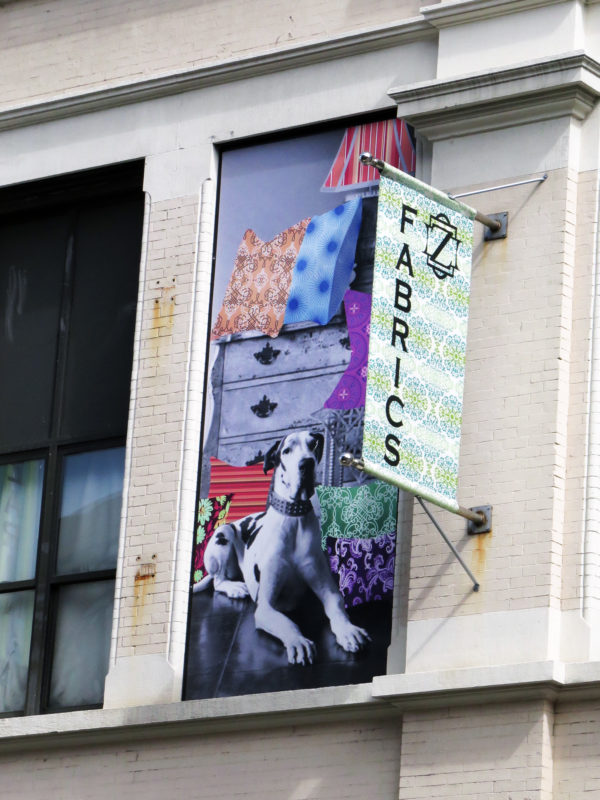
christo-sketch-uncropped-xlarge_trans++i4775N4LE1QgT4--AiardLyvLhmnMaE6WdE1QslAByAchristo-reichstag-large_trans++qVzuuqpFlyLIwiB6NTmJwVYUy4rw_nPPIq1hfIdv4MgLook at the materials needed – look at the size of the Reichstag that he wrapped – not likely he walked into the Michaels Crafts Emporium and said give me some 55,000 m2 of silver-grey shiny polyester fabric and 23 km of rope (which is exactly what the used to wrap a winter landscape of trees in Basel, Switzerland.) I have never seen one of these artworks in real life, but admired when I heard him in an interview how he simply refers to the pleasure and joy art can transmit without having to have deeper meaning. They always mention that the materials are recycled after the project is taken down (some criticism has always attacked the size of their endeavors) but I have yet to figure out what sources they use. Definitely not these: This Lower Eastside fabric outlet, there for generations, sold part of its building on Grant St. last year to some bank for $25.6 million – I guess upholstery didn’t pay the rent with Ikea in town….

IMG_2022

IMG_2023


The photograph of the flowers was taken at Frieze Artfair – unfortunately I cannot find the name of the artist. But it is another one of those where I wonder, where do the materials get collected???IMG_4952


Ahead of her Time

20110412_2754 copy

Netflix carries a movie How to make an American quilt that was scripted after a novel by Portland author Whitney Otto.  One of her more recent books which introduced me to the person I would like to meet today, has not yet been translated to the screen as far as I know. I’m sure it would be a huge hit – the brilliant book Eight Girls taking Pictures is a favorite of mine. Whitney is a gifted story teller. She has a talent for making you care about her characters, to bring their historical place and time effortlessly to the fore, and she weaves plots that are a pleasure to follow.

Eight Girls taking Pictures introduces several radical women photographers who were well ahead of their times, and had a price to pay for their breaking with tradition in the social, intellectual and sexual realms. You never know whether you are witnessing true biographic history or spun tales from tidbits, but it doesn’t really matter since the personalities of, among others, Imogen Cunningham, Lee Miller, Tina Modotti, Ruth Orkin and Sally Mann come across vividly, and the times in which they lived are accurately realized. Go read for yourself!

25794bb332374cabcdccedf6e95f8328My pick of all of them is Hannah Höch, one of the pioneers of photomontage, a member of the Dadaist movement (although not recognized, maybe even edged out, until the lat 1960s when her works started to appear regularly in major retrospectives.) Two years ago her works were shown in Great Britain by the Whitechapel Gallery – here is a review of her and her art. https://www.theguardian.com/artanddesign/2014/jan/09/hannah-hoch-art-punk-whitechapel

She was courageous, non-conformist, flexibly switching allegiances between male partners (she and Raoul Haussmann were a couple for years) and female lovers (she lived with Dutch writer Til Krugman.) She was political – her art declared degenerate by the Nazis, and risk-taking – she stuck the war out in semi-hiding outside of Berlin hiding her work and that of Dadaist exiles. She was a feminist and she never lost faith in her own ability to create true art – even though she had to contend with the saddening fact that not just the bourgeoisie denounced her, but her comrades from the Dadaist movement never took her seriously or jealously guarded their own turfs. (Below is a review of the Dada movement that is just turning 100 years old.)

http://www.prospectmagazine.co.uk/arts-and-books/dada-anniversary-switzerland-cabaret-voltaire-hugo-ball

Höch was born in Gotha, a town very close to Weimar where the photographs were taken.

20110412_2743 copy

She could teach me some real-life photo cutting skills with the scalpel, I would introduce her to photoshop, windows into each other’s worlds – I am absolutely certain we would have a blast with each other.

The collage below I found In Bushwhick, NY.IMG_2429

The Psychology of Color

· Rothko's Color Fields ·

IMG_5378 copy

Some years back I was invited by the Portland Art Museum to give a talk on the psychology of seeing in the context of its Rothko exhibit. Portland homeboy Rothko, color field Rothko, painter who makes people faint in front of his paintings Rothko. Unbelievably interesting and creative Rothko. Clearly his way with color created strong emotions in many viewers, and not just the elite who “knows art.”

440px-No_61_Mark_Rothko
Why might colors influence emotion? Part of the answer may be biological, so that for example colors that might indicate rot or decay might be hard wired into us as things to avoid or things that put us on alert. Part of the answer may involve learning, but it is learning that is inevitable in the natural world like bright sunshine makes bright colors possible but also raises the temperature, more or less guaranteeing that we come to associate those colors with heat and end up talking about warm colors. There are numerous studies showing how people respond emotionally to different colors. It seems that the color of a medicine capsule can influence whether people take their prescriptions meds on a regular basis or take them at all.  Likewise, cool and warm colors affect our sensation of temperature and so people reliably set the temperature higher in a room painted blue compared to a room painted yellow. Sports teams are penalized more often when they are wearing black uniforms. And certainly many studies have shown that hair color, eye color and of course skin color influence how we react to people. Learned associations between the forces of light and the forces of darkness carry, unfortunately, over into all kinds of stereotyping.

IMG_5468 - Version 2 copy 3

So, colors do trigger reactions. However, the various color effects are embedded in a cultural context. For example the association of pink for girls and blue for boys is a modern development. A century ago red hues were associated with masculinity and blue with femininity in Europe, something you can see in fashions and surroundings. In western cultures white stands for purity while in Asian cultures it signifies mourning, and it is interesting to notice that these cultural convention are picked up very early in life.

What does all this then imply for Rothko?  Some of the emotion effects, especially for the late paintings, are straight forward. He is using dark, somber colors, and I have already suggested that these may be tied to emotions for biological reasons or because of inevitable learning. It will be safe to assume that the darker colors towards the end of his life will be perceived to be sadder (independent of our knowledge about the artist’s own psychological state at that point in time) than the earlier, lighter work. Browns and greys and blacks, as we mentioned, might be associated with decay and danger, not just by learning but by some biological hard wiring

Mostly, though, I believe Rothko, in a sense, under – stimulates the eye. This leads you to respond by adding, wandering, exploring, associating. When you are then struck by the impact of these associations you’re likely to ask yourself: wo/man, where did that come from? And if you have nothing but strong color in front of your eye, it’s plausible that you assume that you must be reacting to the colors themselves.  In this way, the emotional reaction is real, but the idea that it is caused by color may just be a mistake.

Color can delight and depress. In vision, however, it has the primary function to help us to detect and discriminate between objects that have survival value.  I would therefor be cautious about strong claims of color causing emotional changes by and of themselves.  This takes nothing away from the astonishing beauty of these paintings.

IMG_5338 copy

Abstract Art and the Brain

IMG_4094 copy 3

“Abstract art does not stimulate the same brain regions as figurative art. Therefore it is not art.” That kind of statement by a prominent arts educator and co-editor of a major journal, Aristos, Michelle Kamhi, needs no comment other than eye rolling.  Yes, there is an association between presenting a figure to the brain and its object-recognition centers lighting up when tested with all the fancy gadgets and methods neuroscience has to offer. But why would the activity in other parts of the brain, when confronted with unfamiliar stimuli, exclude the classification of those stimuli as art? You tell me. (She, by the way, also managed to misinterpret the results of complicated physiological studies, and wrote prominently in the Wall Street Journal that art education has no place for political and social justice topic discussion, but should focus on teaching kids how to draw. Nuff said.)

Neuroimaging and its colorful pictures you see in the news are only correlations – they don’t tell you whether a pattern of activation is a cause of a mental state or a consequence. Even if we set that issue aside, knowing a pattern of brain activation is helpful only if we know the actual specific function of the activated regions, both on their own and as part of the overall ensemble of brain activity, and in virtually all cases we don’t have the level of knowledge about these functional issues to allow interpretation of these activation states – yet.

A lot of what is offered by neuroscience as the newest insight has been part of the psychological canon for centuries. If you look at a painting, figurative or abstract, at different times, while in different internal states, it influences how your brain reacts to it – duh. Personality variables are correlated with creativity – both in producing and consuming abstract art – a high degree of tolerance for ambiguity chief among them. Familiarity increases liking – so that it is more difficult to embrace unfamiliar art. Context influences what emotions arise: all viewers have more positive feelings  when they think an abstract painting is from a museum than was generated by a computer. The split between more educated audiences and the average person on the street in their degree of emotional reaction to abstract art has a similar cause: the context of knowing about the goals of the artist, or the history of modernism, might add to your appreciation of the painting in front of you. (In this case Kasimir Malevich)malevich.supremus-58

Here is the most interesting speculation. When we try to recognize something, activation can theoretically spread across the entire neural network that makes up our brain. That would lead to so many dead ends, that inhibitory mechanisms kick in at the start to narrow the search. With totally unfamiliar stimuli – like an abstract painting – that inhibition doesn’t happen because we don’t know what to exclude as least likely candidates. This frees our thought to go into many and unanticipated directions – an unfamiliar state that we might find pleasant since the brain reacts positively to novelty and insight. Ok, let’s end the psych lecture here and spare you additional reading….


Feather Weight or Heavy Hitter?

· The History of an Art Work Counts ·

IMG_3982 copy
Yesterday I wondered why the very fact that a child might paint like an adult (assuming that really is the case) might undermine people’s acceptance of the art form. After all, Picasso once said, “It took me 4 years to learn how to paint like Raphael, but a lifetime to paint like a child.” In the attached TED talk, Paul Bloom, a Yale psychologist, offers an interesting argument. https://www.ted.com/talks/paul_bloom_the_origins_of_pleasure?language=en

He claims and I quote: “…humans are, to some extent, natural born essentialists. What I mean by this is we don’t just respond to things as we see them, or feel them, or hear them. Rather, our response is conditioned on our beliefs,about what they really are, what they came from, what they’re made of, what their hidden nature is. I want to suggest that this is true, not just for how we think about things, but how we react to things.”

Bloom believes this explains why we detest art forgery, independent of the status that an original painting confers to the buyer. If we are influenced by origins, then the original matters. It has a history of creative power, which the forgery doesn’t.  He goes so far to speculate that Goebbels’ suicide shortly after he learned that his treasured Vermeer was a fake had to do with that shock. (May that monster rot in hell.)

DSC_0223 acopy

If you like abstract art, you are more inclined to believe that these paintings are difficult to create, require time, restraint, thought and special craft. Those elements are not associated with child’s play (independent of whether the child had help from adults) and thus children’s works are not counted. 

These days there is another child abstractionist, Australian Aelita Andre, whose paintings sell for $50,ooo in Soho art galleries. She is considered a true child prodigy; you find many fewer of them in visual arts than in other areas like math and music. Nature seems to play more of a role than nurture in their development and the children have “a rage to master, an obsession to conquer the craft and spend hours honing their skill.” The attached article gives an interesting overview, but leaves us again with more questions than answers.

lead_large

http://www.theatlantic.com/entertainment/archive/2014/11/what-makes-a-child-an-art-prodigy/382389/


My child could paint this!

· The Marla Olmstead Story ·

IMG_4156 copy 2

I remember childhood summers spent at the North Sea in Holland, mixing buckets of sand and water in just the right proportion to drip the mud through my fist, forming what looked like little pine trees. It was a visceral pleasure to grab and release that viscous mix onto the beach. When I look at a Jackson Pollock painting I often wish I could return to that state, using my hands with thick paint instead of mud.

Unknown

Another favorite activity was raking patterns into the wet sand close to the waves, with expansive sweeps and twirls, running, freeing your body from the constrained movements urged on girls in polite company. I can almost feel my arm swinging again when looking at a Phillip Guston painting, a kinetic experience.

schwabsky_guston_FULL_img

I wonder if the attraction of abstract art which allows not to think about “meaning,” for some of us, then, is the ability to re-live an experiential state. Art critic Harold Rosenberg claimed that painting for Pollock and other abstract expressionists was an event, the meeting with paint an encounter. Perhaps their paintings creates echoes of action rather than cognition in our perceptions, an emotional memory of earlier, freer times. In addition, some  neuroscientists suggest that our brains have mirror neurons, which would show activation mirroring the movements of the painters when creating the work. These elusive neurons are a hotly debated topic across perception research; I, for one, still need convincing.

http://www.wired.com/2013/12/a-calm-look-at-the-most-hyped-concept-in-neuroscience-mirror-neurons/

And yet the very idea that a child could paint an abstract masterwork, or that those famous artists had reverted to a more child-like mode, has people question the validity of the art. The best example of this was an affair some ten years ago around a 4 year old child prodigy, Marla Olmstead. Taking the art world by storm with her abstract paintings and making big money, 60 Minutes eventually questioned her abilities and declared she had grown-up help, parents who enabled fraud. A subsequent documentary by Amir Bar Lev installed hidden cameras to catch her in the act, and discussed  the media frenzy around it all, itself becoming some sort of exploitation. https://www.youtube.com/watch?v=j46V9wclBaw (The entire film is also available on youtube).
People were obsessed with finding out “the truth” – to what end? Would a child’s ability to create an abstract master work, devoid of cynicism, painted in child-like naiveté, really void the accomplishment of adults’ paintings? Is the very assumption that that might be possible an acceptable reason that so many people dismiss abstractionism?  I’ll continue to explore this tomorrow.

Abstract Art is dead. Long live Abstract Art!

· Paintings of Lee Musgrave ·

Egg-Red copy

In 1940 the New Republic published an article written by Wyndham Lewis, a painter himself, with the title The End of Abstract Arthttps://newrepublic.com/article/80125/the-end-abstract-art  This witty, sometimes pompous, obituary was clearly premature. If you look at the catalogues of modern art museums in this country and around the world 76 years later, you find the art form dominates the field. Countless journal articles explore its theoretical underpinnings, trying to predict a trajectory.

Closer to home, you find serious artists engaged in its application. Lucinda Parker, Whitney Nye, Terrel James and Gwen Davidson are among them. (Note, all women!) I chose to showcase Lee Musgrave. I like his work and know him as a fellow photographer who walks the same landscapes as I do. I thought it would be interesting to compare photographs of some subjects with his painterly extractions around the same matter. My current take on it is that painting beats photograph every single time. A photograph is of course the pinnacle of representation – the capture of something at a given moment of time. Depending on how much of a thing you photograph it can be more or less  abstract, but really it is of a thing, a documentation. Lee’s abstract painting, on the other hand, draws out some essence, value added by the application of craft, the creation of imagined juxtapositions. Judge for yourself. (Note, I took all these photos long before I even met Lee, planning to use them as building blocks for montages.)

LeeMusgrave_Rendevous#2,45x84

IMG_4094


LeeMusgrave_Happenstance#9-Impulvise,30x40


DSC_0223


LeeMusgrave_FromHereToThere,60x60

DSC_0107


LeeMusgrave_InTheNow#2,40x30

DSC_0121

And here is the match for the lead montage – egg above meet chick below! At least that’s what I see in this painting with the little chicken feet, superimposing reference once again.Schorschi'sWall,60x60

Non-referential, huh?

· Confusion reigns - but that's probably me ·

DSC_0243 copy 5

Written by the editors of the Encyclopedia Brittanica: “Abstract artalso called nonobjective art or nonrepresentational art, painting, sculpture, or graphic art in which the portrayal of things from the visible world plays no part. All art consists largely of elements that can be called abstract—elements of form, colour, line, tone, and texture. Prior to the 20th century these abstract elements were employed by artists to describe, illustrate, or reproduce the world of nature and of human civilization—and exposition dominated over expressive function…. Abstract art has puzzled and indeed confused many people, but for those who have accepted its nonreferential language there is no doubt as to its value and achievements.”

Let’s look at an art critic’s alternate universe (and just so you know how my mind works I chose an art review based on a name of an abstract painter – how can one not explore the art of someone called Cy Twombly?) And I quote:

“It is a cliche that abstract art is distant from real life, impenetrable and remote. Twombly is an abstract painter who tells stories of love, longing and loss. His art is always tangy with experience – it drips life.” Jones refers here to a painting about Hera and Leander, dedicated to Christopher Marlowe, and interprets splotches of color quite convincingly as blood, misty seas, evocations of watery graves (true for all three referenced persons in one way or another.) Note that the references depend on your knowledge of myth and/or history, but references they are, red allegedly representing the bloody fate of Marlowe. Twombly’s paintings, which I have only explored on the web, are of astonishing beauty, storytelling or not. He died some years ago.Cy-Twombly-Hero-and-Leand-007

The lead montage, by the way, is part of my series On Transience that was exhibited last year at the Oregon Jewish Museum. The subject matter concerned the nature of Jewish emigration, and the transient psychological state that comes with displacement in general.

Where does all this leave the quest for understanding abstract art? Yesterday we learned the canon has been challenged; today we find that accepted definitions of the nonrepresentational nature of abstract art is confronted with claims of a representational narrative structure inherent to it after all. Did someone mention confusion?