Browsing Tag

Wislawa Szymborska

Unseen.

I want things to unfold slowly, often my things are quiet and simple enough that it takes time—a kind of slow overlapping—before people feel it.” – Anna Valentina Murch

Unfold slowly it did. It took me a full decade not jut to feel the art but to actually see it.

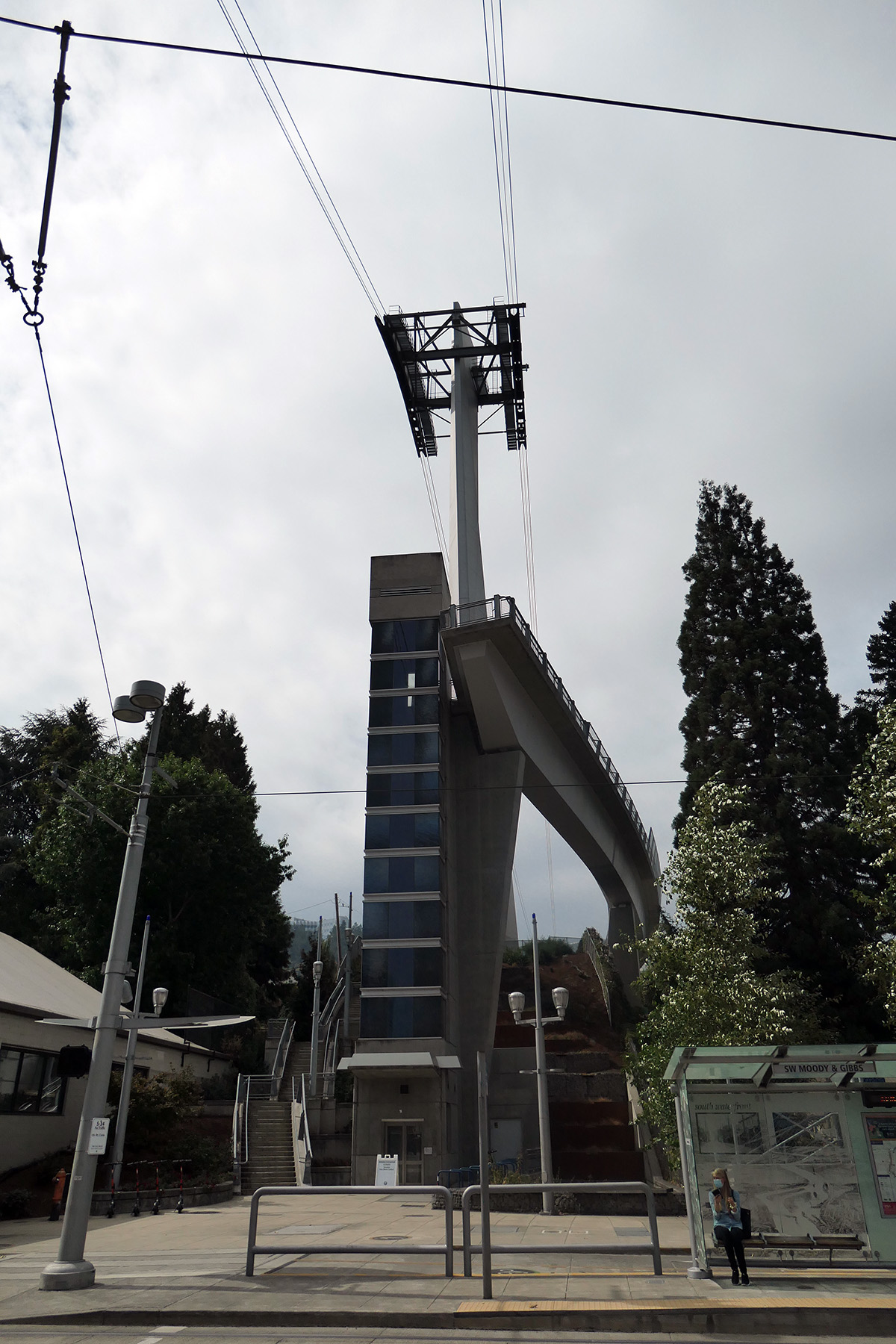
I’ve walked by that elevator shaft on the waterfront for years without ever noticing that the windows contained images of water, different configurations of waves illuminated by differences in light depending on cloud formation or time of day.

Created in 2011 by Anna Valentina Murch (lovingly remembered (and quoted) after her untimely death in 2014 by a friend here,) the unassuming public art is called River Wrap. It consists of 40 photographic images on glass that frame the corners of the ten story elevator tower that connects the Darlene Hooley bridge to the Moody plaza below. The photographs are of reflections of light moving across the surface of water echoing the bordering landscape, the Willamette river.

The idea of water seemingly filling a tower might have had different connotations in 2011 compared to 2021. Then it represented beauty, perhaps intended to be soothing, a reminder of waves lapping gently. Now I can but think of the hurricane-induced flooding of buildings, or memorials to rivers run dry, if not the drowned – art does change when historic context changes.

The elevator is currently closed, so I had no chance to explore what they would look like when you travel up and down at slow speed, or if they can be seen from within at all.

Murch was a British installation artist based in San Francisco. Solo works or those together with her husband Doug Hollis often focussed on ways to make people spend time and look: accentuating reflections, sparkle, glow and change in color of light on various surfaces, often water. A more familiar work here in Portland is the light art attached to the Tillicum Crossing Bridge. It uses 178 LED modules to illuminate the cables, towers, and underside of the deck. The base color is determined by the water’s temperature. The timing and intensity of the base color’s changes, moving the light across the bridge, are determined by the river’s speed. A secondary color pattern is determined by the river’s depth, that changes on the two towers and the suspension cable.

Other notable art installations by her can be found here.

So why did I notice River Wrap now and not before? A possible proximal cause: the light hit it just right to sparkle. But it was a gray, diffuse afternoon.

A two part answer could be:

(1) Distraction.

The elevator tower is across the street from the aerial tram station, where comings and goings of those futuristic looking passenger capsules draw your attention. There is also a never-ending stream of people entering or exiting the OHSU medical building, bound to draw your gaze. There is the new(ish) bridge glimpsed in the background at the river, usually the destination for my walks, beckoning the camera. So I never attended to the west side of the Moody Plaza before.

(2) Increased Attention.

Due to restricted movement, my radius of exploration has so incredibly shrunk. No more travel, no more visits to indoor spaces including exhibitions in galleries and museums, alike. No more walking or photographing where crowds of people congregate, all due to the pandemic. Those spaces, then, that are still open to me therefore are looked at in search of anything that is new, or worthwhile thinking through, or good for surprises while I walk there over and over and over again…

After all, the poem below does not apply to me (although I love it, like so much of her work.) I do behave in the cosmos as advised. At least I try to think so of myself…

Distraction

I misbehaved in the cosmos yesterday.
I lived around the clock without questions,
without surprise.

I performed daily tasks
as if only that were required.

Inhale, exhale, right foot, left, obligations,
not a thought beyond
getting there and getting back.

The world might have been taken for bedlam,
but I took it just for daily use.

No whats — no what fors —
and why on earth it is —
and how come it needs so many moving parts.

I was like a nail stuck only halfway in the wall
or
(comparison I couldn’t find).

One change happened after another
even in a twinkling’s narrow span.

Yesterday’s bread was sliced otherwise
by a hand a day younger at a younger table.

Clouds like never before and rain like never,
since it fell after all in different drops.

The world rotated on its axis,
but in a space abandoned forever.

This took a good 24 hours.
1,440 minutes of opportunity.
86,400 seconds for inspection.

The cosmic savoir vivre
may keep silent on our subject,
still it makes a few demands:
occasional attention, one or two of Pascal’s thoughts,
and amazed participation in a game
with rules unknown.

Wislawa Szymborska (1923-2012): Distraction, from Colon (2005), translated by Clare Cavanagh in MAP: Collected and Last Poems, 2015

One thing is clear, though. So much public art is so in your eye, so prominently placed or gaudily executed that it is almost impossible not to be aware oft it. The quieter kind, like today’s example, then packs the punch of discovery, unbidden, serendipitously,creating a louder and longer lasting emotional echo, at least in my case. A gift.

Water-related music today by Sibelius.

Dreams (1)

Admittedly it’s not a random sample, but many of those who I talk to or correspond with these days relate how much they are inundated with bad dreams. Personally, I’ve had dates with full-blown nightmares way too often in the last year, but that could be explained by illness. The general increase in harsh nocturnal screenplays is surely related to the state of the world, the state of our lives in these strange times.

The poem I am introducing below struck me as all the more remarkable when read against this backdrop.

In Praise of Dreams

In my dreams
I paint like Vermeer van Delft.

I speak fluent Greek
and not only with the living.

I drive a car
which obeys me.

I am talented,
I write long, great poems.

I hear voices
no less than the major saints.

You would be amazed
at my virtuosity on the piano.

I float through the air as is proper,
that is, all by myself.

Falling from the roof
I can softly land on green grass.

I don’t find it hard
to breathe under water.

I can’t complain:
I’ve succeeded in discovering Atlantis.

I’m delighted that just before dying
I always manage to wake.

Right after the outbreak of war
I turn over on my favorite side.

I am but I need not
be a child of my time.

A few years ago
I saw two suns.

And the day before yesterday a penguin.
With the utmost clarity.

Wislawa Szymborska

So is this poem from View with a Grain of Sand (1996) a description of a person who comes into her own in her nightly dreams? More than that, really – is it a boast that she excels, displays mastery, is in full control over life and death and obviously dreams, can decide when and where to focus attention, to partake, to belong?

But for a few stanzas, everything starts with “I” – the narcissistic focus of an imagined parallel life? Or the determination to have some agency in dreams, when deprived of it in real life? Is it an invitation to focus on the positive, as exaggerated as can be, to set lofty goals instead of enduring what’s on offer here and now?

The poet is a real magician in how she draws us in – starting with a painter’s name that triggers something visual, just like in a dream, perhaps a painting that most people have a vague memory of – didn’t the girl with the pearl earring or something related pop up just now? Progressing to some auditory bits (speaking Greek, hearing Saints,) with a side dish of time travel, just like in dreams that move so fluently between the past and present, the worldly and the otherworldly realms. She’s in control – of cars, of flying, of outcomes – no broken bones from falls, no drowning episodes, no futile pursuits – hey, there’s Atlantis after all! She’s no less than a master in everything she touches, from visual art, to music, to writing, and you would be amazed – calling in the recognition that’s deserved by addressing us directly. The prevalence of falling in dreams is acknowledged, a stanza that does not begin with “I”, though it, as well, ends up with dreamt invincibility.

So what happens in the end? A clear memory of a real dream which contains nothing of the professed wizardry, but instead simply two suns. A double dose of light to illuminate the futility of wishful thinking? A symbol for another universe, one where the gap between reality and wishful thinking can be bridged?

A penguin dream, the other day. Getting cold feet, waddling on thin ice? Or the ability to perceive possibilities, strange creatures, with clarity, even if they exist as far removed from us as they currently do? Your guess is as good as mine.

The whole thing requires some serious thinking. Turns out that’s just the thing that will defeat bad dreams.

I am not just saying that. Scientific data are truly reassuring: we can influence our dreams with thinking, even post-traumatic nightmares. Here is a good, easily read introduction to the findings and methods.) Go ahead, practice!

Sweet dreams.

Of Apologies and Good Intentions

Many people who celebrate Christmas have a decorated Christmas tree (if they are lucky: tree shortages are reported.) The custom actually predates Christianity by centuries. Ancient Romans decorated trees with small pieces of metal during Saturnalia, their winter festival in honor of Saturnus, the god of agriculture. Modern Christmas trees appeared in the middle 1500’s.

It is customary to put a star on top which symbolizes the Star of Bethlehem, purported to have guided adoring folks to the manger where the Messiah was born. Angels can be found up there (the manger and the tree) as well, the latter ever after Queen Victoria introduced them in her Windsor Castle decorations. Unlikely that they look like the angels from today’s photographs, though. (Here is a lovely history of the Christmas tree customs.)

My thoughts today, however, were prompted by a different star, one used with customary slight of pen by one of my favorite poets to point to the vastness of the universe where even the sun is small, and to our corresponding speck-ness. Yes, I know, not a word, but an image that, you will hopefully agree, captures our limitations.

Under a Certain Little Star

Wislawa Szymborska

My apologies to chance for calling it necessity.
My apologies to necessity in case I’m mistaken.
May happiness not be angry if I take it for my own.
May the dead forgive me that their memory’s but a flicker.
My apologies to time for the multiplicity of the world overlooked
  each second.
My apologies to an old love for treating the new one as the first.
Forgive me far-off wars for taking my flowers home.
Forgive me open wounds for pricking my finger.
My apologies for the minuet record, to those calling out from the 
  abyss.
My apologies to those in railway stations for sleeping comfortably 
  at five in the morning.
Pardon me hounded hope for laughing sometimes.
Pardon me deserts for not rushing in with a spoonful of water.
And you O hawk, the same bird for years in the same cage,
forever still and staring at the same spot,
absolve me even if you happened to be stuffed.
My apologies to the tree felled for four table legs.
My apologies to large questions for small answers.
Truth, do not pay me too much attention.
Solemnity, be magnanimous to me.
Endure, O mystery of being that I might pull threads from your
  veil.

Soul, don’t blame me that I’ve got you so seldom.
My apologies to everything that I can’t be everywhere.
My apologies to all for not knowing how to be every man and
  woman.
I know that as long as I live nothing can excuse me,
because I myself am my own obstacle.
Do not hold it against me, O speech, that I borrow weighty words,
and then labor to make them light.

Translated by Joanna Trzeciak

(For language lovers, here is a serious treat – 4 different translations of this poem side by side.)

The poem holds for me a complicated emotional tension, one that has been particularly true in this year, a year that held personal tragedy for our family and shared tragedy for mankind, from the persistence of hatred between those not like each other, the victory laps of greed and power, the premature death of so many to, finally, the unmitigated slide towards climate disaster.

The poem’s endless run of apologies had its echoes in my own head – the sense of unearned privilege against the suffering of the many, the sense of inadequacy in fulfilling public moral obligations or my own demands of a private ethical self. Thinking of yourself as inconsiderate, forgetful, unjustly privileged, over-consuming or all around your own obstacle is, on the one hand, a good thing. Insight could lead to change.

On the other hand, it is also a preoccupation with self, with our own role and importance, with individual choice that might or might not make a difference. I do not read the poem as solely a call to go gently on yourself, allow yourself pleasure, acknowledge that you can’t fix everything, an encouragement to just lead your life, because no-one is perfect. I do not believe that self, alone, is to be the ultimate obstacle, the challenge to what is happening under a certain little star.

The title of the poem that puts the individual under a planetary body really points to the fact, in my reading, that it is not just about me, that infinitesimal small speck in the universe. It is about us, all of us, that live and love, act and die under this sun. It is as a collective, on a shared planet, that we have to change ways, or can change ways, with the individual improvement being a necessary but not sufficient step. The focus on untamed individualism, for good or bad, blinds us to the dire need for concerted action as community. We need to plan, agree upon, and carry out changes with shared intent, because the cause is bigger than just individual remedies of personal imperfections.

I, too, across the years, have labored to make words light in this blog, but these I mean in all their weight.

I will take a little break and resume writing in January. Happy Holidays!

The Urge to Display

Yesterday was an emotional day. We attended my son’s dissertation defense via Zoom, sad that we could not be there in person for his graduation. I was also bursting with pride, of course, and simultaneously raging that the current circumstances prevent travel so I could not hold my son in my arms. I was frustrated that I did not understand a word of what he talked about in his presentation, just as I never did when I had occasion to hear my father giving a talk – both passionate chemists. It was bittersweet to think that his grandson chose the same path, never to be seen by him, or his other grandfather, unless there are little viewing slots between this dimension and the one for the departed. Shutters that open for special occasion….

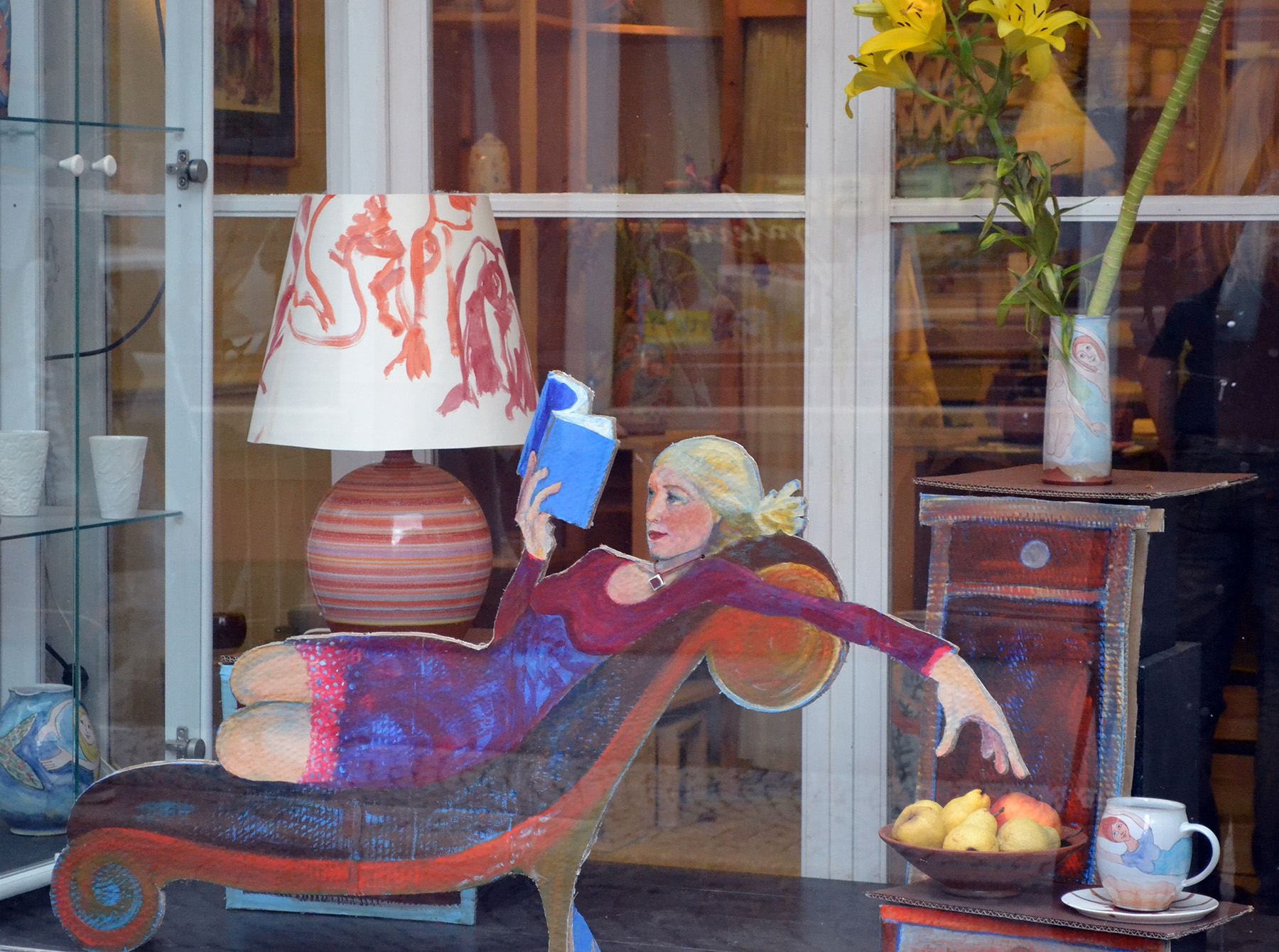
Shutters made me think of windows, windows made me think of how people decorate them, or simply use them to display, well, almost anything, from signs to art to whole collections of stuff. So much stuff. Spilling out.

I have attached a small sample of what caught my attention over the last decade, most of it from Europe, but a couple of them from the U.S.

*

For me it was simply curiosity, while more professional photographers approach window displays with strategy. To lovely results in the case below, I might add. Larger images can be found on the links.)

Jean-Luc Feixa has a new book out that really captures much what is familiar to me from Northern Europe (in his case he photographed in Belgium.) Although I am keen to introduce mostly young women photographers, given the gender imbalance regarding recognition in this as in so many fields, I really liked Feixa’s work when I first saw his landscapes some years ago. They were photographed at the Franco-Spanish border with its contradictory landscape of misty mountains and barren desert. And how can you not covet an artist statement like this:

False American decor – perfect! Now what do we call all that decor in the windows? Open to suggestions!

And here is poetic wisdom that points to the trouble with clinging to the past, the urge to display, and holding on to things…..

The Three Oddest Words

By Wislawa Szymborska
Translated by S. Baranczak & C. Cavanagh

When I pronounce the word Future,
the first syllable already belongs to the past.

When I pronounce the word Silence,
I destroy it.

When I pronounce the word Nothing,
I make something no non-being can hold.

And here is César Franck‘s quintet, wistful (in honor of the Belgian windows,) and intricately constructed (in honor of my son’s synthetic molecule.) Mazel Tov, Solomon!