The Hope I Know
doesn’t come with feathers.
It lives in flip-flops and, in cold weather,
a hooded sweatshirt, like a heavyweight
in training, or a monk who has taken
a half-hearted vow of perseverance.
It only has half a heart, the hope I know.
The other half it flings to every stalking hurt.
It wears a poker face, quietly reciting
the laws of probability, and gladly
takes a back seat to faith and love,
it’s that many times removed
from when it had youth on its side
and beauty. Half the world wishes
to stay as it is, half to become
whatever it can dream,
while the hope I know struggles
to keep its eyes open and its mind
from combing an unpeopled beach.
Congregations sway and croon,
constituents vote across their party line,
rescue parties wait for a break
in the weather. And who goes to sleep
with a prayer on the lips or half a smile
knows some kind of hope.
Though not the hope I know,
which slinks from dream to dream
without ID or ally, traveling best at night,
keeping to the back roads and the shadows,
approaching the radiant city
without ever quite arriving.
BY THOMAS CENTOLELLA
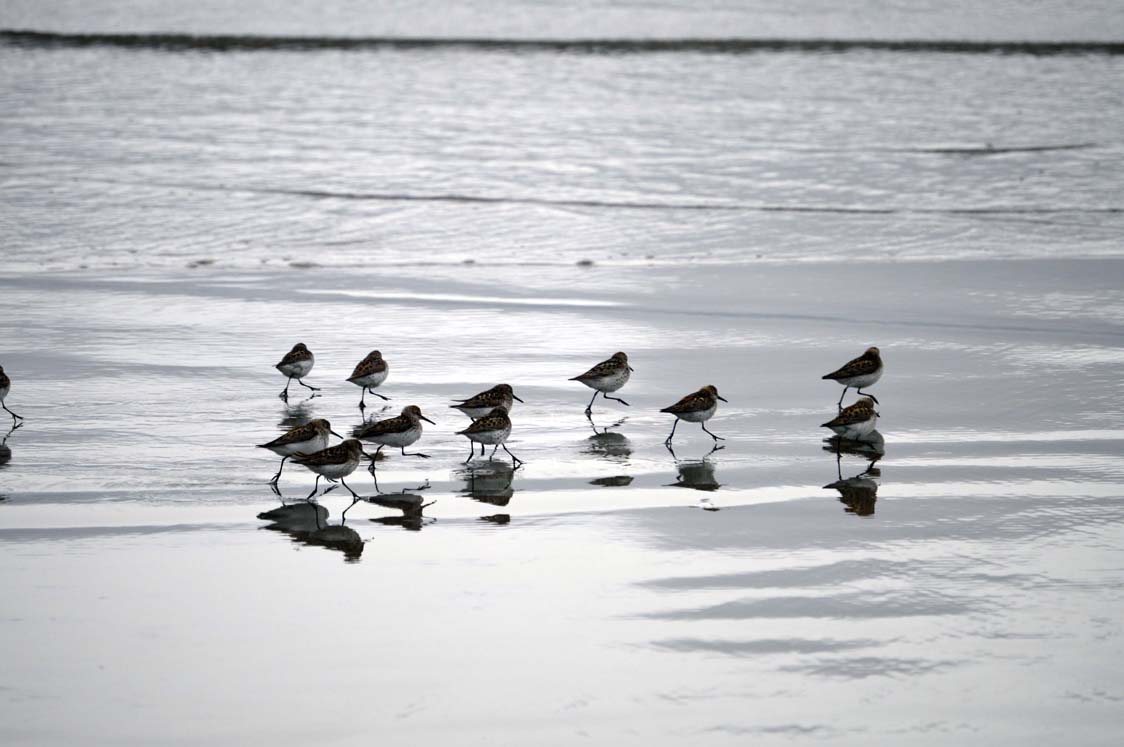
Last week, I set my mind to beach combing, rather than keeping it from the idea. Hope needs sustenance, and it can be found on beaches, unpeopled or otherwise. Although the one I went to seemed to be a world in its own, not a soul in sight. Only traces left via drift wood edifices. Intriguing, but not as beautiful as the drift wood itself.


It was cool, bordering on cold, with intermittent squalls. Not flip-flop weather, a rain coat over the sweatshirt. A welcome break from the heat, though, that had taken a bite out of me.

After so many decades after my arrival in the United States I am still amazed at the frequent experience of being alone in vast spaces, nature easily reached near population centers, all yours, and yours alone, for the taking.

No witnesses to loud singing with a voice cracked by chemo so many years ago, or angry screaming, or crying your eyes out – all the things I phantasize about as possible private acts during solitude. Except, once I’m in nature, those urges completely vanish, my mind and soul entirely focused on the treasures around me, the intricacies of evolutionary design.


A focused mind, until it drifts to things I’ve read about the beach and ocean when I was young and completely impressionable. Now old, and intermittently impressionable, I shudder to think about how I was moved by Ann Morrow Lindbergh’s meditations on grief adjacent to emerging environmental concerns, A Gift from the Sea.


Little did I know, beyond her tragic loss of a child to kidnapping and murder, that she was a not-so-closeted admirer of fascism and Hitler in particular, arguing that totalitarian regimes were “manifestations of an inevitable historical wave of the future.” (Will she have the last laugh, after all?) Being married to a serial cheater, sympathizer and fascist-adjacent Charles Lindbergh, and bearing him 6 children, was nowhere on my teenage horizon. I was simply eager to embrace female role models that excelled in flying air planes and being a successful writer simultaneously.

Role models that embraced science and poetry in one fell swoop, like – the political impeccable – Rachel Carson, who wrote about the oceans with a conservationist’s mind even before I was born. I devoured The Sea around Us.
Hope, at the time, was not about approaching a radiant city, like Thomas Centolella describes in his poem above, but about finding an independent place in the world to explore who I was. Self-centered, in other words, but aware of threats to nature even then.

Carson had it right:
“I wonder if we have not too long been looking through the wrong end of the telescope. We have looked first at man with his vanities and greed and his problems of a day or a year; and then only, and from this biased point of view, we have looked outward at the earth he has inhabited so briefly and at the universe in which our earth is so minute a part. Yet these are the great realities, and against them we see our human problems in a different perspective. Perhaps if we reversed the telescope and looked at man down these long vistas, we should find less time and inclination to plan for our own destruction.”

Like the poet, I know many types of hope. Mine, as well, struggles to keep its eyes open. And it occasionally centers on the young being able to find all kinds of books and be educated, not censored; to read and comprehend early, with patience and the ability to analyze; to tolerate the hard parts of learning, because the acquired knowledge will sustain you through many decades of your life. In other words, not let their minds rot through the use of AI.

If we’re lucky, they will be able to fight the planned destruction, enabled by knowledge and critical thinking! The destruction of the radiant city, the shining symbol on the hill, for one. Before Reagan used this biblical phrase to celebrate American exceptionalism, it was meant to remind us that morality was the cornerstone of this symbol of hope.
Speaking of which (a moral approach to bolstering democracy, that is): if you are in favor of vote by mail, now is the time window to send your comments to the Postmaster regarding the plan to refuse vote mail delivery/absentee ballots in States that will not hand over their voter rolls to the Trump Administration. Here is the link for easy commenting, offered by the League of Women’s Voters. It takes two minute, max.

Music is happy today. In celebration of the (unexpected) majority decision of the Supreme Court to allow counting of mailed ballots that arrive after election day, but were post marked in time. A win for democracy and voters.
