“Enter this sublime corrosion,
Venice drowning in emotion.”
— Venice Drowning, Duran, Duran
The real Venice is not only drowning in ever more frequent and intense flooding caused by climate change, but also in visitors. Like many other cities in Europe, overcrowding by tourists is a serious issue. On the one hand, the traveling masses contribute to the local economies, on the other hand they devour resources subsequently no longer available to those who need them in place. Venice alone has over 8300 spaces rented out by AirB&B, rooms, apartment or houses no longer on the market for locals in need. During the summer, tourists outnumber locals 2:1! This is one of the reasons of brain-drain – educated people are leaving the city, pursuing better options outside of tourism, and leaving a decimated population behind.

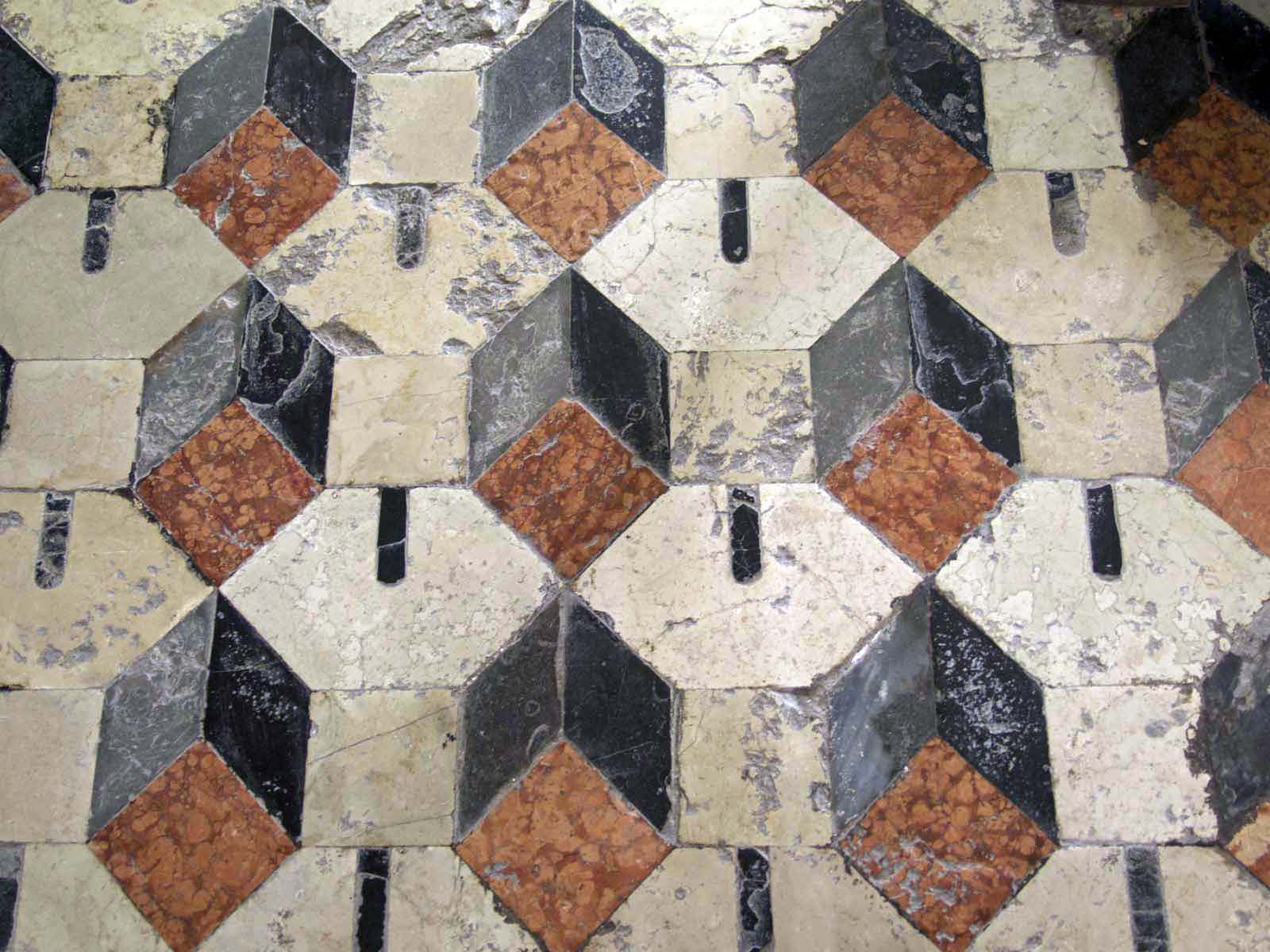
The city also deals with the damage brought to its streets and canals by accumulating trash; the wake of the many boats used for commerce as well as tourism is destroying house and bridge foundations, with repair funds then not available for prevention measures against flooding in general. The many, many feet entering historical sites across Italy, like churches and cathedrals, also wear out church and public building floors, often of archeological or art historical significance (thus today’s pictures from someone who participated in the tourism onslaught, admittedly. Tiles are marble, terracotta, mosaics – the gamut – all beautiful.)

Venice tried to lower the number of visitors by imposing an entrance fee, to no avail. They have now doubled the price of a daily admission ticket (over $10 per person), but if you read the conditions it is clear that there are more exceptions than rules: free after 4:30 pm, free if you stay in Venice proper itself, required only on certain days of the year, etc. – real decreases in number of visitors will have to be achieved by barring rentals, a legally difficult thing to pull off in a free market economy.
In any case, my thoughts went back to the exquisite days I spent in Venice by myself a decade or so ago, marveling at the displays of the Venice Biennale, when I read what our new administration pronounced recently regarding applications for showing at next year’s Biennale. For one, selections are to be announced in September, allotting an astonishingly short timeline, 8, instead of the customary 11 months for artwork preparation.


More importantly, “collaborating artists and curators are now expected to outline how their program ideas “will work to advance the interests of the United States in program administration, design, and implementation.” The proposal review criteria will evaluate an artist’s “ability to showcase American exceptionalism and innovation.” A funding limitations and restrictions section forbids any funds to be used for programming related to Diversity, Equity, and Inclusion (DEI) in accordance with President Trump’s executive order mandating the end of DEI initiatives at the federal level. (Ref.)
People have contacted the ECA and also the National Endowment for the Arts (NEA), responsible for convening the panel of proposal reviewers, for additional information regarding the shortened timeline, and what constitutes American values. So far, no clarification. Perhaps not surprising, given that the ENA, along with the National Endowment for the Humanities and the Institute of Museum and Library Services, is one of multiple government agencies President Trump has threatened to eliminate in his federal budget.
A gentle reminder: deciding which art was (un)acceptable was a huge part of Hitler’s use of his powers (as a slighted artist himself seeking sweet revenge) and the Nazis in general.
“After the Nazi seizure of power in 1933, Germany’s new rulers organised so-called ‘Schandausstellungen’ (condemnation exhibitions) across the Reich; these would ultimately serve as the blueprint for the 1937 Munich exhibition. The exhibitions, which had titles such as Schreckenskammer (Chamber of Terror), Kunst im Dienste der Zersetzung (Art in the Service of Subversion) and Entartete Kunst (Degenerate Art), were united by a common theme: they denounced works of art which were interpreted as an attack against the German people and as symptoms of a cultural decline inextricably associated with liberal democracy. The exhibitions argued that this art had been nurtured by those politicians who had betrayed Germany by signing the Versailles Treaty (the peace treaty that ended the First World War), condemning Germans to a life in servitude to outside forces, and who had thereafter promoted utterly destructive social and cultural trends. Many of the artworks displayed in these early exhibitions would later be confiscated in 1937, recorded on the inventory, and displayed in the Munich exhibition of Degenerate Art. Such pieces included Otto Dix’s anti-war paintings that depicted the gruesome reality of trench warfare and the emotionally and physically crippled veterans it produced. These were denounced as an attack on the honour of the German soldiers and an assault on their heroic memory.
It applied the ‘racial science’ of the day to the art world, establishing a disturbing connection between artistic expression and mental or physical disabilities, both of which were supposed to be eradicated from the ‘racial community’. According to this perspective, all artworks inherently mirrored the racial quality of the artists themselves. This meant that artists considered racially healthy would produce art that celebrated and furthered the advancement of the German race as a whole. By extension, individuals with mental or physical ‘defects’ were thought to be capable only of producing art that mirrored their ‘racial deficiencies’. (Ref.)


Maybe the US contribution to this year’s Architectural Biennale in Venice, should be considered along the administration’s criteria.- For a Biennale titled “Intelligens. Natural. Artifical. Collective,” curated by Carlo Ratti and devoted to illuminating architectural and design solutions for a world threatened by climate change and environmental destruction, the Americans picked: THE PORCH. Yup, that place that the exhibiting teams of architects call an “architecture of generosity.”
Well, I have obviously not seen it first hand, and one can also argue that porches are a place of socializing and potential connection, and extend beyond domesticity, given that we find porches occasionally on civic buildings, libraries, grocery stores, public housing. Oops, is that DEI already? Yet porches are also primarily places of rest, when really we are called to action, at a time when the pressing environmental issues demand solutions.

All the other pavilions went in that direction, exploring tools of technology, artificial intelligence and collective action (under the umbrella of the title) to propose future-oriented designs. Here is a detailed overview of what is currently on offer. Some exhibitions are interactive, bringing the points home in sometimes uncomfortable ways. The German Pavilion, for example, exhibits Stresstest, where you enter a room that makes you suffer from the heat emitted by AC and other technologies.
“German Pavilion curators pose a critical question: How will humans, animals, plants, and infrastructures withstand these rapidly accelerating developments? The exhibition takes an urgent tone, warning that some European cities could become uninhabitable within a few decades. Despite this imminent threat, climate-adapted urban planning is still not being prioritized. The “STRESSTEST” exhibition aims to make this future urban climate both physically and psychologically tangible, asserting that architecture and landscape architecture can and must play a crucial role in creating climate-resilient cities.” Can you imagine something like this now funded by the US administration? Despite its relevance for the health and survival of our very own population?

“Kabage Karanja, co-founder and director of Cave_bureau based in Nairobi, Kenya, and Kathyrn Yusoff, professor of Inhuman Geography at the University of London, were the curators of the British Pavilion Titled GBR – Geology of Britannic Repair, the exhibition reflects on Britain’s architectural legacy and its entanglement with histories of colonialism, geological extraction, and the urgency of the climate crisis. In recognition of their exploration of the relationship between Great Britain and Kenya, focusing on themes of reparation and renewal, the Pavilion curators and commissioner were awarded a Special Mention for National Participation by the Biennale jury.” You think a proposal like this would even be read by the current US administration? Never mind receiving awards?
How will American artists be able to resist muzzling and still create something that speaks to contemporary society, much less has a chance of being awarded grants that allow exhibitions? How will we not become the laughing stock of the world?

In any case, if I were able (and willing) to travel to Venice right now, one of my first visits would be to the Procuratie Vecchie, a building running along one side of St. Mark’s Square, now open to the public for the first time in 500 years in its new form as the San Marco Arts Centre (SMAC). For its opening, they are featuring two architecture-themed solo shows, one a retrospective of the Austrian-Australian architect Harry Seidler—dubbed “the high priest of modernism”—and the other the first international exhibition of the pioneering landscape architect Jung Youngsun. Both promise to be fascinating.

Seidler brought Bauhaus to Australia, and his work is true to his maxim: “Architecture is and always was above all, an art form; that interdependence exists between all the visual arts… The form that architecture takes should have its roots and marriage with painters and the world of the other visual arts. They are all intertwined, and they all reflect the impetus of our time.”
YoungSun Jung has done incredible cross-cultural adaptations of landscaping styles to her native Korea and was a pioneer as a woman in a male dominated discipline.
And then you can go and feed the pigeons on St. Mark’s Place. They will probably still be around when the whole of the island has been washed away…. it is expected to have sunk completely by the year 2100. Details on causes for the sinking and proposed mitigations (all limited and insanely expensive) here.

And here is, of course, Duran-Duran.
