Browsing Tag

Benton Museum of Art Pomona College

Framing.

Framingn. the process of defining the context or issues surrounding a question, problem, or event in a way that serves to influence how the context or issues are perceived and evaluated. Also called framing effect.  – APA Dictionary of Psychology

***

I have been thinking a lot about framing lately. The notion of framing plays a large role in traditional areas in psychology, judgement and decision making and cognitive behavioral therapy, respectively. In decision making, our responses are very much influenced by how a question is framed – emphasizing a gain, or a loss, for example. The very same content information can lead to very different choices, depending on the way it is phrased. We are prone to a kind of cognitive bias, where the salience of certain features, or the stress on positive or negative outcomes, influences our response. We know, for example, that framing significantly influences the choice of cancer treatment by altering how options are presented, such as emphasizing survival rates versus mortality rates. Patients often prefer a treatment framed in terms of the probability of living rather than dying, even if the underlying statistics are identical.

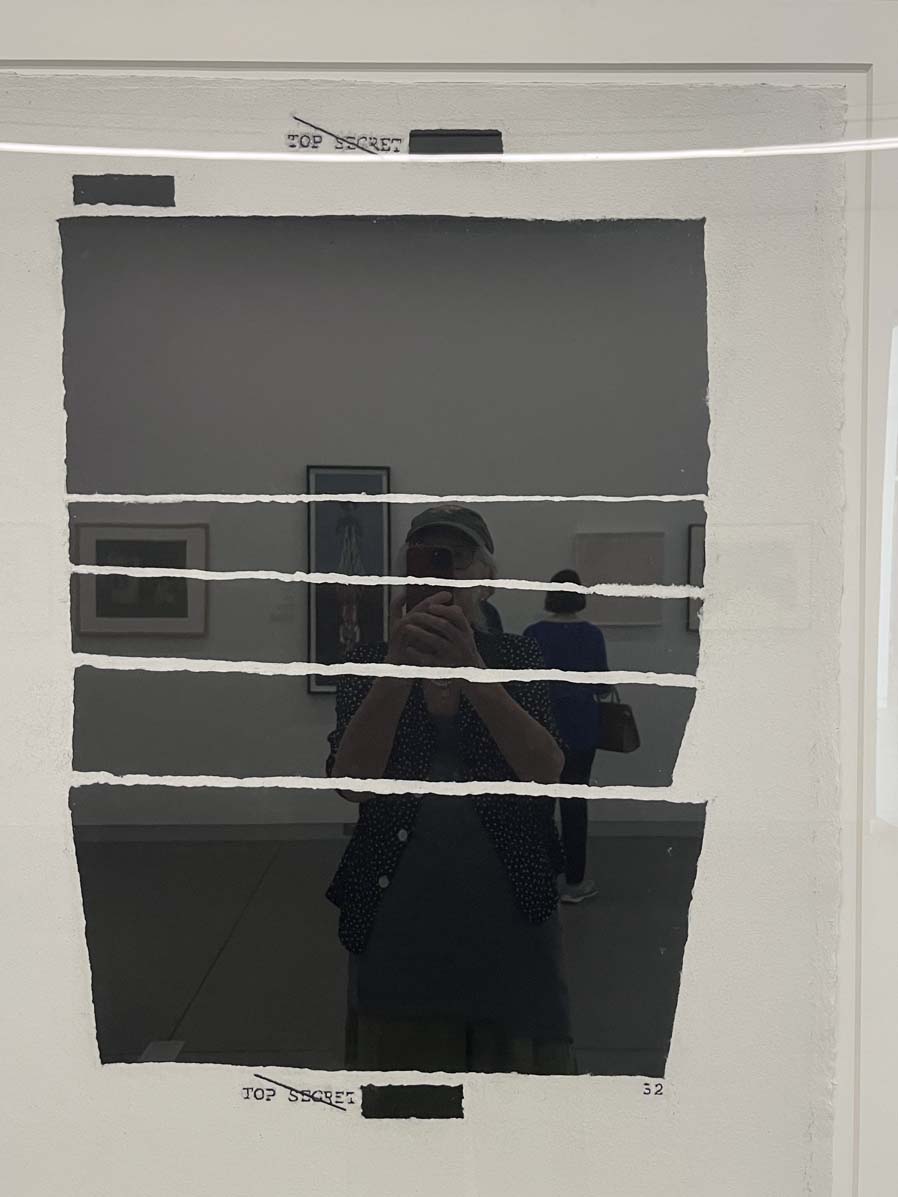
Framing also plays a role in visual art – affecting both, the understanding and appreciation of a work of art.

Some of these thoughts were triggered when I visited an exhibition at the Benton Museum of Art/Pomona College some weeks ago. (The show is now closed. Here are upcoming offerings, equally interesting.)

Doubles: Prints and Drawings from the Museum Collections presented paired works that had been selected by graduate students and young professionals during a seminar introducing works on paper. The approach of “compare & contrast” is a traditional one in art education, with instructions to focus on everything from compositional features, perspective, techniques to comparisons between art movements, different art historical eras, or different approaches to the same topic. What we see in one picture often frames our response to the other one.

Doubles exhibited pairs that most frequently juxtaposed different artists along the lines of either shared topic or shared visual expression. Each selection had a very short statement by the student that explained their choices, with varying degrees of success and/or sophistication. The power of the exhibition came from the accumulation of pairings that made it abundantly clear how juxtaposition can affect your own perception of each individual art work. In some instances, that is, not all of them. Graphic similarities, for example, were cleverly selected, but did not necessarily frame the interpretation of each piece.

Roger Vail Untitled (Figure in Profile) (1970 Photolithograph on paper – Kenji Ueda Untitled (abstraction) (1972) Lithograph on paper

(Be warned, most photos today have lots of reflections due to unfortunate lighting conditions in the galleries, fluorescent strips dominating the rooms.)

Robert Cottingham F. W. Woolworth, 1975 Aquatint on paper – Edward Ruscha Street Meets Avenue, 2000 Lithograph on Rives BFK paper

Thematic pairs – war, the flag, colonial oppression, then and now – came closer to having an impact on each other, although they mostly seemed to be coming from a shared viewpoint, rather than exposing a rift between perspectives.

Francisco de Goya y Lucientes Los Desastres de la Guerra, Plate 66, Extraña devocion! (Strange devotion!), printed 1863 Etching and drypoint on paper

Enrique Chagoya Homage to Goya II: Disasters of War (Plate 33: Goya conoce a Posada), 1983-2003 Etching and aquatint on paper

Fernando Marti American Flag, 2017 Serigraph on paper Barbara Kruger Untitled (Questions) from Celebrating 20 Years of Explosive Graphics series, 2009 Serigraph on paper

(Out in the real world, this photograph of LAPD units assembling to “quell the protests”, with Kruger’s Questions mural in the background (on MOCA’s wall), was taken around the same time of my visit, by Jay L. Clenendin. Pulitzer prize material, if you ask me….)

Jesse Purcell War Is Trauma Grenade, 2011 Serigraph on paper Mary Tremonte Battle Cross over Iraq, 2011 Serigraph on paper – both from War Is Trauma portfolio, Produced by the Justseeds Artists’ Cooperative

Umar Rashid (Frohawk Two Feathers) Map of the West Indies, 1790. Born Alone, Die Alone, 2024 Archival pigment print hand-finished with acrylic paint – Enrique Chagoya Escape from Fantasylandia: An Illegal Aliens Survival Guide, 2011. Lithograph and gold metallic powder on paper

(One of my favorite examples for framing that tags different perspectives instead, comes from the Virginia Museum of Fine Arts in their educational tools about perspectives in art. Their explanation is found in the link above.

***

The most fascinating double in the Benton exhibition was a juxtaposition of work by Lorna Simpson and Naomi Savage.

Lorna Simpson 9 Props (complete set of 9), 1995 Waterless lithograph on wool felt panel – Naomi Savage Upper Torso, 1969 Embossed paper

It was intellectually challenging on multiple levels, with the framing centered on absence rather than presence. Naomi Savage was a photographer, niece to Man Ray, who is represented here with a relief print rather than her photographic work. It was chosen with a focus on “invisibility” because the embossing technique makes the image barely perceptible at numerous angles or in different light conditions.

The usual presence of visual clarity in photography is also turned on its head by the work of Lorna Simpson. Here is The MET’s description of the work, held in their collection:

In 9 Props Simpson challenges preconceived notions about what constitutes a portrait. Rather than depicting actual people, she photographs nine surrogates—vases and bowls that are based on objects in the portraits taken by famed Harlem photographer James VanDerZee in the 1920s, 30s, and 80s. Working with the artisans at Pilchuck Glass School in Seattle, where she was an artist-in-residence, Simpson had the photograph vessels replicated in black glass. Her captions below each “prop” describe the people, clothing, and furnishings in VanDerZee’s original photographs. Unlike VanDerZee’s pictures, however, which seem tied to a particular time and place, Simpson’s conceptual portraits are enigmatic and open-ended, relying on the incongruity of her words and images to suggest meaning and context, but without providing obvious answers.

James VanDerZee 1926 photograph that is referred to. I had to dig those up, just as examples, they were not shown for comparison at the Benton.

(Here are some examples of VanDerZee’s portraiture in general.)

A contemporary Black photographer translating the portraits of well-to-do Blacks by a 20th century Black photographer into black objects that obscure any individuality, just enigmatic stand-ins. She provides narratives seemingly unconnected to the objects in view, if you do not know the history of the referent art. Something visible (mis)representing something invisible to the current viewer, framing the experience as one of searching for connections in the absence of visual clarification. Lack of knowledge of the history fundamentally defines our experience as well as our ability to interpret correctly what is in front of us.

Excerpt of James VanDerZee’s 1923 photograph that is referred to.

For me, then, the larger framing was one of the erasure of historical Black experience with the eradication of visibility. My “framing” of her art was perhaps affected by our present day experience of the obliteration of Black visibility and agency in the public sphere.

300 000 Black women alone have lost their jobs in the federal work force across the last 6 months, work that provided middle-class stability. Black top officers and other senior officials at the Pentagon, fired, historical records about Black achievement in the military, purged. The least diverse Cabinet of any in recent history.

In any case, what is visible in an image, or what needs to be imagined to make sense of it, will have large implications for our own interpretation the art. Drawing conclusions, based on our own available framing, often biased by our previous experiences, or our access or embrace of different versions of history, will guide what we see and what we feel. Pairing black and white pieces, defined by absence more than presence, was a clever, clever way to make that point.

***

Framing affects not only the appreciation of art, but also its creation. In my own case, how do I frame the intent to flag environmental fragility and the need for protection, for example, in a photograph or photomontage? Do I depict loss, or do I depict the possibility of positive outcomes? What can represent each of these states, and do they need to be integral to the landscape or can they be extraneous? Do they need to be literal or can they be symbolic, in order to create the largest affective impact? Do I frame the issues and my respective choices verbally as well for the viewer, or do I let them frame it themselves? All this has me preoccupied as we speak.

You can judge the results for yourself here.

In any event, whether art or life: a reminder to those of my soulmates also prone to catastrophic thinking – framing is a choice, and there are multiple frames to choose from, most often. Pick a perspective that brings you forward, rather than holds you back in waves of anticipatory anxiety.

Let’s do a musical pairing as well, one that shows very different sonatas by the same composer, Beethoven’s Piano Sonata #1 and #32.

PS: Housekeeping: I will be down to 2 postings per week for the summer months. So the next iteration will come next Monday.
Art on the Road: Is there a safe place?

· Three Exhibitions at the California African American Museum and the Benton Museum of Art Pomona College. ·

I write this while in Los Angeles, where U.S. Customs and Border Protection are flying Predator B drones (MQ-9 Reapers) overhead. Israel has launched its attacks on Iran. Closer to home, non-criminal, undocumented adults and children are snatched from homes, businesses, schools, courts and places of worship, some jailed in unapproved detainment camps, some literally disappeared by ICE. A judge has declared the administration’s mobilization of the National Guard against those protesting ICE’s actions in L.A. illegal. DHS Secretary Kristi Noem proclaimed “We are staying here to liberate [LA] from the socialists and the burdensome leadership this governor and mayor have placed on this country and this city.” When a sitting US Senator questioned this use of military force to displace a democratically elected state government, the very definition of a coup, he was forcibly removed, thrown to the floor and handcuffed. (A Senator, by the way, elected with more votes than 48 of the 53 red states U.S. Senators combined.) As of today, the Marines are deployed here. A Florida sheriff announces that law-breaking protesters will be killed. A Big Beautiful Bill threatens to cut off over 10 million American people from existential support. Hurricane season is upon us, and fire rages in the Columbia Gorge, with hundreds of households under mandatory evacuation orders, with the actual elimination of FEMA on the horizon.

The issue of safety – from war, from state violence, from racist persecution without recourse, from economic instability, from natural disaster – looms large, not just in the collective consciousness of Americans waking up to the daily news, but also in the subjects chosen by artists affected by the forces listed above. I had the chance to visit three different exhibitions that tackle the questions of how to live with oppression, instability, an uncertain future – and the ambivalence of the natural environment as both a refuge and a threat.

***

“…the distance between shortened Black lives [from toxicity and climate change] and dead Black places is farther than might be imagined. Black places are parables of the threats of industrialisation, technology, and white ideals of progress, and they are parables of adaptation, interdependence, and supportability.”  – Danielle Purifoy The Parable of Black Places. (2021)

On view until June 29th, the Benton Museum of Art Pomona College presents Black Ecologies in Contemporary American Art. Works by renowned artists, Dawoud Bey, Alison Saar, and Kara Walker among them, and those of artists less familiar to me, Tony Gleaton, Wardell Milan, depict the relationship between Blacks and the environment, urban and rural alike. The impact of climate change on more vulnerable groups, the legacies of plantation slavery, the safety of Black women in particular, are all framed in ways that invite the viewer to question their own stereotyping assumptions.

Wardell Milan My Knees aree getting weak, and my anger might explode, but if God got us then we gonna be alright (2021).

Wardell Milan The most dangerous thing about being a Black woman in America. Is being a Black woman in America. (2022)

Black ecology as a field of scientific study investigates the disproportionate environmental and climate hazards that marginalized communities experience and the politics that make them possible. Pollution and waste sites are often the focus, as is the increasing vulnerability to the threats brought by climate change. However, there is also a call for highlighting not just degradation, but positive aspects of Black ecological life as well: forms of resistance and land relations, brought to the attention of the public by artists as well as scientists.

Kara Walker Harper’s Pictorial History of the Civil War (Annotated) 2005 (Excerpts.)

One example is the epistemology of the blues, a musical form which helps understand the relations between people, land, and survival. Another is the focus on Black food movements, with farming, gardening and other forms of food provisions increasing self-reliance and the ability to withstand deprivation and maintain traditions. (Ref.) Kara Walker’s work below is a terrific example. The idea, then, is to foreground land relations not just as suffering, but as growth, self-reliance and making a safer space for oneself.

Kara Walker Preparatory Drawings for An Encyclopedia of Gardening for Colored Children (2022-2023)

***

She often spoke to falling seeds and said, “Ah hope you fall on soft ground,” because she had heard seeds saying that to each other as they passed.Zora Neale Hurston, Their Eyes Were Watching God.

“What is a safe space for you?” was one of the question posed to more than twenty women living in L.A. by artist Tatyana Fazlalizadeh for her site specific installation Speaking to Falling Seeds at the California African American Museum (CAAM), on view until August 3, 2025.

The studio-drawn portraits resulting from these conversations were enlarged and wheat pasted on the walls of the light-filled atrium, embedded in landscapes, archival photographs and with added text.

The exhibition’s title comes from Zora Neale Hurston’s novel Their eyes were watching God, where the protagonist relates to the nature around her and draws on the concept of community that nurtures the individual. As Fazlalizadeh states, “Speaking to Falling Seeds” reflects on these Black women’s gathering of natural environments around them, as if nature is a blanket that warms, shields, and protects them.”

I was very much reminded of the experiential descriptions and philosophy displayed in another exhibition that I reviewed a few years ago in Portland, OR. A multi-media show, created and curated by Studio Abioto, a family of Black women, who affirmed how to reclaim nature, and create safe spaces combining old and new approaches to ecological stewardship and community. Safety, though, is a relative concept. Whether exploring parks in L.A. or hiking in the forests of the Pacific Northwest, Black women barely move without glancing over their shoulder or facing questioning looks, if not aggression, from those they encounter.

***

“I’m still learning how dogged people can be in denial, even when their freedom or their lives are at stake.”― Octavia E. Butler, Parable of the Sower

This was my first visit to CAAM. Founded in 1977, it moved into its current housing in 1984, a gorgeous 44,000-square-foot facility designed by African American architects Jack Haywood and Vince Proby. It is the first African American museum of art, history and culture that was fully supported by a state, with no entrance fees or other costs to visitors. According to their website, “the Museum’s permanent collection houses 5,000 objects that span landscape painting and portraiture, modern and contemporary art, historical objects and print materials, and mixed-media artworks. Though the collection emphasizes objects pertinent to California and the American West, it also houses a growing collection of artworks from the African diaspora as well as important works by African Americans from across the United States.”

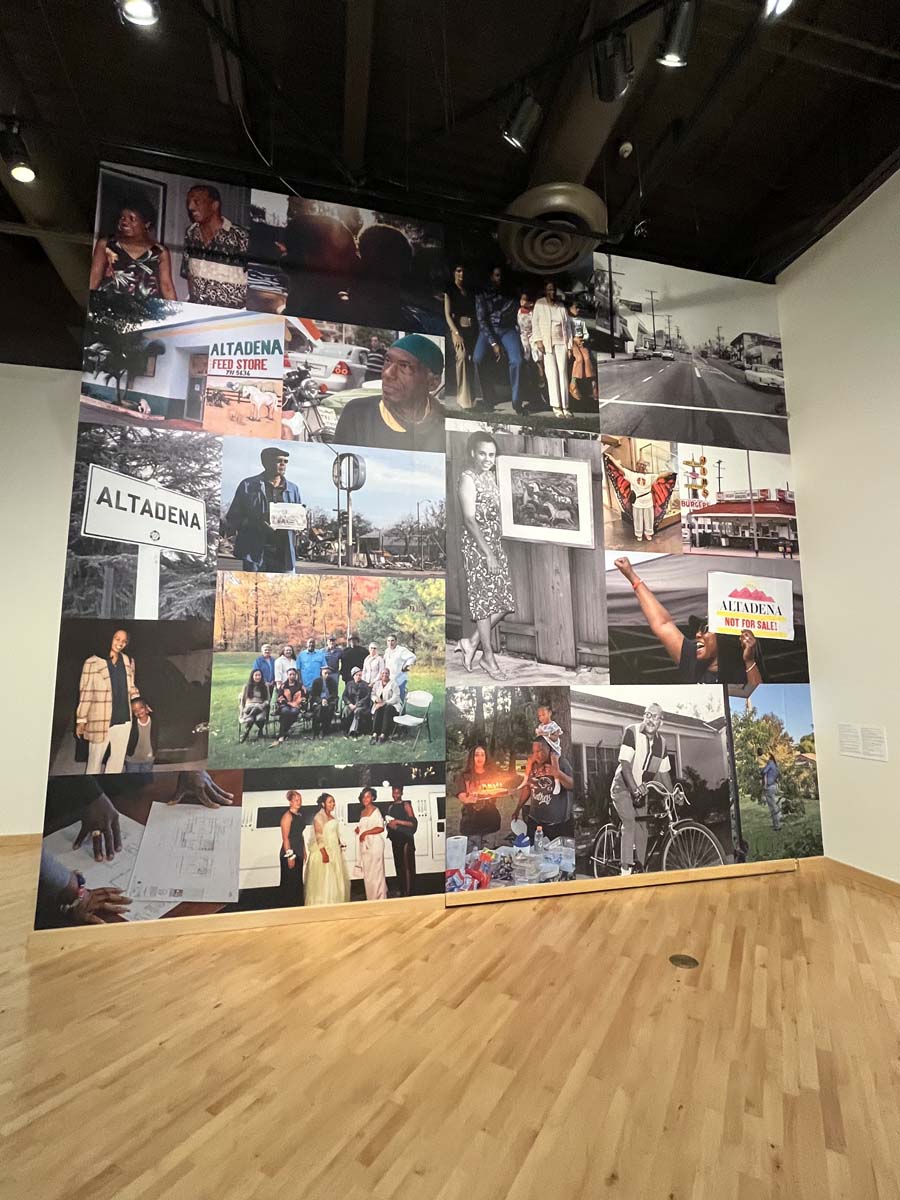
I had come to see a particular exhibition, Ode to ‘Dena, up until October 25, 2025. It honors the Black cultural heritage of Altadena, a community razed by the Eaton Fire this January, burning for a full 24 days. 18 people lost their lives, more than 9000 buildings were destroyed – my kids’ home among them – their contents lost forever. (If you are interested in a smart, perceptive and emotionally brutally honest eye-witness report of a survivor, I recommend Mike Rothschild’s essay collection on his website here. Latest essay on top, it helps to scroll back to the beginning.)

The exhibition was put together at a mind-boggling speed – opening in April, only 3 months down the road from the fire. Beautifully curated, it manages to present a variety of art and creators that reminds us of how much is lost. Irreplaceably so, when you consider that many artworks were stored in the houses that burnt, art and dwellings alike often not covered by insurance (California does not require fire insurance for housing that came down through generations, or the rates were basically unaffordable.) Not that money could restore the lost art. But lack of money forces many an owner to sell the now empty lots to developers with the full understanding that the original character of this close-knit community is going to be radically changed.

Liz Crimzon Fire Creates Art – Altadena and New York Drive – Eaton Fire (2025) Photograph

Altadena was an epicenter of Black art activity in the 1950s and 60s. As an unincorporated area it attracted homeowners that would otherwise not have found the opportunity to buy housing – the location against the foothills of the San Gabriel Mountains meant that smog collected at that barrier, and so was of no interest to wealthier folks who sought healthier places. I have written about the history of the place here and here, with the second link also depicting Eaton Canyon where the fire started. Over the decades, an incredible array of artists, musicians, teachers and activists coalesced around this very special place, leaving a distinct imprint.

Charles White Love Letter II (1977) – Sound of Silence, (1978)

Painter Charles White is one of the more renowned among them, but there is interesting work to be found all over the halls, some by members of multi-generational families all involved with different media, from prints to weaving and everything in-between.

Clockwise from upper left: Kenturah Davis Vol. V (marcella) (2024) – Altadena (2025) – Mark Steven Greenfield Budget Doll/(2012) – Betiye Saar&Alison Saar House of Gris Gris (1989)

Water colors by Keni (Arts) Davis are particularly moving, the selection spanning the years from 2016 – 2025, depicting presence before and absence after the destruction. Here is a sub set.

Keni Davis Beauty from Ashes

Famous writer Octavia E. Butler lived in Altadena and is buried there. Butler was both, a visionary and an astute chronicler of the political experience in a society governed by personal as well as structural racism, and quite aware of the impending threats of fires and floods. The exhibition presents a video outlining her legacy, with the folks at Octavia’s Bookshelf, a book store that became a center for mutual aide and community support in the aftermath of the fire. I had had a conversation with the owner just a few months earlier, when I tried to trace Butler’s footprints in her neighborhood, not just in her novels.

I have been thinking a lot about the writer’s assessment of our capacity for denial, even in the face of factual existential threat. Politics aside, there are scientific data telling us something about climate change, water availability, heat factors, increasing forces of wind and the like. And yet for many people, thrown by their losses into the impossible situation of having to make decisions where to move from here, denial is still at work. (That is if you even have a choice – many people are left so destitute that they are forced to rely on those who they know and who are willing to help.)

Chukes Protector of the Next Generation (2020) Ceramic Richmond Barthé Dr. Mary McLoyd Bethune (1975) Cast Bronze

The bond to home, to a place you know and grew up in, where your friends or family live in the vicinity, all weigh in in favor of underestimating or unconsciously ignoring the dangers the future holds here for you. I get it. I would be paralyzed myself, if attachment is strong, and the options for change so diffuse and yet manifold, that it is hard to even begin to sort it out. Where will you find work? Where housing? Where are communities that fit your needs? How do you protect your kids from too many changes, recurrent displacements? What if you are old and cannot adapt to new environs?

Which leaves the largest looming question untouched: is there any place that is safe? From the fires of California to the fires of the Pacific Northwest, from the hurricanes in the usual Atlantic vicinity to the disasters brought to states previously thought somewhat safe, like North Carolina (think Hurricane Helene), the increasingly frequent and stronger storms in the mid-West, to the earthquake danger along the pacific coast – where should one go? Where will there be enough water, food and still survivable heat for our grand children? How many will compete for those resources when climate migration begins in earnest and nation states become fortresses?

Capt. James Stovall V Blooming Duality (2024).

Some of the strongest work in the exhibition is a multi-media installation from 2002 by Dominique Moody. Her sculptures and work on paper point to our possibility to be grounded by memory as much as experience itself; her poignant characterization of her 9 siblings, strewn all over the world, seem to provide a sense of belonging, regardless of geographic closeness, relational community. The artist is probably most renowned for her project NOMAD, the enmeshment of living life and making art in her nomadic existence in a trailer that is simultaneously an exhibit. It was last shown at FRIEZE, LA, this spring. The term stands for Narratives, Odyssey, Manifesting, Artistic, Dreams – and Moody lives the nomadic life, trained early within a military family that saw constant displacement and change. She has placed herself all over the U.S., including the Zorthian Ranch in Altadena, a while back, with fruitful artistic exchange with the artists there. (I stayed there many years later, with my montage work being influenced as well. It, too, burnt to the ground during the Eaton fire.)

Dominique Moody A Family Treasure Found (2002).

There is, of course, freedom in a nomadic life, and constant stimulation for creativity, particularly if you work with found objects. It is cheap, usually, and the absence of too many belongings can be a blessing. Then again, it is a choice individuals can more easily make than entire populations. And even individuals might need support – Moody herself is legally blind now, a hard fate for a visual artist, and needs a driver for the truck that moves the trailer around.

Rootlessness can imply that you will never lose your roots, sparing you from emotional disruption – but it can also deprive you of the kind of mutual aid that comes from communities that are experiencing harsh conditions together and stand for each other. Communities like Altadena, determined to rise from the ashes, quite literally, and yet irrevocably changed, having to weigh all options for a sustainable future.

What all the art I encountered had in common, was the invaluable reminder that you can choose perspectives. You can look at damage, or at opportunity. You can look at the power of individual choice or the strength provided by communal support. You can allow emotions to rule, or you can favor rational decision making. You can doggedly cling to the familiar or acknowledge that we will all have to embrace change at some point. None of the exhibits did this with a wagging finger, or impervious righteousness. It was work full of integrity, equally acknowledging hope and pain.

A privilege to see it all. And brought to the point by the modern quilting work below.

Martine Syms What do I need most right now? (2023)

What do I need most right now? Indeed, a shared question for all who experience change and disruption. Safety is high on the list.