When I brought my then boyfriend back to Germany for the first time, my father lovingly created a sight-seeing itinerary for a road trip, down to the minutes between named Autobahn exits, hotel information and sites worth visiting. What feels like an eternity later, my now husband has taken up the banner, luckily restricting himself to points of interest and highway exit numbers.
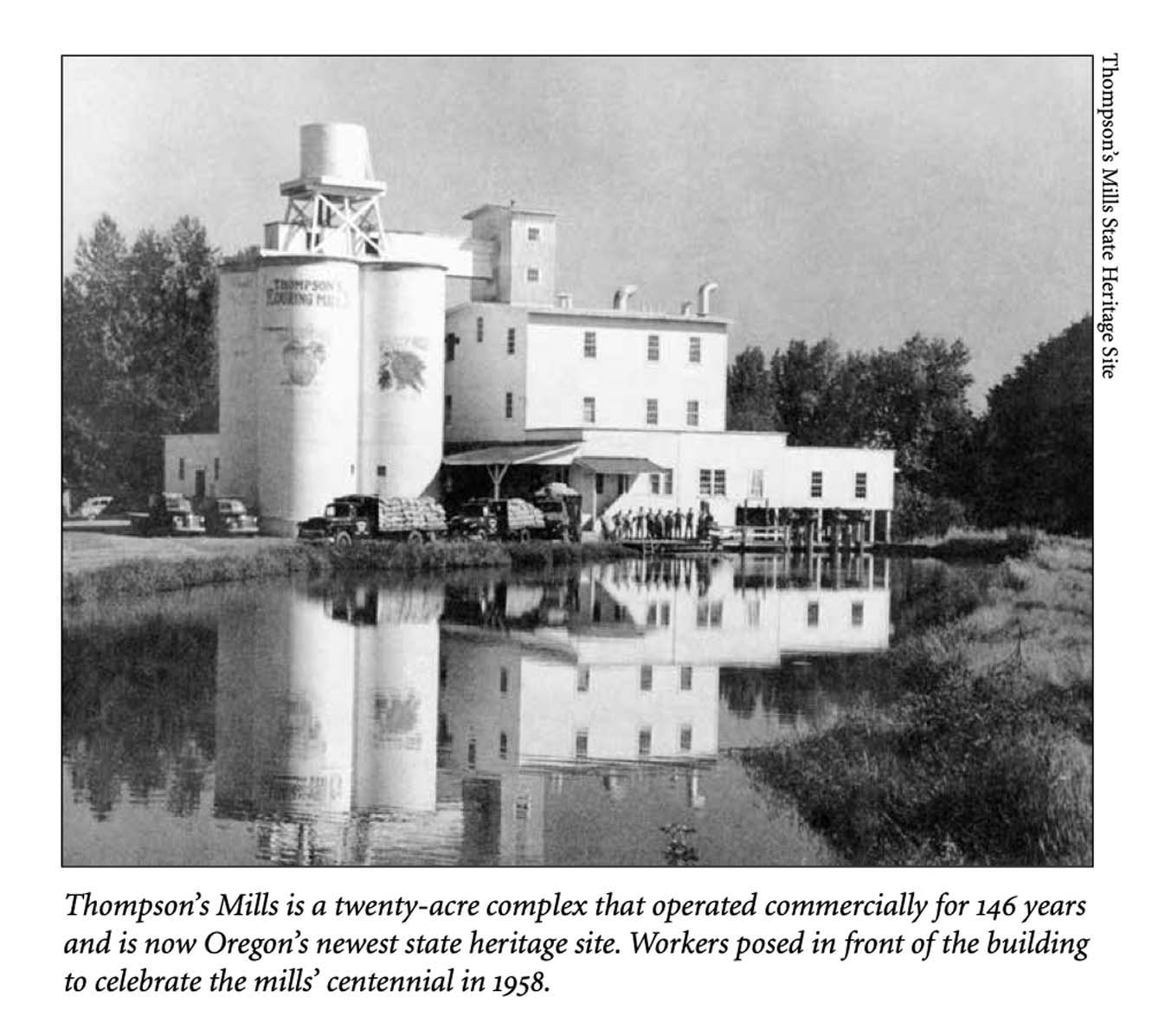
This is how we found the Thompson’s Mills State Heritage Site located a few minutes off I 5 South, in Shedds, Oregon, near Corvallis, on our drive to California last week.

Oregon’s oldest water-powered grist mill is a photographer’s candy store and a historian’s treasure trove. The entire economic, social and political history of Oregon and its relation to world economies and technological development is encapsulated in the objects and machinery contained in these Rube Goldberg-like buildings. Some of it was relayed by knowledgeable and friendly docents, much of it can be found here (I will summarize also from the same author’s in-depth publication in the Oregon Historical Quarterly. Fascinating stuff.)


The six-floor mill building, with storage silos, milling machines and hydro-power plant are located on 20 acres, with a Queen Anne’s home for the mill keepers and boarders who worked at the site, outbuildings and garages, next to the mill. The adjacent Calapooia river was dammed up by the mill owners starting in 1858 until 1986, to produce the necessary power.


In the early days, with a number of changing owners, the mill flourished due to intense demand for flour from the California Gold Rush. There were obstacles – the mill burnt down in 1860, to be rebuilt again immediately, and the small town of Boston nearby completely relocated when the rail road was built further away. But the next owners, German immigrants Martin and Sophia Thompson whose family would operate the mill for three generations, benefitting from international developments and smart investment in ever new technology, kept up with changing fortunes in the trade for a long time.


The Thompsons’ arrival coincided with Oregon’s entry into the Asian Pacific Rim market – flour exports to China were wildly profitable for Oregonians who supplanted the earlier Californian trade opportunities. National politics, however, brought this to an end: the Chinese Exclusion Act of 1882, extended by the Geary Act that same year, restricted Chinese-worker immigration to the United States for an indefinite period. China retaliated sensibly, building its own mills and by 1910, most exports to China had ended, and exports to Hong Kong dropped by 50%.
World War I changed the downturn. The Hoover administration’s food relief program required flour for starving allies. The mill produced 12 hours a day, selling directly to the U.S. Food Administration, with profit margins the highest for the entire run of the family business. I shudder to think of the working condition: the noise was infernal (a 2 minute demonstration of just one milling operation – they had many in parallel going on at the time when the mill was active – was so loud you’d want to cover your ears. Dust was pervasive at the time, despite the installation of blowers, mostly intended to prevent fires, though. Even now, I was glad to be masked, as always.)


Enter sliced bread, yes, you read that right. By 1927, the nation’s enthusiasm for store-bought sliced bread significantly dropped the demand for grocery-store flour, leaving mills to struggle economically. The Thompsons started to diversify, selling flour sacks almost at cost, which had become valuable fabrics for home sewing since the Great Depression. Eventually stopped producing flour altogether in 1942, manufacturing pellets from grass seed instead, processing oats, corn and molasses, increasingly focussed on animal feed. Eventually the mill was converted into a power-generating plant in the 1980s, selling power to Pacific Power and Light Company. By 2004 it was sold to OPRD and converted into a heritage site, with more than 3000 artifacts catalogued and staffers learning to operate the original machinery for demonstrations. By 2007, the site was opened to the public.


It is truly worth a visit, both for the thoughts it generates about the history captured in the various exhibits, and the thoughts about what was excluded.
***
The land on which the mill stands, was part of a plot purchased in 1851 by Americus Savage, his wife and 5 children, the newest born on the pioneer trail to Oregon and named Columbus. (What do these names make you think?) The Oregon Donation Land Claim Act offered 640 acres to married couples, and Savage claimed a lot near the Calapooia river, that came with water rights, all of which he sold at a later point. The land and its rivers and watersheds had been home to the Tsankupi (“Calapooia River”) band of the Kalapuya for over 10 000 years. The 1855 Treaty of Dayton, taking away the land for promises of various services, led to the forcible removal of the Tsankupi to what are now the Grand Ronde and Siletz reservations. They are now members of Confederated Tribes of the Grand Ronde Community of Oregon and the Confederated Tribes of Siletz Indians.
I did not see a land acknowledgement at the historic mill site, but I might have simply missed it.


There is, however, one to be found from The Calapooia Watershed Council which acknowledges the traditional homeland of the Kalapuya people. There are more than fifty different ways of spelling Kalapuya, including Calapooia and Call-law-puh-yea.The council is located in Brownsville, Oregon in the traditional territory of the Tsankupi (“Calapooia River”) band of the Kalapuya.

There were some allusions in the mill’s exhibits to fights over water –
“Thompson’s Mills held some of Oregon’s oldest water rights, which provided the mill 180 cubic feet per second of the Calapooia River even in water-short times. Because Oregon’s water laws are based on the principle of prior appropriation — meaning the oldest water rights on a stream are the last to be cut off in times of low flow — Thompson’s Mills was able to demand water rights regardless of the needs of users in other areas. During times of low flow, the mill was allowed to divert the river’s flow to maintain the allowed 180 cubic feet per second, leaving little or no water for upstream farmers and ranchers.” (Ref.)

This went on for decades, legal threats and fights included, as well as physical threats to the safety of the mill. Note, though, that the conflict ensued between various factions of the settlers, and, increasingly, environmentalists in the 1990s, and did not mention specifically the Native American history of protection for salmon or other spawning fish that were part of the tribal cultures. It was the tribes, who for some 14000 years had been the stewards of the Willamette Valley, with controlled burning practices helping to clear the land, deposit nutrients into the soil and guarding fish populations, making it an extraordinarily fertile place.


Water levels now, (after dam removal and increasing droughts due to climate change, as seen from inside of the mill) – on left – and then – on right,
Who decides what history is included or left out at historic sites or other history institutions?

When Rivers Were Trails –
Elizabeth LaPensée (Anishinaabe)
This question loomed large for me in the context of other developments on Kalapuyan land: the recent closure of Five Oaks Museum, a history museum founded 1956, showcasing the life of pioneers with artifacts provided by their descendants. Its exhibition This Kalapuya Land, was drastically changed with new leadership and a guest curator, Steph Littlebird Fogel (Grand Ronde, Kalapuya) in 2019. The revised and critically annotated, new This IS Kalapuyan Land was a mix of historical information, contemporary Native American art, and historic artifacts, including an impressive slate of artists, offered online in 2020.
Carol Haskins (Grand Ronde)
Don Bailey (Hupa)
Nestucca (Grand Ronde)
Cole Haskins (Grand Ronde)
Jason Cawood (Modoc)
Derrick Lawvor (Modoc)
Angelica Trimble-Yanu (Oglala Lakota)
Phillip Thomas (Chickasaw)
Diane Smith (Grand Ronde
DeAnna Bear (Eastern Band Lenape)
Jana Schmieding (Cheyenne River Lakota)
Whitney A. Lewis (Chehalis)
Tincer Mitchell (Navajo)
Lindsea Wery (Ojibwe)
Joni Millard (Assiniboine, Gros Ventre, Crow)
Elizabeth LaPensée (Anishinaabe)
Greg A. Robinson (Chinook)
The new goal was to prompt critical thinking around representation of Indigenous history and identity in non-Indigenous institutions, and the mood of the staff, diversified Board and leadership was excited and hopeful in 2021 after the museum emerged from Covid closures.

Floating Loksi’-
Early in 2025, just 4 years later, friends and supporters of the museum received the announcement that the museum was closing for good.


The Sun Bathed Everything –
Angelica Trimble Yanu (Oglala Lakota)
I have no privileged information about all the factors that led to the closure, but all agree that operations funding was no longer available from previous sources. The museum, with a six figure loan liability, had to close the building and furlough the staff last December. Many of those who had previously supported the institution, in particular foundation grants and private donors, did not renew funding; some were explicitly upset over the direction the museum was taking, away from pioneer traditions towards more diversified story telling, including an online exhibition called “Gender Euphoria: Contemporary Art Beyond the Binary” (Ref.)
Any attempts to find alternative sources of funding were not seen as feasible by the Washington County Board of Commissioners (BCC) who are focused on how to shut down the operation and distribute the collection. Washington County has now resumed control of the Cultural Resources Collection.

That Bear Tooth Necklace –
Whose story gets told and how it gets told is more often than not dependent on who holds the purse strings, or the political power to engage in revisionism, both locally and nationally. This fact was already claimed by Missouri Sen. George Graham Vest, of all people, a former congressman for the Confederacy in 1891, still at that late date an advocate for the rights of states to secede.
In his speech, reprinted by the Kansas City Gazette and other papers on the next day, Aug. 21, 1891, he announced: “In all revolutions the vanquished are the ones who are guilty of treason, even by the historians, for history is written by the victors and framed according to the prejudices and bias existing on their side.”
On a national level, this does not just pertain to contemporary attempts to re-install confederate names, monuments, or privilege to non-inclusive sites (remember that most Confederate monuments were erected after 1890 — not to memorialize lives lost during the Civil War, but to assert white power in the Jim Crow era.) As I write this, there are also changes to exhibitions concerning slavery at the Smithsonian, and at the U.S. Holocaust Museum:
An exhibit at the United States Holocaust Memorial Museum that takes a critical look at the United States’ response to Nazi Germany is slated to temporarily close after Labor Day for upgrades, sparking concern among some staff over what potential changes could be made amid President Donald Trump’s sweeping review of museums and their programming, sources tell ABC News.(Ref.)
This after the New York Holocaust Museum removed Trump images from a Hate Speech exhibition after intervention from a Board Member this June. (Ref.)
Art, just as factual information, can have an impact on our perspectives of history – but only if it can be seen. The selective curation of museum contents, or the loss of museums altogether, do no favors to an American people trying to understand its history fully.

S.O.S. –
S.O.S. indeed.