I am skirting the issue. I should be writing about the politics of war, but my head would explode. Let’s turn to the interesting people department instead. Given that it is Women’s History month, I’ll start with a 19th century poet and union leader attuned to skirts.
The Skirt Machinist
I am making great big skirts
For great big women—
Amazons who’ve fed and slept
Themselves inhuman.
Such long skirts, not less than two
And forty inches.
Thirty round the waist for fear
The webbing pinches.
There must be tremendous tucks
On those round bellies.
Underneath the limbs will shake
Like wine-soft jellies.
I am making such big skirts
And all so heavy,
I can see their wearers at
A lord-mayor’s levee.
I, who am so small and weak
I have hardly grown,
Wish the skirts I’m making less
Unlike my own.

Lesbia Harford was an Australian poet, lawyer and labor activist. Her father abandoned the family after bankruptcy, her mother toiling to get the 4 young siblings fed and educated. Harford was one of the first women to get a law degree at Melbourne University in 1915, where she became interested in the politics of class relations as well as feminism. She decided to work in the garment factories to understand truly the conditions of working class life, particularly among women. Despite having congenitally defective heart valves which made physical labor difficult, she went on to become a leader of the Industrial Workers of the World (IWW) around 1916.
She was openly bisexual, often in polyamorous relationships, and radically honest in her poetry around feminine issues that would not be discussed in public. She died from tuberculosis at age 36, her last years of life tortured by illness and dependency.
The poem struck me as both anguished and angry. Here is this small person, overwhelmed by the weight of the production task, metaphorically as well as literally. Stunted, she sews for women who are clearly of a different class, unrestrained in their consumption, free to eat and rest. Yet even these Amazon-sized women are burdened by the weight of heavy skirts, jelly-like limbs prohibiting escape.
Heaviness even when the contraptions of previous eras – the crinolines, the farthingales, the petticoats – were long abandoned. Skirt length and materials varied across time, of course, not least affected by the economics of any given era. If you look at shapes and lengths in relation to war vs. peace times, for example, you find straight correlations, with skimped materials when times are hard. Length also, eventually, became a means of protest and liberation – the mini skirts of the 1960s the most famous example.
***
Skirts were on my mind for a number of reasons. I had read about a woman who collected woolen skirts for decades from Midwestern thrift stores, up until she was 89. For the next 10 years – Audrey Huset lived until her 99th birthday – the collection of over 1000 vintage skirts was stashed in cartons in a garage. Her granddaughter, artist Mae Colburn, started to archive them in 2022, with the help of her parents, professors of costume design and photography, respectively. They sorted them according to a range of colors, plaids, and silhouettes – here is the link to the digital archive where you can be amazed at the collection.

I try to wrap my head around the motivation: how can you accumulate so much stuff, without even using the garments? Then again, I can just see the joy of the hunt, the glory of a find of an unusual specimen, the hope that these will make some warm recycled rugs in the future, the physical pleasure of touching woven wool of that period (much denser and of higher quality than what we see today.) A passion that gets you out of the house and in contact with people into your high eighties…still. Collectors are a mystery to me.
***
Then another skirt appeared on my screen. An expert knitter, designer and dancer had shared the instructions for a voluminous, long skirt she called the Paris skirt, and asked her 35.000 subscribers on Instagram (or anyone else) to knit along. There was a huge resonance, an exploding array of pictures posted of the variations generated by knitters across the globe. A new community instantly created, although I have asked myself how people who have not been knitting for ages, could afford to participate.

The pattern is not difficult. The materials required, on the other hand, are prohibitively expensive, if you do not already own a stash of remnant wool accumulated across many former projects. The mohair wool, for example, costs an average of $30 or so for 50 grams, which give you some 500 yards (the project requires over 2700 yards for larger sizes, and that does not account for knitting with double or triple strands that give the skirt some heft and bounces on the bottom.) Five different sizes of circular knitting needles required: the largest alone, US 13 mm, costs easily $27. If you had to start from scratch you could spend $300 or more, for a homemade skirt!

But again, the use of leftover materials is a sustainable practice, and the making of your own clothes a political act. Add a community that derives a sense of connectedness from the shared experience, and you have truly accomplished something. The designer herself considers knitting a form of resistance.

***
Then a book appeared in the mail, a gift from a friend who rightly anticipated my pleasure of receiving it. Loosely bound in recycled (and strangely fragrant) jeans material, it is titled Fav Pieces of, followed by some 50 names of people from across the globe. Let’s ignore the fact that the choice of font, an illegible page of contents, and an occasionally tortured introduction trying to provide intellectual heft, all scream for attention. It is, after all, published by Thaddaeus Ropac Publisher of Modern Art. (I did not yet see the book on their publications website.)

Let’s focus instead on the fabulous idea of editors Frauke von Jaruntowski and Gerhard Andraschko Sorgo, to collect essays from people with various backgrounds about their favorite piece of clothing or other adornments. And admire the range of images provided with the design, including portraits of items, owners, or both, and some contextual pictures that are meaningful, ranging from laypersons’ snapshots to serious photography.
The essays make us think about our relationship to clothes and, in turn, the ways beauty norms, body image, experienced gaze, memory, class conformity, politics, moods as well as our yearnings, influence our consumerism – or our rejection of it.

It is a fascinating read, if only for the comparison between explanatory attempts. Some people reveal intensely private information, others block with superficial description. Multiple owners describe how the item makes them feel internally for its own relevance, history or associations. Several emphasize how a given piece allows them to create a persona projected outwards. A few discuss the relevance of fashion in their lives, yet others the need for comfort, rather than public effect. Some are eloquently descriptive of beauty, others refer but to function.
Oversharing, reticence, courage to expose vulnerability, vanity, strategic self positioning, thoughtful introspection, or simple autobiographical anecdotes – all can be found between two covers.
Only two skirts made the list. One is from an exchange between designers, a hand-stitched, non-traditional patchwork quilt in return for hand painted plates. The essay informs about the history of Scottish tartans, symbol for traditional Clans. It then turns to lovely interpretation of the possible meaning of patch-worked remnants, creating a style that belongs to all. A Mix-and-Match Clan for a rootless citizenry, a remix overcoming divisions, and an important reminder that we can create something new from old. The reader truly understands why that is a favorite piece in this context.

The other skirt appears to have been protectively underused, in contrast to its oft worn twin in more muted colors, both purchased at KENZO in 1980’s London, simultaneously. The beloved bright one was a match for the buyer’s brilliant mood at the time, the darker one more likely acceptable in the owner’s day-to-day existence. A short comment on personal history that brought the good mood in the 80s in stark relief, and a cryptic snippet on how she regrets not having worn the favored piece enough, are the parentheses for the half-page long musings.

***
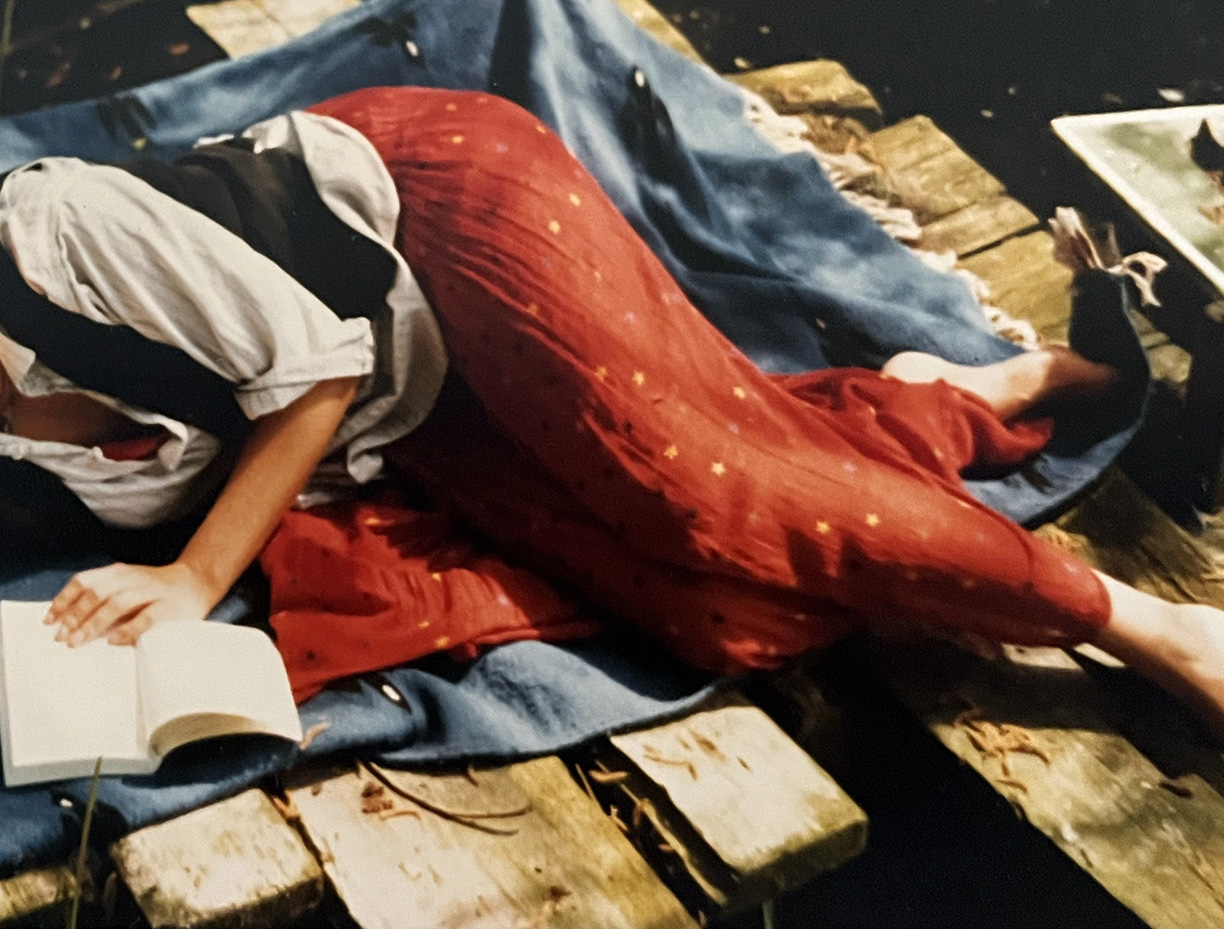
I used to wear skirts all the time. These days, not so much. I live in the functional, no need to think, can get dirty, ready to hike, comfortable uniform of pants and sweaters. But my favorite item in my closet is indeed a skirt, and it has accompanied me through good times and bad ones, for probably 20 years or longer. It replaced an old, red, star-sprinkled favorite that somehow got lost during emigration. I wear it when I travel, when I give lectures, or when I need a boost to my sense of who I am, during tricky encounters.

I picked it for my double portrait sessions with Henk Pander when he was still alive, a project, Eye to Eye, where he painted the photographer, I photographed the artist, across weeks of sittings. The skirt felt like the appropriate feminine counterweight to the absence of feminine symbols, eradicated by mastectomies for cancer. It’s most important attribute, other than a cheerful patchwork of patterns, is that it is light and wide enough to run in. No heavy skirts, no constricting pencil shapes ever again!


Henk Pander in his studio.
The skirt is also associated with something I am occasionally proud of: resisting overconsumption, for the most part, sticking to the tried and true. (I previously reviewed fiber artists, Ophir El-Boher, who embodies that concept in her art.) Of course that, too, comes from privilege. When you have permanent space to store things forever, when you have enough clothing that any one item is not worn to threads, when you have the funds to buy good quality that lasts, it is easy to do the right thing and not yield to compulsive purchases. In that way, then, the skirt reminds me to be grateful for all the choices I have.
Music today leads us back to the top – the fate of seamstresses in an exploitative economy. A Yiddish Ballad about the 1911 Triangle Shirtwaist Factory fire.