Are the Mardi Gras Indians best defined as a community, a tradition, a brotherhood and sisterhood, or an example of living history? “All of the above!” – Big Chief Derrick Hulin, in a 2023 interview with the Smithsonian magazine.
***
“Today is a happy day!”yelled the woman in front of me last Thursday, wildly swinging her hula hoops. My sentiment, exactly.
Anne McEnerny-Ogle, the Mayor of Vancouver, WA, seemingly agreed. She joyfully greeted a large crowd settling in at the Waterfront Park last Thursday, celebrating the end of a successful free concert series offered by the city this summer.
Mayor Anne (right) Ruth J. Wikler in background.
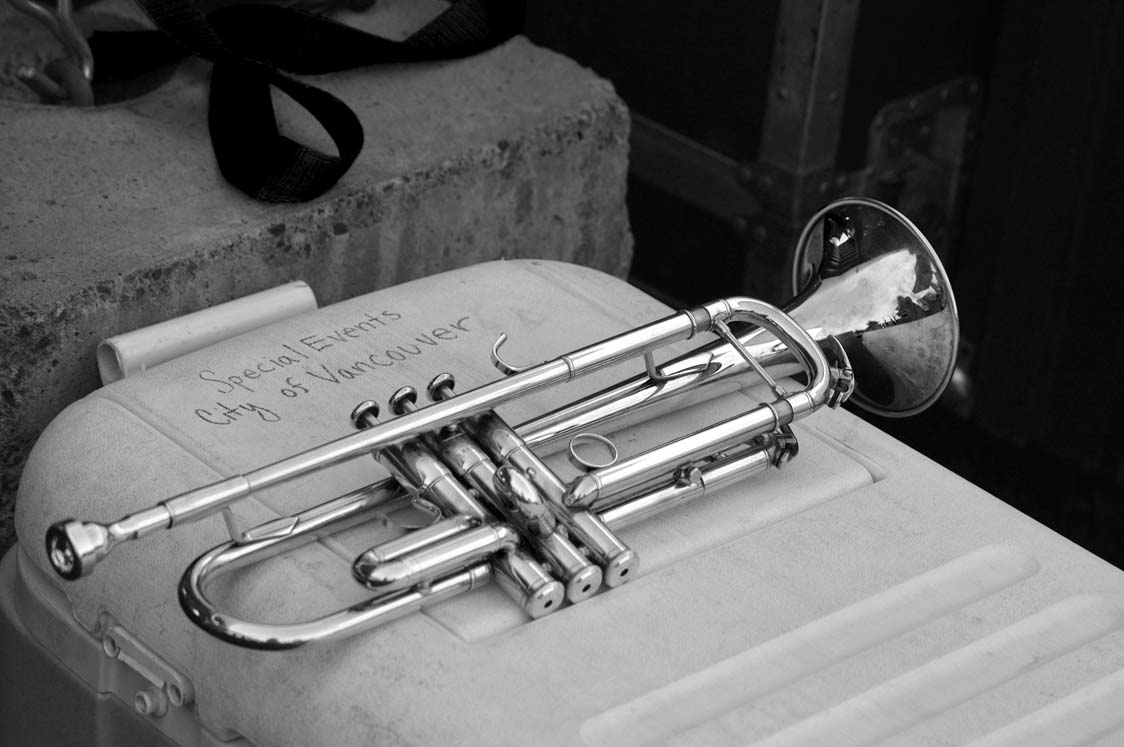
A mild summer evening, not a cloud in the sky, people picnicking, mingling, parading interesting sartorial choices.
Not a thought about the upcoming divisive Clark Council Primary race, not a single confrontation about the rebuilding of the structurally unsound I5 bridge connecting Portland and Vancouver, with hotly debated light rail addition or refusal thereof.
A break from worrying about wildfires or how to pay for the next tank of gas. Just a Mayor, recently re-elected for yet another term by wide margins, warmly welcoming young and old to a thriving waterfront and a very special concert ahead. Friendly city staff helping out, handing out earplugs for those who needed them, answering questions. Community at its best,
That sense of inclusivity was echoed by the opening remarks of the group of people who had helped the city’s programming add a spectacular act: the two-time GRAMMY-nominated New Orleans band, Cha Wa.
The Clark College Foundation, represented by Director of Arts Programming, Partnerships, & Philanthropy, Ruth J. Wikler, provided the talent and helped bring Cha Wa to the Vancouver Waterfront – and this is just the beginning.
“This concert launched the second-ever season of the Clark College Foundation Presents performance series with what is quickly becoming a hallmark of this regionally unique program: culturally and artistically one-of-a-kind performing artists from around the country and the world bring their extraordinary expressions to Clark County audiences in special ways that uplift and spotlight both Clark College’s talented students and wide-ranging academic programs,” Wikler said.
Clark College Vice President of Instruction, William (Terry) Brown, praised the ongoing collaboration with the city.
Don Romesburg, Dean of Social Sciences and Fine Arts (right), and Doug Harris, Chair of the Music Department (left) talked about what the college has to offer, proudly presenting the opening act for the concert as well: students from the Music Department playing traditional jazz.
“They’re killing it”, someone in the crowd erupted, loud applause echoing that sentiment. Talented young men, all.
***
Cha Wa managed to rouse the crowd to its feet, once they started playing. They are part of a New Orleans tradition of Mardi Gras Indians, combining historic chants with jazz, R&B, hip-hop, rock, soul and African-inspired music.
Many of New Orleans’ Blacks have celebrated Mardi Gras for over a century, creating and wearing Native American-inspired costumes, hand-stitched and adorned with beads and feathers in the most intricate fashion, embracing extensive labor (and often cost) for these suits. The suits usually consist of a crown, a dickie (tuxedo front) and an apron, handcrafted over a period of six months to a year. They draw inspiration from both Native American and African ceremonial dress.
Dozens of “tribes” parade during Mardi Gras, chanting and singing call-and-response songs, playing tambourines, cowbells, drums and other percussion instruments. Sometimes they are staging friendly competitions with rival “tribes,” alerted to them by a traditional “spy boy,” who walks in advance of each social group. “Cha Wa,” they call, ” We’re coming for you!”
A distinctly African-American tradition, it is believed to have originated in the 19th century to pay homage to the Indigenous people who helped slaves to escape and survive in the wild, on land once belonging to the Chitimacha Tribe. Some escaped slaves tried to make it in maroon camps (makeshift settlements in Louisiana’s swamps and bayous), while others sought shelter with Native communities, which then assimilated the Africans into their tribes. Choctaw, Seminole and Chickasaw and mixed-race people of Black and Indian heritage knew the fate of the enslaved. They constituted some 20 percent of the state’s enslaved population during the antebellum period, when New Orleans was a hub for the colonial slave trade.
There have been some discussions around the issue of cultural appropriation by one social group using the adornment of another. The 2021 documentary Big Chief, Black Hawk addressed the issue, generally approving of a hybrid of Native and West African Cultures. If two marginalized group are willing to support each other, can that be called cultural appropriation?
***
The band Cha Wa was founded by musical director and drummer Joe Gelini a bit over a decade ago. They have amassed awards for their vital and musically integrative albums, a music simultaneously true to its roots and yet inventing its own idiosyncratic style.
My absolute favorite part of their Vancouver performance, other than the wildly talented saxophone playing of front singer Tajh Derosier, was the way the story was told.
Historic facts about the fate of those enslaved in Louisiana, those who tormented them and those who came to help them, were contained in a narrative seamlessly blending with the music. For a representative cross section of their music, I recommend listening to “Spyboy,” one of Cha Wa’s celebrated early albums.
***
Lots going on in Vancouver, WA. Growing collaborations between city and college. Grants gifted by generous individuals and organizations to the Clark College Foundation, supporting the educational value of art in all of its forms. And plenty more enticing events in the offing, next weekend’s Vancouver Arts and Music Festival among them. (Program information found in the link.)
You can find me at Esther Short Park then for sure – betting on another happy day!
Bringing my own chair this time.
Here are the Clark College and Clark College Foundation contributions to the upcoming festival:
(Can’t miss the clowns…!)
FRIDAY August 7th: Performing Arts: Clown Garage/The Waddle Ensemble: 4pm & 6pm (20 minute appearances; 4pm features Clark College Baking & Acting Students)
Visual Art: Exhibit dedicated to Clark College Visual Art student work: 10am-6pm, Esther Short Building.
SATURDAY August 8th: Literary Arts: Clark College Creative Writers read from 11am-12n at Acoustic Stage
Performing Arts: Clown Garage/The Waddle Ensemble: 1pm, 3:30pm, & 5pm (20 minute appearances; 1pm and 3:30pm feature Clark College Baking & Acting Students)
Visual Art: Exhibit dedicated to Clark College Visual Art student work: 10am-6pm, Esther Short Building.
SUNDAY August 9th: Performing Arts: Clown Garage/The Waddle Ensemble: 11am, 3:30pm, & 5pm (20 minute appearances; only 11am and 3:30pm feature Clark College Baking & Acting Students)
Visual Arts: Exhibit dedicated to Clark College Visual Art student work: 10am-2pm, Esther Short Building.
Still on vacation. Just popping my head up for five minutes to bring you some cheer amidst all the frightening news flooding the zone. Just feels like cheer is desperately needed, even if a bit trivial.
I have been watching a new-to-me site out of Lithuania on the net. The Ancient Dog triggers equal amounts of amusement, consternation, wondering and being creeped out. Someone has taken AI to provide lectures by (most often dead, and some fictional to begin with) people, summarizing their philosophy, teachings or world views.
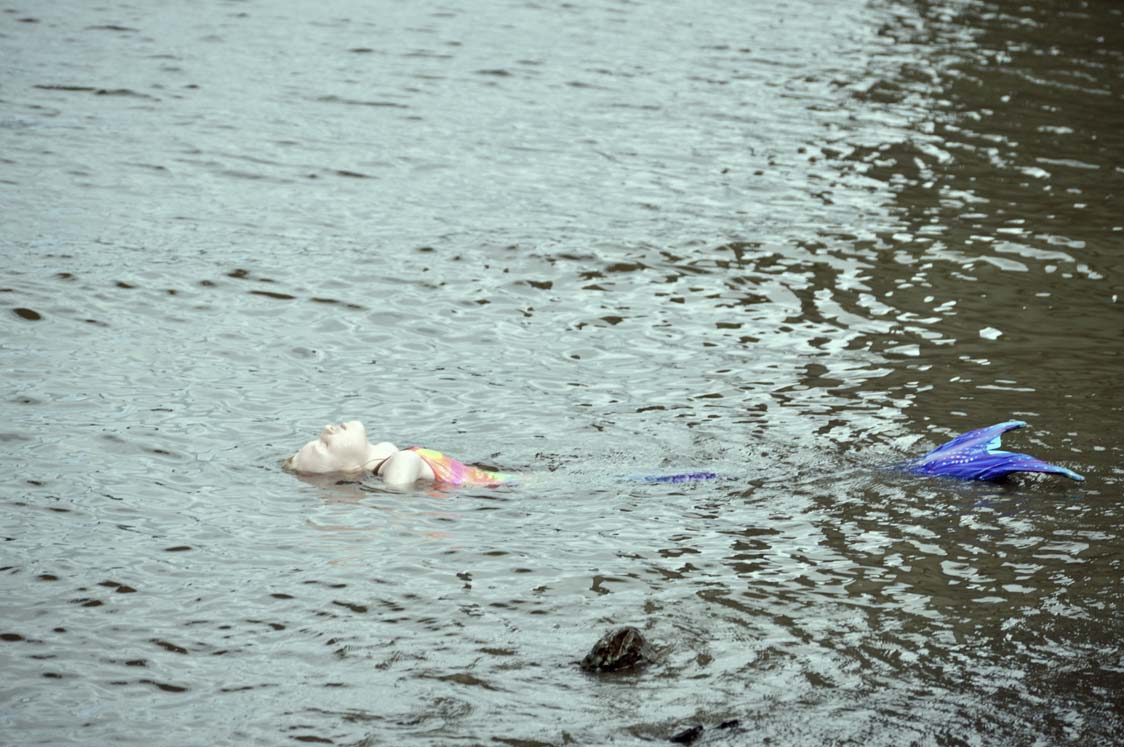
Poet’s Beach in Portland, Oregon on Mermaid Parade Day.
It is weird to see the likes of Hannah Arendt, Lacan, or Camus speaking to an (imaginary) audience about the central tenets of their philosophies as if they were alive. It is even weirder to see generated representations of van Gogh or Jesus do the same. Knowing that the videos do not contain real people, why should we trust that what they are telling us is real, or more precisely true to what their work actually was about?
I have read many of these classics 100 years ago, but I certainly cannot count on my memory to declare what is correctly communicated, or what is manipulated by sleight-of-hand. Are the lectures riddled with errors when artificial intelligence extracts original passages and merges them all together in convenient lecture format digestible to a 10th grader?
Then there is the series’ Professor Bruno Vero, an entirely imaginary prof who teaches us about more philosophers or artists, suspicious if only for his stereotypical outfit of tweed jacket and wool vest, gray beard and unruly curls giving off liberal college vibes. All that’s missing is the leather elbow patches.
Long story short, there is a through-line to many of these 3 minute or so lectures that has to do with how we should approach a life lived right, beyond asking about life’s meaning, or erecting whole philosophical constructs or religions to distract us from the fear that there might be no real meaning to our existence after all. And that is generally a welcome reminder.
It also brings us, finally, to mermaids. I had a chance to see them partying at a small beach along the river yesterday, after they marched in a big parade through town that I skipped. The creativity in costuming and make-up, for mythological figures and marine wildlife alike, made my heart soar.
Dress-up and masking was exquisite, and the joy that people exhibited when showing off the costume details to me, or standing proudly for a portrait, was infectious. Celebrating a kind of mysterious beauty, reveling in the childhood remnants of fascination with fairy tales, extending love to the many endangered species in our oceans by fancy representation – humanity at its creative best. Humans living the right life by acknowledging that beauty, whimsey, creativity are all necessary to counterbalance the horrors happening in our world right now, and to keep us sane. Certainly made me happy for a full Saturday afternoon, before more news of the fires across the globe landed.
___
Not that I forget that we have choices, but also obligations. A gentle reminder that the SAVE Act is now incomprehensibly before our Senate. Senator should be told in no uncertain terms that it CANNOT pass. Here are the facts:
Note the very last clause that will come as a surprise to many voters…. when it is too late to jump through the administrative hoops. Best to call or email your senators.
Back to my lawn chair in the garden. Enjoy your week and this lyrical symphonic Mermaid music.
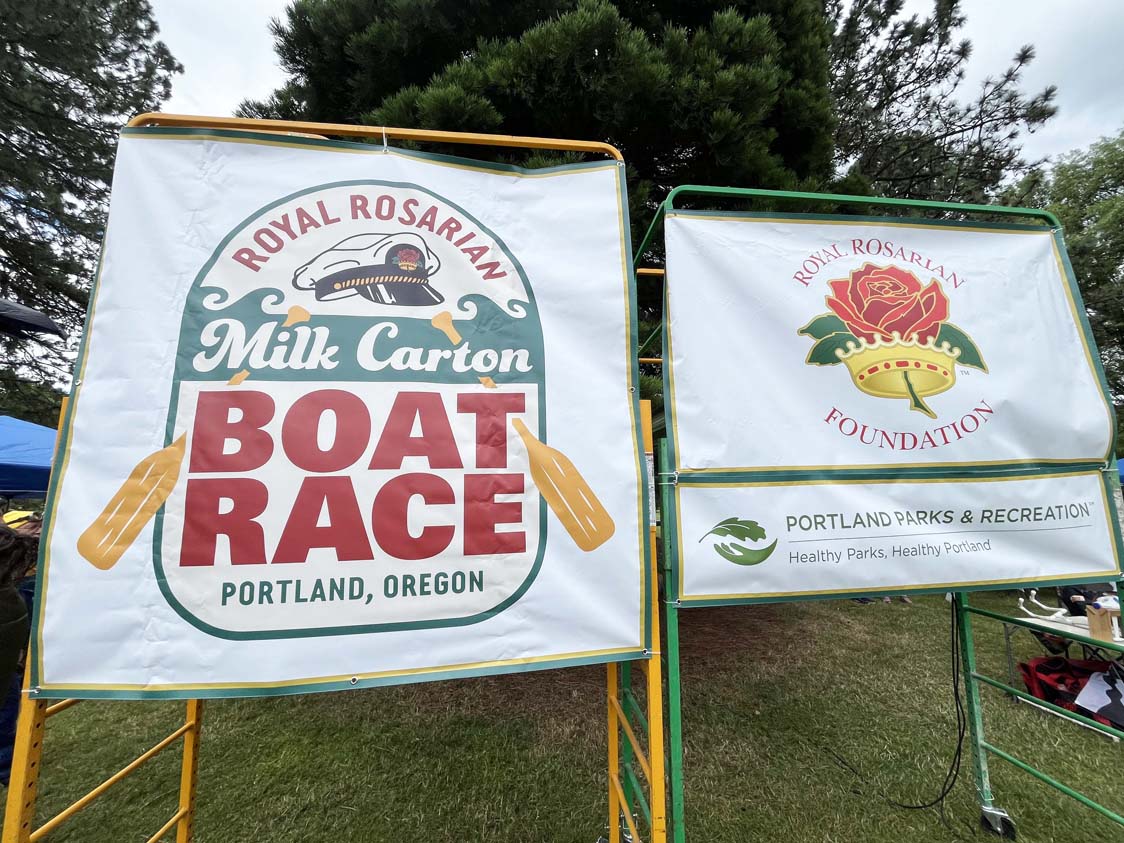
Last Sunday I visited an annual event that has been a Portland tradition since the mid 1960s. The Milk Carton Boat Races at Westmoreland Park display engineering ingenuity, civic commitment by organizers and sponsors, and above all family togetherness that lasts through many months of learning about watercraft construction, preparation of costumes and paddling practice before the culminating races. In that regard they are a microcosm of what can be good about our nation, a common good, no less, since the events are inclusive, free to visit, and making use of city parks dedicated to the community.
A short history of West Moreland Park and its usage, written by Dana Beck 4 years ago, can be found here. It explains the role of the Royal Rosarians (for non-Portlanders: these are “ambassadors of Goodwill”, a 114-year-old civic organization associated with our famous rose festival) as current sponsors of the races. They know how to put on a party, but more importantly work hard to maintain civic cohesion and draw youths into engagement with our civic institutions. Including instructions to how to build a boat from dairy cartons….
I will let the photographs speak for themselves. They captured some of the joy and excitement, parent-child bonds,
friendship groups,
the fashion quirks as well as smart costumes designed at home,
the ambassadors who organized the event and greeted everyone with warmth and poise,
and some of the volunteers from multiple organizations and businesses who helped make things run smoothly.
Not to mention the canine presence….
It was the perfect on-ramp for thoughts about the 4th of July, and the special birthday this nation is celebrating, seeing the diversity among participants all happily cooperating to provide a joyous moment for Portland’s citizenship. A melting pot of people, paddling on rickety structures, lovingly maintained, cheered on by a large crowd of (mostly) strangers. Groups from all walks of life (and likely political backgrounds) joining in a shared task. No commercial exploitation, or lure to buy stuff to consume – simply the excitement of the competition and the creativity exhibited in the designs and sportsmanship in a civic space. A commonwealth.
There are others who have meaningfully written about the problems and uncertainties we are currently experiencing as a nation, Rebecca Solnit and Jennifer Rubin among them with insightful analysis. I, however, just want to cling to the glimpses of happiness from last Sunday, a reminder what is possible in this country, what we can make possible if we embrace the ideas about equality on which this nation was founded.
I am skirting the issue. I should be writing about the politics of war, but my head would explode. Let’s turn to the interesting people department instead. Given that it is Women’s History month, I’ll start with a 19th century poet and union leader attuned to skirts.
The Skirt Machinist
I am making great big skirts For great big women— Amazons who’ve fed and slept Themselves inhuman. Such long skirts, not less than two And forty inches. Thirty round the waist for fear The webbing pinches. There must be tremendous tucks On those round bellies. Underneath the limbs will shake Like wine-soft jellies. I am making such big skirts And all so heavy, I can see their wearers at A lord-mayor’s levee. I, who am so small and weak I have hardly grown, Wish the skirts I’m making less Unlike my own.
Lesbia Harford was an Australian poet, lawyer and labor activist. Her father abandoned the family after bankruptcy, her mother toiling to get the 4 young siblings fed and educated. Harford was one of the first women to get a law degree at Melbourne University in 1915, where she became interested in the politics of class relations as well as feminism. She decided to work in the garment factories to understand truly the conditions of working class life, particularly among women. Despite having congenitally defective heart valves which made physical labor difficult, she went on to become a leader of the Industrial Workers of the World (IWW) around 1916.
She was openly bisexual, often in polyamorous relationships, and radically honest in her poetry around feminine issues that would not be discussed in public. She died from tuberculosis at age 36, her last years of life tortured by illness and dependency.
The poem struck me as both anguished and angry. Here is this small person, overwhelmed by the weight of the production task, metaphorically as well as literally. Stunted, she sews for women who are clearly of a different class, unrestrained in their consumption, free to eat and rest. Yet even these Amazon-sized women are burdened by the weight of heavy skirts, jelly-like limbs prohibiting escape.
Heaviness even when the contraptions of previous eras – the crinolines, the farthingales, the petticoats – were long abandoned. Skirt length and materials varied across time, of course, not least affected by the economics of any given era. If you look at shapes and lengths in relation to war vs. peace times, for example, you find straight correlations, with skimped materials when times are hard. Length also, eventually, became a means of protest and liberation – the mini skirts of the 1960s the most famous example.
***
Skirts were on my mind for a number of reasons. I had read about a woman who collected woolen skirts for decades from Midwestern thrift stores, up until she was 89. For the next 10 years – Audrey Huset lived until her 99th birthday – the collection of over 1000 vintage skirts was stashed in cartons in a garage. Her granddaughter, artist Mae Colburn, started to archive them in 2022, with the help of her parents, professors of costume design and photography, respectively. They sorted them according to a range of colors, plaids, and silhouettes – here is the link to the digital archive where you can be amazed at the collection.
I try to wrap my head around the motivation: how can you accumulate so much stuff, without even using the garments? Then again, I can just see the joy of the hunt, the glory of a find of an unusual specimen, the hope that these will make some warm recycled rugs in the future, the physical pleasure of touching woven wool of that period (much denser and of higher quality than what we see today.) A passion that gets you out of the house and in contact with people into your high eighties…still. Collectors are a mystery to me.
***
Then another skirt appeared on my screen. An expert knitter, designer and dancer had shared the instructions for a voluminous, long skirt she called the Paris skirt, and asked her 35.000 subscribers on Instagram (or anyone else) to knit along. There was a huge resonance, an exploding array of pictures posted of the variations generated by knitters across the globe. A new community instantly created, although I have asked myself how people who have not been knitting for ages, could afford to participate.
The pattern is not difficult. The materials required, on the other hand, are prohibitively expensive, if you do not already own a stash of remnant wool accumulated across many former projects. The mohair wool, for example, costs an average of $30 or so for 50 grams, which give you some 500 yards (the project requires over 2700 yards for larger sizes, and that does not account for knitting with double or triple strands that give the skirt some heft and bounces on the bottom.) Five different sizes of circular knitting needles required: the largest alone, US 13 mm, costs easily $27. If you had to start from scratch you could spend $300 or more, for a homemade skirt!
But again, the use of leftover materials is a sustainable practice, and the making of your own clothes a political act. Add a community that derives a sense of connectedness from the shared experience, and you have truly accomplished something. The designer herself considers knitting a form of resistance.
***
Then a book appeared in the mail, a gift from a friend who rightly anticipated my pleasure of receiving it. Loosely bound in recycled (and strangely fragrant) jeans material, it is titled Fav Pieces of, followed by some 50 names of people from across the globe. Let’s ignore the fact that the choice of font, an illegible page of contents, and an occasionally tortured introduction trying to provide intellectual heft, all scream for attention. It is, after all, published by Thaddaeus RopacPublisher of Modern Art. (I did not yet see the book on their publications website.)
Let’s focus instead on the fabulous idea of editors Frauke von Jaruntowski and Gerhard Andraschko Sorgo, to collect essays from people with various backgrounds about their favorite piece of clothing or other adornments. And admire the range of images provided with the design, including portraits of items, owners, or both, and some contextual pictures that are meaningful, ranging from laypersons’ snapshots to serious photography.
The essays make us think about our relationship to clothes and, in turn, the ways beauty norms, body image, experienced gaze, memory, class conformity, politics, moods as well as our yearnings, influence our consumerism – or our rejection of it.
It is a fascinating read, if only for the comparison between explanatory attempts. Some people reveal intensely private information, others block with superficial description. Multiple owners describe how the item makes them feel internally for its own relevance, history or associations. Several emphasize how a given piece allows them to create a persona projected outwards. A few discuss the relevance of fashion in their lives, yet others the need for comfort, rather than public effect. Some are eloquently descriptive of beauty, others refer but to function.
Oversharing, reticence, courage to expose vulnerability, vanity, strategic self positioning, thoughtful introspection, or simple autobiographical anecdotes – all can be found between two covers.
Only two skirts made the list. One is from an exchange between designers, a hand-stitched, non-traditional patchwork quilt in return for hand painted plates. The essay informs about the history of Scottish tartans, symbol for traditional Clans. It then turns to lovely interpretation of the possible meaning of patch-worked remnants, creating a style that belongs to all. A Mix-and-Match Clan for a rootless citizenry, a remix overcoming divisions, and an important reminder that we can create something new from old. The reader truly understands why that is a favorite piece in this context.
The other skirt appears to have been protectively underused, in contrast to its oft worn twin in more muted colors, both purchased at KENZO in 1980’s London, simultaneously. The beloved bright one was a match for the buyer’s brilliant mood at the time, the darker one more likely acceptable in the owner’s day-to-day existence. A short comment on personal history that brought the good mood in the 80s in stark relief, and a cryptic snippet on how she regrets not having worn the favored piece enough, are the parentheses for the half-page long musings.
***
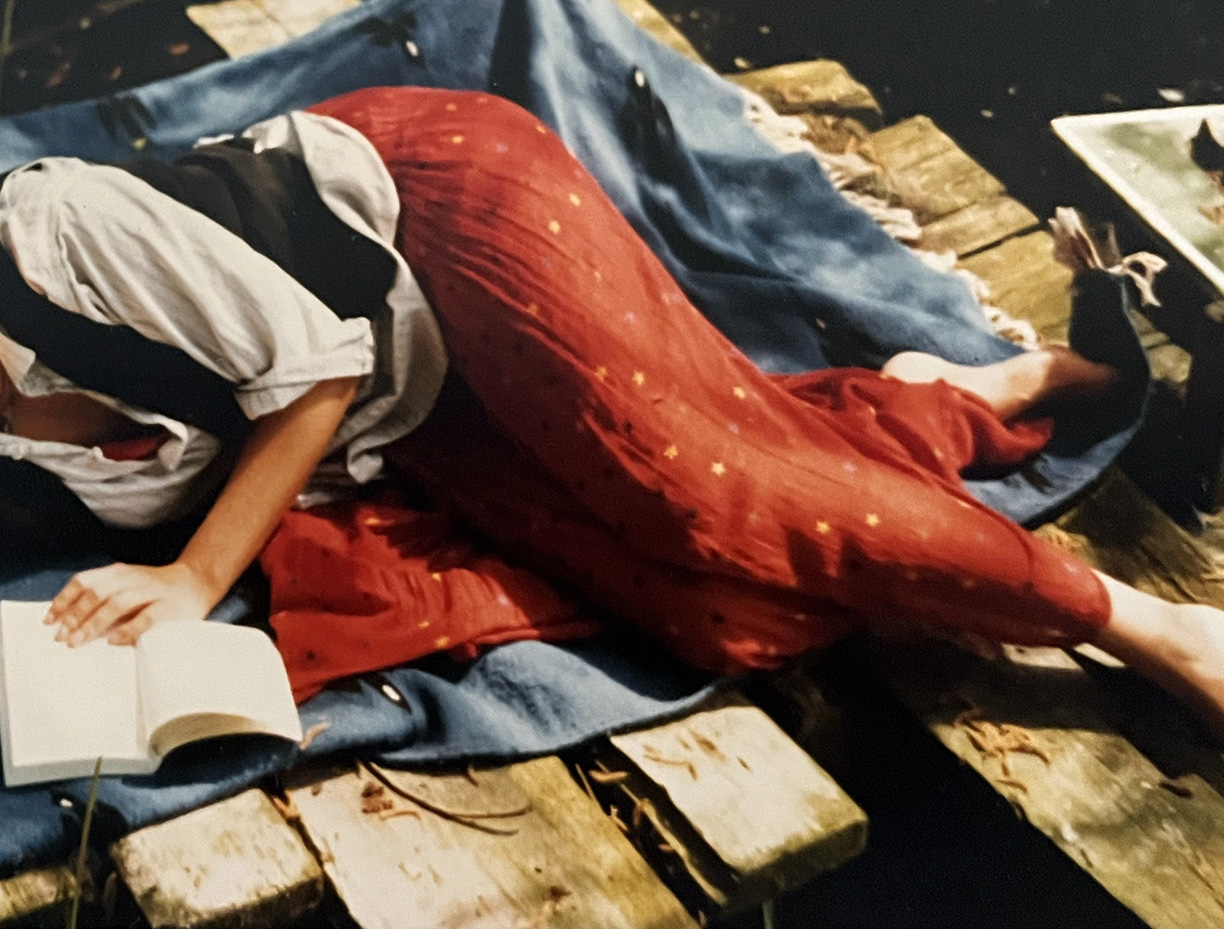
I used to wear skirts all the time. These days, not so much. I live in the functional, no need to think, can get dirty, ready to hike, comfortable uniform of pants and sweaters. But my favorite item in my closet is indeed a skirt, and it has accompanied me through good times and bad ones, for probably 20 years or longer. It replaced an old, red, star-sprinkled favorite that somehow got lost during emigration. I wear it when I travel, when I give lectures, or when I need a boost to my sense of who I am, during tricky encounters.
I picked it for my double portrait sessions with Henk Pander when he was still alive, a project, Eye to Eye, where he painted the photographer, I photographed the artist, across weeks of sittings. The skirt felt like the appropriate feminine counterweight to the absence of feminine symbols, eradicated by mastectomies for cancer. It’s most important attribute, other than a cheerful patchwork of patterns, is that it is light and wide enough to run in. No heavy skirts, no constricting pencil shapes ever again!
The skirt is also associated with something I am occasionally proud of: resisting overconsumption, for the most part, sticking to the tried and true. (I previously reviewed fiber artists, Ophir El-Boher, who embodies that concept in her art.) Of course that, too, comes from privilege. When you have permanent space to store things forever, when you have enough clothing that any one item is not worn to threads, when you have the funds to buy good quality that lasts, it is easy to do the right thing and not yield to compulsive purchases. In that way, then, the skirt reminds me to be grateful for all the choices I have.
Music today leads us back to the top – the fate of seamstresses in an exploitative economy. A Yiddish Ballad about the 1911 Triangle Shirtwaist Factory fire.
On Tuesday I stood in line early to watch the celebration of the Lunar New Year at Lan Su Chinese Garden. The long wait was worth it, despite cold feet and a mounting worry that my parking might expire before I got to visit the garden in full.
A kindly gentleman with a nifty beard contraption kept us in good spirits – he distributed red envelopes with lucky coins in them – Hongbao – to children and adults alike. This is a traditional custom ensuring that generosity is remembered and rewarded.
Then the lion dancers arrived at the plaza in front of the garden. Quick change in attire – it does get hot in those costumes.
Plenty of opportunity for the press to take pictures, and then the dance began.
Each lion had two hidden actors, some quite young, all very athletic as well as expressive. They happily “ate” the dollar bills offered to them by an enthusiastic crowd, kids transfixed.
The musicians were impressive as well, even though I feared I would go deaf standing right next to them, camera in hand and thus unable to plug my ears…..
Finally the gates to the garden opened. Dancers, musicians and public rushed in, making the rounds through the various pathways, performing some more on the terrace.
The garden was beautifully decorated with small, tasteful ornaments on some of the trees, horse graphics in the windows, and colorful sculptures in the ponds.
The combination of Horse (the 7th of the 12 Chinese zodiac signs) and Fire (one of the 5 rotating elements) reoccurs only every 60 years and is believed to be particularly powerful. The sign is associated with energetic, determined, resilient personalities with an entrepreneurial drive. It is also burdened with superstition: in some Asian cultures it was believed that women born under this sign were likely to overpower potential husbands and thus not a good match. Consequently, birth rates declined in those years to avoid exposing daughters to an uncertain fate.
It never ceases to amaze me how cultural mythology actually shapes our behavior.
Astrologers also claim that years of the Fire Horse are associated with important political and social events. Can we find that to be true of 1966, the last time the Fire Horse appeared?
Spoiler Alert: yes we can; and no, I did not check 1965 or 1967 just to confirm my hunch that important things happened then as well, as they do every year….
I will, however, remark on where we are 60 years later.
1966 saw the start of the Cultural Revolution in China on May 14, initiated by Mao Zedong. This socio-political movement aimed to preserve Chinese communism by purging remnants of capitalist and traditional elements from Chinese society. Bloodbath, but also initially making huge inroads to combat inequality, both in land holdings and educational access.
Where are we in 2026? China’s Xi Jing Ping is certainly not as despotic as Mao, but also not as open to relative freedoms as his own father was, choosing a middle path. One can look at repression under his leadership and the fraught issue of Taiwan, but also at long-term planning that takes into account scientific knowledge, climate change and so on, securing economic stability for billions of people.
Other major shifts in governments abroad: Indira Ghandi was elected as Prime Minister in 1966. Tough maneuvers to get into and then stay in power, with a focus on nationalism as well as leftist politics of redistribution of wealth. In 2026 we have Narendra Modi whose right-wing leadership has led to a resurgence in Hindu nationalism, taking away the autonomy of Kashmir in 2019, and relentless democratic backsliding in the following years.
Closer to home: 1966 saw an increased engagement in the Vietnam war and concomitant protests. It also saw a variety of legislative actions benefiting Americans: Lyndon B. Johnson’s presidency created significant domestic policies, including the Great Society programs aimed at eliminating poverty and racial injustice.
Dr. Martin Luther King Jr.’s ‘Letter from Birmingham Jail’ was published. It became a seminal text in the American civil rights movement.
Medicare was officially implemented. The Freedom of Information Act was signed into law, promoting transparency in government.
We joined the United Nations International Covenant on Civil and Political Rights and the International Covenant on Economic, Social and Cultural Rights. These covenants are key international treaties that outline fundamental human rights and freedoms, establishing standards for all nations.
The National Organization for Women (NOW) was founded on June 30, 1966, and aimed to advocate for women’s rights and equality, addressing issues such as workplace discrimination and reproductive rights.
The Endangered Species Act was signed into law on December 28, 1966, marking a significant step in wildlife conservation efforts in the United States. This legislation aimed to protect species at risk of extinction.
And last, but not least, the Cuban Adjustment Act was signed by President Lyndon B. Johnson. This legislation aimed to provide a pathway for Cuban refugees to adjust their status.
2026: Measures to improve or protect the rights of women and racial minorities are actively rescinded, under the guise of DEI hostility. Reproductive rights and voting rights are under particularly vicious attacks. I had written about the SAVE act earlier, but remember, if ratified it will make it harder for married women, poor people, students and native Americans to vote. Millions of them.
We have numerous instances where healthcare is endangered through the new bills that Congress and the President established, with Medicare a likely target for further restrictions.
We are blockading Cuba (while ICE is rounding up Cubans in Florida) to the point where we are accused of human rights violations by the international community.
Can some Fire Horse please gallop in to promote significant directional change for the rest of 2026????
In the meantime there is always the natural beauty of the garden, camellias, plum blossoms and paper bush in bloom. There are also many events scheduled (see the garden’s website) including light shows and miniature horses on site to be admired by the kiddos.
Music today: Dmitri Shostakovich completed his Cello Concerto No. 2 in 1966, matching the mood of our times.
The essay below was written before the horrific events of the last days, the mass shootings at Brown University and Bondi Beach, the stabbing of a righteous couple. I wondered this morning, if it would be frivolous to post it. But it ends with thoughts of having to create light when there is none, reminders of making a world shine during difficult circumstances. I think that core message is what we need. So here goes….
_____________________________
Hah! The universe tells me to think, not mope.
I had barely started to whine about the fact that I miss live singing, both as a participant and a listener, when, within 24 hours, interesting pieces about singing popped up in my news feed, in publications as diverse as The Guardian, Nature and High Country News.
It began with listening to Bach’s Christmas Oratorio, familiar from childhood. In retrospect, it seems as if we sang not just in this season but all the time in the 50s and 60s – in class rooms, at services, at demonstrations, at parties, on school field trips in the busses, and eventually at live performances. Belting out the newest hits from the Beatles or the Kinks, Procul Harum, the Stones, Joan Baez, Joni Mitchell, Bob Dylan, Traffic, Jonny Halliday and Gilbert Bécaud, you name it. Informed by listening to Radio Caroline or Radio Luxembourg under the covers on contraband tiny transistor radios, strictly prohibited in my boarding school. No matter how much I loathed being stashed there, when we sang, a sense of community took over.
(Portraits today of people of that – my – generation. I always wonder what someone’s musical taste might be, why I stereotype many of them as (Grateful)Deadheads, and if I’ll ever find a match to my idiosyncratic musical preferences.)
Later I joined choirs, until chemo wrecked my voice; then regularly attended choral concerts, until the Covid pandemic shut down my ability to be in close proximity to large crowds. These days what goes for singing is croaking along to my Bandcamp collection in the privacy of my car on solo rides to my nature outings. Oh well. Could be worse.
I was squarely reminded of that, when I read about people who have made it their business to sing to people on their deathbeds. The assumption is that it calms the dying, and allows them to cross the threshold, accompanied by soft, slow melodies and harmonies sung by up to 4 practiced people who travel to homes and hospices. Importantly, they only sing their own compositions, assuming that more familiar tunes would “keep” you from letting go, clinging to or (re)living the past. Hmmm.
I am firmly convinced that we have no agency in the choice of timing our exit, as I have discussed previously, and so nothing we do or don’t do, will have any influence. But would a music lover feel more comfortable with simplistic, if sweet tunes by these threshold choirs, than the familiar sounds of, say, a Mahler or Schubert song cycle? For that matter, would one feel comfortable with strangers in the room (though still better than the traveling harpists so prevalent in local hospitals…)? You can read all about the choirs here.
***
As it turns out, not surprisingly, hard times, punctuated by traumatic events like 9/11 or the pandemic, have an impact on songs. Interesting research, recently published in Nature, analyzed 50 years of song development (1973 – 2023) for the lyrics of songs on the US Hot 100 Billboards. (Heads up for sampling bias: certain genres are not reflected in these charts, from rap to early punk, which was censured, just think Ramones or Sex Pistols. Reggae and Latin music was extremely popular but did not make it into these charts since at the time based in club culture.)
But for the general popular music we see clear trends: across time, themes of stress and negativity increased, while simultaneously the lyrics got less and less complex. Across the same 50 years, rates of depression and anxiety increased, as did the negative tone in the media and fiction books, amidst recent drops in IQ and PISA test scores.
Preferences in music consumption could mirror what is going on in the surrounding culture and one can speculate about what emotional regulation we choose in response to what is happening around us. We can select music that aligns with our current affective state (stressed), or we can listen to music that brings us closer to a goal state (happy) – in short, we can regulate our moods by choosing particular musical coping mechanisms. The research here was interested if that happens in ways we can predict for society as a whole, particularly during periods of traumatic events.
As it turns out the prevalent mood congruent trends were NOT amplified during 9/11 or Covid; in other words, people did not listen more to upsetting music when they felt particularly frightened. If anything, people chose to listen to more positive music instead, modulating their mood perhaps in ways that allowed them to make it through these hard times.
The complexity of lyrics – or absence thereof – is currently affected by yet another variable: the arrival of AI on the scene. Here is Timothy Snyder’s description of the AI renditions of classic Christmas songs, musical score intact, lyrics changed, as experienced in a coffee shop just a few days ago. In his inimitable prose:
My guess would be that someone, somewhere, entered an instruction to generate winter and Christmas songs that avoided “controversial” subjects such as divine and human love. And so we get mush. In a reverse sublimation, the sacred becomes slop. …
The carols bear a message about love, one that that no machine will understand, and that those who profit from the machine perhaps do not want us to understand. Love begins humbly, takes risks, recognizes the other, ends in pain, returns as song. And begins humbly again.
As always, his essay is worth a quick read.
***
Let’s end on a more positive note, though, keying in on A or C major (preferred keys by Earth, Wind and Fire, one of my favorites, as it turns out.)
I found the poem below about singing songs that are also centered on love, incredibly perceptive as well as motivating. The poet Valencia Robin was a recipient of a National Endowment of the Arts Fellowship, her poems have appeared in a wide-range of journals, anthologies and podcasts including The Best American Poetry, The New York Times, Poetry Daily. Here she cites a quite familiar line from The Essential Earth Wind and Fire, album 2002, track 9 All About Love, a song that inspired the poem:
“And if there ain’t no beauty, you gotta make some beauty,”
Have Mercy,
Listen to me Y’all……
Ars Poetica
I woke up singing my favorite song as a kid and I mean, really singing, catching myself all morning, asking myself what it means, a reminder perhaps that we can be strange — we wake, we sing, we wonder why we’re singing, we realize how seldom we have a song in us anymore, remember how we used to play/be Aretha and Anita or Earth, Wind and Fire — Maurice bringing it, sending us on one of the few oldies where the words ‘right on’ don’t sound silly, standing in the middle of the room giving our all to the olive-green sofa and wood paneling, mama at work — we even had his little laugh down and when’s the last time we believed what we were saying so completely, all that 70’s positivity, all that gospel pretending to be the devil’s music — and is that what ruined us, why we’re so bad at real life — practically screaming the last line, And if there ain’t no beauty, you gotta make some beauty, deciding without even knowing we’d decided that that — Lord help us — was the dream.
It’s still the dream. And about time, that poems titled Ars Poetica don’t just give a nod to Horace (he wrote the very first poem with that title about the craft of writing poetry), but acknowledge the likes of Maurice White whose poetic lyrics motivated and uplifted generations.
And now excuse me while I slink off to hum this and grab the camera to make some beauty out of a dreary winter landscape. You can come along, if you sing!
I borrowed that title from writer Celeste Ng who posted it in response to the inane opinion piece by Ross Douthat in the NYT, wondering if women ruined the work place (I will not even link to it – they later shifted the titled to liberal feminism instead of “women.”)
Low energy on my end this week, so you get to look at some portraits I took of strong women, and a collection of publications (I found ready-made) that blamed women for ruining – well, everything.
It would all be laughable, if the bigotry wasn’t so scary.
\
Portrait of a Woman
She must be a variety. Change so that nothing will change. It’s easy, impossible, tough going, worth a shot. Her eyes are, as required, deep, blue, gray, dark merry, full of pointless tears. She sleeps with him as if she’s first in line or the only one on earth. She’ll bear him four children, no children, one. Naive, but gives the best advice. Weak, but takes on anything. A screw loose and tough as nails. Curls up with Jasper or Ladies’Home Journal. Can’t figure out this bolt and builds a bridge. Young, young as ever, still looking young. Holds in her hand a baby sparrow with a broken wing, her own money for some trip far away, a meat cleaver, a compress, a glass of vodka. Where’s she running, isn’t she exhausted. Not a bit, a little, to death, it doesn’t matter. She must love him, or she’s just plain stubborn. For better, for worse, for heaven’s sake.
A short piece for music today, introduced as: “Being a woman writing music in the early 20th century was an act of feminism in itself. In the 1920s, a critic at one performances remarked with surprise that Ruth Crawford Seeger could “sling dissonances like a man”—because, you know, what could a woman possibly know about discord?”
And eyes beholding radiance. And the gnats’ flickering dance. And the seas’ expanse. And death, and chance.
Ursula K. Le Guin, second stanza in A Hymn to Time (From Late in the Day Poems 2010 – 2014)
Some people spend their entire lives reading but never get beyond reading the words on the page, they don’t understand that the words are merely stepping stones placed across a fast-flowing river, and the reason they’re there is so that we can reach the farther shore, it’s the other side that matters…
by José SaramagoThe Cave (p.60), (2003)
—
A few years ago I visited the Sigmund Freud Museum in Vienna’s Berg Gasse. Driven by a somewhat morbid curiosity, I guess, given that I ain’t buying what the man was selling. His claims of offering “science” out of step with how science proceeds, his concepts of memory often completely inaccurate, his assertions about children and child development flatly wrong, his analytic method for the therapeutic process, involving class and traditional gender stereotypes, having done more harm than good. I do concede, however, that the he was a literary giant, converting his extensive humanistic education into far-reaching and complex contemplations that challenge readers to think hard about his suggestions.
What can an exhibition about a literary figure, (or for those so inclined, the father of Psychoanalysis,) convey? A recreation of his environments, the typewriter here, the ashtrays there, the proverbial couch long moved to England, various photographs of different life stages, copies of manuscripts or even original pages, earned awards, and everywhere the collection of knick-knacks, or artifacts from ancient cultures: it all struck me as detritus of a life forced to abandon, or a shed carapace with the substance – his towering intellect – missing in the room.
Then again, the exhibition certainly fed our eternal craving for human interest stories, opening a window into the life of an (in)famous man, if not his mind (or even at the expense thereof.) And having opened this window into the personal details of an existence might, in turn, lure you to open the door into the more interesting part of the house: actually engaging with his writings.
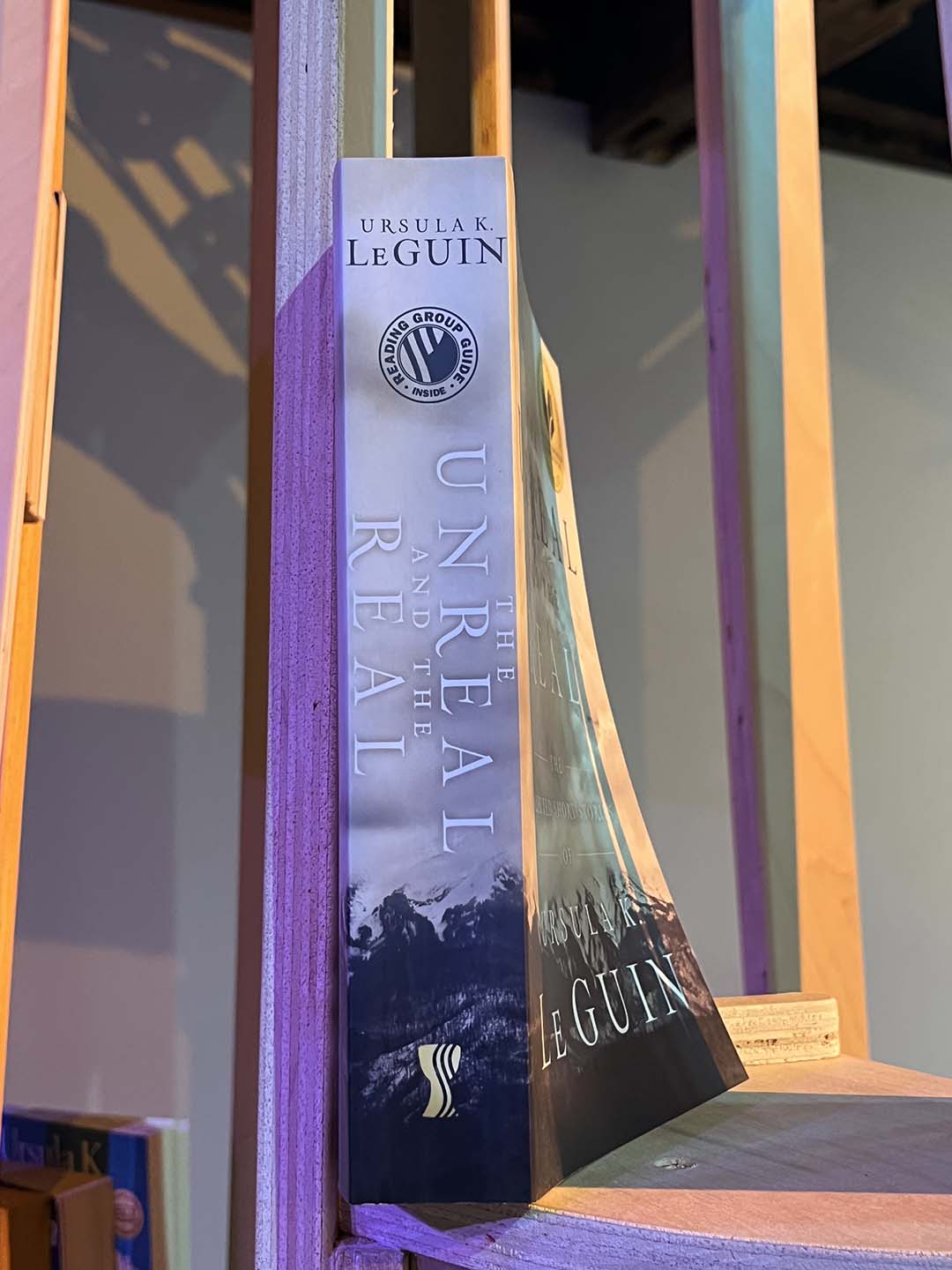
All this came back to me, with trepidation, when I planned to visit a recently opened exhibition at Portland’s Oregon Contemporary. Another literary great on view, and one, in contrast, who I greatly admire: the author, poet, blogger and all around renaissance woman regarding creative modalities: Ursula K. Le Guin (1929 – 2018).
To come straight to the point: this exhibition is much more successful on many levels, although, it, too, suffers from the structural constraints around conveying at least some of the heft and style of the intellectual output of its literary protagonist. There were many things I delighted in, and there were some I sorely missed, that might or might not have been possible to introduce.
(I will skip biographic details that can be easily learned from her website. A compact overview was also recently offered by one of the talented StreetRoots writers – shout out to our local street newspaper! By her counting, it is pretty amazing to look at the volume of Le Guin’s output: 21 novels, 11 volumes of short stories, 12 children’s books (please see the popular picture book “Catwings”), four collections of essays, multiple volumes of poetry, and four of translation, including the Chinese classic text Lao Tzu: Tao Te Ching and the poems of Gabriela Mistral.)
The exhibition title A Larger Reality is ambiguously open to multiple interpretations, but LARGE unambiguously ruled sensory perceptions. The visitor enters a cavernous space, greeted by a larger than life portrait of the author. A brilliant choice among the many photographs available of a strikingly photogenic woman across her life-span, depicting Le Guin as we knew her during the last years of her life, no shying away from old age skin and sagging features. No pretense here, no softening of reality. I cannot think of a better promise that this will be no hagiographic show, but an uncompromising honoring of the truth embodied by this face, a face exuding wisdom and zest in equal measure.
An enormous dragon stretching across almost an entire wall, grabs your attention next – a fanciful mural that embodies the playfulness so prominent in the written work. The scales are dotted with photographs of the author across a lifetime, many including her family. The dragon spikes on top, or whatever they are called, contain the titles of her most successful output.
Small display cases accompany the mural, offering personal benchmarks, and glimpses of activities that cannot be separated from her life as a writer, or that mattered in addition to her professional career. I’ll get back to that in a bit.
Next we encounter a large accumulation of drawings of maps, all preceding the various worlds Le Guin created in her novels and stories. The facility with drawing, and as shown in subsequent display cases, water colors and sketches is enviable – but not as enviable as the fact that the quality of prose is absolutely matched by the quality of her poetry (something you would not learn from this show.) It was a smart curatorial choice not to dilute the impact of the geographic inventions and depictions by other illustrative output. The stunning variability of the maps themselves can be better appreciated this way. (Readers in GB: You can see some of this work as well. Open through December 6: The Word for World: The Maps of Ursula K. Le Guin at the Architectural Association Gallery, London, UK.)
Not done with large yet. There is Mother Oak, a humongous tree where you can sit and read her stories or listen to her voice (what a gift to have those recordings. I so miss the voice of my parents, unable to recreate them accurately in my mind, much more so than visual memories.) In contrast to the oak tree in her book Direction on the Road, this one does not expand and shrink depending on the approach or departure of people interested in its stories. It is just a – large – reality.
Multiple interactive stations invite the visitor to engage with some of the science fiction and fantasy ideas. A recreation of the author’s workspace, including the view out of her window, familiarizes us with her environment. Videos add more introductions to visual creativity.
In the next room we encounter numerous display cases offering ephemera of her various interests. The walls are exhibiting pieces by very different artists done in response to Le Guin’s work, and yet another large mural depicts a variety of people and anthropomorphic creatures offering books that had some impact on the author. Framed in pink, no less. It did not work for me, too contrived, and lacking the intellectual elegance that I so associate with the writer and that was captured in the mural by the entrance.
A wizard’s cape, created by one of Le Guin’s daughters, reminds us of the abolition of genders in Earthsea, times for great celebration marked by such a robe. She fashioned it from various hoods of doctoral gowns worn by the writer who received no fewer than 8 honorary doctorates. Smartly conceived and beautiful in one fell swoop!
***
Political writing of the highest order is rare. Moments at which a particular language is opened to a further range of possibilities – a new tone, a new conception of human purposes, a sharper or wilder rhetorical ascent – in any case happen very infrequently.
– T.J. Clark Those Passions: On Art and Politics, p.327
—
The gallery website introduces the exhibition as such: “A Larger Reality: Ursula K. Le Guin offers a biographical and poetical portrait of one of Oregon’s best known artists. Examining important moments and themes in Le Guin’s life and oeuvre, the exhibition encompasses a rich variety of media, immersing guests in the ideas, playfulness and hope that course through Ursula K. Le Guin’s art.“
The exhibition scores on most of those points. Yet, the important themes in her oeuvre just weren’t exposed enough (and, mind you, I am always willing to admit maybe I missed the relevant info. I will happily stand corrected.) For example, Le Guin’s political advocacy is represented with a variety of buttons on a bag with a tongue in cheek printing of “I have abandoned truth and am now looking for a good fantasy.” The signage there reads that she was advocating for a variety of causes in her life, from anti-war movements to tree preservation. The description of her as an anti-capitalist is softened with the humorous referral to her love of shopping, particularly shoes. These attenuations might bring her closer to the rest of us mortals, but they really underplay the intensity or progressiveness of her positions as they appear in her writings. Cloaked in science fiction, her writing was political of the highest order.
It would have been great to introduce, particularly to those new to her, the variety of political topics that forever reappeared, and associate them with particular books, to catch new readers’ interest. Curious about feminism or gender identity? Read Lavinia, or The Left Hand of Darkness, or The Wizard of Earthsea. Thinking about the evil of colonialism? Read The Word for World is Forest or Always coming Home. Can anarchism work as a form of political entity? Find out in The Dispossessed. I could go on about issues of power, our relations to the natural, world, you name it. But here is one I care about most: Want to know why the writer is considered by so many as the queen of moral dilemmas? Go straight to The Ones who walked away from Omelas, a short story that won the 1974 Hugo Award for Best Short Story, given annually for a science fiction or fantasy story, and appeared a year later in The Wind’s Twelve Quarters.
A city full of joy, prosperity, security relies on its citizens’ complicit acceptance that it is all maintained by a single child being tortured and kept in permanent isolation in a fetid hole. Only a select few walk away from the city and its immoral bargain after viewing the child, towards an unknown fate beyond the perimeters of “paradise.” We have obviously graduated from one child to several million who we currently willingly starve in our own country, or kill by omission around the world with the abandonment of USAID, or murder by commission of weapons sales for the Gazan genocide, which brings the issue of complicity in ever sharper focus.
Pat Barker, another inimitable writer, voiced in an interview with the Guardian’s Susanna Rustin almost 20 years ago: “Fiction should be about moral dilemmas that are so bloody difficult that the author doesn’t know the answer. What I hate in fiction is when the author knows better than the characters what they should do.”
I can’t think of a single novel that I’ve read of Le Guin’s that does not directly or indirectly force us to face a moral or ethical quandary and think through the consequences of free will, or the constraints on destinies imposed by oppressive powers.
The real is imported into the unreal, and vice versa.
What makes her so impressively different is the fact that none of this involves didactic scolding, or condescension, but always, always offers glimpses of hope, the possibility of change if courageously – and collectively – pursued. No defined solutions, but no Antigones for Le Guin either!
At the same time, she could be quite cutting in her answers to those of us (yes, myself included) who asked apparently stupid questions during readings and lectures. She did not suffer fools.
The refusal to accept black & white answers or cling rigidly to positions, made up for that. I remember vividly my college students’ reactions year after year, when we discussed a video of her talking about gender issues in my Social Psychology or Psychology of Women classes. The expected outline of the difficult position of women in societies organized around patriarchal principles was always counterbalanced by Le Guin holding forth on the fate of young men in those very same societies – they are expendable, good for canon fodder. Male and female students alike felt seen and were able to engage in much less defensive discussions.
And speaking of young people, it would have been great to have some knowledgeable sources provide an overview of how much of an influence this author has had on younger, aspiring writers across the years, including the awards given to them, like the 2025 Ursula K. Le Guin Prize for Fiction, which you can see for yourself here. Her breadth of interests is certainly reflected in the composition of nominees.
***
Theo Downes Le Guin introduces the prize ceremony in the video link above. He is also the main curator for the exhibition portraying his mother, with his sisters offering major contributions as well. I cannot help but wonder how you find a balance between (on one side) the desire for proud public display of your mother and all she achieved, and (on the other side) the need for privacy not just regarding the subject of the show, but your own relationship to a parent who, by public decree, was a Living Legend.
Portland was hometown of all the Le Guin’s, with near cult status afforded to the elder sitting alongside of the fact that the younger ones have considerable standing in their own right. If curatorial interests clash between what is opportune for public display and what is important both for privacy and for keeping the spotlight on the mother, how do you solve the dilemma?
I have earlier described in Oregon ArtsWatch Theo’s curatorial prowess, but the current situation is unique, with a number of potential vulnerabilities. What does it imply psychologically when you set your task to be one of describing comprehensively the importance of your mother, while also mourning the absence of a beloved person, gone for good? Digging through life-long archives inevitably entails reminders of a childhood shared with her profession, no matter how often (and in this exhibition repeatedly stressed) she voiced her conviction that parenting and authoring were perfectly compatible, even complementary. What does it mean to be in the wake of your mother’s departing ship, likely happily engaged as her literary executor, building the Foundation, arranging traveling exhibitions (at least I hope, for this one should find a broader audience) but – as a result of all of this — no longer able to devote full energy to pursuing what you used to do?
These are all questions brought to mind in a year that has seen its share of biographies about larger-than-life mothers and the complexities of filial love – the off-putting How To Lose Your Mother: A Daughter’s Memoir by Molly Jong-Fast and the fascinating Mother Mary Comes to Me by the brilliant Arundhati Roy the most prominent ones.
I experienced the Le Guins’ curation as an act of generosity as well as a public service, keeping an important voice alive for all of us. Cannot imagine that it hasn’t been hard, though.
One last shout-out: Oregon Contemporary’s Executive Director Blake Shell not only checked people personally into the exhibition, but approached with serious interest at the end of my round, offering to engage in conversation. I was pressed for time and so had to leave promptly, but would have enjoyed that interaction with someone so intimately involved in the whole enterprise. The gallery is facing hard times, like so many of our cultural institutions. The National Endowment for the Arts revoked its federal funding for the 2026 Artists’ Biennial that was intent to showcase a diverse group of Oregon artists, many expected to defy the administration’s imperative to deprive us of “DEI” associated art. You can learn more and help here.
Oregon Contemporary 8371 N. Interstate Ave Portland, OR 97217
Hours Fri / Sat / Sun, Noon–5pm Free and open to the public / ADA accessible
Suggested Donation $14.90 for those who can.
Additional events:
Saturday, December 6th Event: First Saturday, Talk with Michelle Ruiz Keil & Ashley Stull Meyers and Screening of CROSSLUCID’s Vaster than Empires Time: 5:00-8:00pm, 6:00pm start of event
Saturday, February 7th Event: Todd Barton performance of Music and Poetry of the Kesh by Ursula K. Le Guin & Todd Barton with a screening of Kesh, a short film by Rankin Renwick Time: 5:00-8:00pm, 6:00pm start of event
I started to look at memes which are sprouting after the Louvre heist, but then thought they are probably all in your view already, related by everyone from OPB to Town and Country Magazine….
I also found myself thoroughly out of touch with the dominant meme references to a Bollywood movie called Dhoom 2, featuring similarly daring jewel robberies and managing to make more money than any previous action caper at the time. I’m getting old or out of mainstream – probably both. Apparently the cinematic thieves were given another chance at (a reformed) life. We wait to see what happens to the real life suspects apprehended yesterday.
The heist had come up in the context of thinking about museum staff or leadership who are currently sacked or deciding to resign for far more worrisome reasons – refused censorship among them – than lack of museum security. But then I was simply too lazy to dredge up all the examples that had accumulated in my inbox across the last months.
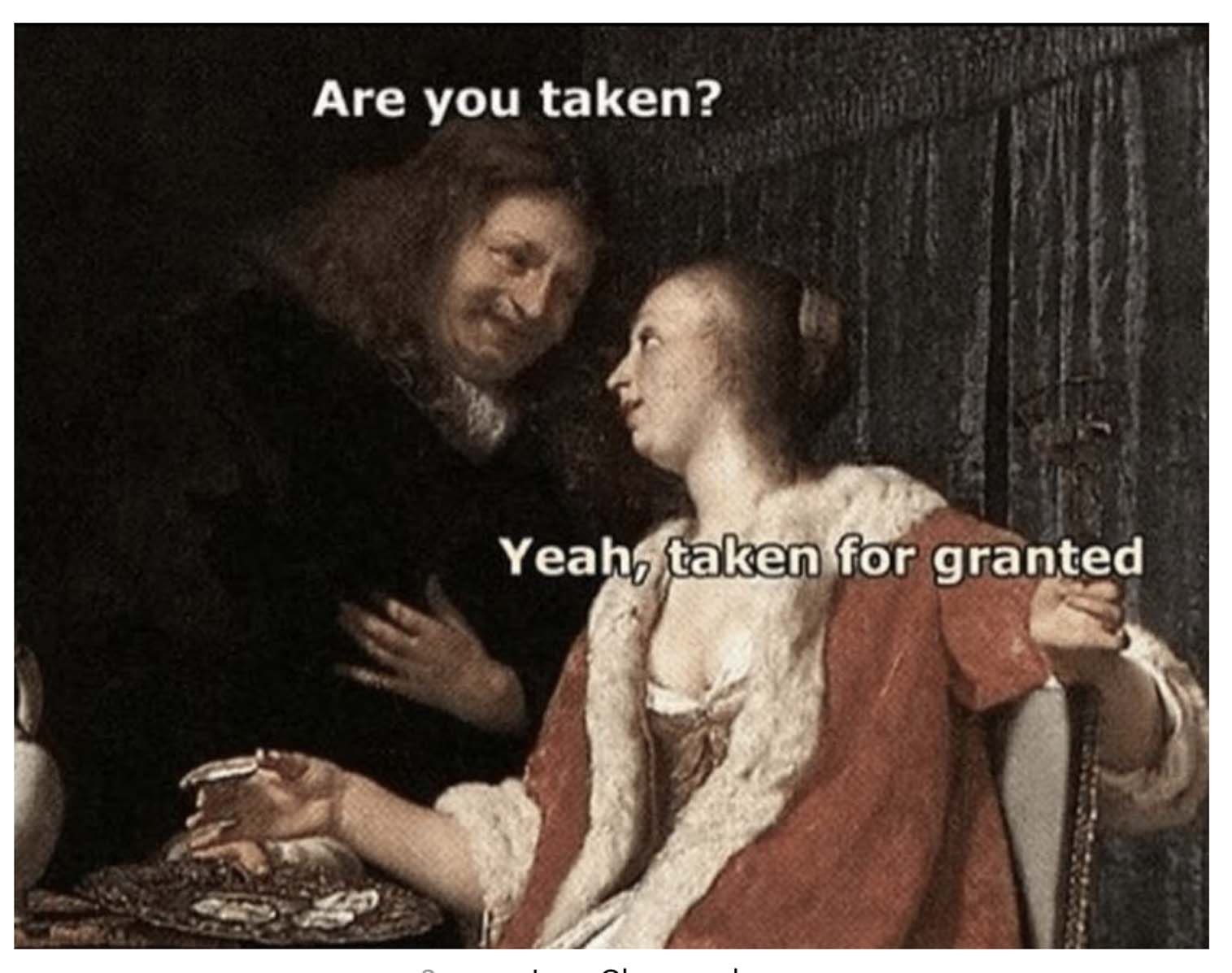
So I turned to a more familiar and easier knowledge base instead: memes about classical works of art. For your amusement, then, some images dedicated to several friends of mine (you know who you are!) and one of self portraiture – you may guess.
Given the medley of memes, starting with the Louvre heist, music today is a medley of French composers, some famous opera music included, mostly warhorses. Which brings me to the educational part of Monday:
Here is a hilarious introduction to all that’s wrong with contemporary opera…..
Thank you, L., for sending this. Made me snap out of it.
A two-and-a-half year-old of my acquaintance is by all reports besotted with pumpkins and other Halloween decorations. I have been sending her photographs of pumpkins and some considerations for how to explore different colors, since painting is another current cherished activity.
Today’s images, then, are the results of my trying to keep up with the creativity of my favorite toddler. They are also related to the poetry of Richard Brautigan, the master of observing everyday occurrences and putting them into innocent, childlike, anti-poetic words that can be grasped by everyone, exert an incredibly strong visual pull, and are deceptive in their simplicity.
—
The Pumpkin Tide
I saw thousands of pumpkins last night come floating in on the tide, bumping up against the rocks and rolling up on the beaches; it must be Halloween in the sea.
It is the time of year, where walks around the neighborhood are dominated by Halloween decorations. Plain, messy old pumpkins have been replaced by plastic ones, inflatable figures waste electricity, and attempts at humor compete with gruesome skeletons and jumping monster spiders.
How do you explain to a child what this is all about? Do you explain the pagan origins of Halloween, coming from the Celtic world of ancient Britain and Ireland? A celebration of the beginning winter period, a day where the souls of those who had died were believed to return, and those who had died in the preceding year were on their journey to the afterworld? With bonfires lit to frighten away evil spirits, and disguises and masks worn to not be recognized by the ghosts among us?
Or do you center the 7th century Christian attempts to supplant pagan rites with the introduction of Allhallotide, a three-day Christian triduum dedicated to remembering the dead that begins with Halloween (October 31- the evening before All Saints’ Day became a holy, or hallowed, eve, from which the word “Halloween” evolved,) and is followed by All Saints’ Day (November 1) and All Souls’ Day (November 2)? (Ref.)
Protestant Reformation, by the way, put an end to this for non-Catholics. Majority Catholic countries, like most of Mexico and South America, still celebrate, often happily and vividly, the Day of the Dead.
Or do you stress the notion of a now secular holiday, devoted to fun costumes and endless candy, if your parents let you….? So how to explain the ubiquitous skeletons?
***
These are the same questions I ask myself when thinking about fairy tales, or kids exposed to adults teaching them to take the bible as a literal document to be believed. Does it make a difference in how children learn about these things if and when the adults themselves believe in the tales they tell or not?
I suppose the function of fairy tales (or biblical lore) as instructions for how to understand the world, behave in the world and perhaps change a world that is unjust and menacing, is enhanced by a belief that the threats are for real. If you trust that you’ll end up eaten by the witch if you abscond to the woods, or fry in hell if you covet your neighbor’s possessions, you might be indeed more inclined to follow the rules.
Note, though, that it is not always about punitive actions. Fairy tales in particular often stress the positive outcomes of courage and risk taking, the questioning of hierarchical oppression, the power of empathy and reciprocal aid. And in modern versions, the Disneyfication of the old stories, if you will, evil powers and their reach have certainly been tamped down, compared to what the originals contained, stressing agency instead of assured victimhood.
The German fairy tales I heard as a child were assuredly different than the ones I read to my American children, more brutal and more inclined to stress the consequences of misbehavior. And fear was a palpable experience, in the absence of Halloween decorations, for a non-Catholic child in my catholic village during All Souls’ Day in the beginning of November. I have written about it before, but the flickering of remembrance candle lights on the graves of the local cemetery, breaking through the darkness of the flat, misty landscape of beet fields and meadows, gave me bone-deep shivers as a child. It was not about ghosts. It was about death. Death in the context of a too recent war, with evil at its roots.
Now, ignoring ghosts, specters, witches and all the other symbolic stand-ins, we are focused on the existence of evil again, in the context of war and in the vicinity of cease-fire agreements, in unadulterated crimes against humanity, as just one example picked for its sadistic timing. Could come up with uncountable more, all over the world, all sides.
How do you preserve the innocence of a young child, model courage and foster their fearlessness, provide them with a moral compass with a true north of all humanity in our current world? How do you celebrate the memory of the dead when we are all implicated in bringing about their demise, be it by action, indirect financing, or simple silence and averting our eyes?
Any answers out there?
I was thinking hard about what music to include today. There is the heavy, if beautiful piece by Ralph Vaughan Williams, Dona Nobis Pacem, Give us Peace. It is a war protest, and includes the Catholic Agnus Dei, three poems by Walt Whitman, a speech by Quaker politician John Bright, and excerpts from the Biblical book of Jeremiah.
But in the interest of lifting us all (and preserving a young child’s chance to listen to some really cool music!) I think I’ll recommend this. Maurice Ravel wrote this to commemorate friends and acquaintances who died in WW I, and was accused of doing it too light-hearted. His response: “The dead are sad enough, in their eternal silence.”
It is us, the living, who need this musical consolation. Music, painting pumpkins, watching kids blossom – creativity and connectedness help us to get through hard times in one piece. They are the tools to guard ourselves against the pain, the hopelessness, the fear at our doorsteps – feelings that surface way too often these days, at least for me.