Floating into Fall.
· Weaving Time: NUNO – Textiles of Tradition and Transformation at Portland Japanese Garden. ·
If you are interested in textile design and live on the West Coast, you are currently in luck. The Los Angeles County Museum of Art (LACMA) just opened a major retrospective of works of the collective design studio NUNO, headed by Reiko Sudō. Textile Alchemy: The Art of Reiko Sudō & NUNO presents over 100 limited edition textiles, many of which are drawn from LACMA’s collection, including sketches, raw materials, tools, mock-ups, and prototypes. At the center of the exhibition hall is a retail store that allows visitors to purchase items associated with the studio, a recreation of the original 1984 NUNO shop offering textiles, clothing, and accessories. Rather than being irritated at the consumerism urged on visitors, we can celebrate that this arrangement stresses the fact that NUNO’s creations are primarily about function. Their beauty and innovation non-withstanding, these fabrics are meant to be applied, whether in wardrobes, interiors or as architectural design features.

Closer to home, Portland Japanese Garden features a smaller, compact presentation of the output of the studio, artist and artisans. Weaving Time: NUNO – Textiles of Tradition and Transformation is a lovely introduction to these famous Japanese fabrics. The visitor is not only offered a rich visual environment, but also encouraged to experience the fabrics tactilely, using our sense of touch to understand the variability of much that is produced by NUNO. Reiko Sudō is clearly not just en vogue, but also in last month’s Vogue, which featured an informative biography of the designer, who traveled a complicated path despite her stunning talent and visionary energy.

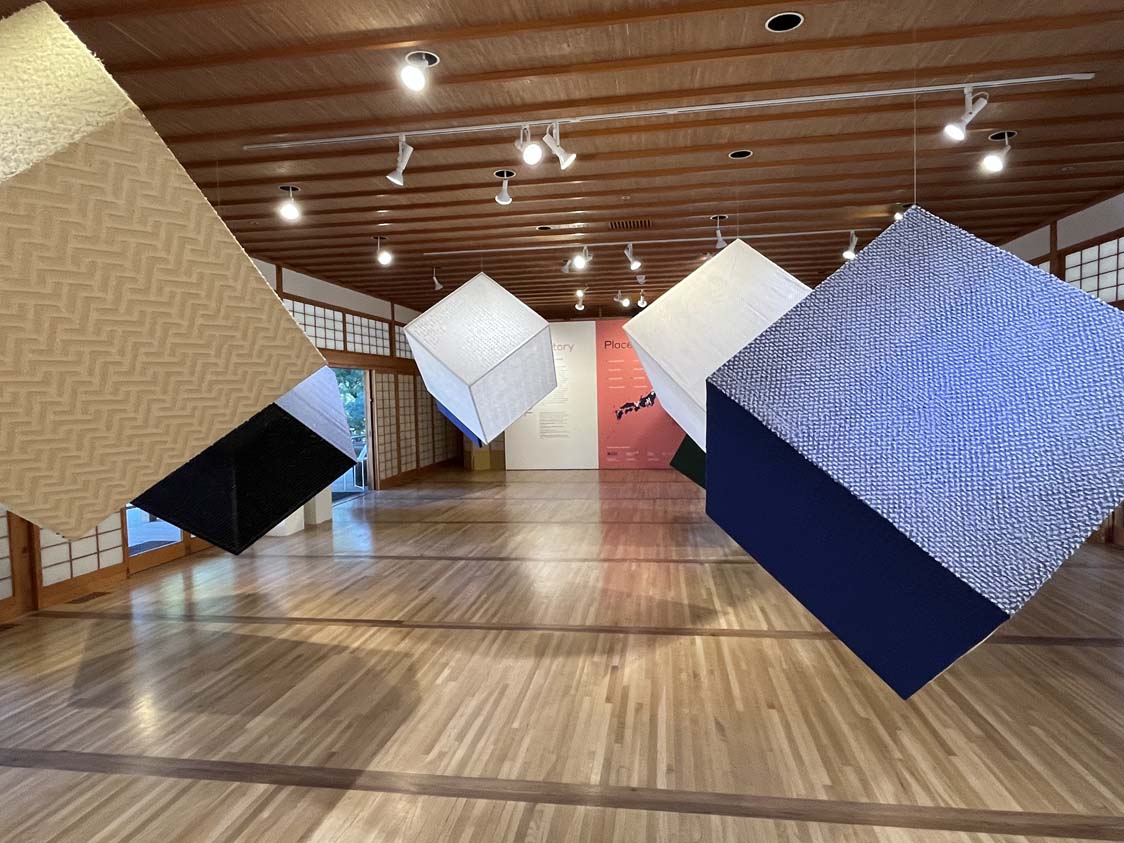
The Pavilion is filled with large, colorful cubes, suspended from the ceiling. They slightly sway and shift when the sliders to the outside are open, creating an impression of floating in space. Each stands for one of eight regions of Japan that are associated with distinct styles of textile production, with the cubes’ respective six sides covered by cloths representative of a region. It is an efficient use of limited space.


One of the side walls holds samples to touch, and explanations about the points of origins for these fabrics. The other side wall informs visitors about the processes used to bring traditional ware into modernity, including cutting edge chemical and physical processes revolutionizing the production of fabrics that combine beauty with function.

The choice of the Portland Japanese Garden exhibition title – Weaving Time – seemed fortuitous to me. It includes both variables that are special about Sudō and her collective: a look backwards aimed at stewardship of traditional process and a leap forwards in employing cutting edge new technologies to produce futuristic materials. For the newly opened David Geffen Galleries at LACMA, for example, she created a set of curtains that guaranteed transparency but also protected art work from harmful sunlight. The sputter-plated chrome textile they created is fire-resistant (the codes are rigorous), and has an interesting metallic sheen, in both matte and gloss varieties. No wonder they went for the Alchemy exhibit title – there is something about the fusion of materials and her and NUNO’s role as catalysts. I still like “our” title better, though, since the preservation of history is such an important role in a world that tends to ignore the old crafts at best, and relegates them to the dustbin at worst.


The curtains in front of the Garden’s Pavilion are made of nore material. The way they swayed and softened the view of the surrounding landscape while still somewhat transparent, was the best transition to the fall garden that I could imagine.

I consider this time in the garden as floating into fall. The softness of the coloration is not yet superseded by the full saturated fireworks of color change. Leaves seem tentative,

floating in sunshine and shade alike,


or gathering on the many water features.

Yet there is still solidity in the canopy, with only the occasional renegade leaf starting its earthbound descent.

Curtains and cubes around and within the pavilion echo that visual or perhaps even emotional impression.
***
I reached the Japanese Learning Center at the end of my walk. A small portion features NUNO textiles caged in bamboo, created by master woodworker Chūzō Tozawa of Hinoki Kougei. The row of paravents are entirely monochromatic and meant to evoke the Pacific Northwest’s rainy season.


The cynic in me often wonders if these titular allocations are made to please a specific audience – I could have just as well bought the idea that these fabrics relate to the snow at Fujiten, Niseko or Hakuba Valley, or the cherry blossoms’ shades of white. Better to ignore the labeling and immerse myself visually – these fabrics are etherial and almost hypnotizing if you stare at them for a long time. Again, despite their objectively static nature in those frames, they can induce perceptual floating if you hold your gaze just long enough.

***

I’ll let others debate where the boundaries are between design and art. For the record, her work’s status as art remains complicated for Sudō herself. “I want to make textiles that move people, emotionally,” she explains. “But fundamentally, I really want my fabrics to be used.” (Ref.)
It is the case, though, that fiber arts have made a huge impact on the art scene across the last decade or two, with their visibility ever rising. That can include the use of specific textiles to create installations, as Sudō herself did with Adrian Gardère, for example, for MUJI stores (she sits on the Board of the company.)

Reiko Sudo and Adrian Gardère Koi Continuum (2026) Photocredit Phillip Reed

More often it means the use of any kind of fiber in ever more creative configurations, with myriad processes employed. (For a quick overview of the variability of contemporary fiber arts, check out this, examples ranging from cute to uncanny.)

One intellectual and artistic lodestar for the fiber arts is the Fiber Arts Biennale From Lausanne to Beijing, showing the most accomplished artists at the museum of Tsinghua University in China. Interwoven Horizons, the most recent 13th Biennale, stated as a profile:
This edition explores the convergence of fiber art within material culture, ecological ethics, and technological evolution, examining how the fiber medium carries tactile experiences and cultural heritage in contemporary expression while bridging local and global contexts, tradition and future.
Seems to echo much I’ve learned about NUNO’s approach. Here is a link to the exhibition view (embedded in the conference report.) The images are stunning.
You have to travel a bit less – Leeds in West Yorkshire, rather than Beijing – to see a current exhibition at the Henry Moore Institute, that shows the sculptural qualities fiber art. One of my favorite contemporary fiber artists, NYC- based Sagarika Sundaram exhibits Reservoir . The center piece of the show is a 23 ft (7 meters) felted structure, Blue Mountain 2026, which looks to me (I’ve only seen photographs) more like a wave, and thus leads us back to floating. Spectacularly beautiful in its drape and undulations.


I am bringing up the global context because I have repeatedly felt that the exhibitions I review at Portland Japanese Garden, even though dedicated to Japanese artists, bring themes and creative processes to our attention that overcome insular preoccupations. Just like the microcosm of a sculptured and carefully maintained Japanese garden reflects the larger configuration of nature that surrounds us, the small but smart exhibitions we encounter in the Pavilion address themes that cross borders. Questions of material culture, cultural heritage, historical correlations or the impact of a globalized world on nations’ development are all raised from various artistic perspectives. For me, who loves the garden as a natural place, its role as a stimulant for thought through art and design has taken on an almost equally important value. Some exhibitions more so than others, of course, but then again, some seasons register more so than others. The current one is a favorite: floating towards fall.
