“Poetry is not a resting on the given, but a questing toward what might otherwise be.” – Adrienne Rich
A dear friend sent me a poem by Adrienne Rich (1929-2012) some months ago. I have been mulling over it and tried to read up on the poet, going beyond my previous cursory knowledge. I thought about the poem again today (I am writing on Mother’s Day) because of the huge identity shift that happens when you become a parent. But it also applies to something that many artists, myself included, struggle with: how to progress, change view points, accept ruptures or even seek them out, so you don’t end up stale, but evolve.
The poem is called Transcendental Etude, and it is long, posted below in full. It is dedicated to Rich’s life-long, much younger partner, after she had divorced her husband and started to explore her lesbianism. The title is an allusion to Liszt’s Transcendental Études, a set of technically (eventually) extremely challenging studies that were composed across 25 years of his life (starting at age 13) and meant to build performing skills. They are also quite narrative, providing a glimpse into a set of images in time, and constantly moving, like all etudes.

Ken Hochfeld #40 (Series Leaning) (2025)
Rich’s mother was a performing concert pianist, until her dominant husband, a pathologist and department head at Johns Hopkins, put an end to it; he was a demanding and overbearing father as well, according to the biography I read, and both pushed the child into a life of achievement, with brilliance assumed to be a given. She played Mozart and wrote her first lines as a 4 year-old, no less. The poet later dealt in much of her writing with the issues of authoritarian dominance as a form of abuse, as well as the challenges to her Jewish identity, motherhood (it radicalized her, three sons before her thirtieth birthday, later renowned for her book on motherhood as an institution, Of Woman Born) and her evolution into a lesbian (her first, doomed, love-affair was with her psychoanalyst (ethics, anyone?), Lilly Engler, who was still closeted.
Here is a short version of her biography from The New Yorker. She succeeded early in life, surrounded by minds as brilliant as her own at Ratcliff (Ursula LeGuin among them), won publications and awards while still being rather conventional in the 1950s, then evolving as a poet, as the NYT obituary called her, “of towering reputation and towering rage.” No matter how difficult a person she might have been, burdened with chronic pain from rheumatoid arthritis and the trauma of her husband’s suicide after their divorce, her intellectual curiosity and commitment to feminism are surely remarkable.
In any case, this is not about Adrienne Rich. This is about words that make you think about how life changes you, or, for that matter, your art. The first page contains lyrical descriptions of landscape, nature, man’s interference, and musings on the fleetingness of time, its short duration not allowing us full comprehension.

Ken Hochfeld #4 (Series Leaning) (2025)
The second page is more anguished: instead of being able to study our lives like the evolution of the Liszt etudes – from simple to difficult – we are thrown into the full harshness of it, after a few months of security at our mothers’ breast and lap, then nothing but wrenching apart and isolation.
“Everything else seems beyond us,
we aren’t ready for it, nothing that was said
is true for us, caught naked in the argument,
the counterpoint, trying to sightread
what our fingers can’t keep us with, learn by heart what we can’t even read. And yet
it is this we were born to. We aren’t virtuosi
or child prodigies, there are no prodigies
in this realm, only a half-blind, stubborn
cleaving to the timbre, the tones of what we are
– even when all the texts describe it differently.
And we’re not performers, like Liszt, competing against the world for speed and brilliance
(the 79-year-old pianist said, when I asked her What makes a virtuoso? – Competitiveness.)
The longer I live the more I mistrust
theatricality, the false glamour cast
by performance, the more I know its poverty beside the truths we are salvaging from
the splitting-open of our lives.”
There comes a point, though, she argues on the next page, where we have to take ourselves seriously, or cease to exist. We have to be true to ourselves, in other words, rather than adhere to the scripts provided by society or fill the expectations laid out by others. We WILL find ourselves in free fall, but she argues that this fate was in store for us in the old ways of being as well – we have to take a leap into the unknown to be able to reconnect, ultimately to the love embodied by the symbol of a mother.

Ken Hochfeld #31 (Series Leaning) (2025)
And now we enter the most beautiful part of the poem: a description how we can integrate ever so many ways of beings, if we acknowledge how multifacted we are, rather than conforming to a single assigned role. I am the lover and the loved (agent and subject), home and wanderer (haven and world), she who splits firewood and she who knocks (the strong one and the one seeking help), a stranger in the storm, two women, eye to eye measuring each other’s spirit, each other’s limitless desire,” – all images of parts forming a whole. Remember, this was lived and written during the years when open acknowledgement of radical feminism and homosexuality was not yet tolerated as some decades later.
The poem goes on with a return to descriptions of what is in sight, but this time focused on the boundless ability to create – a woman constructing a quilt-like collage out of wondrous objects, natural ingredients, luminous colors. She is no longer concerned with achieving a masterwork, “something of greatness, brilliance,” but rather attends an integrative task, arranging bird feathers, wasp nests, shells and sea weed, among others. The bucolic descriptions of exterior landscape from the first page, marred by man’s destruction, now transposed into an interior realm, seemingly whole.
“pulling the tenets of a life together
with no mere will to mastery,
only care for the many-lived, unending
forms in which she finds herself”
The poem has a tall order, matched by a tall promise. Cut yourself loose from societal expectations, regarding a single gendered or professional role, as well as demands of outstanding performance/mastery. Replace with a discovery and integration of facets of self, despite the price paid for defying norms. Allow it to unfold over time, (like Liszt’s program of etudes) and you will be rewarded by an unleashing of creativity and the potential of return to the unconditional love of a female, back to the beginnings.
Tall dreams.

Ken Hochfeld #38 (Series Leaning) (2025)
***
As I said at the beginning, Mother’s Day was a trigger for today’s musings. It is hard enough to discover who you are and how to bring that into the world, if it contradicts expectations and convention. It is even harder, when a new role of parenthood dominates for the mere reason that a loved, helpless little being is completley dependent on you, and the magnitude of the task is both physically and emotionally draining. It is made all the more difficult by society’s rigid proscription as to what constitutes a “good mother” (or father.) I strongy believe there are many different ways to be a good parent, all of which have room to unfold only if you are true to yourself. Ignore the performance aspect – the need to please or to oblige – and work with what you have and can deliver. After all, if you want your offspring to be tuly free to be who they are, and have the strength to reach for that even if it goes agaist prevailing rules, you need to model.

Ken Hochfeld #10 (Series Leaning) (2025)
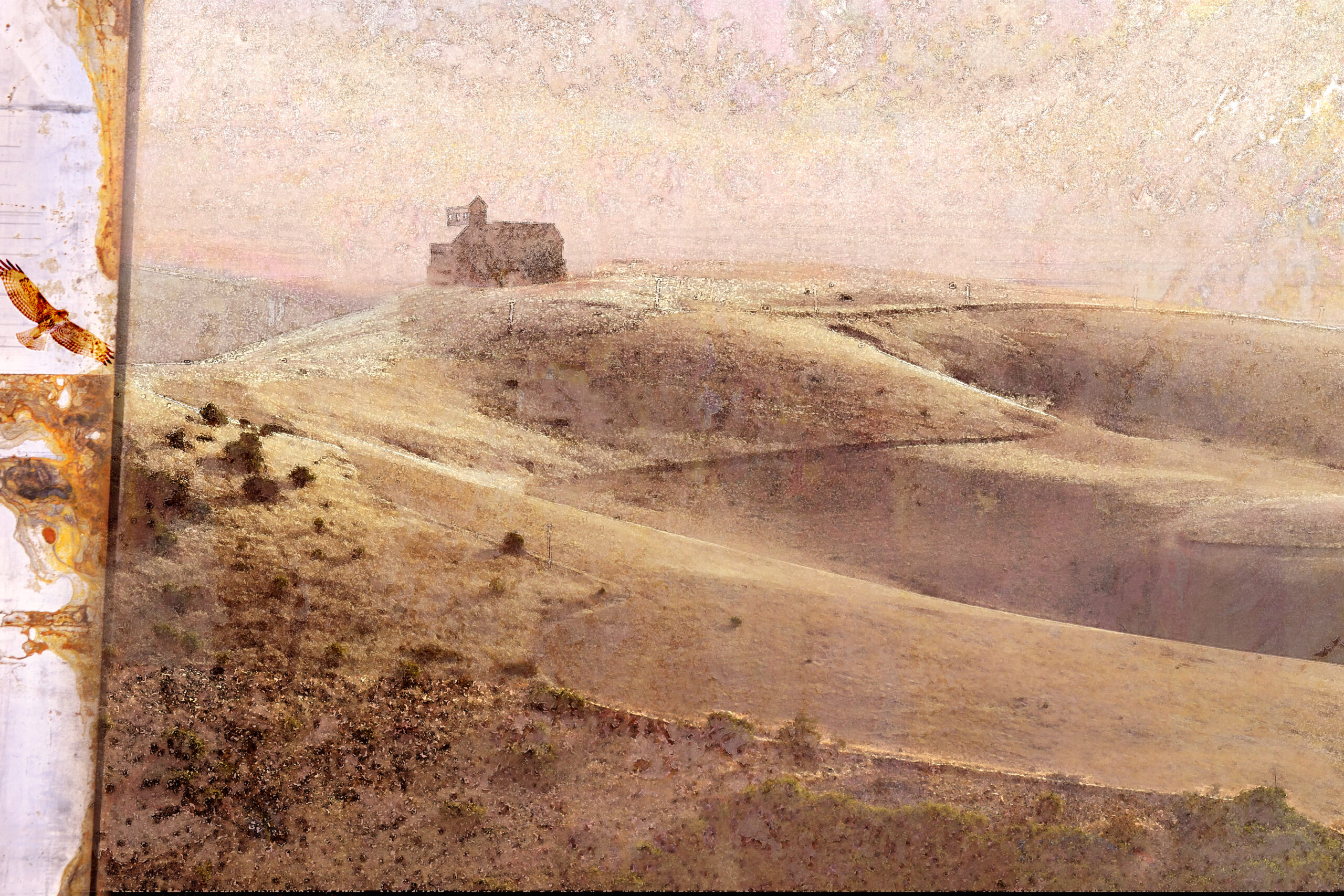
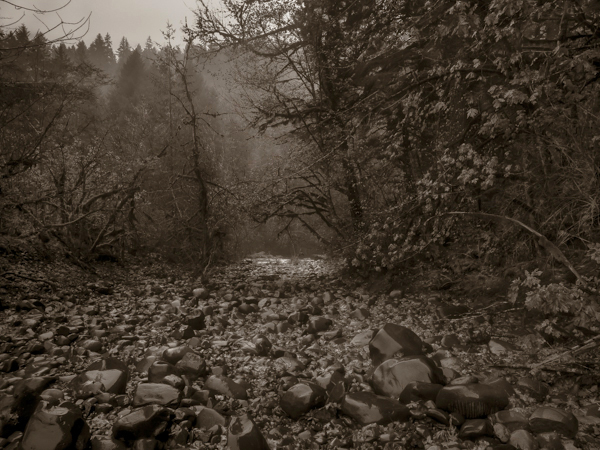
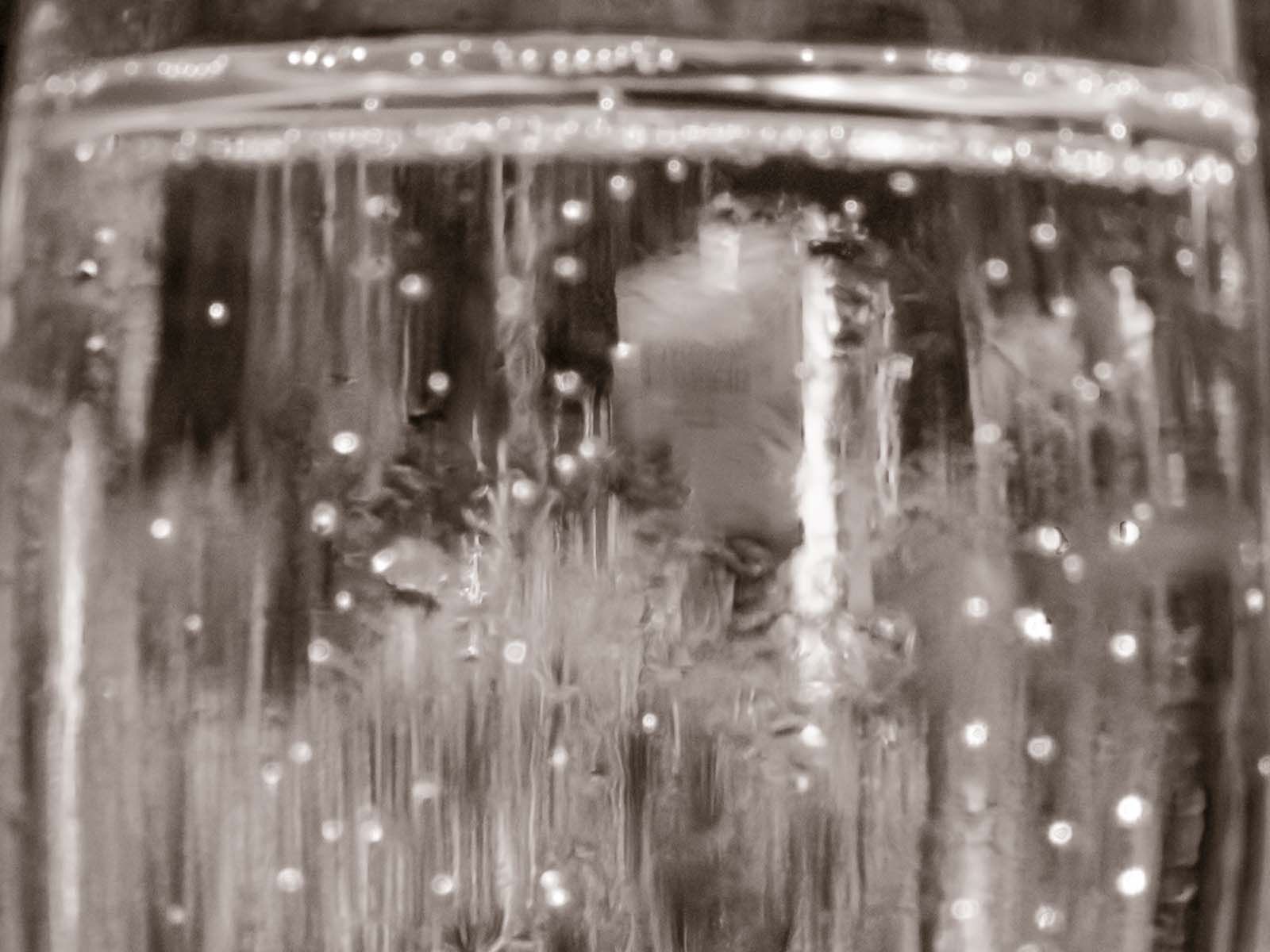
Which is, or course, the impetus for true art as well. When you start to deviate from norms – particularly established and touted in the community of landscape photographers, I fear – you are clearly in free fall, as Rich describes it. Today’s images by Portland photographer Ken Hochfeld are a gripping example of an attempt for new ways of expression. The focus of this work, Leanings, the way I interpret it, is on the un-seen, brought into being by what is visually defined – a seeming contradiction in terms.
“A questing for what otherwise might be,” as I introduced Rich’s writings above, seems to be an apt descriptor here. The threshold between depiction and imagination is increasingly permeable in these photographs, without sacrificing defining elements of photography in terms of spatial layout, contrast effects or composition. Strong, beautiful work, and an evolutionary leap from his previous output.

Ken Hochfeld #18 (Series Leaning) (2025)
Want to guess today’s music?

Ken Hochfeld #8 (Series Leaning) (2025)
TRANSCENDENTAL ETUDE
[for Michelle Cliff]
This August evening I’ve been driving
over backroads fringed with queen anne’s lace
my car startling young deer in meadows – one
gave a hoarse intake of her breath and all
four fawns sprang after her
into the dark maples.
Three months from today they’ll be fair game
for the hit-and-run hunters, glorying
in a weekend’s destructive power,
triggers fingered by drunken gunmen, sometimes
so inept as to leave the shattered animal
stunned in her blood. But this evening deep in summer the deer are still alive and free,
nibbling apples from early-laden boughs
so weighted, so englobed
with already yellowing fruit
they seem eternal, Hesperidean
in the clear-tuned, cricket throbbing air.
Later I stood in the dooryard,
my nerves singing the immense
fragility of all this sweetness,
this green world already sentimentalized, photographed, advertised to death. Yet, it persists
stubbornly beyond the fake Vermont
of antique barnboards glazed into discothèques, artificial snow, the sick Vermont of children
conceived in apathy, grown to winters
of rotgut violence,
poverty gnashing its teeth like a blind cat at their lives. Still, it persists. Turning off onto a dirt road
from the raw cuts bulldozed through a quiet village
for the tourist run to Canada,
I’ve sat on a stone fence above a great, soft, sloping field of musing heifers, a farmstead
slanting its planes calmly in the calm light,
a dead elm raising bleached arms
above a green so dense with life,
minute, momentary life – slugs, moles, pheasants, gnats, spiders, moths, hummingbirds, groundhogs, butterflies – a lifetime is too narrow
to understand it all, beginning with the huge
rockshelves that underlie all that life.
No one ever told us we had to study our lives,
make of our lives a study, as if learning natural history or music, that we should begin
with the simple exercises first
and slowly go on trying
the hard ones, practicing till strength
and accuracy became one with the daring
to leap into transcendence, take the chance
of breaking down in the wild arpeggio
or faulting the full sentence of the fugue.
– And in fact we can’t live like that: we take on everything at once before we’ve even begun
to read or mark time, we’re forced to begin
in the midst of the hardest movement,
the one already sounding as we are born.
At most we’re allowed a few months
of simply listening to the simple line
of a woman’s voice singing a child
against her heart. Everything else is too soon,
too sudden, the wrenching-apart, that woman’s heartbeat heard ever after from a distance,
the loss of that ground-note echoing
whenever we are happy, or in despair.
Everything else seems beyond us,
we aren’t ready for it, nothing that was said
is true for us, caught naked in the argument,
the counterpoint, trying to sightread
what our fingers can’t keep us with, learn by heart what we can’t even read. And yet
it is this we were born to. We aren’t virtuosi
or child prodigies, there are no prodigies
in this realm, only a half-blind, stubborn
cleaving to the timbre, the tones of what we are
– even when all the texts describe it differently.
And we’re not performers, like Liszt, competing against the world for speed and brilliance
(the 79-year-old pianist said, when I asked her What makes a virtuoso? – Competitiveness.)
The longer I live the more I mistrust
theatricality, the false glamour cast
by performance, the more I know its poverty beside the truths we are salvaging from
the splitting-open of our lives.
The woman who sits watching, listening,
eyes moving in the darkness
is rehearsing in her body, hearing-out in her blood
a score touched off in her perhaps
by some words, a few chords, from the stage:
a tale only she can tell.
But there come times—perhaps this is one of them –
when we have to take ourselves more seriously or die;
when we have to pull back from the incantations, rhythms we’ve moved to thoughtlessly,
and disenthrall ourselves, bestow
ourselves to silence, or a deeper listening, cleansed of oratory, formulas, choruses, laments, static crowding the wires. We cut the wires,
find ourselves in free-fall, as if
our true home were the undimensional
solitudes, the rift
in the Great Nebula.
No one who survives to speak
new language, has avoided this:
the cutting-away of an old force that held her rooted to an old ground
the pitch of utter loneliness
where she herself and all creation
seem equally dispersed, weightless, her being a cry to which no echo comes or can ever come.
But in fact we were always like this,
rootless, dismembered, knowing it makes the difference. Birth stripped our birthright from us,
tore us from a woman, from women, from ourselves
so early on
and the whole chorus throbbing at our ears
like midges, told us nothing, nothing
of origins, nothing we needed
to know, nothing that could re-member us.
Only: that it is unnatural,
the homesickness for a woman, for ourselves,
for that acute joy at the shadow her head and arms
cast on a wall, her heavy or slender
thighs on which we lay, flesh against flesh,
eyes steady of on the face of love; smell of her milk, her sweat,
terror of her disappearance, all fused in this hunger
for the element they have called most dangerous, to be
lifted breathtaken on her breast, to rock within her
– even if beaten back, stranded again, to apprehend
in a sudden brine-clear thought
trembling like the tiny, orbed, endangered
egg-sac of a new world:
This is what she was to me, and this
is how I can love myself – as only a woman can love me.
Homesick for myself, for her – as, after the heatwave breaks, the clear tones of the world
manifest: cloud, bough, wall, insect, the very soul of light: homesick as the fluted vault of desire
articulates itself: I am the lover and the loved,
home and wanderer, she who splits
firewood and she who knocks, a stranger
in the storm, two women, eye to eye
measuring each other’s spirit, each other’s
limitless desire,
a whole new poetry beginning here.
Vision begins to happen in such a life
as if a woman quietly walked away
from the argument and jargon in a room
and sitting down in the kitchen, began turning in her lap
bits of yarn, calico and velvet scraps,
laying them out absently on the scrubbed boards
in the lamplight, with small rainbow-colored shells
sent in cotton-wool from somewhere far away,
and skeins of milkweed from the nearest meadow –
original domestic silk, the finest findings –
and the darkblue petal of the petunia,
and dry darkbrown lace of seaweed;
not forgotten either, the shed silver
whisker of the cat,
the spiral of paper-wasp-nest curling
beside the finch’s yellow feather.
Such a composition has nothing to do with eternity,
The striving for greatness, brilliance –
only with the musing of a mind
one with her body, experienced fingers quietly pushing
dark against bright, silk against roughness,
pulling the tenets of a life together
with no mere will to mastery,
only care for the many-lived, unending
forms in which she finds herself,
becoming now the sherd of broken glass
slicing light in a corner, dangerous
to flesh, now the plentiful, soft leaf
that wrapped round the throbbing finger, soothes the wound; and now the stone foundation, rockshelf further forming underneath everything that grows.
By Adrienne Rich – The Dream of a Common Language: Poems 1974-1977. New York: W.W. Norton & Company, Inc.
(For sticklers – I got as close to the correct format as I could. There area few line breaks that are not entirely accurate. Couldnt figure it out in the word program.)

Ken Hochfeld #2 (Series Leaning) (2025)