 February 23, 2026
Here you see me, with my morning coffee cup, thinking what I should do for the next blog. I was working on a longer piece, but would not finish in time. My focus was drawn to the cup because I had recently encountered a series of paintings containing cups, presented by the inimitable French gallerist Yoyo Maeght.
So I thought, let’s offer some of those and some additional ones, celebrating the joys of hot coffee during cold days. Or any day, come to think of it. After all, new Harvard research shows that 2 to 3 cups a day are tied to significantly lower dementia risk, and slower cognitive decline. (Not the decaffeinated kind, though – the more caffeinated, the better, it looks like.)

Paul Cézanne, Woman with a Coffeepot (1890–1895)
Just then, a friend sent me the essay below, which I decided to post in full. It is something I rarely do, but the writing resonated on so many levels and the shared love for birds is obvious. The observations and emotions expressed feel familiar in almost uncanny ways. At the same time I decidedly disagree with some of the sentiments. A piece to make me think, then, so very welcome. The author is Chloe Hope who has been writing about death and birds with sensitivity and wit for quite some time now. Here is her substack link, so you can see for yourself.
You get the somewhat haphazard combination, in other words, of a borrowed text and a borrowed visual idea, the former defiant, the latter comforting. I guess as good a combination as any to start our week with.

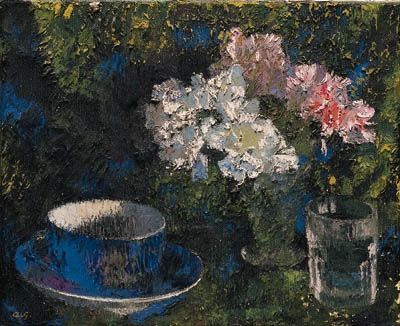
Félix Vallotton Nature morte avec des fleurs (1925).
in accordance
one eye on the sky…
By Chloe Hope
Someone in the village has been feeding the Kites. There’s an unusual number, wheeling above the valley—David counted forty, the other day, spinning a languid gyre. I’ve a cricked neck from holding my face parallel to the sky, and at times they hover so low I can see the whites of their glassy eyes. Their constant spectre is as intimidating as it is hypnotic, and they drift overhead like a half-remembered dream, while we press on below. One eye on the sky. I find myself envious of their honeyed glide. The grace with which they seem to meet the day. I have, of late, become increasingly irritated by my seeming inability to feel a sense of ease. The news cycle exhausts and demoralises. What was a creeping sense of disquiet has become a steady march of dread, and the crumbling of systems which long presented themselves as trustworthy continues unabated—each passing week seeing the circle of complicity widen, and the nature of what was being protected grow ever darker. The news is magnetic interference and my mind a compass needle that cannot find true north. I am exquisitely disoriented by this moment in time. My defensive go-to, since childhood, in the face of confusion and unrest, is to sense-make. The tumult that infused my youngest years saw understanding become sword and shield—and confusion my mortal enemy. Those grasping arms served me well; until, of course, they didn’t. Until wielding tools of rationale became as insane as the thing I was fighting. Some things will not yield to understanding. Certain darknesses have no angle from which they begin to resolve, and to keep searching for one eventually becomes its own kind of madness.

Henri Matisse Laurette with Coffee Cup (1917)
Over the years, I have had the extraordinary good fortune of being involved in the early weeks of many a young Bird’s life. As with any newborn being, there are exciting points of progression which way-mark their developing birdness: eyes opening, pin feathers forming, perching. A particular favourite of mine to witness, however, is the first wing stretch. Any wing stretch is a joy to see, but there’s something about the first one that feels seismic—as though the wings themselves are making a declaration of intent to the sky—“Soon, vaulted blue. Soon.” Each time the sight lands sharp in my chest, the strange sting of something so perfect it makes me nervous. Each time I am made to question what I will declare to the sky. A wing is a refusal of gravity; a rebuttal, made of bone. The architecture so ancient it renders us a footnote. Feathers extend in graduated tiers, the whole apparatus light but not frail—hollow bones latticed within, muscles knitted along the keel. When a Bird lifts its wings, it is shaping pressure. Curving and carving air. Whether Robin or Raptor, they sense the invisible and answer in accordance.

Francisco de Zurbaran Still Life with Chocolate Breakfast Undated
Flight is a holy intimacy with the world, one clearly reserved for those who know how to belong to it. And few belong to it more completely than the Andean Condor. These spectacular Birds have a wingspan of over 10 feet, stand more than a meter tall and, weighing 15kg, are among the largest flying Birds in the world. At the turn of the decade, a study of these Condors revealed that, while airborne, they flap their wings less than 1% of the time. One of the Birds monitored flew for over five hours, travelling more than 100 miles, without beating their wings once. These magnificent beings take to the skies, and surrender to the currents they find there. They do not fight the air they’re met by, nor wish for better winds. They sense what is, and answer in accordance—and the world, thus met, holds them aloft. Their surrender is not capitulation, but an active and intelligent response to the world exactly as it is. And their radical trust ignites my own.

Henri Fontain LaTour Vase de fleurs avec une tasse de cafe (1865)
Surrender is exquisitely difficult—for me, at least—and it seems that no matter how many times I manage it, it never becomes something that I know how to do. I’ll mither and loop, all while knowing there is an alternative, but it somehow feels out of reach. I wonder whether the act of letting go, of yielding to the very is-ness of things, tends toward rocky terrain because some part of us knows that a day exists, suspended in the geography of the future, where the final task to be asked of us will be that very thing. Each time I open my arms and tilt my head to the sky, and meet the world on its own terms in a posture of vulnerability, I am preparing for—and speaking to—my ultimate surrender.
It’s windy here, today. There’s a horizontal line of chimney smoke scoring across the garden. The Kites are undeterred—in fact I think they’re playing in it. May we each meet the day with the grace of these Red Kites, and may we each meet Death with the grace of a soaring Condor.

Jean Etienne Liotard Lavergne Family Breakfast (1754)
“Suspended in the geography of the future” – I just love that phrase; it applies not just to eventualities we meet in our own lives, but also in the unfolding of art history. Just look at the Liotard version of breakfast and then take in Juan Gris – a mere 160 years apart.

Juan Gris Breakfast (1914).
What sticks with me, though, from the essay, is the distinction between capitulation and surrender, and the sense that an unwillingness or inability to surrender might be problematic. That we have to practice surrender for the day when it is inevitable. I disagree. I think we have to practice NOT to surrender, particularly as women in this world, or as people dealing with illness. Why worry about attitude, when death might sneak up on us unexpectedly, or soothe us into a non-conscious state before departure, or simply declare the time is now. You don’t expect an emotional stance from a baby being birthed, it simply has no choice in the matter. Why then from the person who is equally forcefully dragged into the reverse process?
The implication is somehow that an approach of a certain kind can and will ease things at the end. Yet I have seen during hospice work that all 4×4 combinations – letting go, fighting against, good death, bad death – regularly occur. Why use energy now to shape yourself into something you hope matters, when that energy could be used to pursue what you love now, what feels comfortable now, what strengthens you in daily struggle now? There are dangers to surrendering in advance – in politics as much as on the sick bed.
I’ll place myself happily among the group of defiant young women and their cups below, by one of Sweden’s foremost contemporary painters. Just dare me to let go!

Karin Mamma Andersson About a Girl (2005.)
It is claimed that Johann Sebastian Bach insisted on his morning cuppa. “Without my morning coffee, I’m just like a dried up piece of roast goat.” Here is his Coffee Cantata.

Édouard Vuillard Tasse et Mandarine (1887)


Sara Lee Silberman
I love both the art and the not-surrender sentiment.
And sending greetings from can-barely-see-out-the-snow-covered-windows suburban Boston!