
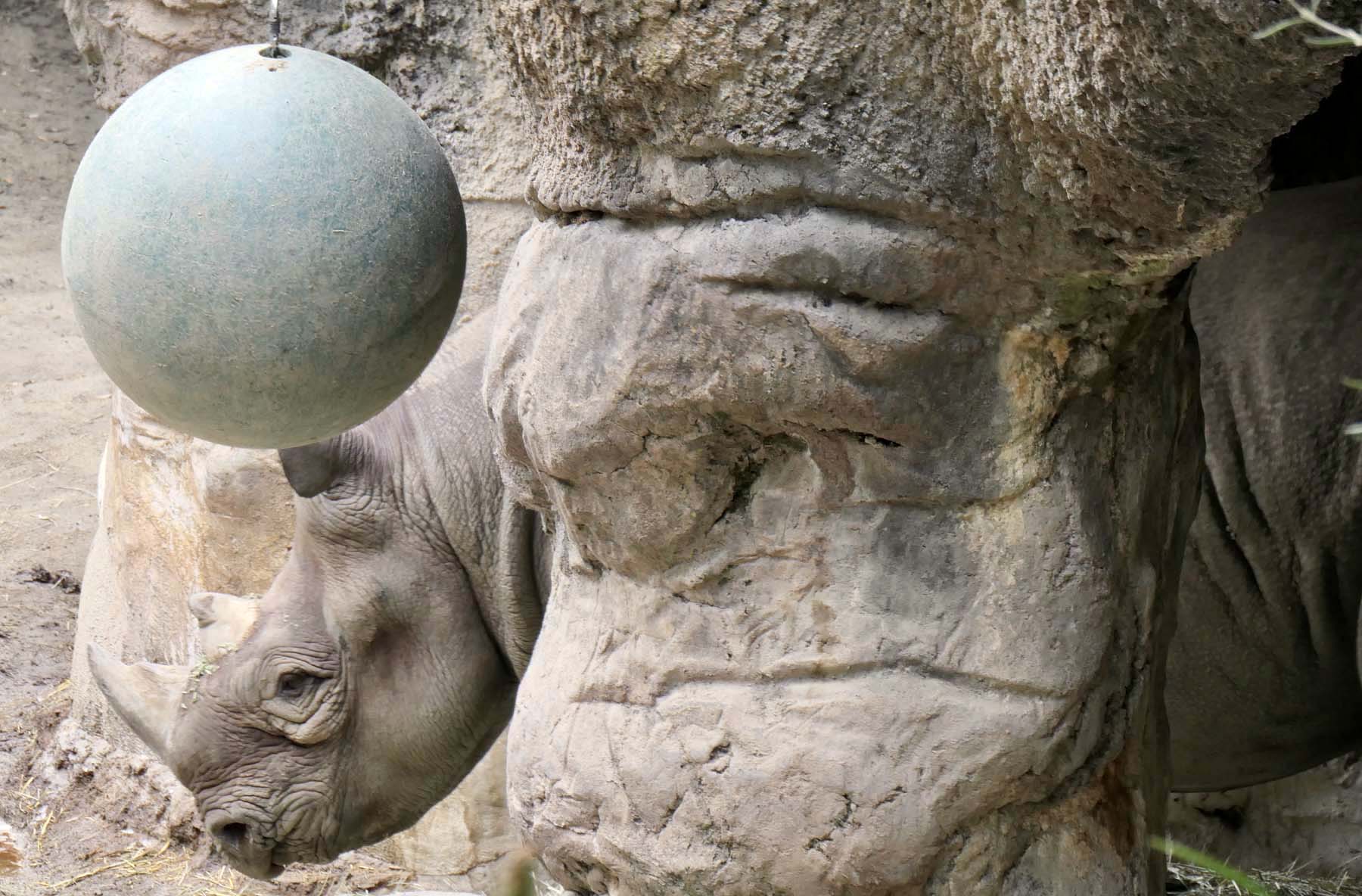
Count me among them. At least during the stretch when I was 9 or 10 years old, devouring books about Africa, and clueless about the indoctrination I received. Why my parents, serious liberals, did not discuss these books that I got from the (postwar!) library – familial and frequent German literature from the beginning of the 20th century for the young set – is a mystery to me. It all came back when I saw the rhinos recently, flooded with memories about the vicarious excitement of a white rhinoceros hunt where the white colonialists managed to kill them, when the Africans did not want to engage in the slaughter.

Rhinos can weigh up to six tons and run between 30 and 40 miles per hour – inconceivably fast. The white and the black rhino are threatened with extinction due to poaching for their desired horns. Both, by the way, are grey and differentiated really by their lip shape. The wide mouth of one, weit in Africaans, was mistranslated as white, thus the name. They are endangered due to poaching of their horns, believed to have medicinal properties, once ground into powder.

Africa has traditionally been a space for white projections, as well as a reservoir for stereotypes of Blacks. We associate the continent with untamed nature, wild animals, a place perfect for romanticized longing. That sure was the case for me, a kid bored growing up in a small village, dreaming of adventure in arid deserts and lush jungles (seemingly the only two ways African nature was presented.) Then again, the “dark” continent was also a dangerous and threatening place, defined by natural catastrophes, hunger, diseases and bloody wars. A mix, then, of fascination and aversion.


German children were educated about the needs of and justification for colonialism from the moment of its beginnings. Boys, that is. The girls were only included once the need for white brides became apparent, late in the unfolding, around 1904-1906 or so. “The stories appeared at a time when the ‘race laws’ in the colonies were becoming much stricter, and colonial policy, together with the bourgeois women’s movement, was encouraging the emigration of young, single white German women to the colonies, preferably German South West Africa, to prevent ‘mixed marriages’ between white German men and Black women.” (Ref this links to a scholarly article on the impact of colonial literature on education, a fascinating read. )
All of a sudden girls were encouraged by stories of feisty heroines who would be sent to Africa, build homes and gardens, allowed to be more independent than back home, including hunting in untamed nature, but eventually finding the love of their life in some colonial officer (often upward social mobility was hinted at as a prize), making white babies, and sending stolen treasure in form of cocoa, coffee, rubber back home, so direly needed by the fatherland. (Note, I was into rhino hunts, not nurseries…)Note also that some racist aspects of the narratives continued on into the 1960s, or even in contemporary kids’ books, long after many of the colonized nations became independent.)

Come to think of it, the expedited admission of South African white “refugees” to the US, per instructions from up on high, is not just based on lies about genocide, but also related to the desire for white babies. I hear a lot of them will be settled in Idaho, where they will find a like-minded community near the Arian Nation. But that is a topic for another day.
Typically, these stories involved white saviorism, helping the “primitive” population to survive and prosper, but also dominance: the young women had a mission to bring culture to the “savages,” the African continent conceived as having no history or culture, literally cultivating them as if they were animals or plants. Describing them as exotic (just like the surrounding fauna and flora), or stereotyping them as childlike, invited the female readers to see themselves as “educators.” The boys’ stories focussed on dominance: describing the population as lazy, amoral, bent on violence and bloodshed invited the strong hand (and if necessary gun) of the colonialist. The distortions applied to the perception of the native peoples helped solidify the identity of the rulers: privileged with knowledge, culture and power, dishing it out in benevolent or hostile ways, never doubting the god-given hierarchy of white over Black.

This is, of course, how belief systems, no matter how insidious, get transmitted from generation to generation – children’s literature seeds the stereotypes and lures you with identification with adventure, exoticism, wealth and romantic love. This is exactly why factions in the culture wars try to weed out anything that might oppose their tenets or inform about alternative interpretations. The purges of libraries right now, the shutting down of children’s TV programs that make racism, stereotyping, misogyny and/or colonialism a topic, are essential to the project of making white children believe they are a the top of the value pyramid, and entitled to submission from everyone else. As early as possible.

Here is a comprehensive overview of what is going on with public libraries, school libraries and issues of free speech. And here is an interesting review in the Los Angeles Review of Books of the ongoing purges and the effects on librarians who have to function in an ever more hostile, polarized world.
I was, of course, fortunate enough, to be provided with all kinds of literature, and higher education which eventually opened the door to critical thinking and insights about the project of colonializing Africa or any other place deemed inferior. But those old books sure stimulated fantasizing about adventures in an exotic world, immersion into unimaginably wild nature, one on one encounters with rhinos and elephants.

I blush thinking about it. Such easy fodder for the PR machine promising me I, too, could be an explorer, a pioneer, a discoverer. I made it to North Africa, but never further south. These days, I explore the zoo, but ended up thoroughly anti-racist. I guess I count that as a win.
Beautiful Kora music from Africa, naturally.


Tula-Tu is the newest calf in Portland.