Rest in Power, Michel Saran.
· 1938 - 2026 ·

My heart is heavy today, after a German friend and mentor died peacefully two days ago, surrounded by his family. I am grateful that we were able to say Good Bye on the phone last week. I learned that he was fully ready to walk on, with cancer having wrecked his body. His biggest complaint to me concerned the fact that he was no longer able to paint, having intense double vision in addition to balancing problems. Passionate about his craft to the last, the artist in a nutshell.

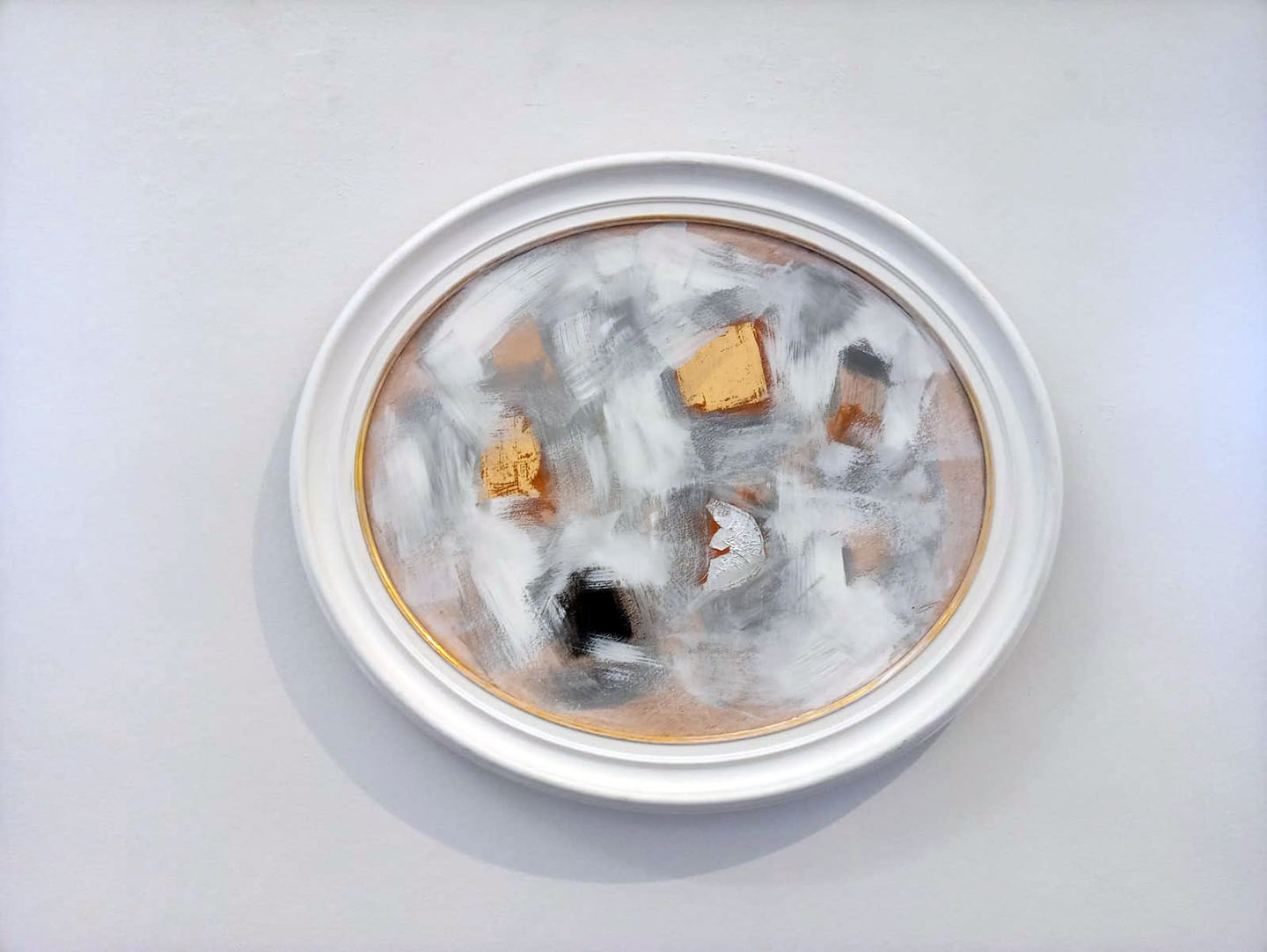
In retrospect, one of his strongest series of obscured faces seemed to anticipate the inability to see. More likely, it expressed one of the greatest fear of any visual artist: loosing their eyesight. Those paintings, some of which I photographed in his studio, also encapsulate another truth. It was hard to see the subject behind the paint, hard to really know the painter behind his ever voluble quipping, joking, story telling. Endless colorful anecdotes obscured a number of significant losses across a lifetime, rarely discussed.

Michel was born in 1938 in Halberstadt, a small city in the state of Saxony-Anhalt, in the Harz mountain range of Eastern Germany. A military base since WW I, the city became the center for Junker aircraft production during WW II, housing an SS forced-labor camp, not far away from the Langenstein-Zwieberge concentration camp. The Luftwaffe airbase was target of Allied bombing campaigns in 1944; during the last days of the war, after the Nazi town administration refused to surrender, 218 Flying Fortresses of the 8th Air Force, accompanied by 239 escort fighters, dropped 595 tons of bombs on the center of Halberstadt, killing about 2,500 people. The left-over 1.5 million cubic meters of rubble were handed over to the Soviet Red Army forces in June 1945. Imagine experiencing this as a 7 year old. I don’t even know if he lost family or neighbors, and I have known him since 1969.

At that point he had been in then West Germany for 8 years. By chance, Michel was abroad in 1961 when East Germany erected the wall, keeping its own population from leaving the country. He decided to stay in the West, another rupture, given the future inability to visit with folks at home. He had been trained as an optometrist, then enrolled in the Academy of Fine Arts in Dresden. He now transferred to the Staatliche Kunst Akademie in Düsseldorf, studying painting under Ferdinand Macketanz (as did Gerhard Richter, same class, same year) and under the far more interesting Gerhard Hoehme, a close ally of Jean Dubuffet’s Art Informel movement. Despite being a Meisterschüler, a kind of post-doc for graduates with distinction, Michel had to leave the lively artistic and intellectual environment of the city. Married to a young writer and poet, penniless with a child, soon two, on the way, he took a position as a high school arts teacher in the provinces, guaranteeing a steady income – and isolation.

This is where I met him, in the school’s art studio where I hung out, when the rest of my class, all boys, no girls, had sports or religious instructions (I was not part of that entirely catholic environment.) I had transferred to that public school from a despised private all girl boarding school after months and months of hospitalization, to be closer to home. Spent the summer in daily tutoring in a stuffed study of an ancient, smelly prof to pick up two years of Latin in 6 weeks – not exactly a great time in the life of a 16-year old. Michel’s first action proved he was a real Mensch: I was overcome with unanticipated menstrual pain to the point of fainting, embarrassed beyond description in that all male environment, and he just picked me and my bike up and drove me home, in the middle of the school day.

The artist and his wife eventually bought and remodeled an old vicarage in one of the small villages of the Selfkant region where I grew up. It was a bastion of colorful decorations and lights, a wild garden, progressive politics and conversations about art and literature through the nights, all amidst an environment that was deeply conservative, religious and narrow minded. I learned a lot about the courage to be different during later visits, after I had long moved to the big city to go to law school. I also got sternly scolded by Ingrid, and affectionately distracted by Michel, when I appeared again and again after yet another fling gone south, heart broken, driving 100s of kilometer through the night to seek sanctuary. “You need to find a sturdy farm boy, with intellectual potential!” was the recurring instruction. Well, I happily ended up with the intellectual potential, if not the farm boy….
We stayed in touch, by letters, phone and visits, during the tough times of Ingrid’s tragically early death from breast cancer; during the years I had moved to the U.S.; during the times Michel was more upset than I had ever seen him before, when his second wife was gravely ill, followed by a miraculous recovery. He rarely talked about his feelings, but proudly reported on his two children and grand children, who live in New Zealand and Holland, respectively, and were luckily able to be with him during his last days.

He claimed he was not surprised that I eventually began to make art, not just write about it, and was one of the first substantive and engaged critics. These phone and email conversations were essential for someone like me who had never had any formal art education; they were also influenced by the fact that he was always open to new ways of seeing and depicting the world, open to new mediums like my photomontages.
I have written a bit about Michel’s approach to art here before. What strikes me today, during the type of retrospective one is drawn to by permanent loss, is his willingness to risk change. There were so many oscillations between abstract and figurative approaches, exploring sculpture in addition to two dimensional work, systematic experimenting with closed vs. open perspectives, shifting from whimsey to deadly serious depictions.

I am also thinking about the role of chance. So often, in the art world as everywhere else, your success depends on external variables beyond your control, and not necessarily on the depth of your talent, or your ability to strike new territory. What would life have been like, if East Germany had not become an authoritarian state? What would have been possible, if a monthly state stipend or other sponsorship had made an independent artistic career possible, without being encumbered with a “day job”? Would it have made a difference if his studio had been in an urban environment rather than the rural landscape of the western provinces? Would his regional recognition be supplanted by a national or international one?

We will never know. What I do know is that his family lost a man who loved them deeply. I lost a relationship that was special for its transformation from a student-teacher status, where a 16 years age difference was huge, to an egalitarian friendship between adults, signified by shared knowledge of loved ones we had lost – my parents, his first wife. The world lost yet one more gifted, interesting artist who worked, relentlessly, in the margins of the art world, overshadowed by the few of his generation who made it big, and yet had not necessarily more to offer. It did not matter much to him – all he cared about was being able to bring his vision onto the canvas.

In our ultimate phone call he was still clear enough to tease me. Fritzi, he called me one last time, even though he knew full well I despise the nick name and always protested.
Well, Michel, Fritzi mourns you.
May your memory be a blessing.

Sketch he did of me as a 17 year-old. The portrait never got finished, with a baby and a toddler in his house.