In the Evening

By Else Lasker-Schüler, translated by Eavan Boland.
***
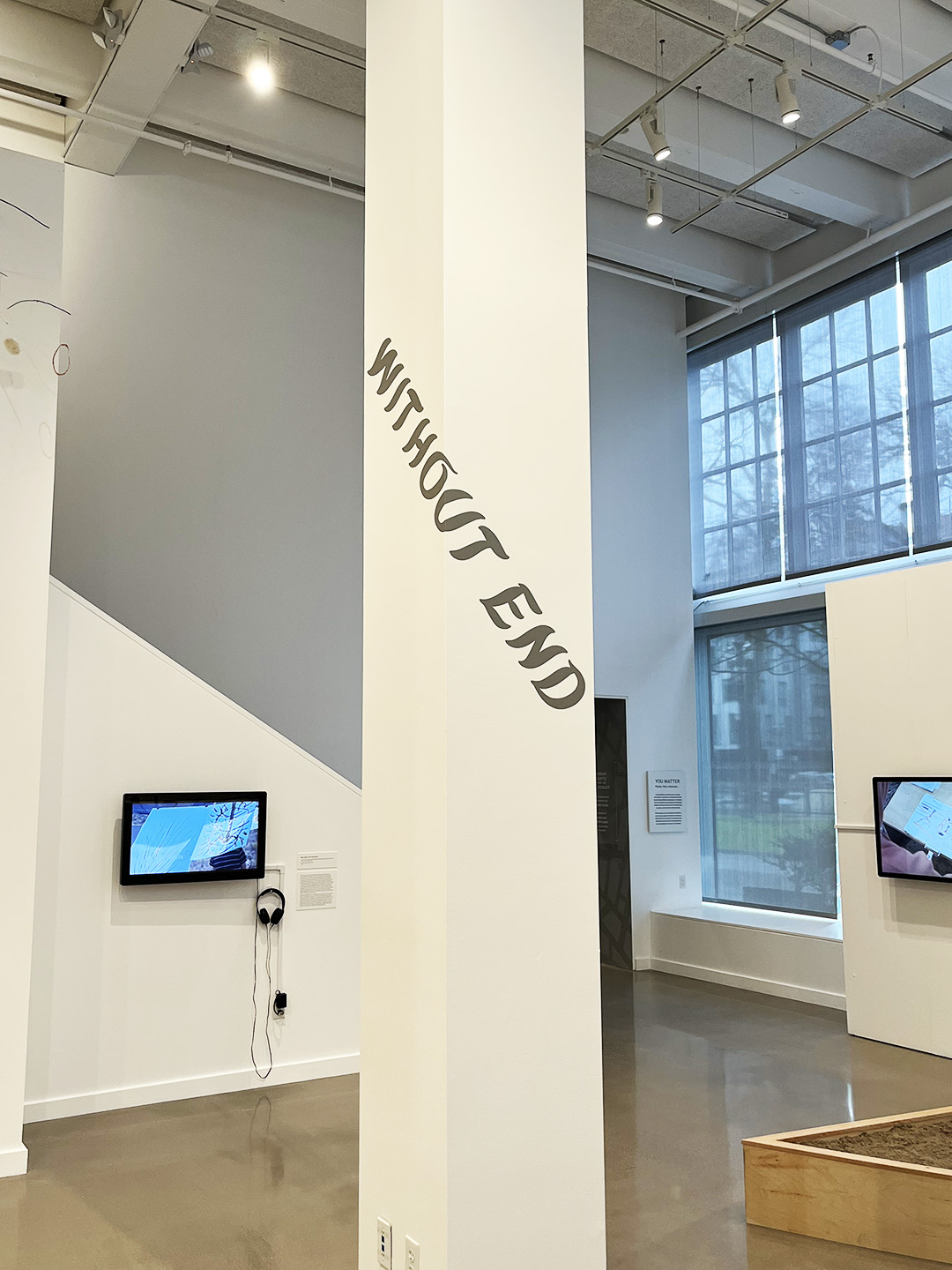
It was pure coincidence that I visited Cara Levine‘s exhibition Without End at the Oregon Jewish Museum and Holocaust Education Center during the same week that my kids arrived in town. They are permanently relocating as survivors of the Altadena /Eaton Fire that destroyed their house, their neighborhood, their newly planted gardens and every memento they owned from more than three generations. Not a coincidence, then, that Levine’s current work, concerned with grief elicited by climate-related natural disasters and originating in exactly those same (Palisade) fire-induced losses, intensely resonated on a personal level.
Levine’s work has focused on loss, grief and pain of all kinds across the years of her practice since she earned a BFA from the University of Michigan in Ann Arbor, MI (2007) and an MFA from California College of the Arts in San Francisco, CA (2012). More importantly, though, it has offered perspectives on both, the causes of losses and communal ways in which healing can be implemented. Put differently, the work is not exclusively focused on individual experience, but on unveiling the collective circumstances that are producing loss, as well as offering tools to overcome trauma.

Before I get into the specifics, let me emphasize what I consider the strongest aspect of her work before us.
Real grief strikes down to the bone. There are no layers, no occlusions, no obscurations that it does not penetrate – they all become irrelevant. Levine’s sculptures and installations have that same directness: what you see is what you get. In our world where art often takes pride in obscurity, the need for deciphering, the veiled references, the analyses left to those in the know, her work will have none of that. Language is explicit, forms are defined, function leaves no room for interpretation. The art directly communicates shared human experience, and the artist is on an equal level with the viewer, no hierarchical distancing allowed. This, of course, is the basic element of communal experience, a focus of Levine’s makings, just as much as the individual’s grief.
***
I first came across Levine’s projects in 2022, when I was writing about the waves of eco-anxiety and post traumatic stress disorder of climate catastrophe survivors seen by clinical psychologists. Therapists face both increasing number and intensifying depth of anxiety disorders related to climate change. Data from the general population confirmed the trend. “A 2020 poll by the American Psychiatric Association showed that “more than two-thirds of Americans (67%) are somewhat or extremely anxious about the impact of climate change on the planet, and more than half (55%*) are somewhat or extremely anxious about the impact of climate change on their own mental health.”
What could be done before you need to find a therapist? Some political moves might help activists. Science is contributing tools to fight collective helplessness. And then there is art: Levine and other contributing artists invited people to participate in physically digging a hole to throw in their grief. For seven days, echoing our Jewish custom of sitting Shiva after a death – a time when community meets and supports the mourner – a large hole was dug in Malibu. The project happened on the grounds of the Shalom Institute campus which was devastated by the Woolsey Fire of 2018, an early taste of the fiery destruction to come. It struck me at the time that digging that hole might be one of the ways in which we could dig ourselves out of one: forming alliances (the contributors ranges from Chumash tribal leaders to cantors from local Synagogues) would provide an exit to suffering grief in isolation. Alerting community to the causes of wild fires might also lead to collective action to tackle climate change denials.
A video of the project can be watched at the current exhibition. So can a subset of exhibits from Levine’s project alerting us to the number and types of deadly shooting of unarmed civilians.
***
This is not a Gun (TINAG) was triggered by an article in 2016 Harper’s Magazine that depicted objects held by unarmed victim of police shootings. The artist carved replicas of these innocuous objects, and workshop participants created ceramic models while discussing topics of racism and police brutality often associated with these kinds of shootings.

One of the most famous of these cases happened in New York City in 1999, when unarmed 23-year-old Guinean student named Amadou Diallo was struck with 19 of 41 rounds fired by four New York City Police Department plainclothes officers. They were charged with second-degree murder and subsequently acquitted at trial in Albany, New York on the grounds that they had a reasonable expectation to be endangered and drew a gun first in self defense.

Since then, long-term data collection revealed the fact that these shootings disproportionally victimize Blacks and other people of color. But there is also research evidence that Blacks and Whites both misperceive something innocent to be a weapon more often, if the object is held by a Black rather than a White person. In other words, all of us are likely to exhibit modern racism or implicit racism – automatic, unconscious, unintentional – still being tied to a culture that routinely links the idea of Blacks with the idea of deviant behavior, or a set of ideas, mostly bad, that concern violent crime, poverty, hyper sexuality or moral corruptness.
You might not act on those beliefs, you might deny them, but the associations are carried by most of us through permanent exposure to the linkage of Black to negative or threatening concepts, whether we are aware of it or not, whether we have the best of intentions and the most egalitarian politics. (For a more detailed discussion see my review here.) Projects like Levine’s draw attention to the stereotypes (and for that matter the historical burden of racism) with the hope of motivating people to intercept their own mental associations.

Acknowledging the existence of racism, explicitly or implicitly expressed, and the hold it has on our society is the necessary antecedent to fight it. I can scarcely imagine a more timely reminder given what is unfolding in our communities at this very point in time, regardless of the color of unarmed victims of state violence.
***
The new work in this exhibition centers around containers of sand, intended to be deposits of what we release into them – drawing our sorrows, by hand or dowel. For those dealing with climate-related losses a lasting memento is offered – “silver linings” made of pewter filling in the contours of a sand drawing (by appointment, see the OJMCHE website)

They will be given to the participants and a replica stored in the artist’s collection. Examples from prior studio work are on display.

Sands shift, patterns will disappear, but the act of thinking what to depict and the physical act of drawing might very well form a containment that holds the grief momentarily outside of ourselves. Only to return.
Without end. As the aptly chosen exhibition title suggests.
Maybe the healing comes not from the unrealistic termination of the pain, but the insight that we walk on shared ground, sand before us containing multitudes, a communal experience. Certainly in the case of our own family’s post-fire trajectory, community sustenance made all the difference. The help – emotional, physical, financial, spiritual – being extended from the farthest corners was medicine. Solidarity as a first hand experience.

But maybe it is also a time to put the aspect of healing on a slow burner, and instead increase the heat of resistance against forces that create avoidable losses in the first place. Climate change denial is just one of the aspects of hostility towards science that we are currently experiencing, but one that has huge implications for the planet at large. Our time is running out to implement the necessary changes that can prevent the worst suffering for millions of people killed or ravaged by loss through climate catastrophes.

An installation of imprinted birchwood panels on some sort of infinity loop names types of loss, predominantly private causes, but also some of the general political challenges we face, from the legality of immigrants, the divisiveness in our society, to the lack of protecting our earth. I found myself longing for stronger words, in visually more prominent positions. The TINAG project was so courageous and openly political. Why not here? We live in an age of multiple mass extinctions around the world, at a time when authoritarian or even fascist history repeats itself in a variety of disguises across nations. This is a time of pandemics, starvation and withholding of medical or economic aid that dooms hundreds of thousands of people. Horror without end.
How do you draw a representation of genocide in a sand installation? The birchwood would have held the word.
***
What held grief was a dream catcher high up, pretty easy to miss, commemorating the untimely death of artist Peter Simensky, chair of the Graduate Fine Arts MFA program at California College of the Arts, Levine’s friend and mentor, to whom this exhibition was dedicated. For those unfamiliar with this unusually creative, political and perceptive artist, here is a link to an exhibition booklet from a previous memorial exhibition at Reed College’s Cooley Gallery and here is a link to his website.

I could not discern if one element of the dream catcher was indeed made out of pyrite, a kind of rock central to Simensky’s last artistic endeavors, Pyrite Radio works. Doesn’t matter. Whatever form his signal takes, I believe it will contain pride and joy at what is on display in the gallery below, the courage not to walk away from grief included.
Without End – Recent work on Grief by Cara Levine
Until May 31, 2026
OJMCHE
724 NW Davis Street
Portland, OR 97209
Wednesday – Sunday: 11 – 4