Browsing Tag

Sam Marroquin

When the World Looks Away

There is no witness so terrible and no accuser so powerful as conscience which dwells within us.” – Sophocles

Three years ago, I visited the Alexander Art Gallery for the first time. I had come to review Henk Pander’s The Ordeal, not knowing it would be his last solo exhibition before he died the next year. Paintings and drawings from across a lifetime depicted apocalyptic scenarios and narratives that referenced predominantly death and destruction. As I wrote at the time, “No matter how expertly painted, how creatively crafted, how defiantly clinging to beauty in all its visual instantiations, these paintings are about horror, that which is unleashed upon the world by evil forces, that which is experienced by the subjects of the painting, and that induced in us who view the cruelty on hand.”

The painter would have probably agreed that some of these sentiments apply to the work currently at the gallery. Sam Marroquin‘s exhibition When the World Looks Away is about the years of ongoing horror experienced by Palestinians in Gaza. The artist confronts us with depictions of humans under existential threat, their bodies and spirits under relentless assault, their culture and history intentionally eradicated, their grief more than a single generation can hold. As of this writing, there are now Israeli orders for even Doctors without Borders and other aid organizations to leave the strip by February, during ongoing mass displacement. This, and continued violence despite the cease fire agreements, will worsen the situation for the civilian population.

Alexander Art Gallery featuring Sam Marroquin

Henk would have been thrilled to see that there is a young artist at the beginning of her promising career taking up the mantle of bearing witness, and calling on us to do the same. This is pretty much where the comparison ends, though, given that he created huge oil paintings, and large pen-and-ink drawings thriving on the contrast between their size and the pristine executions of small strokes, thin lines and subtle markings. Marroquin’s, in contrast, are mixed media works, blind contour outlines drawn in charcoal, filled with acrylic paint, with added text for many of them.

I had seen a smaller subset of these intense paintings before, impressed by the use of her non-dominant hand to produce fluid impressions of scenes depicted on videos and print material of first hand experiences by Palestinians and other witnesses on site. At the time, the focus in conversations with the artist was on the selectivity of our media diets, connected to where we feel ideologically, or intellectually or “tribally” at home. Live witness accounts of the trauma are available, but never disseminated by most of the mass media, or are actively suppressed by factions on either side of the conflict. Marroquin felt compelled to step into the breach and expose us to the accounting, provide access to information that is not predetermined by the setting on our news channels and social media.

Sam Marroquin Despair (2024)

Seeing the body of work a second time, now in its entirety of over a hundred paintings, smartly curated by Kate Simmons, reinforced some of my earlier reactions and provoked additional observations. Unsurprisingly, my current (independent) reading also shifted the focus, and so will make an appearance here in a bit.

Sam Marroquin Starving (2024)

***

On a number of dimensions, Marroquin’s work reminds me of that of Charlotte Salomon, who was murdered in Auschwitz. The German artist’s paintings were fluid, influenced by graphic design, amounting to the impression of a graphic novel. They were narrating the autobiographical experiences, early life and later suffering of a Jewish woman who had to flee state violence and racist persecution, to no avail. Caught in France, she was shipped to the camps, her paintings survived in hiding. It was a large body of cumulative work, depicting multiple facets of life under existential threat on pieces of cheap paper, with whatever coloring materials could be secured in exile. She added text to amplify the universal meaning of individual experiences.

Charlotte Salomon  Life? Or Theater?  Excerpts (1941-1943)

When the World Looks Away shows a lot of stylistic visual resemblance, eschewing conventional painting for a more graphic style. Manga books come to my mind. The compulsive inclusion of every aspect of the narrative is also present. Marroquin refers to the loss of life and limb, the hunger, the bombings, the absence of medical care or the difficulty to obtain it. She depicts the attacks on select groups beyond Hamas terrorists, journalists, medical personnel and aid workers included, on top of the indiscriminate targeting of civilians. The painter describes the intentional destruction of cultural and educational institutions, the fate of political prisoners. She also refers to the international protests, and the treatment of protestors as criminals. The artist uses script often by doubling and superimposing words, creating an echo effect that resonates across time. Just like in Salomon’s work, witnessing is one of the through lines of Marroquin’s approach.

Sam Marroquin Goodbyes (2024)

Over and over the current paintings return to the children: innocents swallowed up into a maelstrom of violence and grief, at times specifically targeted, least able to defend themselves against the dangerous pressures of hunger, disease and cold. Irrespective of type of conflict, partisanship, country, from the Middle East to Syria, Ukraine, Sudan or the Republic of Congo, young non-actors who are most in need of protection are sacrificed to the ravages of war. Orphaned, disoriented, starving, burnt and maimed, they induce such a fright into the empathetic viewer that you want to turn away.

Sam Marroquin A Fine Line Between Life and Death (2024)

Sam Marroquin Where to? (2024)

Sam Marroquin Starved to Death (2025)

The artist bears witness – and tries to compel us to same – to the agony war unleashes onto humanity, regardless of who are the perpetrators, who are the victims, what cause can claim to be justified or what lessons of history are ignored. (Regarding the Gaza conflict, the International Court of Justice (ICJ) in the Hague is considering a case since late December 2023, claiming Israel was violating the Convention on the Prevention and Punishment of the Crime of Genocide through its actions in Gaza. It will likely take until 2028 to get a decision. Full arguments for the case from Israel are due next week, January 12th, 2026. If ICJ judges will find that both acts of genocide and incitement to genocide have taken place, their orders should bind states. However, there is really no mechanism to enforce international law, in particular international human rights law and international humanitarian law.)

Marroquin’s unflinching gaze on suffering, pain likely vicariously experienced when putting it into visual form across years of exposure, is remarkable. I would not have that in me. I can barely look at it for long amounts of time, which makes me ashamed.

Sam Marroquin To Grieve (2024)

***

It’s one thing to feel shame about not meeting your own standards. It is an uncomfortable feeling, and saddening. Emotions run even higher when I am told by others, “You should be ashamed of yourself!” But I am also mindful of the converse — when, for example, I find myself angry that others are not ashamed by their (often tacit) acceptance of actions or events I regard as vile. I certainly find myself enraged when the powerful act hideously and with no sense of shame.

Shame, and its counterpart shamelessness, deserve a closer examination, given that they are ubiquitous, and clearly provoking massive reactions. They are of importance in my own ways of approaching the world, obviously including the reception of art. They are also important in configuring the world I live in, often not for the better (just think of all the shaming around body image, or sexual victimizing on the internet, as just one example.) Two recently published and/or translated books are currently on my desk to help understand what’s at stake.

David Keen’s Shame: The Politics and Power of an Emotion just arrived, so I can only report on the introduction, but am already intrigued. Keen is a British political economist and Professor of Complex Emergencies at the London School of Economics. The core of the book tackles how shame can be instrumentalized, in politics, in war, in social hierarchies that assign (and reserve) a space to victims or for perpetrators. Shame can be loaded onto people, often with nefarious purposes, and in turn falsely promised to be lifted (often by the same actors who impose it in the first place.) In a social-media linked society where shame and shaming is increasingly prevalent, shamelessness itself can be sold as an attractive spectacle – a symbolic escape from shame, a taste of freedom, a flight from the constraints, disparagements, insults self-doubt and self-admonishments to which mere mortals are regularly subjected and subjecting themselves.”

Sam Marroquin Amputee (2025)

French philosopher Frédéric Gros’s A Philosophy of Shame approaches shame from the psychological perspective of the individual at the intersection with society, inextricably linked. Shame can be instilled by being assigned an inferior place in a hierarchy – there are plenty of “shame-generating frameworks” like stigmatisation, stereotyping, and inferiorisation by mechanisms of race, gender and class, or sexualized violence. We internalize that these relegations are our fault, and correspondingly feel shame rather than disgust for the perpetrators. In this sense, shame silences, subjugates and damages.

However, the philosopher also believes that there is an element of anger and rage in shame, which will, if we turn it against us, be very destructive. If I look at massacres of civilian populations, for example, I might be enraged, ashamed at my powerlessness to do anything about it. Often, and particularly if I am implicated by association with a perpetrating nation or group, that shame might convince me to close my eyes towards the cruelty committed in my name. It is simply too overwhelming to feel the shame, so I blind myself to the facts.

Yet, and this is the core message of the book, shame can also spark positive action. It might become an “ethical” shame where we project ourselves into a future reflecting on actions that would or would not shame us. Shame can be a stimulant, in other words, for imagining possible worlds and behaviors promoting desired outcomes. We live in a culture that ver much wants to distract us from assessing the ethical standards involved in the nation’s actions. The author’s prescription: “A proper response to shame has the potential to draw our attention to injustices or moral failings instead, and rouse us to resist and attack the status quo.”

Shame can rouse conscience in some way, then, just as Marroquin’s work does by relentlessly reflecting a reality that questions the morality of our actions, even as remote bystanders. We have choices: to look at suffering or not; to avoid complicated conversations or not; to support those in need or not; to make our voices heard or not.

To imagine a better world, or support the status quo.

If shame works as a catalyst toward defying shamelessness: bring it on!

***

‘When the World Looks Away’

Sam Marroquin
Jan. 5–Jan. 30, 2026

Monday-Friday, 9 a.m.-5 p.m. 

Artist Talk: Wednesday, January 14th from noon to 1pm.

Alexander Gallery is located in the Niemeyer Center at Clackamas
Community College.

19600 Molalla Avenue
Oregon City, Oregon 97045


Sam Marroquin World’s Child (2025)
Seeking Warmth.

It is the fundamental task of art to fight against alienation – to go to bat for authentic hearing, seeing, feeling, thinking against the stereotypes and societal patterns that are full of hostility towards being thoughtful and perceptive.” – Erich Fried in Rudolf Wolff (Hrsg.): Erich Fried. Gespräche und Kritiken, 1986. (My translation.)

***

If you look up the meaning of the word “authentic,” the Thesaurus suggests this: genuine, honest, true, real, original, unmistakable, historical. I cannot think of a better description of the art of Ceija Stojka (1933-2013) a Roma artist, Holocaust survivor, and activist whose work is increasingly displayed by major venues, providing welcome contrast to so much of the inauthentic hokum out there.

Ceija Stojka The Mama (detail with gallery entrance reflected in the glass covering the painting.)

Across the last few years the artist’s paintings, drawings and journaling were on view at Gallery Christophe Gaillard in Brussels, the Museum of the City of Lodz in Poland, at the European Roma Institute for Arts and Culture, at the 35th Bienal de São Paulo, at Kassel’s Documenta 15 in Germany, among others. Opening in April, they are at the Bibliothèque Nationale de France, Paris, in a group exhibition, Apocalypse. Yesterday and Tomorrow.

Luckily, we dont have to travel that far. Some of Stojka’s work is currently shown at the Vancouver, WA gallery Art at the Cave, together with exhibits by Daniel Baker and Sam Marroquin, and short videos about the artists by Erin Aquarian, in a show titled “Seeking Warmth.”

Stojka’s father was murdered by the Nazis even before the entire family was imprisoned in concentration camps. She, her mother and all siblings but one brother survived, despite being routed through Auschwitz, Ravensbrück and ultimately Bergen-Belsen. A miracle, given that out of 12 000 Austrian Roma, between 9000 and 10 000 perished during the Holocaust. After liberation, she attended school for a few years before she had her first child at age 15. She became a successful carpet merchant, and had two more children within the decade (two of whom preceded her in death, adding more tragedy.) It was only in her mid-fifties that she started to put her traumatic experiences into diverse forms of expression, music, self-taught visual art and journaling. It is no exaggeration to say her memories poured out, with over a thousand works of art and writing composed during the decades before her death at age 79 in 2013.

Ceija Stojka Untitled (Wagon in Forest)

Before I turn to her art, a grateful acknowledgement that individual people accompanied this artist to express herself and help bring about the prominence she has achieved. One of Austria’s most distinguished documentarian film makers, Karin Berger, was the first to engage with Stojka in the late eighties. A full documentary about the artist and her trauma, Ceija Stojka: Portrait of a Roma, was published in 1999. Lorely French, who taught German language and literature, as well as film and Roma writers, retiring this May after 39 years at Pacific University, was the artist’s friend. Importantly, she translated the first English version of the memoirs of Ceija Stojka, and is a founding member and member of the board of the Ceija Stojka International Association.

The art on display in the current exhibition is a small-scale version of Stojka’s oeuvre as a whole: there are the paintings that represent a “bright cycle” – scenes referencing life as the Romani people experienced it before the descent into the hell of the Holocaust. The acrylics are expressive, colorful, reminiscent of folk-art, and often quite sophisticated in their perspective for a self-taught artist. They report what was seen, but also communicate a sense of longing for a way of life that no longer exists. Wagons, streams, summer meadows, birds and flowers everywhere, and many people forming community around chores, more often seemingly idyllic than not. Exactly a way a child would experience her childhood, without the adult knowledge of how the Roma had to fight against prejudice and persecution long before the fascists arrived on the scene. It is a remarkable feat as an artist to be able to reproduce that experience from a memory store that by all means should have been overwritten by the horrors that followed.

Ceija Stojka Untitled (Wagon with people at stream)

These very horrors are captured in Stojka’s “dark cycle,” drawings in ink and some other materials that comprise the other half of her output. These drawings are often accompanied by text. For clarity, the English translations are repeating the meaning of the words, accurately conveying what was said (a choice I would have made as well.) What gets inevitably lost – and the part that makes her texts so indelibly authentic – is the orthography of the artist. Having had but a few years of school, after liberation and before she had her first child, Stojka writes how one hears the words, phonetically, and not according to our spelling and grammar rules. It gives the texts a texture of spontaneity and intensity, of words tumbling out of a mouth rather than a pen, providing the message with an amount of urgency that can simply not be captured in translation.

Ceija Stojka Ravensbrück 1944. Liberation 15.4.1945

These two cycles, bright and dark, interact to magnify the void caused by evil, by offering us the memorial building blocs of a remembered childhood, catapulted into the abyss. The longing for the wholeness of life before is drawing us in, and then spitting us out into the agony of what came after, or the bitterness of the realization of what the artist had to endure. The yearning for the remembered ideal frames the depicted trauma caused by genocide, multiplying the horror exponentially.

Ceija Stojka They devoured us.

We find both, personal grief and political anger in Stojka’s drawings and texts. What makes her so effective as a messenger is the concreteness of her reporting. She did seek warmth by resting amongst the dead (hence the title of the exhibition), shielding her from the wind. She fought off starvation by chewing and swallowing little balls of wool her mother had unraveled from the sweaters still on the corpses, or by eating grass pried from under the floorboards of the barracks, or sap clawed from trees. She banned despair by clinging to hope, perceived by her to be what gave them strength.

Ceija Stojka Hope – that was what gave us strength 1944

***

“Was wir suchen ist schwer zu finden. Die Angst, die müssen wir nicht suchen. Die ist da.” “What we are searching for is hard to find. We don’t have to search for the fear. That is there.” (Translation by Lorely French.)

***

Stojka’s relationship to fear is more complex. On the one hand, she models for all of us an incomprehensible amount of fierceness and courage in poems like this.

On the other hand, she describes, again concretely, a typical behavior that is the result of her experience: “You can’t walk along the street without looking over your shoulder.” (This sentence was juxtaposed with a quote by the poet Erich Fried, an Austrian compatriot who fled into exile after the Nazis killed his father and who survived the war in England. “For I cannot think without remembering.”)

Fear permeates the past, her book titled: Even Death is terrified of Auschwitz. It seeps into the presence – already in the year 2000, she worries about next generations forgetting history, and the fact that a far-right party joins the government coalition.

She proclaims soon after: “Ich habe Angst, dass Europa seine Vergangenheit vergisst und das Auschwitz nur am Schlafen ist. Anti-ziganistische Bedrohnungen, Vorgänge und Taten beunruhigen mich und machen mich sehr traurig.” (“I fear that Europe is forgetting its past and that Auschwitz is only asleep. Anti-Romani threats, happenings and attacks worry me and make me quite sad.”) (Ref.)

The fear, however, seems to be one of the motors for her activism to educate Austrians and the world about the history and the plight of the Romani people, activism for which she received accolades and awards. To this day, Austria has not officially recognized the Holocaust or the Samudaripen/Porajmos – in Austria referred to as the Holocaust of the Roma – through any legislative act; the Holocaust of the Roma is instead recognized as an integral part of the Holocaust as such. (Ref.)The Romani people, assumed to have originated in Asia, most likely Punjab or Kashmir, and who have never identified themselves with a homeland, have been persecuted since the middle ages within the various countries where they traveled and traded. The Porajmos saw up to half a million Roma murdered. Like Jews, they were segregated into ghettos before transport to extermination camps. After the war they were forced to settle in various locations. In post-war Czechoslovakia, where they were considered a “socially degraded stratum”, Romani women were sterilized as part of a state policy to reduce their population. As recently as the 1990s, Germany deported tens of thousands of migrants to Central and Eastern Europe, with large percentages of the Romanians among them being Roma.

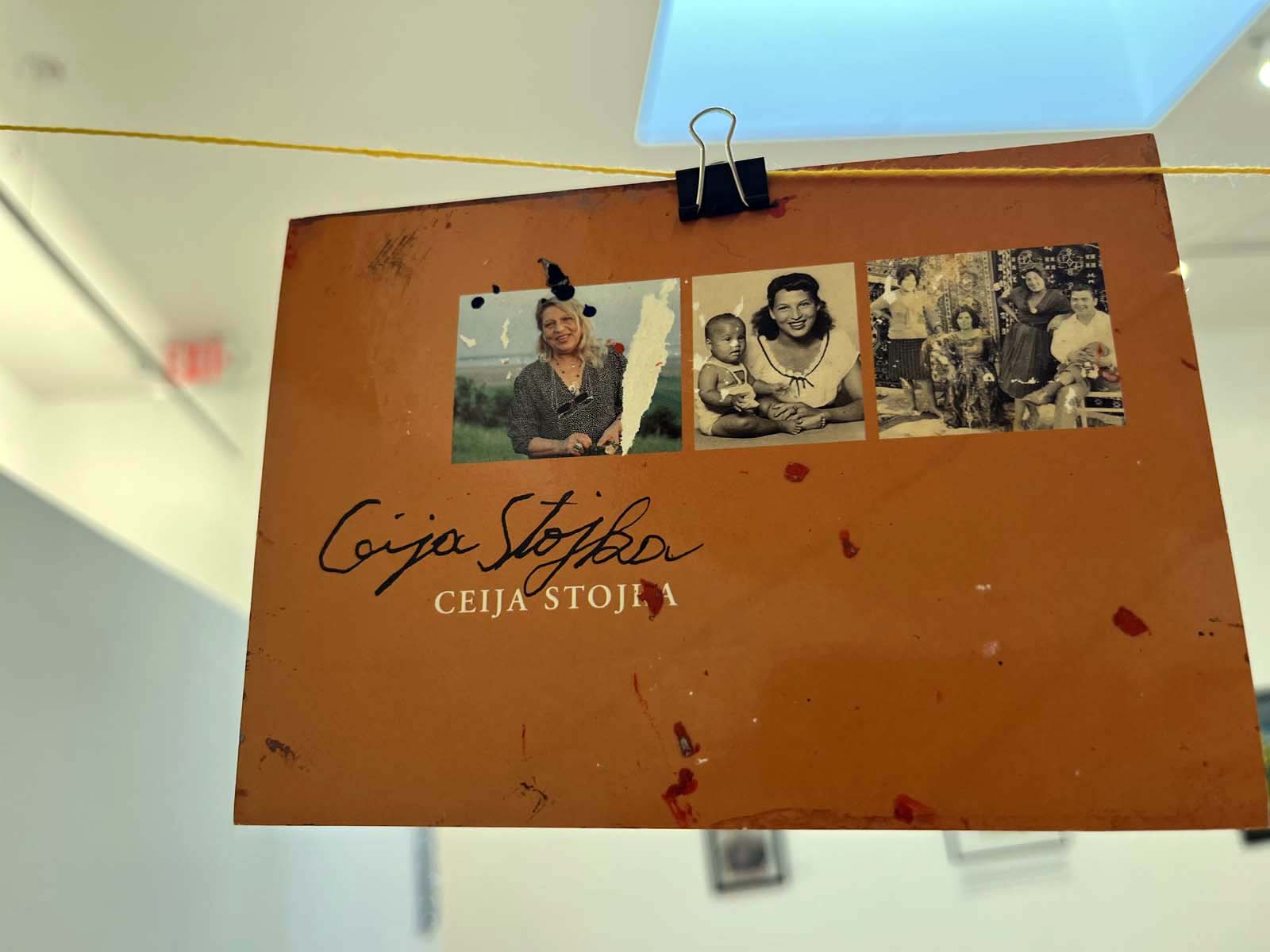
Postcard work of Ceija Stojka (which I consider some of her strongest communications.)

Fast forward to our own times, where for the first time ever since 1945, Austria saw this far-right party, the FPÖ (Austrian Freedom Party,) win the most seats in national elections with garnering almost 30% of the vote last September. (The centrist parties managed to form a governing coalition some many months later that excludes the extremists.) A member of the FPÖ had only a few years back distributed anti- Romani, hate-filled videos on social media, but could not be criminally indicted since he is protected by immunity as a member of congress.) Anti-Roma hate crimes are frequent occurrences across Europe, with assault and arson attacks against homes physically endangering people. Ethnic hatred and claims of “Gypsy criminality” are clearly making a comeback in tandem with rising anti-Semitic sentiments fostered by extremists movements and now parties.

Fear can be a tool. It can motivate us to (re)act and fight for justice, as the artist did. It can be both, exploited and imposed by draconian measures and persecution, as radical right ideologies have successfully discovered. Fear of others, of globalization and immigration, of status loss or “replacement,” can be turned into hatred of scapegoats, often ethnicities other than one’s own. Fear of consequences of protest or non-conformity can smooth the path of authoritarians who want to consolidate power.

Ceija Stojka knew that, expressed that, resisted that. In life and in art.

***

Daniel Baker is a Roma artist and theorist of renown who lives in the U.K. He uses metalised polyethelene rescue blankets, sometimes sculpted, sometimes crocheted, to combine conceptual issues related to survival strategies and practices with a visual aesthetic that echos Romani patterns. Part of his theoretical work concerns the (in)visibility of ethnic minorities, particularly those that are not geographically anchored. In a somewhat ironic turn, his work could have been displayed a bit more visibly in the gallery – you had to work to discover it.

Daniel Baker Emergency Artefacts.

Sam Marroquin shows her series The Madness of War in the upper parts of the gallery. An astonishingly large number of charcoal and acrylic paintings were fitted into the space without overcrowding. Kudos to whoever hung this, likely Sharon Svec, whose curation of this exhibition is splendid overall. The paintings are simplified reproductions of scenes depicted on videos and print material of first hand experiences by those living through the hell that is contemporary Gaza. Put on paper with the artist’s non-dominant hand, they appear more like the drawing of a younger person, a lack of perfection and child-like approach that parallels what we see in the paintings of Stojka. Here, too, are concrete depictions of humans in existentially threatening situations, their bodies and spirits bombed into extinction, their grief more than a single life time can hold. Block letters introduce the artist’s suggestions of the emotions and thoughts likely experienced, all universal enough that they promise verisimilitude.

Sam Marroquin Paintings along the Gallery Wall from the series The Madness of War.

The work makes several strong points. For one, any claim that we have moved beyond atrocities imposed on any one group is moot. The indiscriminate killing of men, women and children, of rescue personnel and journalists/reporters is not a thing of the past, intentional starvation included. Secondly, the suffering depicted is universal, even if it is applied in this case to the particulars of the fate of Palestinians. We could as well be looking at Syria, Ukraine, Sudan or the Republic of Congo. And, importantly, Marroquin’s drawings reveal a humanity of the victims that will elicit empathy in all but the most hardened, allowing a sense of shared humanity across borders.

Sam Marroquin Paintings from the series The Madness of War

The issue, then, is the fact that all of these images were, as “originals,” available in public sources, live-reported during this conflict. They never made their way to those fixated on selective mass media or social media sources that are ideologically inclined to show some sides of suffering but not others. The polarization experienced in a country divided about our political future, is reflected in the visual diet that we consume, basically determined by what the powers that be put into the relevant “larders.” In some way, then, art that is not explicitly associated with media that we deem trustworthy or disreputable, respectively, might inform consumers whose minds can be opened if approaching artistic depictions without easily triggered prejudice. In theory. In practice, of course, we have to mourn the fact that the likely distribution of this important body of work pales in comparison to that of even the smallest partisan social media outlet.

Sam Marroquin Paintings from the series The Madness of War

Before we despair, and in honor of the remarkable resilience of Ceija Stojka and others exposed to existential threats, let me close with a poem (Ertrag is the German title) by Erich Fried, whose words introduced this review. (And yes, I’ve been a fan since my teens, when he was first published by the German publishing house Klaus Wagenbach, before anyone else took on his poetry.)

Dividend

Gathering hope
from solvable problems
from possibilities
from all that
which holds promise

Reserving
strength
for only that
which truly
requires action

Is the way to amass
quietly
a supply of
despair
never spent.

-by Erich Fried

SEEKING WARMTH

March 2025

ART AT THE CAVE, 108 EAST EVERGREEN BOULEVARD, VANCOUVER, WA, 98660, UNITED STATES360-314-6506 GALLERY@ARTATTHECAVE.COM

HOURS: TUES-THURS 11-5PM, FRI AND SAT 11-6

For specific upcoming programs related to the exhibition, go here.