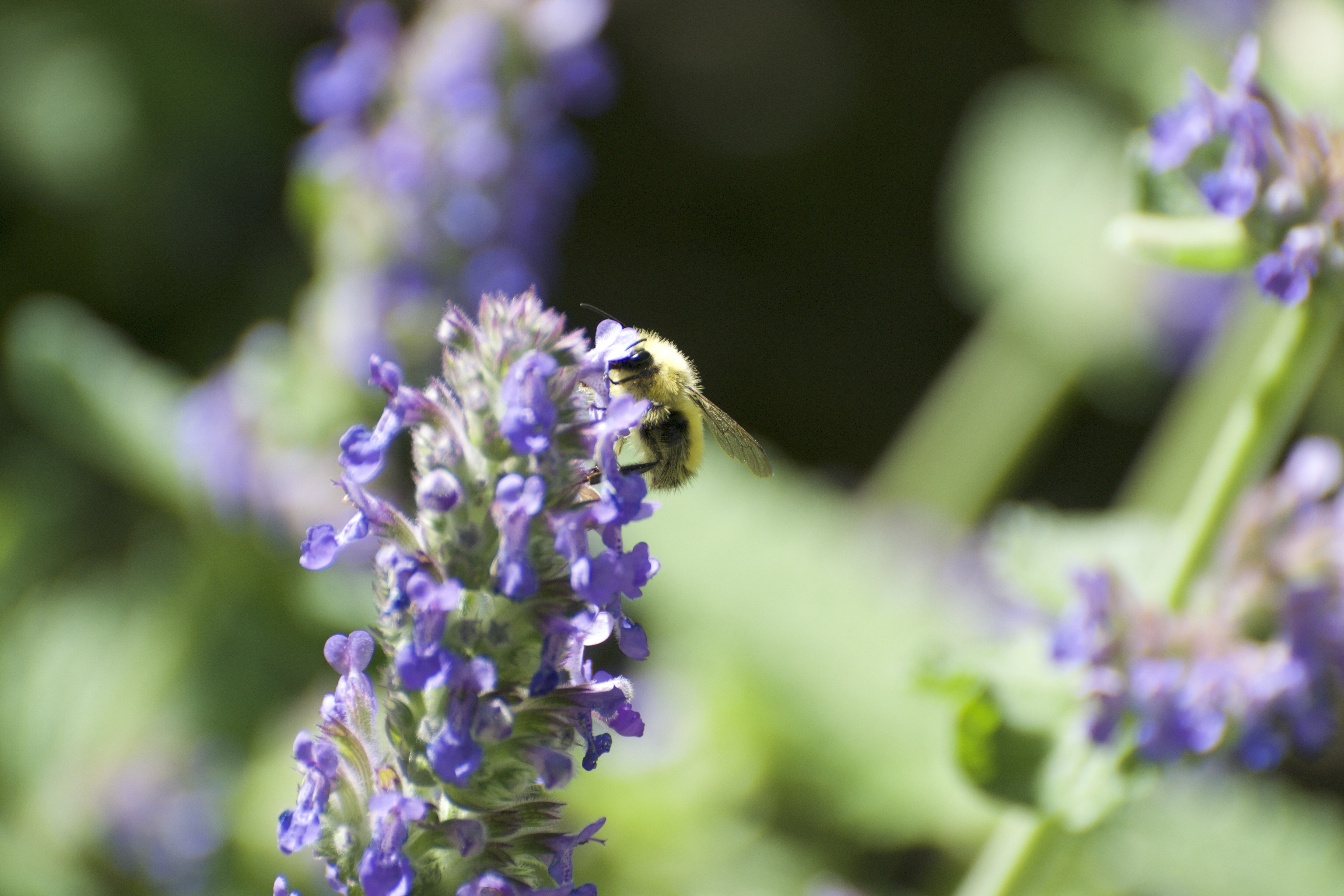
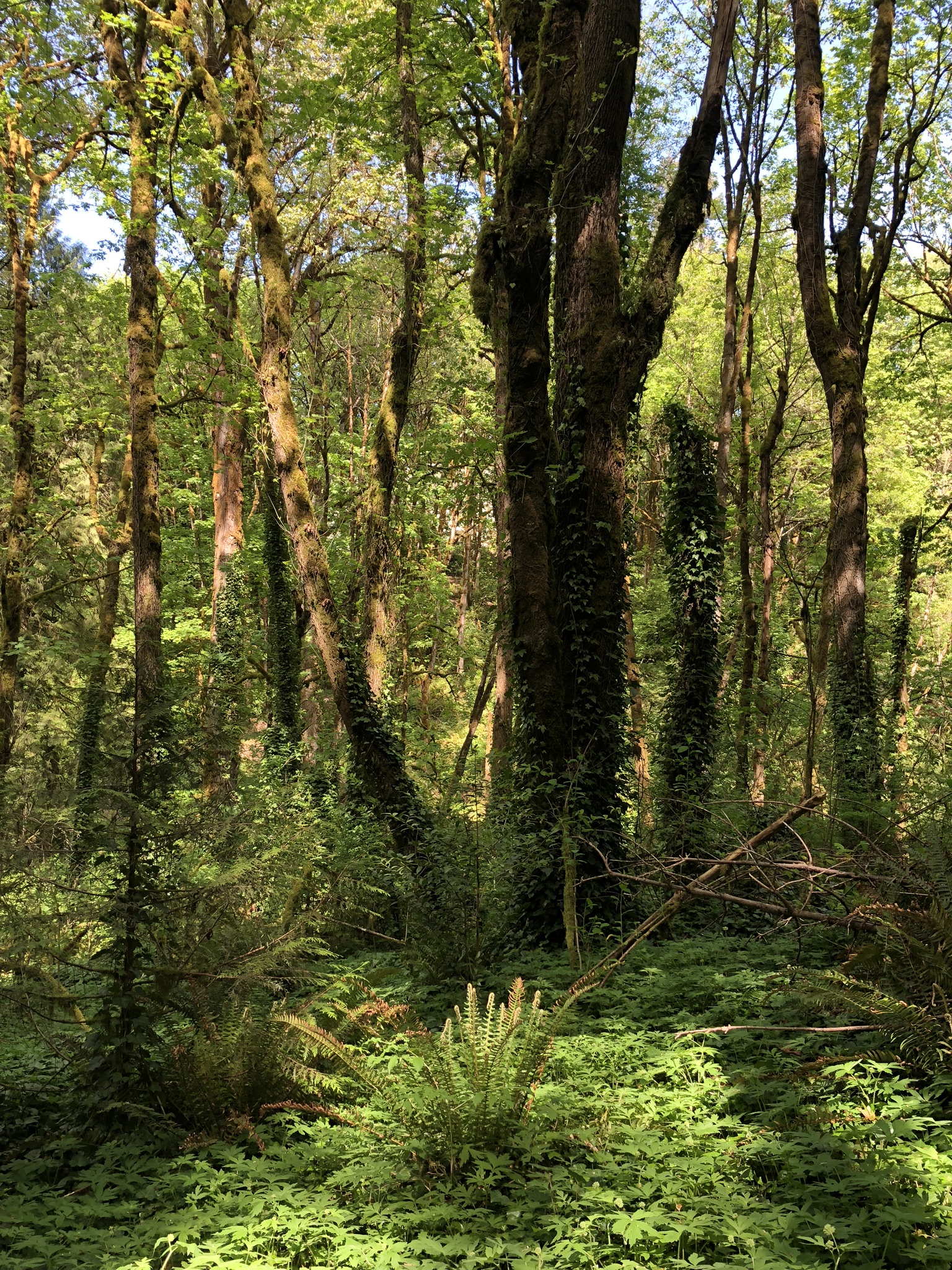
We used to call it a walk in the woods. Not exercising, just going out into nature. These days many refer to it as forest bathing. HUH?
The name might have changed, but the experience has not. If you attend closely to what the environment has to offer you develop a sense of connectedness to that environment.
The New York Botanical Garden, some years back, used a related approach, celebrating its 50 acre Old Growth Garden. They asked someone from the Poetry Society of America to engage those walking in the woods with real “seeing.” Poem Forest was the result.
Strategically placed lines from 2.500 years of poetry were to be read aloud, at locations that corresponded physically or conceptually to the poetry. You can find the images with the poetry lines in the article linked above. A simple way of slowing down and seeing. Maybe I should do something like this in Tryon Creek Park, the old growth paradise close to my house!
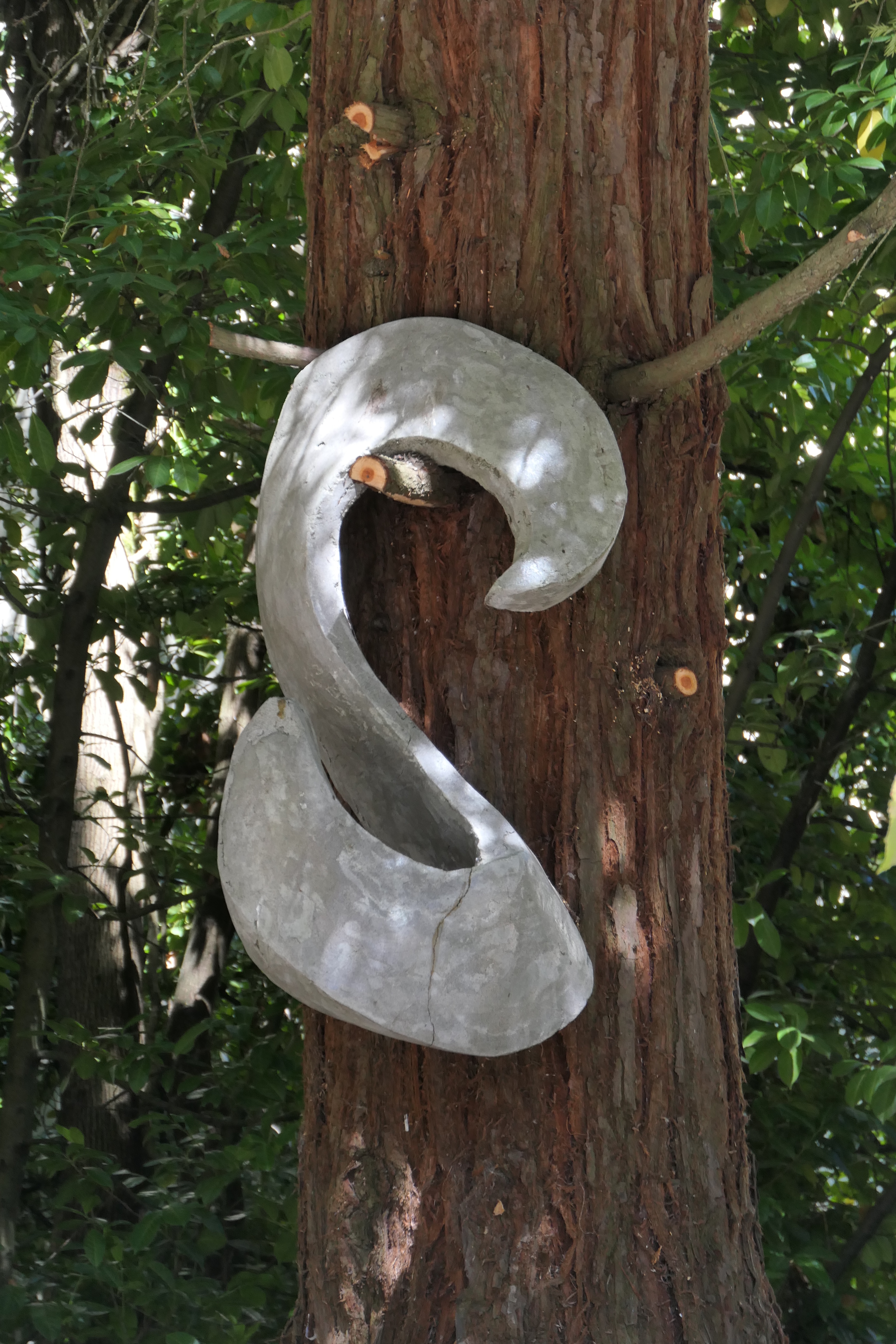
I was reminded of all this when I discovered a wooded corner of the Lewis&Clark campus yesterday, filled with little art pieces presumably left over from the students’ classes last year or during the summer. It made you stop and look, thinking about the intersection of art and nature. Gift of the day.
Here is yours: one of the best choirs in the world:
Out and about in Washington County, I saw signs at the side of the road advertising a Lilyflowerfest – “the only one West of the Mississippi River!”
It didn’t take a minute to turn my car around to explore what that could possibly entail. Off I was to Parry’s Tree Farm and Nursery, located at 45627 Northwest David Hill Road in Forest Grove. Well, let’s say outside of Forest Grove, into the hills, and eventually down a gravel road. When you’ve come that far, you don’t balk at the out-of-nowhere entrance fee either, small as it is at $3.
I also think balking would not have been physically possible, even if you wanted to, given the sensory overload that occupied all of your mental and physical processing gear within seconds.
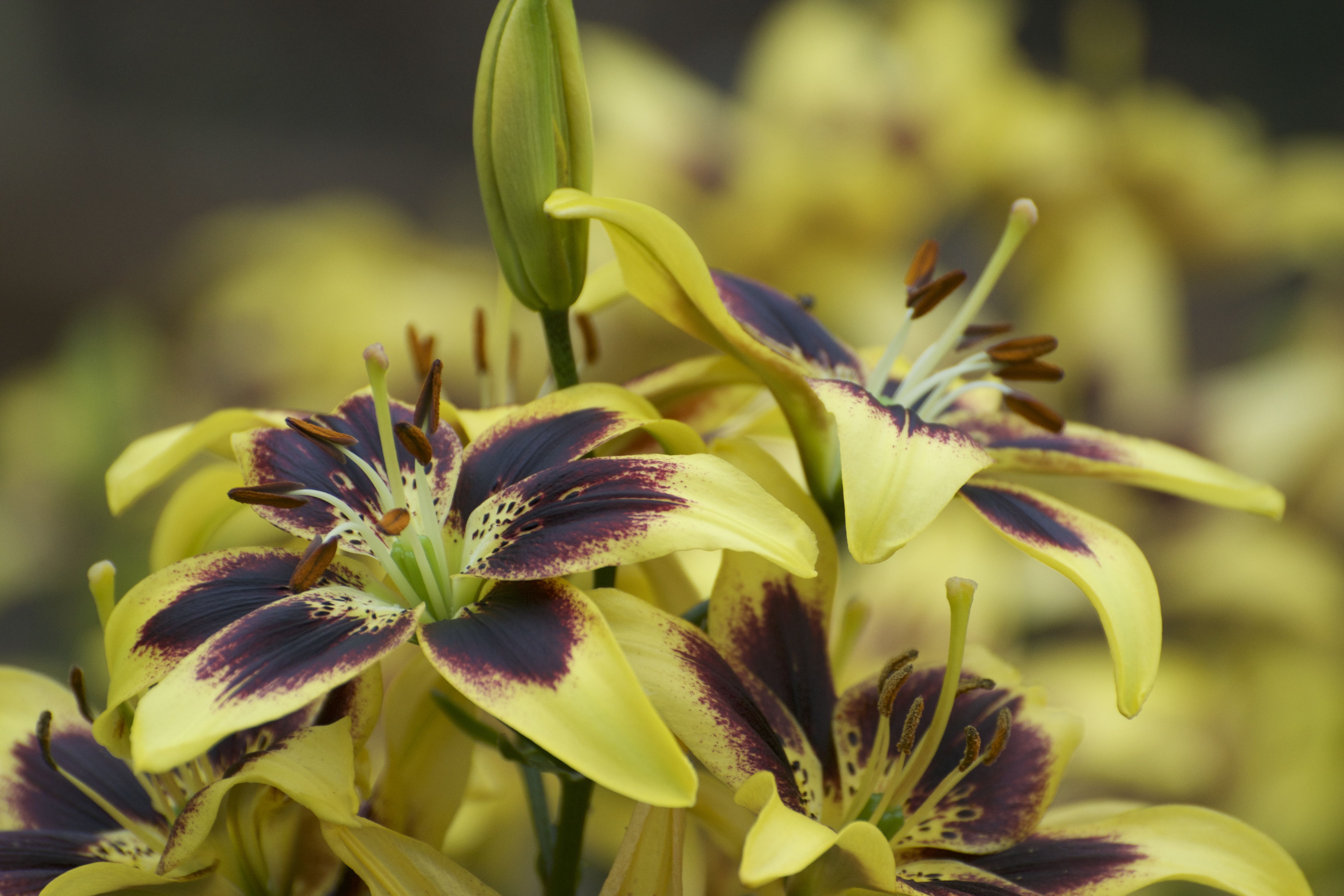
The small farm devoted two areas sheltered by netting to the display and sale of over 20.000 garden tested day lilies, oriental lilies, asiatic lilies, tiger lilies, orienpet lilies and more.
It was a riot of color. It was also an abundance of fragrance, even though not all of the varieties shown do smell. And your ears were, shall we say, assaulted by elevator music of the harp and bells kind, loud enough to interfere with thinking.
What thought was still manifest was one of the “hope I don’t laugh out loud” kind at the pleasure of both the truly wonderful display of flowers and the incongruous side-line decorations – lovingly dressed-up scarecrow types that were plopped among the floral displays. And geraniums (!) surrounding the farmer on his tractor…
Nothing but pleasure, really, including the fact that a hummingbird photobombed my photography amongst the flowers.
I can’t grow lilies in my woodland garden which lacks sun. They would also be too showy for the rest of the flowers that congregate in small spots devoted to a cottage garden. But they surely impress with the intensity of all of their parts, from stamen size to smell to saturation of hues – a photographer’s delight.
Music today introduces Ignace Lilien – yes, the German plural of the flower’s name. A renaissance man, composer, pianist, chemical engineer and all round art aficionado, he survived the Holocaust in Holland with fake papers. I chose his song cycle – 4 songs of beggars – because of the affinity to the “lilies in the field” meme so often cited in the Bible. But I am also adding a Sonata Modern Times just because it is so up-lifting.
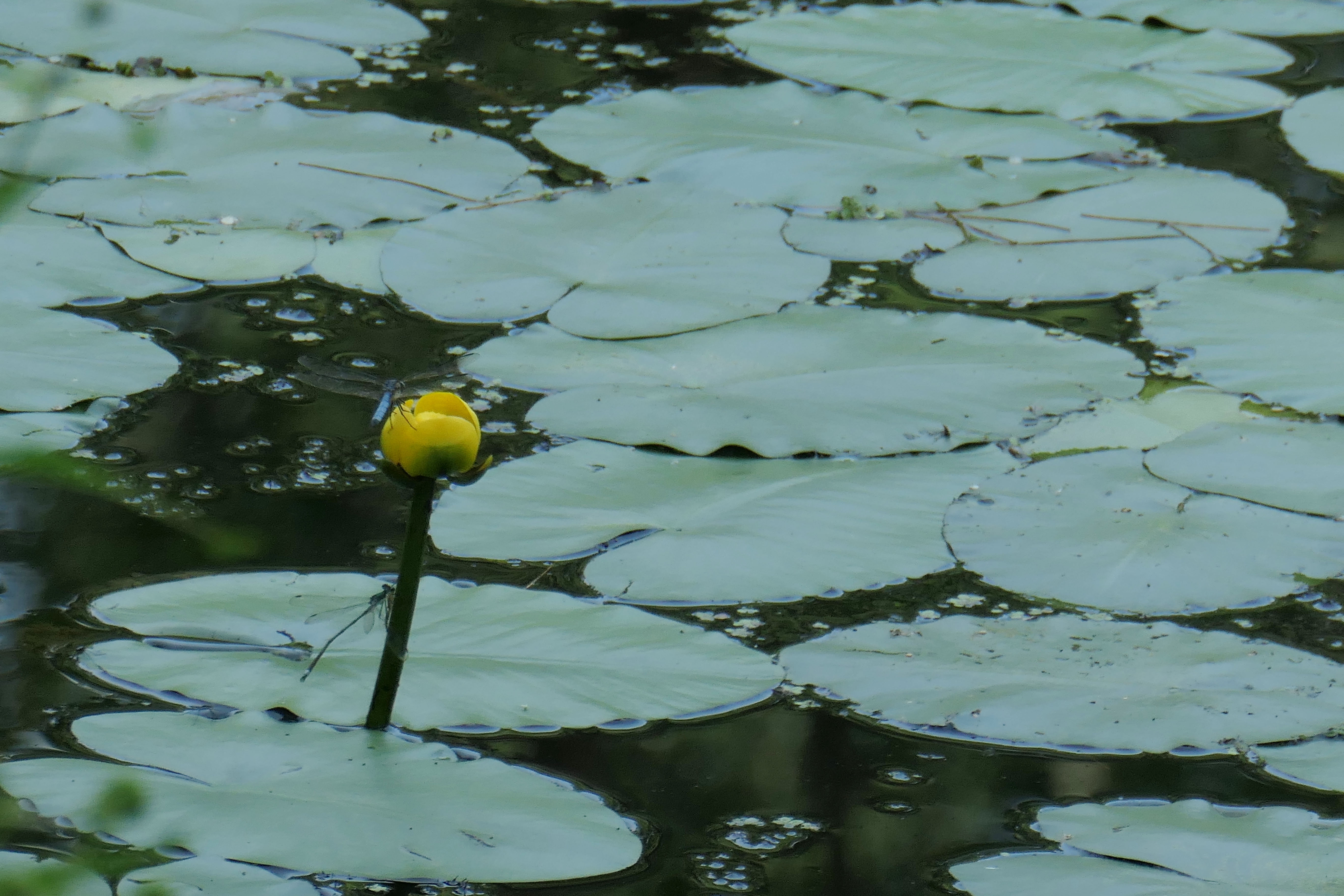
And now for something utterly different, simply because of my chance to sit still and photograph a few dragonflies recently – and my sense that it’s been way too long since we looked at nature….
Here are some facts:
(All taken from this article here, which had a nice summary of the topic.)
1 ) Dragonflies were some of the first winged insects to evolve, some 300 million years ago. Modern dragonflies have wingspans of only two to five inches, but fossil dragonflies have been found with wingspans of up to two feet.
2 ) Some scientists theorize that high oxygen levels during the Paleozoic era allowed dragonflies to grow to monster size.
3 ) There are more than 5,000 known species of dragonflies, all of which (along with damselflies) belong to the order Odonata, which means “toothed one” in Greek and refers to the dragonfly’s serrated teeth.
4 ) In their larval stage, which can last up to two years, dragonflies are aquatic and eat just about anything—tadpoles, mosquitoes, fish, other insect larvae and even each other.
5 ) At the end of its larval stage, the dragonfly crawls out of the water, then its exoskeleton cracks open and releases the insect’s abdomen, which had been packed in like a telescope. Its four wings come out, and they dry and harden over the next several hours to days.
6 ) Dragonflies are expert fliers. They can fly straight up and down, hover like a helicopter and even mate mid-air. If they can’t fly, they’ll starve because they only eat prey they catch while flying.
7 ) Dragonflies catch their insect prey by grabbing it with their feet. They’re so efficient in their hunting that, in one Harvard University study, the dragonflies caught 90 to 95 percent of the prey released into their enclosure.
8 ) The flight of the dragonfly is so special that it has inspired engineers who dream of making robots that fly like dragonflies.
9 ) Some adult dragonflies live for only a few weeks while others live up to a year.
10 ) Nearly all of the dragonfly’s head is eye, so they have incredible vision that encompasses almost every angle except right behind them.
11 ) Dragonflies, which eat insects as adults, are a great control on the mosquito population. A single dragonfly can eat 30 to hundreds of mosquitoes per day.
12 ) Hundreds of dragonflies of different species will gather in swarms, either for feeding or migration. Little is known about this behavior, but the Dragonfly Swarm Project is collecting reports on swarms to better understand the behavior. (Report a swarm here.)
13 ) Scientists have tracked migratory dragonflies by attaching tiny transmitters to wings with a combination of eyelash adhesive and superglue. They found that green darners from New Jersey traveled only every third day and an average of 7.5 miles per day (though one dragonfly traveled 100 miles in a single day).
Bonus for nature lovers: here is one of the earliest film makers exploring the secrets of nature, dragonflies included:
A few weeks ago I went to the museum of the Rhode Island School of Design in Providence, RI. I had never been to the state before and the city was appealing – I can only imagine how it looks even more attractive when all the college and art students are back in town.
RISD is, I think all agree, one of the best art schools in the country. The current exhibit of select members of the 2019 graduating class delivered proof of that.
The show was fresh, irreverent, thought provoking and testament to a lot of technical skill in addition to a lot of creative ideas. Works with and on paper, glass, installations, fabric arts with some phenomenal weaving, painting, and photography – all convinced. Here are some samples. (I was bad, I did not record titles and names, put it down to jet lag. Here is an overview.)
For me the most impressive work (and that name I noted) was a wall of large photographs hung in a floor to ceiling grid, all 15 seemingly depicting the same head and neck, photographed from the back. Only on closer inspection did you realize slight variations, like, for example, a different necklace, or the absence of the necklace. More minute variations revealed themselves only if you kept staring and comparing and evaluating.
Stephen Foster Azimuth 2019
Note it is the head of a Black person. The back of the head of a Black person. The fact that we don’t easily recognize people cross-racially (Whites are horrible at correctly identifying Blacks, and vice versa, and true for other cross racial identification as well) is brought home in spades. It is conveyed by the fact that we have to look really hard to proclaim they “Don’t look all alike to me.” The real-life implication are of course most painfully felt in the legal system, where mistaken identifications lead to verdicts that incarcerate innocent people.
We also, ironically, feel free or even compelled to look at the back of a head, we are in a museum after all and searching for meaning or understanding of the installation, when in real life we do not look, sometimes actively avoid looking. Staring at a person is not socially acceptable and staring at a person of a different race can be misinterpreted and lead to tension. “Made you do it!,” I could almost hear the artist muttering in the wings…
The face is never revealed, another representation of the chasm of not knowing between viewer and subject, the mostly White museum patron and the Black model. Why should he look at us when we don’t look at him?
The name Azimuth is also in no way explained. I hope it is an art history joke (it would be exceedingly clever) referring to two artists who for a short while in the 1960s published an art review called Azimuth and ran a gallery called Azimut. For these two, Piero Manzoni and Enrico Castellani, White was central to their art, in color and materials. 4 years ago an exhibit at the Peggy Guggenheim Collection in Venice revived the work. (Details here.)
In any case, I had a blast being challenged by this work. The photographer is surely a young man we do want to keep an eye on – his ships will come in.
Weaving by one of Foster’s class mates.
Music today shall be by offspring of the city of Providence: a Roomful of Blues
With the oil boom in North Dakota and the extraction of Canadian tar sands, shipment of crude through the states of Washington and Oregon has increased by 250% since only a decade or so ago. Last year Oregon alone saw 19.000 of those tankers on mile-long oil trains pass through, and much of it ends up in Portland at a terminal owned by Zenith Energy. Here the crude is unloaded into massive storage tanks and later pumped onto ships bound for refineries and factories. (An informative article about the problems with this can be found here.)
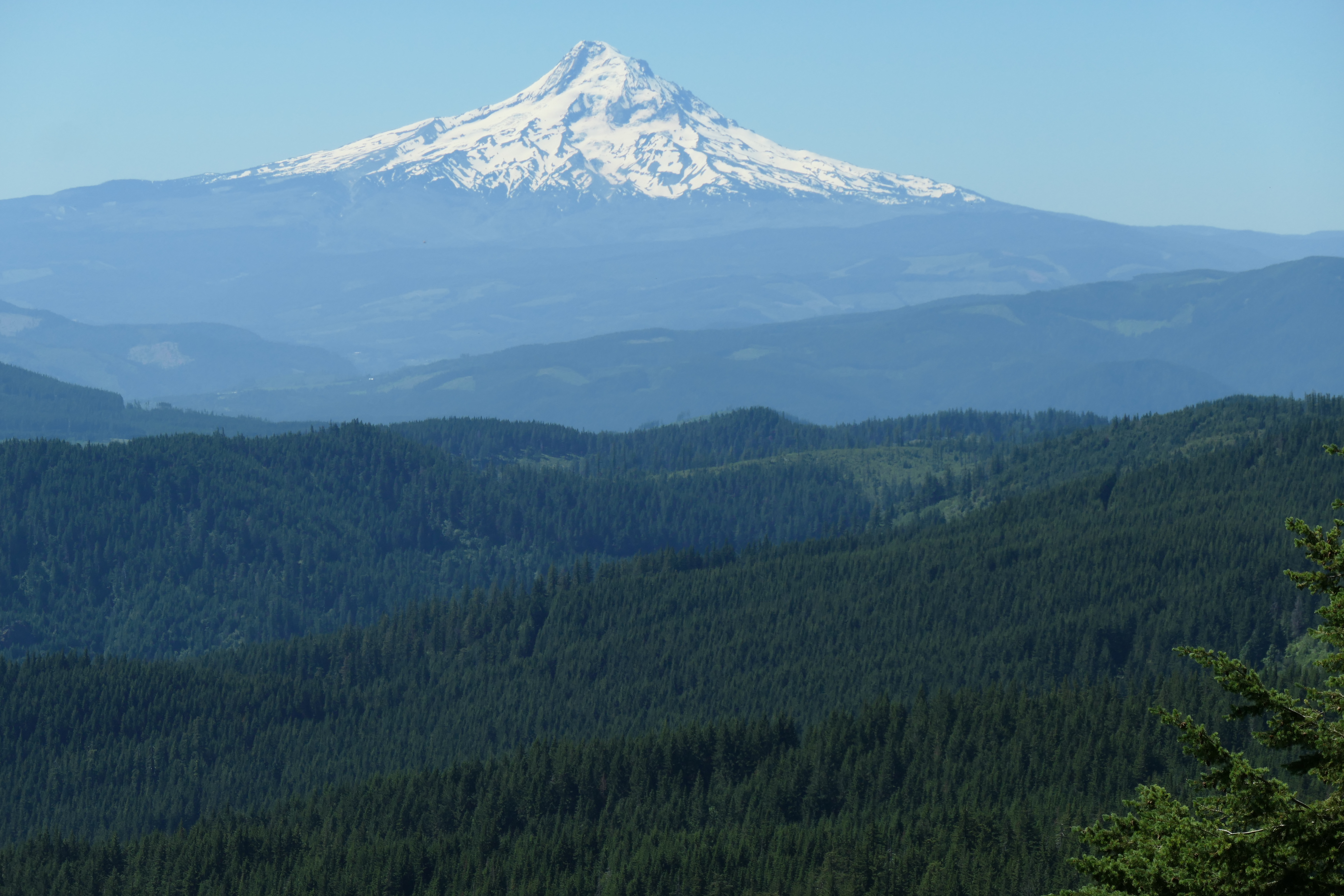
View of Mt. Hood
The Columbia River Gorge is the key route for oil transport moving through the Pacific Northwest. You have as many as 18 oil trains a week – and no one is fully prepared for action against toxic inhalation hazards or worse, catastrophic accidents, particularly since the oil moving through WA and Oregon is unusually volatile. The railroad companies responsible for the trains have had accidents elsewhere, in North Dakota and Alabama, and of course we got our first warning with what happened in Mosier, OR in 2016, when a Union Pacific oil train derailed, catching fire and spilling a small amount of oil into the river during salmon migration.
View of Mt. Adams
I thought it was time to remind ourselves of all this when I heard that the house legislature passed a spill planning bill (House Bill 2209) on Monday. The bill had been delayed for years by corporate money in politics while other West Coast states have long taken action. It now allows the state to levy two fees to fund plans for spills.
What happens to amateur identification with a sieve as brain – best guess: buckwheats and desert parsley
For an oil bill it is still pretty watered down:
“The bill requires railroads to prove they carry enough insurance to pay to clean up a worst-case spill in Oregon. It defines a worst-case spill as 15 percent of a train’s load — far less than spilled in the worst spill to date.”
But at least it contains no secrecy provision:
A few months after the tanker cars overturned in Mosier, Union Pacific wrote a check for $5,000 to then-Rep. Mark Johnson, R-Hood River. When oil spill legislation came up in 2017, Johnson introduced an amendment Union Pacific wanted: to keep any spill plan secret. That bill died after The Oregonian/OregonLive and Oregon Public Broadcasting reported on the unique secrecy provision.
LupinesRock PenstemonsSmall SunflowerWindflower
————————
Here is once again the trailer to the documentary film I am involved with as a set photographer about the dangers of crude oil extraction and transportation, and the ways progressives are trying to tackle the issues in court.
Indian Paintbrush Pink Phlox Mariposa LilyCampion and Larkspur
And to drive the point home to what is at stake if explosions start fires, photographs today are from a gorgeous hike near the Columbia River on Sunday, up to the Monte Carlo ridge. (Alternative routes can be found here.)
And in our irony department, here is a beautiful set of songs by Woody Guthrie commissioned by the Bonneville Dam administration for PR….
A like for wide-open, grassy spaces near water. A preference for, yes, blueberries. Fidelity for life, with a mate chosen to match your own size, more or less. “Gang”broods, where several young ones of different families cluster together guarded by one or two adults. And, last but not least, an increasing affinity for life in urban spaces.
Geese, of course.
I met them yesterday in downtown Portland, resting on the sidewalk, until it was time to go foraging on the lawns of the Esplanade. They like grassy areas to be as open as possible so that they have an unobstructed view of predators while munching on the grass which they can miraculously digest.
The product of that digestion, alas, is one of the nuisances of the increasing goose populations in cities: 3 pounds of poop per goose per day. Shall we say it adds up…..
Aggressive, territorial behavior when it comes to nesting season can be another problem. Most dangerous, though, is the possibility that these geese create traffic accidents, including the potential for colliding with airplanes with catastrophic consequences.
Why are they around? Turns out not for the food – foraging in cities is less productive than in the fields or other less built-up places.
It is for safety. 2.6 million geese are “harvested” by hunters annually in North America, as the Cornell Lab of Ornithology put it so delicately. That’s out of a population of approx. 4.2 million. Obviously they’ve heard the news that they won’t be shot dead in cities. Or not at that rate, anyways. It also keeps them warmer – survival rate for geese in Northern cities is 100% compared to their counterparts roaming the wild in winter – 48% do not make it. (Birds for the study cited above, by the way were lured with Honey Nut Cheerios to be tagged for observation – I guess their all time favorite blueberries were too expensive….)
Man, the little ones are cute though, particularly when they unblinkingly stare back at you practically walking across your feet:
As were their human urchin counterparts, busily trying not to let go of the rope……
Music today is one of my all time favorite renditions of the Children’s Corner by Pascal Rogé, in honor of the young one’s facing a life in an ever more dangerous world.
May we learn to share space and protect each other.
This is, of course, the time of year, where everything explodes in the garden, scents and sights mingle, and first and foremost roses rule (just in time for the Rose Festival – which I will report on at some later point.) Well, they rule, if you have sun, and take good care of them, which directly implies that today’s photographs are not from my own garden….
The tallest rose bush ever recorded stood 23 feet tall.
A Colorado fossil allowed archaeologists to determine that roses have existed for more than 35 million years.
Hildesheim, Germany is home to a large rose bush that has been growing on the wall of the Cathedral of Hildesheim for over 1,000 years. I still can’t find the photo that I took of it…..
People in 15th century England lived through the “War of Roses.” The war got its name after roses were used to symbolize which side people supported or were fighting for. White roses symbolized Yorkshire and red roses symbolized Lancaster.
There are over 4,000 songs about roses out there. Not obvious I’ll find a piece of music that I like…..
Roses are one of only three flowers mentioned in the bible. The other two are lilies and camphire.
For years, breeders tried to genetically manipulate different species and colors of roses to create a blue one. In 2004, the world got its first blue rose.
After he spent 15 years growing it, creator David Austin sold his Juliet Rose at the 2006 Chelsea Show for nearly $15.8 million.
This ain’t it
Why would anyone crowd their brain with facts like these? Why not instead let the flowers speak for themselves? Let’s give it a try.
Then again, we might be distracted by wondering about articles like this which suggest rose water cures about any ailment under the sun – and it must be true because the article was “reviewed” by a person who has 6 titles behind her name….although scientific papers seem to concur – see conclusion below:
The R. damascena is one of the most important species of Rosaceae family mainly known for its perfuming. Its major products are rose water and essential oil.
This plant contains several components such as terpenes, glycosides, flavonoids, and anthocyanins that have beneficial effects on human health. The pharmacological effects of R. damascene are widespread. Most of the CNS effects are hypnotic, analgesic, and anticonvulsant effects. The respiratory, cardiovascular, laxative, antidiabetic, antimicrobial, anti-HIV, anti-inflammatory, and antioxidant are other effects of this plant.
Here is a Finnish composer’s ode to the queen of the flowers;
Busy bees – or was that bumbly bees? This photographer was both, busy and bumbling, as well as forced to be extremely patient. I was sitting in front of the foxgloves in my garden, waiting for the bumble bees to emerge from the blossoms. By the time I had focussed the camera, they were, of course, long gone. Most of the time, anyways.
I had more luck in another beautiful garden where a huge variety of plants attracted a variety of bees, so many of them that I could practically shoot a picture wherever I had the camera pointed.
The phrase “busy as a bee” can be found as far back as in 13th century Chaucer’s Canterbury Tales. They should add “smart as a bee” when you look at recent scientific experiments that reveal how these insects are able to perform complex cognitive tasks like, for example, discriminating between different art styles.
Have bees rewarded with sugar water when landing to feed on one of four different paintings by an Australian aborigine artist or put off by some bitter solution when landing on any one of four Monet reproductions and voila: if you now show them new paintings of each of these masters, they immediately pick the Australian art – and all it takes is one afternoon to have them figure it out. Now why did I have to take years of art education in high school?????
Not that it did much good. At least I didn’t end up like this: Dancing, covered in bees, with meditating comrades drifting off into La la land….
Here is something less funny but more interesting: a short clip on bumble bee life and social structure. And with this I wish you a busy Tuesday filled with sweetness in one form or another.
And no, it’s NOT ging to be Rimsky- Korsakov today, fooled you. Instead do enjoy this:
Walking through my garden towards dusk this weekend, watering can in hand for the new plantings, my eye was drawn to numerous small creatures. Oblivious in their own small universe, perhaps tired, they did not budge when I moved the iPhone directly above them, my watering task all but forgotten.
In the mysterious ways memory works, I suddenly recalled a miniature landscape I had encountered years back in the middle of Manhattan, to be looked at through a glass embedded in, I don’t know, a construction fence? Some office wall? No, I checked: Wall of the Museum of Arts and Design, on Broadway.
The artist, Patrick Jacobs, builds pseudoscientific dioramas using paper, styrene, acrylic, vinyl, neoprene, wax, and hair, and photographs among other materials, viewing them through lenses as he works, using tweezers and brushes. They are lit from within and exhibit incredible depths. Below are links to some of his typical work. If you are in Italy, you have a chance to catch his most recent exhibit until June 9th…..
You look at the panoramas through circular shaped lenses, which reminded me of the Claude glass, an optical device used by 18th century landscape painters. The convex black mirror allows you to asses tonality and light and shade ratios in its reflection. I have always thought it would be interesting to do a landscape photography project with one of those things – probably done already by numerous photographers. Nonetheless, it would fit into the themes of reflection and distortion so much part of my montage work. Which reminds me: I have finally re-designed my art website – give it a look, feedback appreciated!
And for your Monday morning jolt, here is another insect-related masterpiece….gives you a crunching start into a hopefully bug-free week:
Spitbugs!
Unless you want to end up like Rothenberg who does all this interspecies music.
Done with grisly – long live grizzlies. I am rounding out this week which was devoted to interesting aspects of fauna in our lives with a short film clip that truly moved me.
It documents the life work of a man who overcame the trauma sustained as a medic in the Vietnam war by devoting himself to the documentation and protection of grizzly bears in this country. To tell the truth, it made me cry.
Then again, maybe it’s the unusually early heat that has me in a dither.
Since, as you have correctly assumed, I can locate no bears in my photo archives, I will fall back on the words of the film’s subject: “Saving the wild is the mother of all things. That is where we gather life, the potential for wisdom. If we are to have survival, that’s how and where it’s going to take place.”
My “wild” – as wild as it can get a 10 minute drive outside of a metropolitan area – is a daily refuge, a reminder of change and natural order, a place where I can be found photographing, or simply walking, and where I find occasional misplaced pieces of myself. It sustains me, and if it doesn’t bring wisdom, it does have the potential for joy.
Right now it harbors numerous small flowers, in stark contrast to the splashy bloom you see in gardens across the city. Buttercups, blackberry blossoms, woodruff, false Solomon’s seal, coral bells and, if you are lucky, lily-of-the-valley peek out of the abundant green. The water skimmers race across the surface of the brook and the woodpeckers have made their holes big enough to hide in. Ferns unfurl and little white candles are strewn among light green grass, still not touched by dust.
The deer rest here, digesting their abundant meal of columbine, hostas and cornflower blossoms, served nightly in my garden, much to my dismay.
I used to curse the slugs on my morning rounds, now I yell about the deer. But I can’t stay angry. Who has the privilege to live so close to “wild?” It’s only fair to pay a price, perennials it’ll be…..
Music today is an interesting piece by Leonard Bernstein – composed in reference to Plato’s Symposium, in particular about the two speakers Phaedrus and Pausanias. They both talk about love (Eros for one, Aphrodite for the other.) I figured that would do: love (today for the “wild,”for nature,) wherever it comes from, is captured in the music.