Browsing Category

Nature

A Woman ahead of the Times

This surgery shortened week is devoted to cheerful passions and preoccupations. For me, birds belong in the former category, graffiti in the latter.

So when I saw this article in last week’s NYT I had to grin – been there, done that, as today’s photographs will confirm. Here is the link to the NYT, click on the picture.

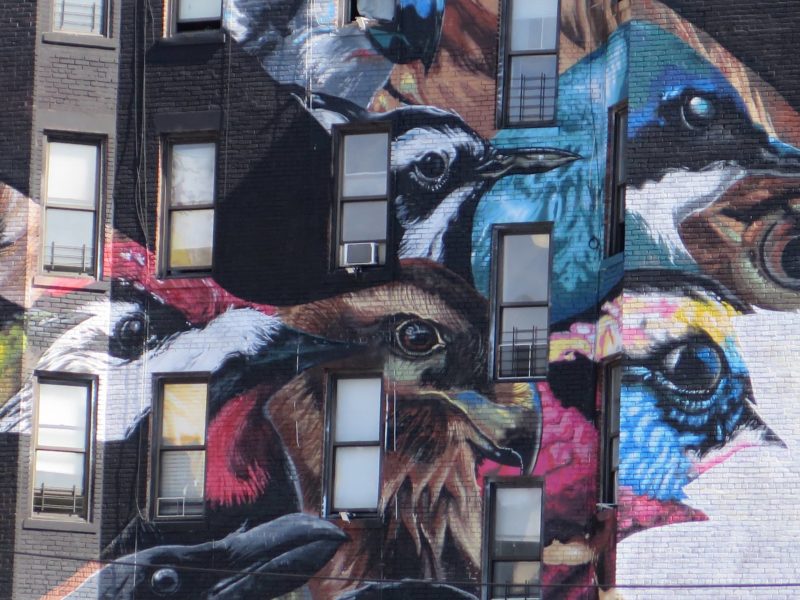
The article is about a fabulous project: painting and spray painting the hundreds of bird illustration by John James Audubon, a pioneering ornithologist, onto surfaces where they can be admired daily. The bird murals are spread across Harlem and Washington Heights, and number so far between 70 and 80 (of an intended 314…) – many more than when I visited in March 2016 trying to scout them out without a serious map.

Audubon was an extraordinary man. His life reads like an adventure novel written by someone like Jules Verne, Daphne du Maurier or Alexandre Dumas, tropical islands, slave mistresses and nursemaids, escape from the Napoleonic Wars, travel with Native American tribes, changing names and nationality, included. He traveled more in his time, on horseback and sailboats across the continents and between them, than most people I know in our own century. He was into birds from the get go and throughout his life which had twists and turns he pursued knowledge about them and painted them all. Reading about him, even on Wikipedia, makes you dizzy. https://en.wikipedia.org/wiki/John_James_Audubon

The National Audubon Society was founded in honor of this adventurer, naturalist and artist in 1896, with President Roosevelt creating the first national wildlife refuge in 1903. Here is an overview of the history – (including the bit of proper Boston ladies trying to get women to boycott wearing hats with feathers as to protect the birds….)

http://www.audubon.org/about/history-audubon-and-waterbird-conservation

And the next link gives up-to-date info on the Audubon Mural Project.  http://www.audubon.org/amp

Just have to get back to NY, don’t I?


Bright Spots

The Pacific Northwest light is once again dark grey and streaked with rain. Sheets of rain, really. Needs to be counterbalanced and with what better topic than the history of the sunflower – which I knew nothing about but had to explore since I have such a cache of cool pictures of this plant. You take your cheer, where you can get it, right?

And what did I learn? Helianthus Annuus sure likes to travel.

The plant was cultivated since 3000 BC by Native Americans in New Mexico, perhaps even earlier than corn. Seeds and oil were used for food and body painting, stalks for building and other plant parts for medicinal purposes.

In the 15oos  some Spanish colonialist took it back to Europe, with the English recording a patent in the 1700s for squeezing the oil. Seeds moved to Russia and under Peter the Great commercial production began – with the blessings of the Orthodox Church which exempted sunflower oil from the list of forbidden oily foods during lent. By the 19th century over 2 million acres in Russia were devoted to sunflowers with much scientific breeding for increasing yield, disease resistance and quality of the oil.

Of course,if you had it with placid sunflower fields you could always turn to St. Petersburg, the city built on bones. You didn’t expect me to be silent on czarist politics, did you? Just saying….

https://www.theguardian.com/books/2017/aug/13/st-petersburg-three-centuries-murderous-desire-jonathan-miles-review

The return trip to the US happened in the late 1800s, seeds brought over by waves of Russian immigrants. During our own time European demand of the product was so big that over 5 million acres were planted in the US for export, so the seeds traveled eastwards again. They even went upwards: into space in 2012 to be planted at the space station.

Source for all of these tidbits is the link below:

http://mentalfloss.com/article/68726/10-glorious-facts-about-sunflowers

It even taught me that you can use the head as a scrubbing pad……..

Enjoy the brightness, the sturdiness, the heliotropic model for moving with the light during this storm plagued weekend!


Sauvies Island, again

Regular readers are familiar with my obsession with Sauvies Island. It is one of my favorite spots to photograph, or, more importantly, to be. I regularly visit to air out my soul.

Since this week’s blog is devoted to recent encounters, I will report on last Thursday’s meeting with unfettered joy – a sunny Rosh Hashana stroll on Sauvie. I went there to walk and contemplate, so the photographs are incidental; in any case Portland has an uncrowned king of Sauvies Island photography, Ron Cronin.  Check out his work – the variety of landscapes and seasons he captures are unparalleled ( and that is saying a lot in a town that is teeming with talented and devoted nature photographers. http://www.augengallery.com/Artists/cronin.html

Here is one of Ron’s images that someone smart at the art museum added to the collection.

PAM has diverse paintings of Sauvie as well: I can think of Charles McKim’s 1920 landscape painting Sauvie Island

Sauvie Island

and Percy Manser’s Fall Trees near Water, 1928.  

Henk Pander has done multiple water colors over the years there, of which this is one of my favorites.

The funny thing is, I could lead you to the exact views represented by these paintings if you give me a day and pack your rain gear…. little has changed in almost 100 years. Somehow that contributes to the sense of being in some totally authentic landscape, something not marred and something shared with other artists.

I walked the Oaks Island trail last week, a 5 k round that will close by the end of the month until late April, to protect migrating birds and nesting waterfowl. The puppy thought he had landed in paradise, chasing those swallows and eventually flushing out a gaggle of geese – unclear who was more startled, the birds or the bird dog.

The grass was golden, the waters calm, and the trees washed free of the accumulated dust after the recent rains. The red-winged blackbirds gorged on the occasional drifts of wild seeded sunflowers and the herons did not disturb the peace with their squawking voices.

And here they were: the sandhill cranes announced themselves from afar with their cries, then flew by in formation, returning from wherever they travel to for a winter’s rest. My favorite birds this time of year.

“Sandhill Cranes give loud, rattling bugle calls, each lasting a couple of seconds and often strung together. They can be heard up to 2.5 miles away and are given on the ground as well as in flight, when the flock may be very high and hard to see. They also give moans, hisses, gooselike honks, and snoring sounds. Chicks give trills and purrs.” I think the Cornell Lab of Ornithology got positively poetic in their choice of adjectives…. if you push the sound button on the lower end of the attached link, you get to hear them.

https://www.allaboutbirds.org/guide/sandhill_crane/sounds

I was trilling and purring for the rest of the week – that is until the German election results came in….


Recent Encounters

I am often astonished when I think about the variety of experiences in my daily life. So I thought this week, instead of writing depressing warnings about losing our soul as a nation, I’ll talk about what happens around here or in my wanderings in general. There is always something surprising.

Let’s start with revisiting a standing date I’ve described before: once a week I walk at Oaks Bottom with a dear friend and wizard of technical gadgets – which comes in handy as you will see when the story unfolds.

As I described Oaks Bottom before – it is a wildlife sanctuary located between a small amusement part and a strangely decorated crematorium.

To get from one to the other you have to pass through a dark tunnel – a satisfyingly cheesy metaphor for any old Tuesday morning.

You walk through meadows,

then wooded paths, along a lake that sports diverse wildlife depending on the time of year and amount of water.

Herons congregate here, owls nest here, young explorers abound,


and the homeless camp out here, occasionally rounded up by the authorities followed by volunteer garbage collectors.

And of course, selfie-takers – can’t avoid them, even in the woods, standing on unsafe surfaces.


Once you come across the lake you walk back on a bike path that parallels train tracks. In the winter Santa Claus is known to run that track with a steam engine decorated with reindeer and filled with the squealing short set. Not being run over by bikes poses a kind of challenge for people and dogs alike, but the views are worth it: the Willamette river can be glimpsed through the trees, all manner of nautical traffic, and the misty clouds over the West hills.

This week the hike was punctuated by cries for help. A disoriented, disheveled, bend-over man who could barely walk implored us to call 911. He had lost his way in the woods, fallen, lost his glasses and, by the wet looks of his clothes and the laceration on his face, had spent the night on the ground. He was on the other side of a fence and another hiker joined us to stabilize him. My cell promptly had no connection, but the hiker reached the police. My friend, thinking on her feet, knew how to drop a pin on our location on her phone, and so when the two of us walked the mile or so to meet the ambulance people at the street access, she could direct them where to go, wheeled stretcher and all. I hope it worked out for the guy.

I know for myself, that I was ashamed for my hesitation when first approaching him: the idea it might be some raving drug addict or some such came to mind way too fast. Not sure I would have stopped if I had been on my own. More proof, if needed, of how our humanity is affected by issues of social injustice.

My archives are full of photographs of this place. But I thought it would be a nice challenge to document the narrative with photos taken on just one visit there, last Saturday.

Safety before Profit

If you asked me last week what I think when I hear the word Oklahoma I’d say: State in the mid-West and a hit musical by Roger and Hammerstein.

This week, on the other hand, the dominant association to the word Oklahoma is earthquakes. Maybe I’m reading too much for my own good. But the story about what’s happening in Oklahoma really exemplifies my quest as to what we as a nation should resolve for the New Year: listening to science – and act on what we learn –  to avoid disaster.

The links below provide details, but here is the rough version: By the end of 2014, 567 earthquakes of at least magnitude 3.0 were recorded in Oklahoma, more than the number of 3.0+ magnitude earthquakes from the previous 30 years combined. In 2014, there were over twice as many earthquakes recorded in Oklahoma as in California, making Oklahoma the most seismically active state in the contiguous United States by a substantial margin. In the last two years that number increased even more as did the magnitude of the quakes: the largest one recorded as 5.8.

The attached article spells out the consequences if we reach the magnitude of 6 on the Richter Scale in particularly sensitive locations, like Cushing, OK where 14 major oil pipelines intersect and hundreds of tanks holding 60 million barrels of unrefined oil are sitting targets (tanks are not subject to federal safety regulations, wouldn’t you know it.)

And I quote: if there were a major one that broke pipelines and split, say, half those tanks, the environmental disaster would make the Exxon Valdez spill of 260,000 barrels of oil near the Alaska coast nearly three decades ago look like the results of a kid knocking over her uncovered juice cup.

https://www.dailykos.com/stories/2017/9/14/1698565/-A-big-earthquake-could-turn-Cushing-Oklahoma-into-one-of-the-worst-oil-related-eco-disasters-ever

So what do we think causes this strange increase in earthquakes?

In one word: greed, in multiple forms.

Large companies drill for oil and gas in Oklahoma, making tons of money where labor is cheap and regulations scarce. The drilling process involves a lot of waste water that needs to be disposed of. For that purpose they create deep disposal wells even below the levels of oil and gas extraction and then pump the brine – now a mix of water and chemicals – into those wells. The EPA says there are about 40,000 disposal wells nationwide. The water that hits lower strata deep in the earth can set off seismic activity – after years of denial now even State regulatory agencies acknowledge the causality. After the 2016 earthquakes you saw 37 wells shut down because they were deemed too risky. Which is, of course a drop in the bucket.

That water could be recycled. People do it all over the States, but not in Oklahoma. The oil companies claim: “underground wastewater disposal is currently the safest and most cost-effective way to dispose of produced water.” Drillers also argue that recycling is more expensive, in part because they must pay to transport the wastewater to recycling facilities. But they promise they’ll check for safety gaps more frequently…..

The New Yorker story below is an in-depth description of what is happening. It also mentions that much of what you see when driving through Oklahoma is starlings and cows, which prompted the photo selection. And a goose, because they are everywhere, and I like them…..

https://www.newyorker.com/magazine/2015/04/13/weather-underground

We all know the writing on the wall, but we do not act in time – we should change that, as a country, putting our citizens’ safety before the profit garnered by the energy giants. And this concludes our New Year’s resolution – l’Shana Tovah!

Earthquake Map

The Birds of Summer

Yesterday I mentioned the dog(days) of summer; today it’s going to be the birds you saw flying around over these last many months: ospreys.

I like everything about them. They are fearless, they are willing to let you come (relatively) close, they have an interesting way of adapting to current conditions. They usually lay three eggs that both parents tend to but that hatch not all at once. The staggering of chicks ensures that one is bigger than the two others and if there is a food shortage it will make it sure it is fed first. That way during times of scarcity only one bird will survive in an environment that can only carry that load. If there’s plenty then all three will thrive and fledge into a world that has food and room for all of them.

A world, that is, that is not poisoned by chemicals. Ospreys were threatened because commonly used agricultural pesticides thinned their eggshells and hampered reproductive strength. They have now come back in force because of tight regulations that protected the species, and many involved naturalists who built osprey “gardens” – platforms in the landscape where they tend to their nests out of harm’s way. In Portland you can find them reliably on Sauvie Island and at the Tualatin River Wildlife Preserve, the two places where the photographs were taken.

The links below show a video of these fishhawks  and an article that discusses the results of protectionist measures. And I quote gleefully from the NYT: For myself, I also love ospreys because they give me a chance to remind the Republicans who generally own seaside real estate (and covet ospreys) that these birds are a living reminder of how well government regulation can work. We saved ospreys not just through laws regulating pesticides and protecting migratory birds, but also through the Clean Water Act of 1972, which turned the Connecticut River, and many others, from an open cesspool to a precious natural and recreational resource.

http://video.nationalgeographic.com/video/osprey

Ospreys are considered a type of eagle in many Native American tribes, and are accorded the same respect bald and golden eagles are. In coastal tribes where ospreys are most commonly seen, they sometimes play ‘police’ or guardian roles in traditional legends, and seeing one is sometimes considered to be a warning of danger to come – or so tells me the Native American Legends website. http://www.native-languages.org/legends-osprey.htm

Well, I don’t need warnings of dangers to come, am well aware of them as it is – all I have to do is look at may laundry drying outside sprinkled with ash that is falling from our skies as a result of the forest fires.


Dog Days

Not sure what I cherish more – getting a surprise gift from a semi-anonymous source (a thousand thanks to B’s BFF)….) or reading said gift, which turns out to make me laugh out loud while learning.

The book, written by Mark Forsyth, is called Etymologicon – A Circular Stroll through the Hidden Connections of the English Language. More of a spiraling, tumbling, somersaulting romp through numerous languages of the world, if you ask me. It helped distract me from yesterday’s news of yet another cruel and despicable presidential act – the rescinding of DACA. I spare you my cynical thoughts and instead share with you what I now learned about the roots of the word cynicism.

Loosely quoted: “The Cynics were a school of ancient greek philosophy, founded by Antisthenes and made famous by Diogenes. Cynic meant doglike. Diogenes taught and debated at a gymnasium called Cynosarge, Gymnasium of the White Dog, because a white dog had once defaced a sacrifice there, running away with a piece of meat. Diogenes, not being a native Athenian, was forced to teach at this Dog’s Gymnasiusm, which is how one hungry and ownerless canine gave his name to a whole philosophical movement. A fun litte result of this is that any cynical female is, etymologically speaking, a bitch.”

And speaking of dogs, it sure feels like the dog days, although they only last through mid – August, that hot, oppressive part of late summer. I now learn that people thought that Sirius, the Dog star, second brightest in the sky after the sun, combined its light with the sun for added heat (it cannot be seen during late summer when it rises and sets at the same time as the sun.) Sirius means scorching in Greek – and the only thing I know of these days that enjoys this heat is the sunflower……


Friday’s Question

Seems like wherever I look I see stuff published on the upcoming eclipse. The science end, the mythology angle, the aspect of what it will do to our state when the influx of a 1000000 or so sun gazers hits the parched lands….

For your reading pleasure (admittedly I am too hot to write and am counting the hours to the advertised rain on Sunday) here are two links that offer an interesting slant on the event.

https://www.theatlantic.com/science/archive/2017/08/annie-dillards-total-eclipse/536148/

Dillard’s essay is a lyrical report, if such a things exists, of a total eclipse she saw in Washington State in the 80s. Cannot think of a way to say poetry-like prose that doesn’t sound like a cliché, but suggest her words should be set to music. By Alma Mahler.

https://www.theatlantic.com/science/archive/2017/08/kings-beware-the-eclipse-looms/536385/?utm_source=nl-atlantic-daily-081017

Andersen, senior editor at the Atlantic, has a knack for writing about science and history as if they are inseparable subjects. His musings on the psychological power exerted by these rare celestial events are a worthwhile read.

And then there is Kentucky. Read here what they are expecting on 8/21 (In a strange coincidence, August 21,the day of the 2017 eclipse, carries a lot of significance for Hopkinsville. That’s the day, in 1955, that a local farmhouse in nearby Kelly received an alleged visit from a band of extraterrestrials and a fierce gunfight ensued. Local police and military police from nearby Fort Campbell investigated, and the incident received considerable coverage from the national press.) 

http://www.atlasobscura.com/articles/the-tiny-kentucky-town-that-eclipse-fans-are-obsessing-over

I, personally, think nature picked a particularly bad time to show off in this way. For one, the millions of superstitious people, some in the highest ranks of government, might just use an eclipse to dig deeper into their fantasies of being told “this or that” by a higher power. “This or that” being associated with heat and fury, no less. And darkness, no longer passing.

Secondly, the drought-stricken parts of our state will see so many people drive through, camp out, light their choice of inhalant, and then discard it or the ashes, that accidental fires are almost guaranteed. And not that many fire brigades are available given how many forest fires are already being fought, and how little water is around.

Tense times, then, which I will bravely try to overcome by getting myself a big dish of ice cream. Right now. Which brings me to Friday’s question.

Coffee, strawberry or vanilla?


The Other Forest


The hike report of this week ends with a poem by one of my favorite poets of all times. The WW I site he refers to is of course far from here, but our land, too, has seen its share of death inflicted by the colonialists.(Although I say with teary relief, there will be fewer dead after the Senate vote less night sunk the American Healthcare Freedom Act….. )

The Ardennes Forest

Cup your hands to scoop up sleep
as you would draw a grain of water
and the forest will come: a green cloud
a birch trunk like a chord of light
and a thousand eyelids fluttering
with forgotten leafy speech
then you will recall the white morning
when you waited for the opening of the gates

you know this land is opened by a bird
that sleeps in a tree and the tree in the earth
but here is a spring of new questions
underfoot the currents of bad roots
look at the pattern on the bark where
a chord of music tightens
the lute player who presses the frets
so the silent resounds

push away leaves: a wild strawberry
dew on a leaf the comb of grass
further a wing of a yellow damselfly
and an ant burying its sister
a wild pear sweetly ripens
above the treacheries of belladonnas
without waiting for greater rewards
sit under the tree

cup your hands to draw up memory
of the dead names dried grain
again the forest: a charred cloud
forehead branded by black light
and a thousand lids pressed
tightly on motionless eyeballs
a tree and the air broken
betrayed faith of empty shelters

that other forest is for us is for you
the dead also ask for fairy tales
for a handful of herbs water of memories
therefore by needles by rustling
and faint threads of fragrances–
no matter that a branch stops you
a shadow leads you through winding passages–
you will find and open
our Ardennes Forest

Zbigniew Herbert

Critters

I wonder if a hike report is boring to those who have not been on it.  Yeah, some pretty flowers, some spectacular snowscapes, some cute wildlife.  Maybe working your body hard to get to the sights makes them more special when you take them in?

For me, it’s not just the body that gets a needed work-out on a hike, it is also my mind. As you can possibly predict, my brain will react less to the tranquility of nature and focus more on the thoughts that are provoked by seeing the developments encroaching on these pristine spaces of our state, the ravages of the wildfires and, yes, the decline of the bird population.

This, in turn, had me read up on ecological issues, and what I learned is actually quite encouraging. The Nature Conservancy website alerts to a new project called SNAPP – Science for Nature and People Partnership. This enterprise is looking to promote “evidence-based, scalable solutions to global challenges at the intersection of nature conservation, sustainable development and the well-being of people.

Their working groups are amazingly diverse and led by some remarkable people across fields.” Experts, scientists and practitioners convene from around the globe to address some of the world’s most pressing challenges, in ways that no single organization could accomplish alone. SNAPP builds a collaborative web — consisting of some of the foremost conservation and humanitarian organizations, academics, government agencies and multilateral institutions — to develop cutting-edge solutions. Solutions that can make a real difference for nature and the people who rely on it.”

Just look at the projects they tackle – including biodiversity issues in North America. http://snappartnership.net/?intc3=nature.science.lp.splash3 

(If you open this link and scroll down, it gets you to a table of content that can be read at a glance)

Fire Research Consensus, Ecosystem Services and Biodiversity, and Forest Sharing or Sparing are the three working groups that invite further scrutiny after coming home from Mt. Hood, hot, tired, achey and happy.  In the meantime, I’ll delight in the images of the critters I encountered.