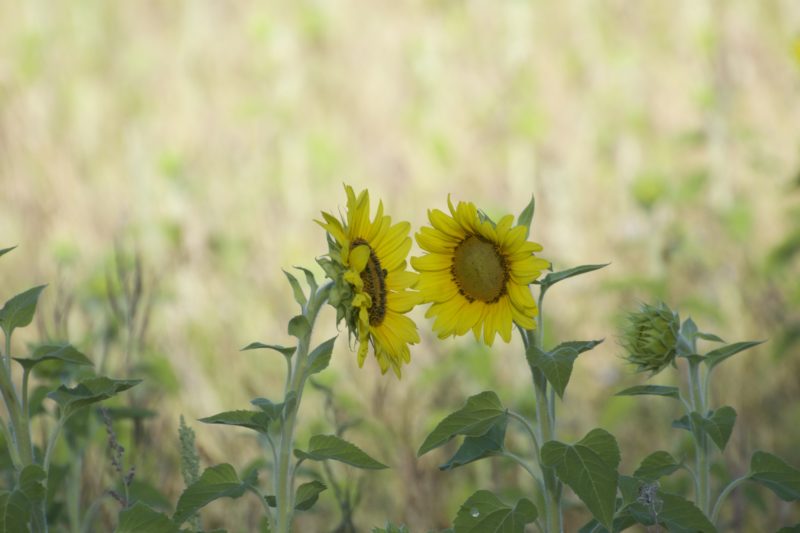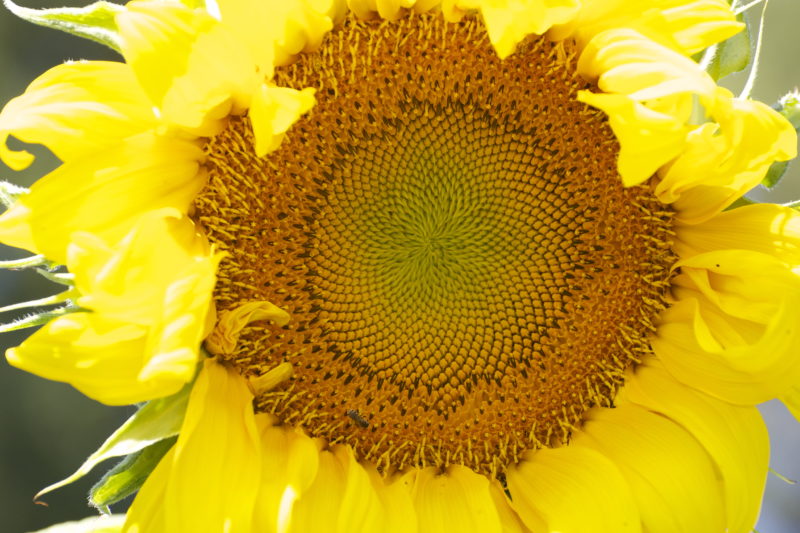

The Pacific Northwest light is once again dark grey and streaked with rain. Sheets of rain, really. Needs to be counterbalanced and with what better topic than the history of the sunflower – which I knew nothing about but had to explore since I have such a cache of cool pictures of this plant. You take your cheer, where you can get it, right?

And what did I learn? Helianthus Annuus sure likes to travel.

The plant was cultivated since 3000 BC by Native Americans in New Mexico, perhaps even earlier than corn. Seeds and oil were used for food and body painting, stalks for building and other plant parts for medicinal purposes.

In the 15oos some Spanish colonialist took it back to Europe, with the English recording a patent in the 1700s for squeezing the oil. Seeds moved to Russia and under Peter the Great commercial production began – with the blessings of the Orthodox Church which exempted sunflower oil from the list of forbidden oily foods during lent. By the 19th century over 2 million acres in Russia were devoted to sunflowers with much scientific breeding for increasing yield, disease resistance and quality of the oil.

Of course,if you had it with placid sunflower fields you could always turn to St. Petersburg, the city built on bones. You didn’t expect me to be silent on czarist politics, did you? Just saying….

The return trip to the US happened in the late 1800s, seeds brought over by waves of Russian immigrants. During our own time European demand of the product was so big that over 5 million acres were planted in the US for export, so the seeds traveled eastwards again. They even went upwards: into space in 2012 to be planted at the space station.

Source for all of these tidbits is the link below:
http://mentalfloss.com/article/68726/10-glorious-facts-about-sunflowers
 It even taught me that you can use the head as a scrubbing pad……..
Enjoy the brightness, the sturdiness, the heliotropic model for moving with the light during this storm plagued weekend!