Browsing Category

Psychology

Individual Differences

13-blackbird-xiii-copy-2

What difference does it make if you are good at visual imagery, or, reversely, at spatial imagery?

For one it might influence your career choice, with visualizers being advantaged in the arts, and spatially gifted people advantaged in the sciences or engineering. As mentioned before, it also might have an impact on autobiographical memory, with visualizers more apt to be able to relive their experiences, including a lot of sensory detail.

That can come with a price, though. There might be a linkage between vivid visual imagery and some aspects of mental illness and this point may in turn suggest new forms of treatment for some illnesses. For example, a prominent symptom of post-traumatic stress disorder is the experience of “flashbacks” – immensely vivid and often-intrusive images of a traumatic experience. Both schizophrenia and Parkinson’s disease can involve involuntary (but highly vivid) hallucinations. Some people diagnosed with phobias experience troubling images (e.g., images of snakes for someone with ophidiophobia [fear of snakes], images of spiders for someone with arachnophobia [fear of spiders], and so on). It seems plausible that therapies will need to embrace these findings, seeking either to disrupt these troubling images or, in some cases, to ‘re-script’ the imagined event.
13-blackbird-vi-copy-2

And then there are the people with “super” skills, so-called eidetikers. The memories of these people have a photographic quality. This form of imagery is sometimes found in people who have been diagnosed as autistic: These individuals can briefly glance at a complex scene and then draw incredibly detailed reproductions of the scene, as though they really had taken a “photograph” of the scene when first viewing it. But similar capacities can be documented with no link to autism. Research described a woman who could recall poetry written in a language she did not understand, even years after she’d seen the poem; she was also able to recall complicated random dot patterns after viewing them only briefly. Similarly, a 10-year-old eidetiker saw a complex picture for just 30 seconds. After the picture was taken away, the boy was unexpectedly asked detail questions: How many stripes were there on the cat’s back? How many leaves on the front flower? The child was able to give completely accurate answers, as though his memory had perfectly preserved the picture’s content. For more detail see: http://plato.stanford.edu/entries/mental-imagery/quasi-perceptual.html

Let it be clear, though: we know very little about this phenomenon, how frequently it exists and what the underlying mechanisms are. More often seen in the movies than in real life!

Visual Imagery and Perception

img_2622-copy-4

So far this week I introduced the notion that most people can see with their “mind’s eye”, but some cannot. That does not depend on whether you are congenitally blind or not – there are forms of imagery that are spatial, rather than visual, and people without visual imagery can make use of that.  I also claimed that imagery has a lot to do with perception, since the brain areas involved in perception get activated through visual imagery as well.

How far do those parallels go? In some ways mental images are like pictures.

  • Chronometric studies indicate that the pattern of what information is more available and what is less available in an image closely matches the pattern of what is available in an actual picture. Likewise, the times needed to scan across an image, to zoom in on an image to examine detail, or to imagine the form rotating, all correspond closely to the times needed for these operations with actual pictures.
  • In many settings, visual imagery seems to involve mechanisms that overlap with those used for visual perception. This is reflected in the fact that imaging one thing can make it difficult to perceive something else, or that imaging the appropriate target can prime a subsequent perception. In other words, if I ask you to image something it makes it harder to perceive a weak visual stimulus at the same time. And if I ask you to to image something that resembles a visual stimulus you are faster to see it when it pops up on a screen. Further evidence comes from neuroimaging and studies of brain damage; this evidence confirms the considerable overlap between the biological basis for imagery and that for perception.
  • Even when imagery is visual, mental images are picture-like—they are not actually pictures. Unlike pictures, mental images seem to be accompanied by a perceptual reference frame that guides the interpretation of the image and also influences what can be discovered about the image. For example if I ask you to image a simple ambiguous picture like the one below, you are not able to reverse it to its alternative interpretation, something that is very easy to do when you look at the actual picture.unknownDuck/rabbitunknownOld woman /young woman

Art and the Blind

We often talk about the “visual arts”. But it is interesting to ask how visual the visual arts really are. One path forward is to ask both, how people who are blind since birth appreciate art and also create art.

This is a fascinating issue on its own but also can give us intriguing hints about why art is as it is. Certainly some aspect of art are just a matter of convention – just look at ancient Egypt where the convention was to show fee viewed from the side, bodies viewed head on and faces almost always in profile.  But some aspect of art may come from the way our brains (and that is ALL brains) are wired.

egyptian_-_wall_fragment_from_the_tomb_of_amenemhet_and_his_wife_hemet_-_google_art_project

Some of the fabulous evidence comes from Canadian psychologist John Kennedy who has done various studies asking the blind to draw specific scenes, he finds, for example, that blind people with no art training spontaneously use many of the “visual” metaphors that the seeing use. As just one example, they draw lines streaking out behind someone  to indicate fast motion.


http://www.artbeyondsight.org/teach/how-blind-draw.shtml

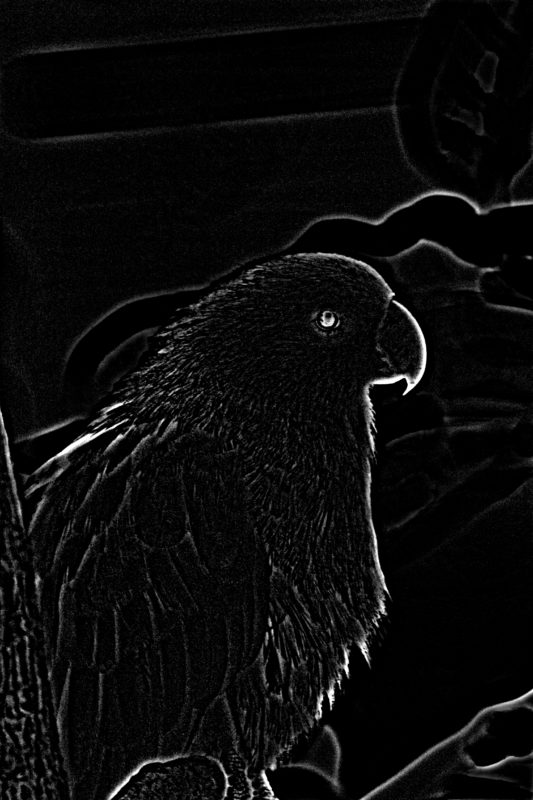
Kennedy has also explored how people perceive line drawing including people in cultures with no history of representational art (e.g. Amazon tribes.) He showed people line drawings of parrots, with lines indicating changes in hue (which looks really strange to American or European eyes because we rarely use lines to indicate color boundaries. ) Turns out they also look strange to the indigenous people of the Amazon who looked at these drawing and wanted to know why the parrot was chopped up into pieces.

dsc_1469


dsc_1469-copy


Here is an abstract of a recommendable book for those interested in the topic: https://tspace.library.utoronto.ca/handle/1807/948

Apparently then at least some of the rules of art are essentially universal, even in people with neither training nor any history of vision, and other rules clearly are nothing but conventions.


dsc_1376

dsc_1373

dsc_1367PS: Why flamingos? How would you possible describe the colors, shapes, movements of these birds to someone who cannot see? The richness in our visual environment is just beyond belief – and something I am deeply grateful for.

Imagery and the Blind

dsc_0143

How does someone who is congenitally blind experience the world? Spatial imagery, I claimed yesterday, is one way to go. But what about something purely visual, like color? Luckily we have testimony of the best kind, uninhibited, funny, explanatory. Made me feel grateful for the perceptual experiences I am still able to have.

http://www.tucsonweekly.com/TheRange/archives/2012/12/18/a-blind-man-describes-his-understanding-of-color

dsc_0091

For color today I picked photographs from the Fairchild Botanical Garden near Miami, FL. Chihuli’s glass creations had transformed an already magical place into something otherworldly when I visited 2 years ago.

dsc_0089

dsc_0072-2

dsc_0261

Spatial imagery

dsc_0031-copy

Yesterday we discussed the link between autobiographical memory and visual imagery.  What, though, if you don’t have any skills for visualization?  We have known since the 1880s that there are individuals who look at you as if you’re crazy if you ask them to describe the pictures in their heads. William James considered that  “thought stuff,” as he called it, might consist in some people not so much of visual imagery as of imagery of other modes, especially the “verbal images” of inner speech. Galton did numerous experiments (not all of them replicable) that intended to show that scientists lacked visual imagery – this is too much of a generalization, but it turns out, indeed, that there are about 2% of the general population who cannot visualize images. For them the request to describe what they “see” with their minds’ eye is like asking you is March 19 black, orange or white. And there are higher proportions of scientists who excel at spatialization.

These days they call it Aphantasia and treat it as if it were a new discovery – http://www.nytimes.com/2015/06/23/science/aphantasia-minds-eye-blind.html

img_6614

People without visual imagery are functioning perfectly well in the world, because there are alternatives, whether James’ inner speech or more commonly spatialization. When they are asked to think about an event while we scan their brain it is not the visual cortex that gets activated but the parietal areas of the brain that are in charge of spatial orientation. The congenitally blind  without a history of form vision are able to represent spatial relationships in dream experience without either visual imagery or compensatory imagery in other modalities. In other words, their dreams reflect the way they experience the world, in spatial, not visual terms.

dsc_0037-copy


Mental imagery

img_6513-copy

This week I am exploring our capacity for mental imagery (or the absence thereof.) I’ve done some research on the topic 100 years or so ago while still active as an experimental psychologist. I am approaching it here, though, with the starting question, why is everyone, and I mean EVERYONE, not just artists, taking photographs? All the time?

img_6426-copy

There are numerous potential answers to this question: People like to show what they are up to, people like to document what others are up to. Most importantly, though, I believe, photographs work as an aide-mémoire, they are helping you to review and re-live and re-enjoy your life. The fact that the visual testimony brings back memories so effectively for most people is based on the fact that remembering our own lives really does resemble running some sort of internal Netflix movie for the majority of rememberers.

img_6232

Should really say – it is my photos, they don’t let me forget anything – except, of course, they let you forget all that wasn’t captured, because you so focus on the content of the image….

We now have solid documentation that people who claim to have really crisp, clear, rich mental or visual imagery also seem to have more detailed memories for their lives. And if I ask you to remember your life while I scan your brain, it is the visual cortex that lights up in activity patterns.

True for all of us? Not really! Stay tuned for tomorrow’s discussion of this fact. In the meantime, relive you vacation with the photo album…

img_6177-version-2

Here is a (somewhat outdated but thorough) review article on mental imagery for those who are interested in the topic:

http://plato.stanford.edu/entries/mental-imagery/

Doping

DSC_1305 copyI will leave most of the writing to the experts today. The link below is an interesting discussion of why we are passionate about sports. It also talks, briefly, about why doping has become such an issue, tied to the financial rewards that are governing excess competition these days.

http://www.3quarksdaily.com/3quarksdaily/2016/01/is-there-too-much-competition-in-sport-.html

I am less interested in doping in sports – despite the interesting political ramifications – and more interested in the equivalent in the academic realm: neuro-enhancers. It has been an ongoing controversy since the first discussion appeared in Nature in 2008. The authors argued that taking certain drugs or stimulating the brains in other ways to enhance cognitive performance might not be something to be afraid of. (Note they did not necessarily recommend it.)

Drugs are already a large part of the competition in the intellectual work, not just colleges and grad schools, but the workplace as well. From the article below:

“Off-label use is already a problem. Amphetamine and dextroamphetamine (Adderall) and methylphenidate (Ritalin) are drugs prescribed to millions of Americans to treat attention deficit disorder (ADD) or attention-deficit/hyperactivity disorder (ADHD). They are also widely used on college and high school campuses as “study drugs” to help students without an ADD or ADHD diagnosis fight off sleep and focus better on their work. A survey in 2008 showed that four percent of 1,800 randomly surveyed students at a large public university had prescriptions for Adderall or Ritalin; another 34 percent of the students (including more than half of the juniors and seniors) had used the drugs without a prescription, almost all of whom said they took it to help them study.Yet we have few, if any, good studies of the safety and efficacy of these drugs when students use them without a prescription to try to improve their educations (or at least their grades).” This was 5 years ago – it has only gotten worse.

http://www.dana.org/Cerebrum/2010/Enhancing_Brains__What_Are_We_Afraid_Of_/

Greeley’s arguments are worth a read in order to be informed about the debate of something that will develop in our lifetimes – and it is up to us to promote it or fight it as we see fit.

IMG_4027 copy 3

Portland Photography Forum

I was asked to put the text below up for folks who could not attend the meeting where it was presented. These were introductory remarks on a session concerned with the emotional core of photographers’ work, which I moderated.

IMG_5540 acopy

Self Portrait 2015

PPF August 2016

“Thanks for inviting me back here tonight. When Mike called me to ask if I was interested in moderating a session on the emotional core of our work I jumped at the opportunity. Not as a psychologist, not as someone with formal training in photography – as you all know by now, hopefully, I have none – but as a fellow photographer/montage maker.

Many of us share a question we are asking ourselves in this era of ubiquitous photography: how can we capture something that is distinctive? For me the answer has been: try less to look with the head and more to look with the heart.   This is a) not easy to admit and b) not easy to do for me.

Not easy to do for me because the rest of my life is spent so head driven, in research and writing. Not easy to admit because of gender stereotypes and the permanent fear to be labeled as a softie if you go for feelings rather than thoughts. That is true for women, who try to get away from the traditional labels; it is also true for men, who are rather conditioned not to talk about feelings in public or admit how they influence the work.

However, when I look at people’s output as well as my own, those images that were emotionally driven – regardless of kind of emotion – really stand out.

I am neither talking about capturing an emotion in the photo – that is one of the hardest things to do – or about communicating an emotion with your photo – almost as hard. I am talking about your own internal state when you are approaching a subject. Being really sad, or really angry or really excited or full of awe will leave its imprint on your work. Now luckily we are not in the extremes of those states all the time – that would be entirely too exhausting. But we can choose subjects that elicit some of these emotions in small quantities.

Travel provides occasions for surprise and wonder. I know that at least two of tonight’s presenters are avid travelers and sailors, and their work captures some of   those elements. I do not understand the disdain some people express when they talk about “travel photography” – yes, it’s easier to be excited about the novel landscapes of a foreign country than your umpteenth walk in Tryon Creek, but so what? That element of excitement transfers into the pictures you take, and your fresh look provides delight for the viewer.

You should be justly proud, though, when you manage to find new views in the familiar. The emotion I experience when indeed walking on Sauvie Island for the thousands’ time is one of such familiarity and attachment to one of my favorite places on earth that I feel almost as part of the landscape. And to document subtle aspects of change feels like an accomplishment. One of our presenters will show photographs of scenes we all know – and yet has a completely personal take on it.

One way to help the heart kind of view rather than the head kind of view is to deeply care about the subject you are capturing. Whether you are documenting the landscapes that are still pristine and fill you with joy, or you document the decay that comes with the state our country is in and that fills you with worry – it will translate into your photographs. I think street photography is often striking because no matter how often you walk and take pictures of the people out there, their fate still moves you. If only towards feelings of guilt….. Portraiture invites a human connection, good portraits certainly are echoes of feelings. Even documentary photography can be driven by emotion in the choice of what you depict, to make a point of the larger issue you are trying to describe. Whether you are an environmentalist or involved with the homeless or proud to depict members of our military or trying to fight racism – the emotional core of your photography will reflect your engagement. I remember the Carrie Mae Weems exhibit at the Art Museum years back, for example – particularly her series “From here I saw what happened and I cried.” Just as photography has been historically used to create identity in the framework of existing power structures, it can question and reshape the way we see the world and the role race plays in it – and Weems images and text did just that.

Are you familiar with the literary critic David Lehman? He wrote in 1991, “There are no truths, only rival interpretations.” (Sign of the Times.) What is applicable for literature is surely true for photography as well, if not more so. There are at least three possible perspectives involved in a photograph: what the photographer sees and tries to capture; what the photographer believes others see and his/her attempt at communicating that; and what the viewer sees in the photograph. A single photograph, then, is subject to multiple interpretations which can vary enormously given the lack of context specificity or other surrounding information.

If that is so, why do we worry? Would it not be best to focus on our own experience while taking a picture, our own relation to the subject, our own struggle with how to shape the scene, rather than “what makes a distinct picture?” I try to derive joy from the activity rather than the outcome. (You might – justly so – argue that I am less burdened than you are: as a hunter/gatherer of materials for montages I do no need the perfect shot – it all gets manipulated anyways. Yes and no. The question of what makes a good montage is similar to what makes a good photograph – does it contain elements that are truly my vision? Does it carry at least traces of what I intend to communicate? Does a narrative emerge in the series? I was, for example, commissioned by the North Coast Chorale in Astoria this spring to do a cycle of 13 montages about war for a musical piece that they were performing – a Mass for Peace called The armed man by Carl Jenkins. I was so fried from the thoughts AND emotions going into the visions of death and destruction that I have not been able to start new work since the performance in April.)

And talking about communication: let’s applaud the courage of today’s presenters to talk about what moves them – that is not easy. When we talk about something so personal as feelings we make ourselves easily vulnerable. That is why it happens so little in public arenas and is confined to the personal safe spaces.

In psychology, talking about emotions has always been a topic associated with the Freudian model of a steam engine – suppress feelings too long, and there’s going to be an explosion. People went so far to assume you could give yourself diseases like cancer, by bottling up. That concept has been thoroughly debunked by modern psychology. (A wonderful little book on this is Susan Sontag’s Illness as a Metaphor.)

In fact that kind of victim blaming has been replaced by the data that show if you underwent a traumatic experience it is healthiest to talk about it once and then not again so as not to relive and cement the memory traces, which would strengthen the tendency for flash backs.

But we are not concerned with trauma here. We are interested in learning to talk about our approach to photography, feelings and all, to help viewers understand our work, and give us feedback that makes a difference.

Daniel Josephsohn, a well known contemporary German photographer, died last week. In his obituary someone wrote: “He saw, where others were simply looking.”

I would wholeheartedly argue the same is true for Alan, Ron and Sam tonight: they bring in work that is evocative and perceptive, rather than pure documentation.


Let’s have them show it!”


Expert Advice

· The experiencing vs the remembering self ·

I’ll make up for yesterday’s overly long rumination by a short suggestion: listen to the master about some amazing traps for your thinking – and how to avoid them. It’s a 15 minute or so TED talk.

https://www.ted.com/talks/daniel_kahneman_the_riddle_of_experience_vs_memory?language=en#t-84198


My own recommendation today (regarding politics…): don’t do this:IMG_2706 copy

Do this instead: IMG_2706 copy 2

If you do you are this:

IMG_4254

If you don’t we’ll all end up here:

DSC_0020

A Mind Divided

IMG_0392

You’ll agree: the process of thinking is complicated. And now you want me to describe it in 400 words or less?

Bare bones, then, the basics. There are two types of thinking at our disposal. A quick, efficient, economic one, called Type I, that uses shortcuts. Type II, on the other hand, is slow, deliberate, effortful. Type I shortcuts are called heuristics, strategies that  save you time and usually lead to a correct outcome. Emphasis on usually – they are error prone in comparison to Type II thinking, which rewards your investment with overall accuracy.

We could not function in daily life without Type I, even though it can lead us astray. Malcolm Gladwell, in his book Blink, made that point forcefully, although he stretched his enthusiasm a bit too far for my taste. But clearly, intuitive quick judgments can lead to life saving results if you look at expert firefighters or pediatric nurses in the ER, and for most of us it is good enough – until it isn’t.

We can be drawn into errors by relying too much on knowledge that is available – because we have encountered it frequently, or because something is vivid, or because we have heard it from a trusted source, even if that knowledge is not applicable. We are also prone to reason mistakenly from single incidents to whole categories (smoking can’t be bad – my aunt smoked a pack a day and lived to age 99….) and vice versa, from stereotypes to individuals (Germans are punctual, obedient, bad cooks – must be true for Heuer.) (You lucked out on two out of three.) Relying on examples rather than statistics is so much easier, when you are short on time and/or distracted!

We can voluntarily shift between these dual modes of thinking but Type II needs the right cues and circumstances. If you MUST make a quick decision, it won’t work; if you have time and the outcome matters a lot, it will be your choice in order to avoid dangerous error. And in general we all do better when presented with frequencies (12 out of 1000 people will get the flu without vaccination) vs. “1.2 % will” or “the probability is .012.” Presenting problems in the right way then really helps people to be better thinkers.

IMG_6281Finally, we have a tendency to seek confirmation for our beliefs – confirmation bias – instead of looking for evidence that might challenge them; we also cling to our beliefs – belief perseverance – even if disconfirming evidence is in front of our very eyes.

A good example would be conspiracy theories: the government is accused of having orchestrated a mass shooting in a night club. (Have you seen how much of that is actually floating around on the web after Orlando?) If the government denies this, you can judge that as clever manipulation to hide something. If the government admits to involvement (fat chance) you have your confirmation. If the government is remaining silent you can keep your belief that this is an attempt to keep the secret. In all cases, your belief was not threatened. Think about that!

I knew it – I blew my word count.IMG_1772