Browsing Category

Psychology

Licentious Lines

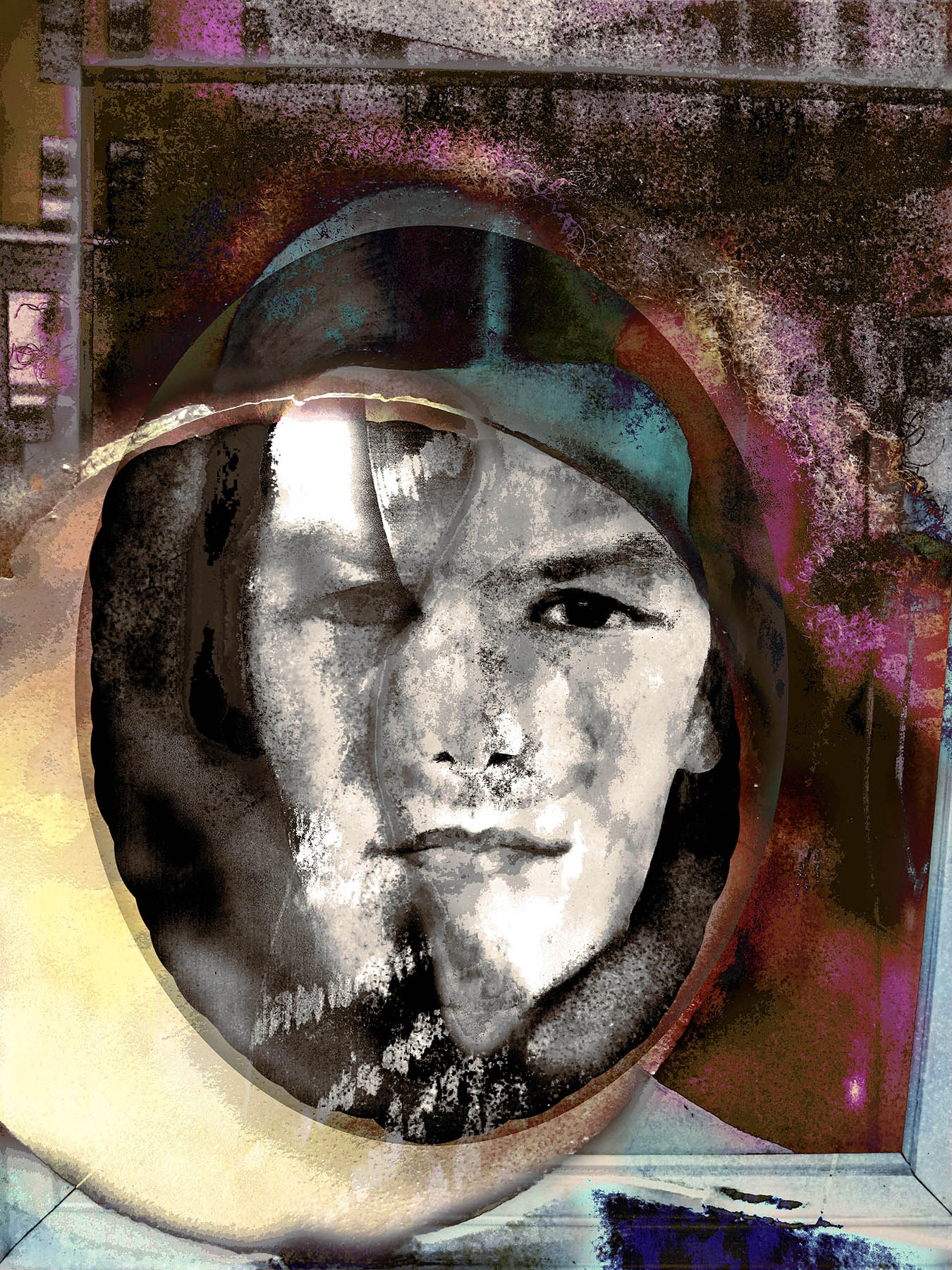
One of the definition of licentious is disregarding accepted rules or conventions, especially in grammar or literary style. The artist I am introducing today extends that disregard to the conventions of portraiture with a distinct line-based approach.

Agnes Grochulska, a Polish painter who now lives in Richmond, Virginia, works with oils but also has a very strong background in charcoal and graphite drawing, and what appears to me, calligraphy.

Constructing portraits with lines is, of course, nothing new. Egon Schiele comes to mind, Mike Parr, Robert Marks closer to home; all configured faces in ingenious ways. Grochulska can be placed in that tradition in her depictions of sitters with calligraphic lines.

Her new work, though, adds some excitement with the addition of lines that do not delineate the portrait itself, but instead frame it.

Portrait with a blue outline #2

You might remember that I devoted a week of blogs on face perception and recognition in February 2017, wearing my psychologist hat at the time. I talked about how we perceive faces holistically, not by attending to individual features. It is the relationships between features that count – the spacing of the eyes relative to the length of the nose and so on – which allow us to construct a whole that leads to recognition. I also mentioned that expectation guides your attention and your ability to interpret or parse a scene.  Importantly, for visual inputs you can only see detail that is landing on your foveas; what lands on your foveas depends on where exactly you’re pointing your eyes; and movements of the eyes (pointing them first here and then there) turn out to be relatively slow. As a result, knowledge about where to look has an immense impact on what you’ll be able to see.

Portrait with Sea Glass Blue Outline

What Grochulska is doing is essentially grabbing our attention with added features – the contrasting and illuminating lines that divide rather than define the portrait – leading us to foveate on those and registering them as features, pulling us away from more holistic processing. We might swing back to the face, try to glimpse its emotional valence, or other associations it triggers, but the magnetism of the lines is strong, we will return to them. For me it resulted in a sense of scanning (although some of these paintings are rather small,) an action often associated with a more evaluative type of perception, looking someone over. It sure triggered my curiosity that I was able to be manipulated that way. It also served as a strong reminder that we should be wary of being caught by salient details, when really what is required is a look at the “whole” picture.

Red Specs

Add to that a more positive reaction: joy. The use of color, in its expressive, declarative form in those frames suggests abandon, a painter not holding back. No wonder people cite Oscar Wilde in connection with reviews of Grochulska’s work: “Every portrait that is painted with feeling is a portrait of the artist, not the sitter”.

Here are additional examples of the Outline Series. I very much hope there will be a time when one can see these paintings in their original form, not just on screen.

Montages today of divided fields of perception:

Music today is by another artist from Poland, who also picked apart lines, and whose work was called bizarre but totally arresting – something one might apply to the paintings as well. Penderecki died this March.

Purpose

“Hat man sein warum des Lebens, so verträgt man sich fast mit jedem wie” “If we have our own why in life, we shall get along with almost any how.”  Friedrich Nietzsche, Twilight of the Idols, “Maxims and Arrows,” §12. 

Less than a year after he was liberated from Auschwitz where his mother was killed, having lost his father at the concentration camp Theresienstadt already and his wife at Bergen-Belsen, psychologist Victor Frankl gave a series of public lectures in Vienna. He discussed his ideas about meaning, resilience, and the importance of embracing life even in the face of great adversity, paraphrasing the Nietzsche quote above as: “Whoever has a why to live can bear almost any how.”  The lectures are now published in English, Yes to Life. In Spite of Everything, as a companion to his famous book Man’s Search for Meaning.

Here is the foreword to the new book, written by psychologist and emotional intelligence researcher Daniel Goleman, who provides a succinct and moving introduction to Frankl’s work.

Frankl eventually developed a psychotherapeutic approach, Logotherapy, often called the third Vienna School, Freud and Adler being the first giants in this trio, that tried to help patients find meaning. He was convinced that the search for meaning is our primary impulse as humans, and that those who could maintain a purpose in life would have a better chance at survival, as observed during his time in the camps.

Independent of whether I agree with these beliefs or not, I do find two thoughts derived from Frankl very helpful. One ist the fact that crisis always contains opportunity. It might not feel that way in the moment, but it can be extracted over time. The second insight was about what exactly can provide meaning or purpose – you need not reinvent the wheel, save a nation singlehandedly, or win the Nobel Prize.

In the linked interview below (ignore the inane title, self- actualization is discussed in a different context) he offers options to find purpose. To fill the void, a void that can be described as apathy, lack of interest, boredom, emptiness, or ultimately despair, we can latch onto one or more of three values: creative values, experiential values and attitudinal values. The first one refers to finding purpose through doing your work, creating something. Contributing your part, whether you clean the streets or improve pharmacological research, is the key.

The second relates to experiencing beauty, or truth or good, giving value to the world that surrounds you, relates to you. You do not have to achieve or accomplish something – value can be found in appreciation of something, whether nature or art. More importantly, we can experience another human being by loving, focussing on their uniqueness, their essence and their potential, and being loved in return.

The third points to your choice of attitude. If you have lost the capacity to do your work and there is no room for experiencing something positive, you have a choice how you react to suffering or tragedy. It is about who you are rather than what you possess, and what attitudinal approach you choose from a multitude of options. Your bend towards courage, dignity and determination can provide purpose.

I would not bring these thoughts to a person who is in the middle of an existential crisis – it would be patronizing at best and cruel at worst. But I hold these thoughts up to those of us who are affected in less life-threatening ways, reminding us that there is the choice of courage and dignity, even if we are unable to provide solace through action.

Music today was composed by Victor Ullman who was killed in Asuchwitz two days after his arrival in October 1944, after having been interned in Theresienstadt before where he continued to devote himself to create music.

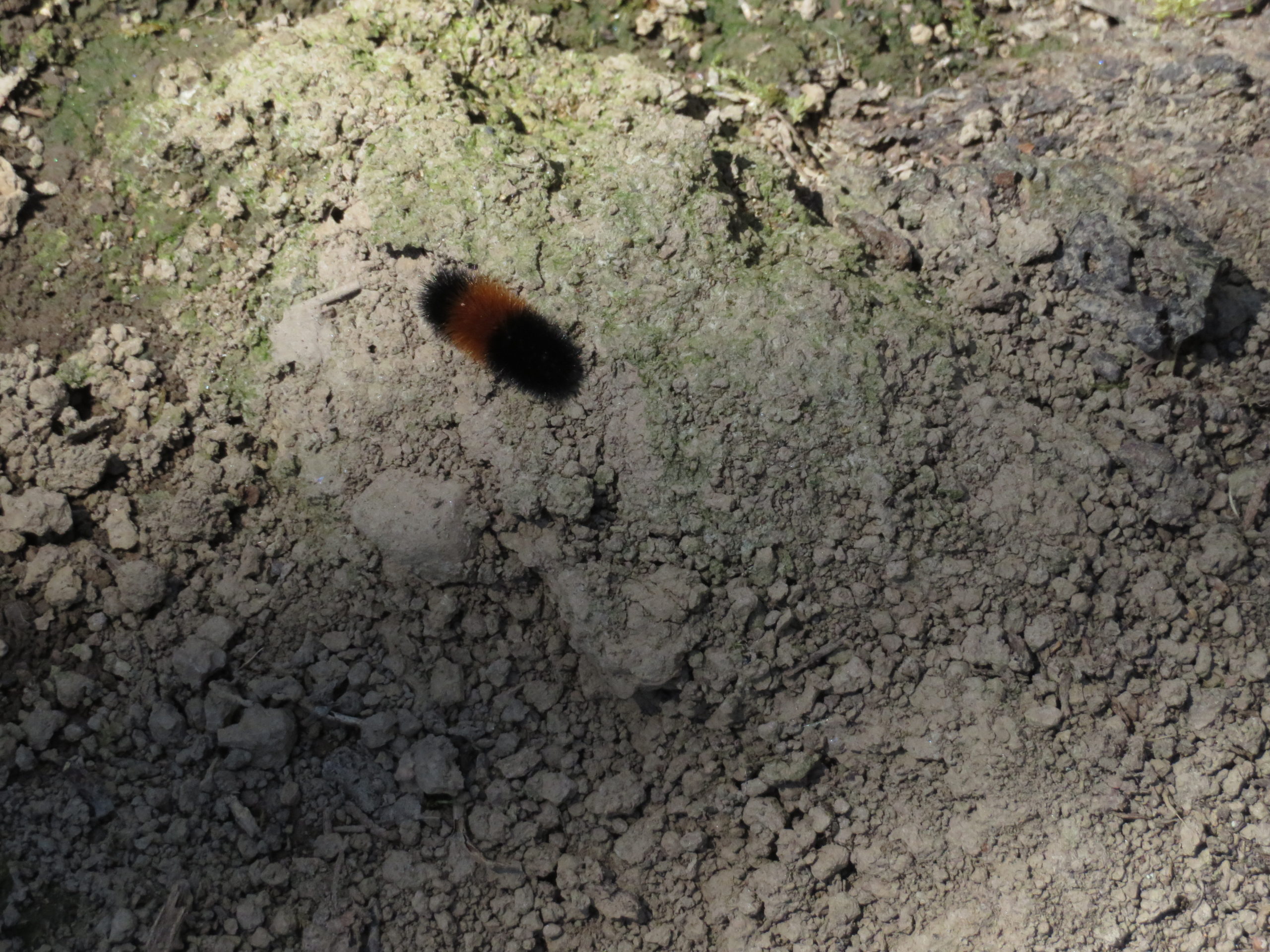
Photographs provide experiential value from the beauty of yesterday’s visitor to my butterfly bush.

Coping Strategies

“The world is violent and mercurial–it will have its way with you. We are saved only by love–love for each other and the love that we pour into the art we feel compelled to share: being a parent; being a writer; being a painter; being a friend. We live in a perpetually burning building, and what we must save from it, all the time, is love.”

Interview with Tennessee Williams – Conducted by James Grissom, New Orleans,1982.

The love of a parent is really the only thing you have to offer when your child is hurt and changed by this mercurial world. Whether it will do any good is up for grabs. Right now our helplessness dominates, with the inability to douse the flames of pain and forced adjustment in this burning building, two weeks post accident, 10 days of ICU and four operations later, now in the general section of the Trauma hospital.

But love is what we have, we offer, we preserve through these foggy times. And I will try and post this week short reminders of the fact that trauma can befall us all and that many people have successfully overcome it, adjusting to new realities, honestly an effort to persuade myself. Or I will choose something that simply inspires, to lift the spirit. Photographs will be from my walks, the one constant in my life, depicting the beauty of nature that is harshly indifferent to grief, and yet nourishing in its own way.

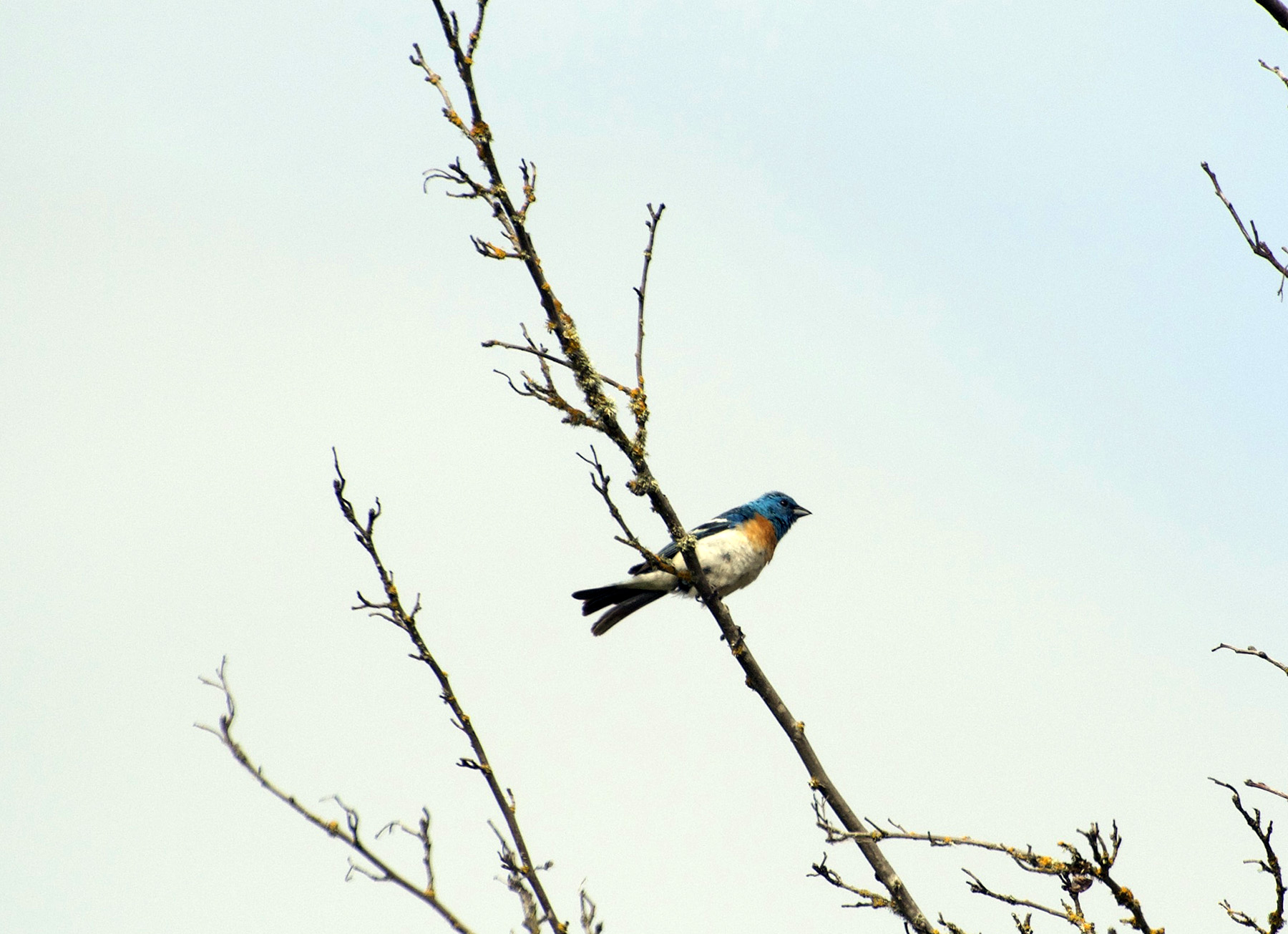
I’ll start with a bird that I had never seen before and now encountered several times – a Lazuli Bunting – whose cheerful coloration and sweet song are the opposite of everything that’s going on right now, and therefor to be tucked away in a small corner of my soul.

Of anchors and dragonflies

We are wired to flit.” This sentence anchored my attention for the microsecond that goes for my attention span these days. The sentence linked to an article about 5th century Saint John Cassian, who complained that the mind… “‘wanders around like it were drunk’,” an amusing and learned essay about medieval monks’ speculations, theories and practical advice to harness attention.

I had been spending an unexpected free hour last Friday sitting at the corner of a pond, observing dragon flies. Big blue ones that never sat still, and smaller red ones that lit on little sticks poking out of the water, frequently taking off and immediately returning again in no predictable pattern. I felt my mind was working in parallel with these creatures, constantly in motion, occasionally resting on a topic, soon off wandering again, flitting, indeed.

I jumped on the opportunity, then, when yesterday’s essay by John Dickerson on focus and good use of time caught my eye in The Atlanctic. It is a pensive piece on the restlessness associated with our current loss of daily structure, and the inability to ward off intrusions that result from our need to follow the news, feel connected through the electronic media and satisfy our craving for distraction. I was taken by the sentence I cited to open today’s blog.

So far so good, in fact I am often engaged by Dickerson’s approach to thinking and writing, as much as one can judge from irregular reading of his essays in cultural magazines. But then I dug a bit deeper into the tool kit he proposed to anchor our flitting ways. He was quite charmed by a method he had received from Marshall Goldsmith, leading executive coach to the nations’ and international big wigs in banking and industry.

Make a spread sheet, with questions on the left, daily answers on the right, weekly averages. Answers can be in binary form, 1=yes met the goal, 0=nope, or devise scales. Questions can be as simple as “Did I make time to weed the garden” or as general as “have I made myself or someone else happy…” The questions, according to Dickerson, are to be about behaviors, not necessarily outcomes. In theory reviewing these every night forms habits, let’s you see where you are strong or weak in spots, and as daily reminders on your desktop serve as rescue signal when you are once again drawn for too many minutes into Twitter….

Of course the mention of “America’s leading coach” had me look up his website, where you can find his version of the spread sheet for free. If you are interested in spending time on 32 questions everyday which delve, among others, into weight management and flossing, consumption of sweets and duration of TV time – outcome oriented, mind you – then this is the way to go for you. If you are capable of paying someone every day to call you and have you read the list to them to be held accountable (our willpower, after all, is lacking as the monks in the year 420 already knew), then this is your path to salvation. Well, that might be wishful thinking. Let’s say, it might be the path to answering all your emails and cleaning the kitchen. Who knows.

For me the whole exercise, perhaps with the exception of the “what have I done for others” bit, is way too focussed on Self. The craving for improvement. The desire for performance. The yearning for predictability. The return to what we once took for “normal.” It is also a token of our privilege. You think someone out of work, living at the edge, out in the streets protesting for BLM has the need, or even someone just devoted to helping defend those who are arrested, or someone buying the groceries for at-risk group neighbors after work has the time and energy to record and discuss 32 item of personal accomplishments each day?

I am currently easily distracted. Yes, it’s hard to write long, thoughtful pieces these days. Pretending that it is a sign of personal messiness, of lack of will, surmountable with the right bag of tricks, ignores and defies our being in a world that itself is stretched thin. This world and I are linked, its and my brittleness needs acknowledging, rather than papering over with pretend improvement. When politics and pandemics defy our norms, my own cannot pretend to be untouched.

Besides, I hate to floss.

Photographs are of dragonflies from the Eastcoast last fall, and the red ones from here last week.

Music has to be Chopin’s Preludes Op. 28 – Nr. 11 is titled the Dragonfly – and the pianist’s dress might as well be borrowed from one, sized XXXL.

Nothing is fixed

Feeling demoralized? Acknowledge it.

Sad? Allow it.

Worried? Accept it.

These emotional reactions have a function, just as positive thinking does. They connect you to others, help you to be alert and prepare you to find protective measures. For a full treatment of emotion regulation, ways in which we manage our feelings if they interfere with daily functioning, I recommend a book by Stanford psychologist James Gross that explores every facet of the process. And since we’re at it, I have also written on the way emotions affect memory, most recently, as of this April, here.

On days when negative feelings approach the level of despair, however, turn to James Baldwin. In his 1964 monograph, Nothing Personal, in response to the Harlem Riots where a Black kid was shot by a White police officer and co-authored with his friend, photographer Richard Avedon who provided portraits, he manages to infuse us with a sense of obligation to live and act and stop despairing. (A detailed review of the edited reprint, (insanely expensive, alas,) here.)

The essay begins with a sly criticism of American advertisement, (sort of ironical when you consider that his collaborator on this book, Avedon, was the most influential fashion photographer of the post-war times) but then turns to the darker issues of being a minority in the United States.

We have all heard the bit about what a pity it was that Plymouth Rock didn’t land on the Pilgrims instead of the other way around. I have never found this remark very funny. It seems wistful and vindictive to me, containing, furthermore, a very bitter truth. The inertness of that rock meant death for the Indians, enslavement for the blacks, and spiritual disaster for those homeless Europeans who now call themselves Americans and who have never been able to resolve their relationship either to the continent they fled or to the continent they conquered. Leaving aside-as we, mostly, imagine our- selves to be able to do-those people to whom we quaintly refer as minorities, who, without the most tremendous coercion, coercion indistinguishable from despair, would ever have crossed the frightening ocean to come to this desolate place?”

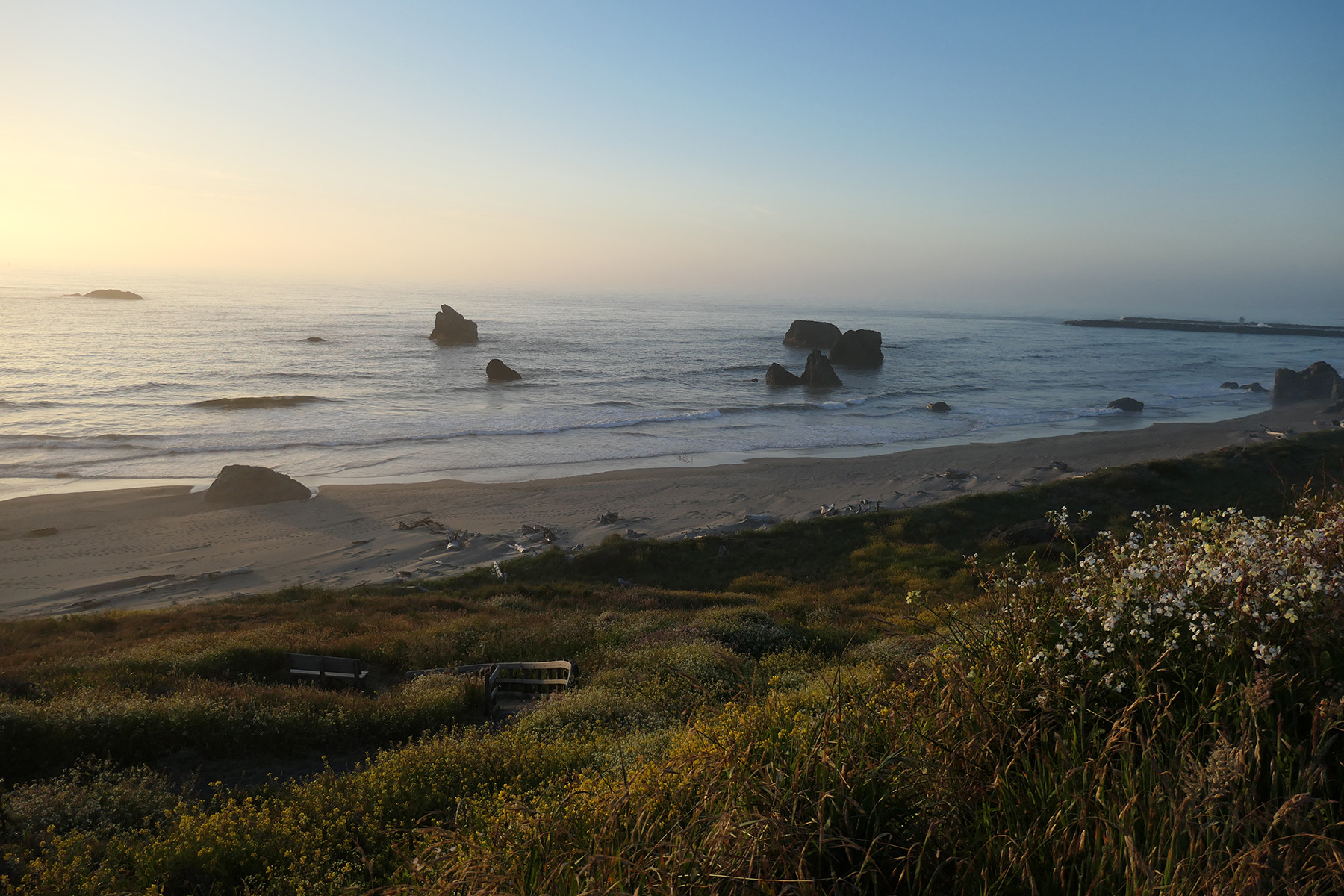
(Photographs today thus of rocks, in grinding sea.)

After describing multiple causes for despair, Baldwin eventually turns to an emphatic call for hope and persistence in dark hours.

One discovers the light in the darkness, that is what darkness is for; but everything in our lives depends on how we bear the light. It is necessary, while in darkness, to know that there is a light somewhere, to know that in oneself, waiting to be found, there is a light. What the light reveals is danger, and what it demands is faith.”

———

For nothing is fixed, forever and forever and forever, it is not fixed (emphasis mine;) the earth is always shifting, the light is always changing, the sea does not cease to grind down rock. Generations do not cease to be born, and we are responsible to them because we are the only witnesses they have.

The sea rises, the light fails, lovers cling to each other, and children cling to us. The moment we cease to hold each other, the moment we break faith with one another, the sea engulfs us and the light goes out.”

Full text of the essay (print it and keep it on your night stand for dark hours!) here.

We might not be able to hold each other physically right now, but the idea is of course at its root one of mutual support and reciprocal solidarity with each other. We can be the light for others, even in hours where things get pretty dark within our own soul. Be a light for someone else, it’ll reflect back, I’ll guarantee it, just as I concur with the claim that nothing is fixed. Ever. We simply need to adjust our time horizons.

Smith’s lyrics for Long Old Road are cited in the essay. Here is the music.

LONG OLD ROAD Bessie Smith 1931 Bessie Smith rec June 11th 1931 New York

It’s a long old road, but I’m gonna find the end, It’s a long old road, but I’m gonna find the end, And when I get there, I’m gonna shake hands with a friend.

On the side of the road,I sat underneath a tree, On the side of the road,I sat underneath a tree, Nobody knows a thought that came over me.

Weepin’ and cryin’, tears fallin’on the ground, Weepin’ and cryin’, tears fallin’on the ground, When I got to the end, I was so worried down.

Picked up my bag, baby, and I tried again, Picked up my bag, baby, and I tried again, I got to make it, I’ve got to find the end!

You can’t trust nobody, you might as well be alone, You can’t trust nobody, you might as well be alone, Found my long lost friend, and I might as well stayed at home!

And here is a full album.

The Will to Disobey

“Vorsicht, Kindchen, Vorsicht!” (Careful, kiddo, careful…) was a constant refrain in the household of my childhood, outnumbering even the “Straighten your back!” and “Darling, would you fetch me my cigarettes….”invocations.

Vorsicht – care, caution, precaution, restraint – built an invisible fence around a child’s desire and need to explore, to risk. For my war-traumatized parents, danger (understandably) lurked in shadows and around every imaginable corner. “Don’t jump off that swing, don’t race your bike, don’t hitchhike, don’t spend time to travel abroad instead of proceeding straight to your clerkship,” the variations were endless. Physical danger, psychological danger, danger to the vision of an unencumbered life in a straight line from school to university to career to marriage to happily ever after. Anticipatory fear was literally a cloud forming a cage.

Steep Creek Falls

Except that we escaped through the invisible bars, at every possible turn, skimmed knees, black&blues, twisted ankles, tropical diseases be damned. I never felt more alive than when climbing prohibited trees as a kid, when sleeping rough on the beaches of Morocco in the early 70s, or hunting for orchids in the temperate rainforests of Venezuela. In fact, lovingly imposed constraint continually incited the opposite: a yearning for risk taking, a struggle with conformity, a will to disobey.

Alaskan Bunch Berries
Anemones
Bead Lilies
Avalanche Lilies
AvalancheLilies
Wind Flowers
Bear Grass

All this is on my mind because in some miniature ways I still thrive on adventure, even when it is now limited to scrambling up and down a pile of rocks on an otherwise moderate, although insanely beautiful hike.

Luckily someone lend me gloves…
The top

No more solo hiking for me, like last year in New Mexico. Photographs today are from an outing last week where two kind souls invited me sight-unseen (regarding my physical condition) to explore with them a tiny slice of the Pacific Crest Trail (Rock Creek Pass). Am I ever grateful they took me with them – Charlie and Dennis, I owe you!

Wildflowers abounded, water rushed down the outcrops, lichen glowed in the diffuse light, snakes saw no reason to scurry away, rock wrens serenaded us and old growth forest calmed the soul along the way.

*

Risk taking, of course, also figures in the larger picture of deciding how to approach life while the country re-opens. We are no longer talking about thrill seeking, but a real and present danger to our lives, if we risk infection with Covid-19.

Any decision has to be based on an assessment of the probabilities of both the danger levels in situations we might seek out or avoid and our own specific vulnerabilities. Outside differs from inside, crowdedness differs from emptiness, duration of encounter with others is a huge factor, as is the presence or absence of masks. Your age and your health status has to be part of the equation.

Indian Paint Brush
Penstemon
Balsam Root (I think)

For me, there is also the question of why. It is not just going to be what am I doing, but why am I doing it? What are the reasons that justify for me to take risks? Do I go back to work, because I and my family could not survive otherwise? Am I truly needed for something, or am I too compliant to simply refuse? Am I staying away from the outside world because I let irrational fear rule me or because I legitimately cannot afford to risk infection? Is there such inherent meaning to be part of a community, or not being idle, that it justifies tolerating moderate risk at my work or the market place? Has fear become a mistress that we need to find the will to disobey?

Bleeding Hearts at the Bottum
Pioneer Violet
Arnika

The same is true for the larger question of risk and civic participation, when you decide the time has come to protest even in the face of radicalized police- and state action, perpetuation of historical injustice.

It is even a question when you contemplate actions often associated with protests, rioting and looting. Asking ourselves why people are doing that might provide surprising insights. One of the best explantations, both in content and rhetorical skill, that I have come across is in the attached short video. Note I have not linked to any other reading today, just so you have time to listen to a powerful voice. (Bonus: you will never play Monopoly again….)

And for music today one of the best choirs in the country with a familiar encouragement:We are not AFRAID today! Let that guide us, within reason.

Have you no Shame?

One of my favorite outbursts in my ongoing battle with the deer in my garden is: “Have you no shame?” Preferably yelling it loudly, as much as my grumpy lungs allow, or my consideration for my lovely neighbors who don’t need more of my screeching. Not that the deer react – they go on munching on my rose buds, my pink wild-geranium flowers, my columbines, their business – you name it.

Even in the wild, well, in the wilds of Tualatin, where they should be less accustomed to human/deer interaction they do not budge. Photographs from Monday’s walk are evidence that I could approach them to up to 2 meters with my small point&shoot camera. Then again, I did not yell, because I was happy to see them anywhere but in my stripped-down flowerbeds.


Much to know about deer, including the fact, among others, proclaimed by a science site: “The Chinese water deer is the only species that doesn’t shed its antlers, because it doesn’t have any.” Glad that could be added to the canon of irrelevant but funny bits in my brain.

Levantine Cave Painting Art, dated from the end of the Mesolithic Age and during the Neolithic Age at Valltorta-Gassulla Cultural Park in Spain near Valencia.

*

I’m actually more interested in talking about shame rather than deer today, since the absence of the former, whether among those cloven-hoofed ungulates or certain members of the political sphere, has significant consequences for our well-being. Thoughts about shame were triggered by a book review of a book by Ute Frevert, managing director of the Max Planck Institute for Human Development in Berlin, and director of its Center for the History of Emotions.

Lucas Cranach the Elder (1472-1553), Adam and Eve, (1526)

The Politics of Humiliation: A Modern History, now translated from the German by Adam Bresnahan, concerns the relationship between power and shame, shaming, or humiliation. Three areas of interest are used to explain the psychological mechanisms: shaming as punishment for individual transgression in the political, public sphere, humiliation online and in school, and foreign policy between countries. I look forward to reading about the history of how shaming developed across the centuries. “It is the story of the democratisation of the right to dignity and honor, which at different times were regarded as belonging only to the aristocracy and not to commoners, to adults and not to children, to men more than women, to a sovereign and not to a people. ” It is certainly interesting to think that not only the display rules of emotions differ between cultures, or genders, but that there were differences, across time, in who had a right to a particular feeling, or the power to induce it.

Attributed to JOHN FERNELEY JR. (British 1781-1860) The Stag Hunt


The ever looming memory of Nazi public shaming of women married to Jews, (or Norwegian public shaming of women in love with German soldiers) also raises questions about gendered approaches to shame: women often had their hair cut forcibly and in public, humiliation always directed at their bodies, in war (ancient and recent) often through the ultimate humiliation of rape.

Frida Kahlo The Wounded Deer (1946)

Found this stag on a hike on Mt. Hood near Paradise Meadow two years ago

As a cognitive psychologist I am of course most interested in how an emotion can be utilized to enact power or manipulate people, mechanisms spelled out in a 2018 interview with the author here. The distinction between shaming and humiliation is important. Shaming was always used as punishment for a norm-defying person to get them to repent and then back into the fold. Humiliation, on the other hand, has the goal to stigmatize the person and set them apart from the group. The state or political actors historically used these mechanisms, but nowadays on-line platforms have joined in, with body/fat-shaming just one example (which reminds me: I did NOT find Speaker Pelosi’s fat shaming of a certain monster appropriate, in fact it irritated me to no end. You can’t join the gutter.)

Here is the contradictory part: on the one hand we, as a society, value honor and respect (and rightfully decry its absence), but on the other hand we show increasing appetite for public humiliation, just look at all those reality shows. The psychological mechanisms seem to point to a gain in self esteem or sense of group membership when we berate and belittle others, openly and in front of everyone. If we are part of the group that is humiliating rather than humiliated, it gives us a sense of security and belonging, as well as power. And if we create specific out-groups through acts of humiliation we can utilize their status for our political purposes, directing and displacing anger at those victims. (Although seemingly, if we are paid enough, we are also willingly complying with a potential state of humiliation – just look at the lines of the casting show. Honor has a price, after all, as Frevert puts it.)


Franz Marc Crouching Deer (1911)

I think, well, I hope that knowing about the mechanisms of how humiliation works enables us to inoculate ourselves against related attempts to employ it as a tool, attempts surely to increase in the context of the election campaign. If humiliation thrives on having a public participate, it is up to us, the public, to refuse to be participants in the spectacle. We can turn away.

Now all I wish is for the deer to do the same.

Today you have a choice between Mozart’s The Hunt and Haydn’s (The Hunt) and Cesar Franck’s Accursed Hunter – maybe the latter felt some shame….


.

First you photograph, then you – forget

Over the weekend, I switched computers from old to new which brought me to the brink of a nervous breakdown. My old programs did no longer run, I had to order new ones in addition to the hardware, figure out changing configurations and face the fact that the forcibly purchased 2020 Photoshop – my toolbox for creating all of my art – did not look or act like the one I’ve been using for the last 8 years. Dropbox is still not working, even my computer whiz – husband is unable to change the ugly font of my mail program. You get the idea.

Neighborhood nature to the rescue, since my walks in state parks, in bird sanctuaries, all my usual haunts are now closed. I brought the camera and today’s photographs depict some scenes from the outing – my gratitude for my surroundings is boundless in these months. As is someone else’s.

*

Plenty of others had the same idea. But overall there was a quietude that was new, and plenty of occasions to watch little wrens, juncos, ravens, and song sparrows daring to be out in the open. First blossoms peeked out of the shrubbery, and the shows had lost their icy edge. The light was glorious, my soul got a good airing.

While I tried to capture some of the beauty, I thought back to a discussion we had last week at home (again). Is there a cost to taking all these pictures? What do we know about photography’s effects on memory? I mean millions of photos are taken everyday, posted on various sites, significant events in our lives recorded. Do we pay more attention to the scene we photograph (which would enhance memory) or less, because we are so preoccupied with getting the shot itself, or presenting a certain view of the world in our postings (which would hurt memory)?

Relatively recent research on this topic seems to indicate that memory suffers. If I have you go through a museum, for example, and ask you either to photograph (with the idea of posting the pictures later) or not, both groups enjoy the experience itself in similar ways. But a surprise memory test a week later reveals that the picture-taking group performs worse in how much and what they remember. People also lack parts of the experience that was non-visual – the sounds, things that were said around them – in their memory banks. This was true for both, controlled studies and those happening in a natural environment.

So, how do I think about that? If I have no recourse to my photos, and my memory is needed to answer questions (in the witness stand, for example,) yes, then it’s a problem. But the gain from sharing my view of the world is enormous, allowing others vicarious joy and experience, and deepen the post-event thoughts through talking about what I saw. In the usual case of being able to see my photos in my archives or an album, they bring back the experience as visual reminders, as faithfully if not more so than any spontaneous recall would. For longer, too, in many instances.

The memory issue, therefore, is not giving me sleepless nights. I am more concerned with what the ever-ready camera at hand does to the moment of the experience. Do you enjoy a walk in the woods if you snap pictures along the way? Are you open to the entirety of the experience, or distracted by a constant search for motive? Can stillness, provided or inspired by nature still happen when you are fiddling with gadgets? The answer, this Sunday, was a resounding YES! The picture taking was secondary, almost an afterthought, when I had delighted in some particular view. For many of the birds I didn’t even raise the camera so I would not frighten them away.

Peace prevailed, and trailed me home. Joy returned when uploading the photos, re-engaging with the forest views. Small blessings in difficult times.

Now if we were in Japan, we could stumble on our hike onto an almost half a mile-long construction, a xylophone that plays Bach’s Cantata 147 in the middle of the forest.

Closer to home, we can just hang out on the porch and listen to this, one of my repeats, I know, but I like to hear it often, for the slavic mix of joy and mourning.

First you see it, then you – think

It is an interesting challenge for the photographer to make do with what we can find in our suddenly severely limited environments. What can I depict, without resorting to my archives, something that is of interest, contains some beauty or has informational value?

How can I find newness when everyday I see the same things, retrace the same steps in my neighborhood? How can I be open to discoveries when my mind is churning with thoughts about the fate of this nation, the suffering of people across the world, the friends who are sick and irritation at my own body that is taking way too long to get back up to full speed?

And how will you, the reader, react to things taken out of context, things seemingly banal when stacked up against your own worries?

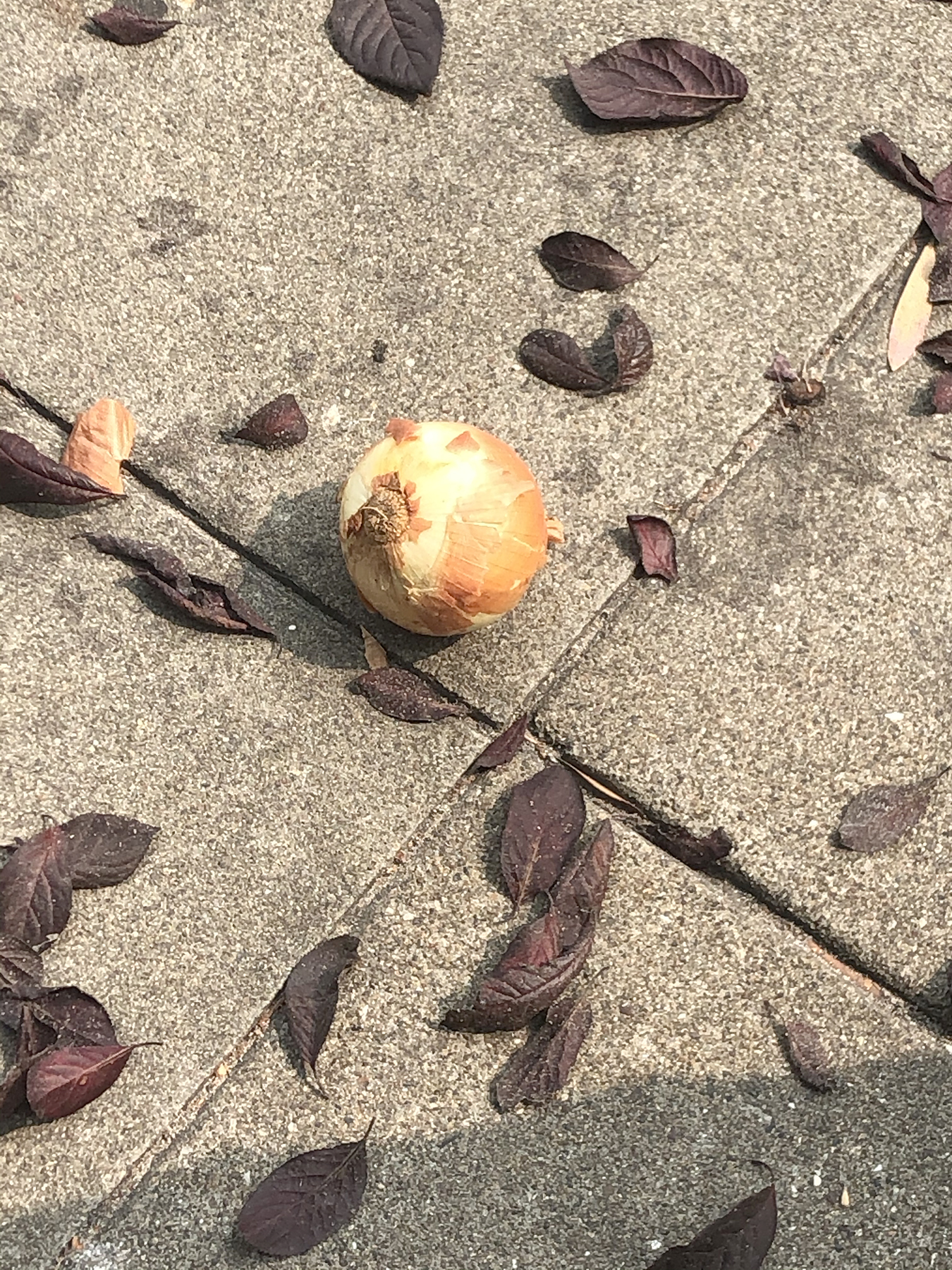
Well, as photographer, I simply do the best I can. Today’s pictures for example, were captured by iPhone just along the street where I live, seen simply because I was looking down, open to small patches of color and hiding my red eyes.

You, the viewer, have the thing to do that you always do when seeing something within a limited context: you try to to make sense of it. That should be easy when I tell you the topic is “found by the wayside.” It becomes more interesting, when the viewing stimulus is more complicated and I can manipulate what I’ll tell you about the context.

And just like that we are at the interesting part of today’s musings: a brand- new study about how people interpret “objective” video evidence, when I give them deliberately manipulated contextual information. What you “see” combined with what you “hear” leads to different reactions.

Simple design: I show you a video that depicts the exertion of force, (or not) enacted (or not) by a police officer who you can’t see clearly since the events were documented via a typical dash- camera (the ones now in use to help us discern whether applied force was excessive or not.) These videos are of real events, grainy, bad quality, no sound – exactly as they are when brought as evidence to court. In our experiment, depending on what group you are in, I tell you that the officer who acted was male or female, White or Black.

What are the results, when I ask you about what you saw and how you would evaluate that evidence? When officers used force, people trusted officers less and perceived them to be less effective relative to when they did not. Despite all participants viewing the same interaction, people who thought they saw a male (vs. female) officer perceived his use-of-force to be driven more by internal traits, such as being aggressive and emotionally reactive, and less by the external situation, a behavior pattern which was associated with decreased trust and perceived effectiveness. In contrast, people perceived female (vs. male) officers’ force to be driven more by external aspects of the dangerous situation, which was associated with increased trust and perceived effectiveness. For what it’s worth, there was no observed interaction with the presumed race of the officer.

I find this interesting – and hasten to add that this is a new finding, not yet replicated, and who knows if it will stand. For one, cops who use force are seen less positively than those who don’t. Female officers, however, were more respected than males, when they exerted force. Usually it is women who are seen as emotionally reactive and driven by internal motives, even when thought to be less aggressive than men. Their counter-stereotypical behavior here is interpreted in their favor – for once. If they acted out, it must have been in reaction to external factors, threatened violence against them or some such.

Independent of those findings, though, the interesting aspect is of course that seeing something with your own eyes can lead to strikingly different evaluations, depending on the contextual information provided by others that shapes your perception as a whole.

So what do you make of this?

In the absence of any further information?

While you think, I’ll provide music sent to me by a friend that made my day – I’ll give you context: Mozart. Magic Flute. Papageno…. followed by the conventional version.

https://www.youtube.com/watch?v=IMXD4h5w8D8

https://www.youtube.com/watch?v=87UE2GC5db0


Necropolitics

Honestly, I am not trying to add to all of our fears and sadness. I do think, however, that we need to face some substantive issues, if we want to learn from this crisis before the next one, climate catastrophe, hits on an incomparably larger scale than Covid 19.

This way: Justice

Therefore I decided to introduce a paradigm today that has been in my thoughts. Fascists in Germany revived a concept in the 1930s of “Thinning The Herd” which goes back to the 18th century belief that when the population exceeds resources government should use war, famine or widespread disease to thin the herd. Now why am I thinking of that?

To counterbalance the heaviness of the topic, photographs today are of chalk arrows that I found on Sunday’s walk in the neighborhood park. In my imagination they point to the goals we are all trying to reach. Should be trying. MUST try!

This way: Peace

Achille Mbembe is a distinguished Cameroonian historian and political philosopher, one of the most brilliant thinkers on the African continent as well as in the US – he holds dual appointments at Duke University and in South Africa. Among the honors he received for his work on social grievances, postcolonial politics and racist thought structures was the 2015 Geschwister Scholl prize (members of the resistance group the White Rose executed by Hitler) and the 2018 Ernst Bloch prize (a German philosopher known for his seminal work The Principle of Hope,) for his philosophy outlining the need for a more humane world.

This way: Solidarity

Mbembe has developed the concept of Necropolitics, the idea of the subjugation of life to the power of death in our contemporary world. In simple words: There are powers that get to decide who lives and who dies, using proximity of death as population control. Before we apply this to our current situation let’s acknowledge that not everything is about the virus. Instead, there are ubiquitous ways in which large populations have been politically and economically managed: people exposed to wars, genocide, refugee crises, prisons, in Syria or the Gaza strip, as well as those whose poverty and precarious living circumstances have been increased through political removal of safety nets, all are governed through direct or indirect proximity to death.

This way: Equity

The philosopher talks about new and unique forms of social existence in which vast populations are subjugated to conditions of life conferring upon them the status of “living-dead,” calling them death-worlds. They are governed by certain forms of economics, which withholds public goods and rights, making existence precarious. They are structured through confinement of precarious populations in certain spaces, most often in camp-form. Refugee-camps, prisons, ghettos, banlieues, suburbs, favelas, all serve as examples. Often these are policed or militarized spaces in which human beings are controlled and can be killed, “a permanent condition of living in pain.” Underlying these management structures is the key characteristic of those in power accepting (e.g. the refugee camps on the Greek Islands) if not actively pursuing (e.g. war in Syria) the possibility of death on a large scale.

This way: Bridge to Safety

We can find these kinds of politics not just in authoritarian, but also in democratic states, where the state confines, imprisons and persecutes certain populations. Not that violence is a state monopoly: when private groups in a society separate into those who arm themselves, and those who are not armed (militias vs citizens,) the idea of killings as something acceptable is normalized. The production of weapons, both for private use or in the context of expanding wars, is a source of economic revenue in these political systems. Exploiting natural resources for economic gain also tolerates that populations are endangered, displaced or eliminated, or future generations sacrificed (Amazon rain forest destruction, for example.)

This way: Anti-Racism

What moral justifications can possibly be given for the way human populations are treated by the powerful? Mbembe offers a catalogue of their excuses, such as the eradication of corruption, different types of “therapeutic liturgy”, “the desire for sacrifice”, “messianic eschatologies”, and, importantly, “modern discourses of utilitarianism, materialism, and consumerism.” The underlying causal mechanism for necropolitics to be performed and expanded in a given society, allowing for exploitation and natural elimination of poor or powerless populations? Racism, both in its institutional and private forms. It’s beyond my scope here to go into detail – here is his book. (And here is the article that I relied on heavily for the summary of the concept.) Eye-openers.

This way: Environmental Protection

*

Back to Covid 19. Doctors and first responders who have to make utilitarian decisions about who gets to live and who will die are not to be faulted in this crisis. Younger lives are weighed against older one, existing conditions against healthy bodies, parenthood against singles, how else can you justify distribution of scarce resources. There are, however, whole governments who have also made utilitarian decisions – this time to benefit individuals (keep the numbers low so my re-election is not endangered) or political ideologies (the free market rules, I am not invoking the Defense Production Act for manufacture of rescue items, or the closing of beaches) or, as I write this, to choose a structural system – our economy and its value – over people’s lives (scrap “expendable” scientific offices, fire “expendable” administrative personell, remove social distancing rules to restart production.)

This way: Sustainability

When someone literally says that the cure cannot be worse than the disease in this situation, they imply that lives need to be sacrificed for profit. And whose lives will this be? Who are the disposable people that no-one is directly mentioning? For every single middle-class or wealthy person there are masses of those who are already going to work sick, because they cannot afford to lose their wages. For every safely ensconced work-from-home person there will be those stuffed into public transportation and factories. There are those who live in cramped quarters because of poverty, or imprisonment, who will drop like flies. There are those who have no access to medical help until it is too late, for fear of cost, or absence of clinics in their counties. There are the homeless who have a high percentage of underlying conditions.

This way: Community

We should say it out loud: those who are deemed disposable are, for the most part, poor, uneducated, deprived of resources, and, in the US, all that is correlated with being black or brown. You think I’m making this up? Look at yesterday’s comments from the Republican right after our dear leader started to get impatient with the duration of the shut-down: here is but one example

Or the Texas Governor suggesting that lots of grandparents would be willing to die to rescue the economy for their grandchildren (never mind that 3.6 million children are raised by their grandparents in this country…) – an expendable group is identified.

This way: Grace

Our task, then, first and foremost, seems to me to identify who is in power, who employs necropolitics, and who benefits from them. That is where the first change has to be forced, by putting someone else at the helm. Secondly we have to pinpoint the underlying economic systems that have enthroned their representatives for their purposes, and figure out how they can be shifted towards a more just and balanced distributions of our communal resources. We can no longer rely on a patchwork of individual support, non-profits, mutual aide societies who try at alleviate the worst of the suffering. Structural change is the only thing that will save us. Quite literally save us, as it turns out.

This way: Back home to write about it all…..

Music today are cheerful African acoustic tunes (Happy birthday, Lieblingsschwester!)

And Rest in Power: Cameroonian Jazz legend Manu Dibango has died from Covid-19 at age 86. Here is his 1972 hit, “Soul Makossa