After the events of this week, every non-White or non-Christian person I know has felt an unease that topped most of what we already experienced for the last two years. For that matter, most of the Christian Whites of my acquaintance share the revulsion. It’s been a hard week living in a country where everything signals movement in a direction that is the stuff of nightmares.
I decided, then, that we all need a little break and distract ourselves with silliness, before we go back to brainstorming how to bring about a movement that is strong enough to counter the forces of money, power, racism, misogyny and xenophobia.
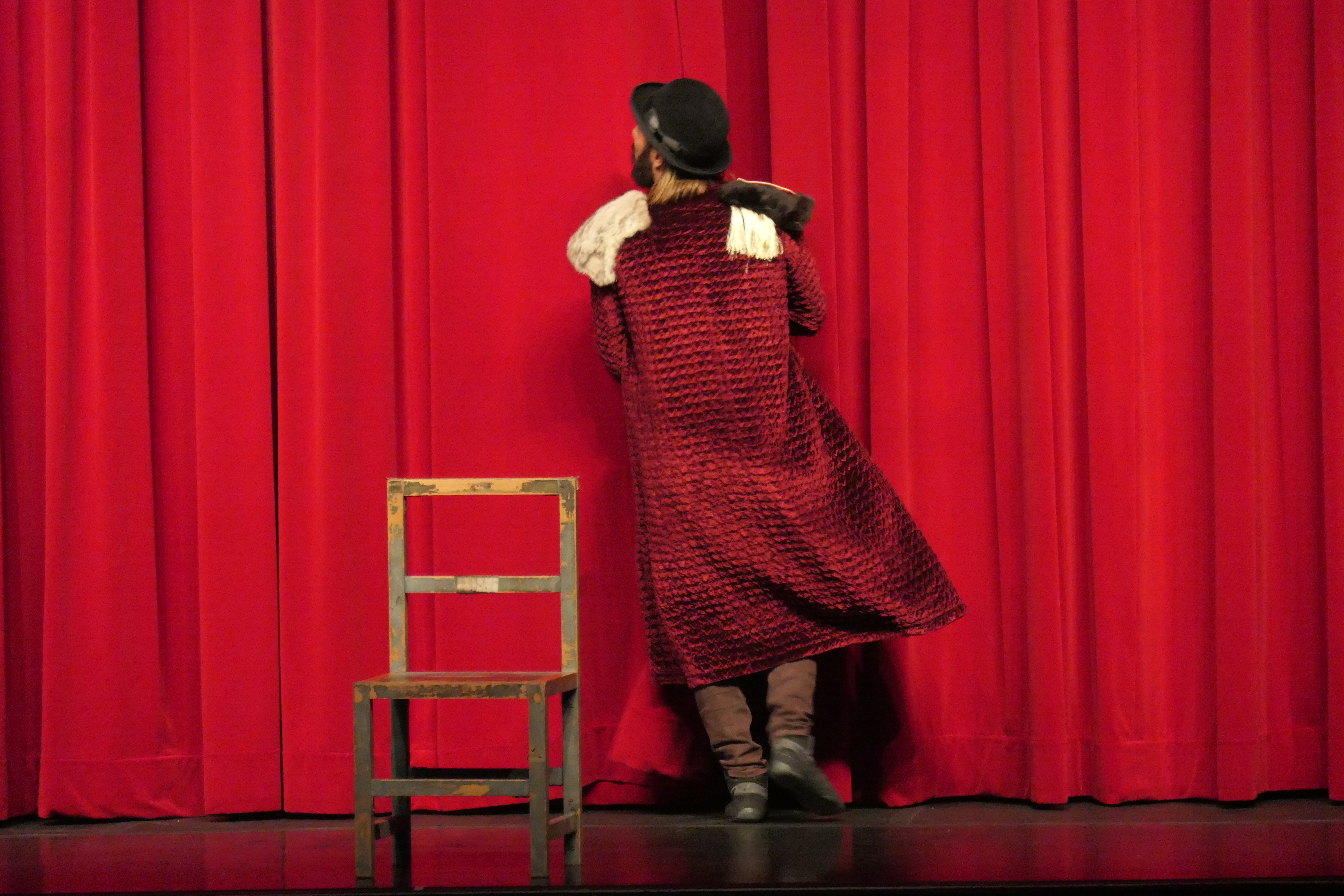
Thus you will see photographs today of a circus performance that was nothing but a romp. Some 8 friends decided to capitalize on their arsenal of tricks and acrobatics, with a singer tangentially leading through the show. It did not provide deeper meaning, or a social justice message, or some educational background, or floated on beauty – it was just an exuberant flouting of various muscles, postures, contortions, bodies and collective silliness that was infectious.
Clouds of confetti, over the top lighting, stunts that reminded of action movies, live music and active engagement of audience members made me think more of Mardi Gras than anything else. The audience was up and standing, clapping and shouting with enthusiasm, providing evidence for the fact how much pure escapism is occasionally needed to counter the heaviness in hearts and heads.
Finale was put on by Analog, a young German company; the showwas offered in Prague in cooperation with the Czech circus rebels of Cirk La Putyka, at the Chamäleon stage in Berlin, and in Australia, before making its way to Montreal.
One of the running gags throughout the evening was one acrobat’s love and emulation of all things Jean-Claude Van Damme (the Belgian martial arts film actor.)
Another highlight were generous helpings of shots of vodka, handed out to the audience…..
The singer in the show I saw was Iman Pearl Williams, accompanied by live drumming.
The original composer of the music was Ena Wild, who is part of the Analog troupe. Here she is in a studio gig in Berlin.
How do you tell a story that is not necessarily your own? How do you draw a landscape that did not always belong to you? How do you document reality without appropriating someone else’s history? These questions pose themselves to any artist, anthropologist, historian who is aware of limitations of their own perspectives.
These kind of of questions also arise for me when constructing profiles of people who I find interesting, whose work I admire, whose politics I likely share and who I get to talk to only once.
Roger Peet, print maker and muralist
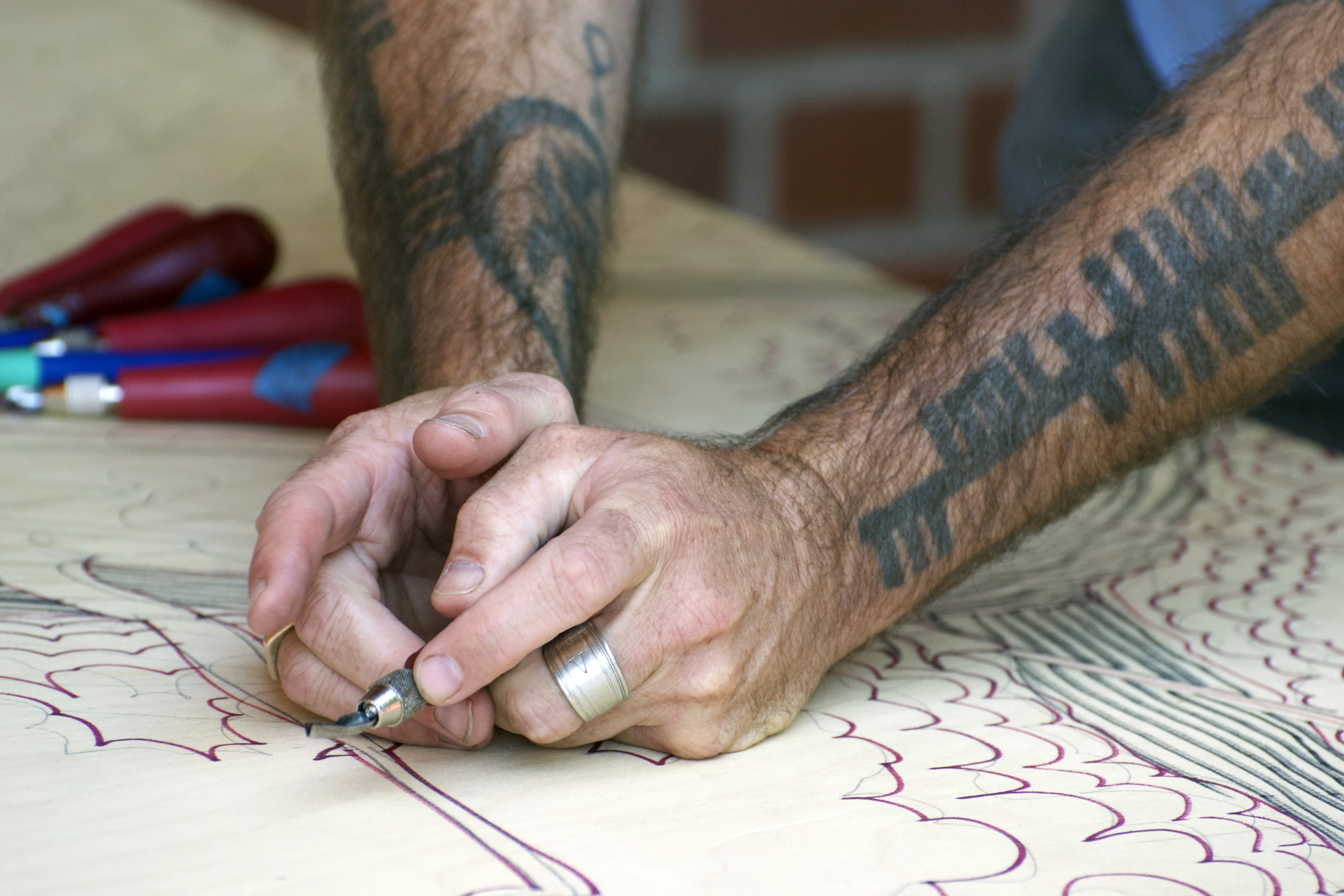
Case in point is today’s portrait of one of the artists chosen for Maryhill Museum’s Exquisite Gorge project: print maker and muralist Roger Peet who I met last Saturday during a public woodblock carving session at the Goldendale Public Library. He is one of 11 artists who in collaboration with community partners are carving woodblocks filled with ideas about individual sections of the Columbia River, all of the blocks to be aligned and printed by a steam roller at the museum in August.
During our short conversation before the public portion of the event, I was quickly convinced that the artist is someone who would ask himself the questions outlined above. His section of the river ranges from the Deschutes River to John Day, including The Dalles Dam, one of four dams built along this stretch of the Columbia between the 1930s and 1970s that displaced Native American communities and wiped out traditional fishing grounds. We ended up in no time discussing the historical, political and environmental implications of that structure as well as other effects of human interference with nature. Yet we also talked about whose story this truly is, embedded in the context of all other assaults on Native American rights, and how one cannot usurp that telling.
Peet is a reserved man, by temperament probably more so than by the stereotypical gage of nationality (he hails from Great Britain and arrived here in the late 80s.) No self-promotion from his end, despite a pretty insane list of accomplishments, from exhibitions to publications to awards, and a range of interests that spans a political universe. Just check the link to his CV on his website, which exhibits a sly sense of humor as well. I warn you, though, that you might be left, as I, forever wondering what differentiates his proclaimed interest in “civilized bad ideas” from uncivilized ones….
A major focus of his work is the Endangered Species Mural Project associated with the Center for Biological Diversity. He created more than 16 larger-than-life paintings of at-risk animals and plants indigenous to communities across the United States, often collaborating with local artists and scientists. Murals depict flying squirrels in Asheville, North Carolina, and a jaguar in Tucson, Arizona, to monarch butterflies in Minneapolis, Minnesota, white fringeless orchids in Berea, Kentucky and cuckoos in LA all bear witness to the fragility of our environment.
(You can read more about it here. Published this January in the National Wildlife Federation magazine, the article was called: Art of the Possible. I wonder if the staff author was familiar with the original source of that quote, Otto von Bismarck, the stern, conservative Prussian chancellor of the German empire from 1871 -1890. In its entirety it read “Politics is the art of the possible, the attainable — the art of the next best.” I wager von Bismarck and Peet would not have formed a mutual admiration society. I certainly believe Peet would not likely settle for the next best. But then again, all I can do is infer, claiming no privileged access to his story.
———————-
During our conversation I could not help but think of another lover of nature, Lage Wernstedt, the famous surveyor of the North Cascades in WA in the early part of the 20th Century. He mapped both the Mt. Baker National Forest and the Okanagan National Forest and inventively named a range of mountains, coming up with Mt. Despair, Mt. Fury, Mt. Terror, Mt. Challenger, Inspiration Peak, and last but not least Mt. Triumph (not that he climbed many of them, by all reports. Stellar photographer, though.)
Well, I don’t know about terror, but the remaining attitudes seemed to smolder under the smooth Peet surface, except that nature was allotted the part of triumph when eventually “calling a day of reckoning in response to our abuse,” to quote the artist.
I surely documented inspiration, the will to bear witness with his art to the parts of the story that belong to all of us: just look at the design on the baltic birch wood block that alerts to what we have diminished and what we have already lost. The big horn sheep and fish have been greatly reduced in numbers (this year’s salmon run alone were so reduced that they barely filled tribal sustenance needs, much less the commercial quota due to, it is presumed, overheated water in the Pacific spawning grounds.) The California condor in the design has long absconded our regions and the Columbia River Tiger Beetle has gone the way of the sandbars that were its home – submerged by the human alteration of the landscape for industrial interests, be they (now defunct) aluminum plants or commercial barge traffic.
————————–
Inklings of challenge, fury or despair all but vanished with the onset of the carving sessions, and what emerged was a gentle, attentive mentor who guided young and old participants alike with passionate explanations and much practical advice.
The Goldendale Community Library courtyard was the perfect setting to allow patrons to participate. A historic Carnegie library, it serves as much as a library as a community center, supporting local arts and artists, according to library manager Erin Krake, who gave a warm introduction to the afternoon’s proceedings.
Erin Krake, Library Manager Lou Palermo, Curator of Education at Maryhill Museum (center) with Erin and her library colleague Susan.
——————
Soon people of all ages carved merrily along, none with more concentration than Joseph Bookmyer who turned 6 years old that very day and whose Dad was happy to have him enjoy this event.
Joseph Bookmyer
————————
I left with a restored sense of hope that this kind of educational project put on by the Maryhill Museum and enhanced by the curators’ pick of engaged, thoughtful and conservation-oriented artists will have an impact. Each mind reached, each perception sharpened, any one consciousness shaped by those who bear witness, it will eventually make a difference.
In Roger Peet’s own way of telling the story:
Relief Print Cranes Lettra 100lb Printmaking Paper signed/numbered edition of 25 9″ x 11″ 23cm x 27cm
A few days ago a drab high school campus in L.A. was transformed – community-relevant paintings — done by 31 artists as part of a weeklong festival co-produced by the L.A. firm Branded Arts and the Los Angeles Unified School District – brought color to the Maya Angelou Community High School.
Prominent artists and students had brainstormed, picked topics, vetted themes with the community at large for the last three years. Proposed sketches were discussed at monthly town halls, and the community turned out completely supportive.
The muralists and students worked together, sculptures were developed as well, and there was a concert during the unveiling last Saturday.
It reminded me a bit of what I had seen in Vienna last year, when various international artists transformed neighborhoods with large graffitied murals, with the support and encouragement of the city administration, art institutions and diverse landlords, whose building walls were used as canvases. I wrote about it here.
However, that project lacked the hands-on participation of people affected by the art – in contrast to the LA mural initiatives which really tried to respond to neighborhood ideas, concerns and needs and ultimately actively involved community members in the production process.
A (fleeting) parallel could be found here in PDX some weeks ago when a group of musicians, presented by Boom Arts, came to town from various US locations and encouraged members of the community to make music together with them. During concerts at the Old Church The Team actively engaged the audience, teaching them new songs, and providing structure through local talent, individual musicians as well as choirs, and political activists. The approach strengthened a sense of community, in addition to loosening inhibitions about singing outside of the privacy of one’s shower.
Outside of volunteering, it is somewhat rare to experience this community spirit, and we are the poorer for it. Most importantly, it brings together people who would otherwise have little contact, fostering a sense of shared interest and/or commitment.
Photographs are from the concert, including members of the Transpose choir.
And so we conclude my travel adventures with a little story and a link to a longer one.
During one of my hikes I shared an overlook spot with a woman who started to talk to me. She had just completed her annual pilgrimage to Chimayo, an event joined by tens of thousands of people each year during Holy Week.
Now she was taking in the sights and recommended that there was one other thing in the region I should not miss. The best Trading Post in NM, she said, was some 30 miles away in Nambe. Be warned, though, she continued, I drop a thousand bucks there on every single visit. Hmmm. How do you reconcile pilgrimages with that kind of spending. Well, not my business.
I did make it my business, though, to explore the Trading Post – the perks of traveling alone and changing plans at the drop of a suggestion. I found a sleepy little hollow with a store, an orchard in bloom, and two very tired women, the owners, sitting on the porch. Mother and daughter had just returned from a long trip to Venice, Italy, where the daughter had gotten married to a camera man. She had worked in the film industry as a stylist, while her mother had been a costume designer. We chatted about Italy and the fact that I had photographed in Murano, the glass making center, from which she had shipped her only wedding present, a chandelier. A Murano chandelier in Nambe – I was intrigued.
Enter the shop – photography strictly prohibited. No wonder: there were costumes from Dances with Wolves and other Western movies displayed on mannequins, costumes for which Cathy Smith, the owner, had won an Emmy award. Add to that big pictures of her induction into the Cowgirl Hall of Fame or some such. All amidst a cornucopia of Indian artifacts and tchotchkes. No wonder she had vehemently rejected my request to photograph her with the words: “I look too wiped-out from jet lag, ” despite the fact that we had a longish conversation in which I was told that the area is a “spiritual vortex.”
I wouldn’t know how to confirm that, but can attest to the fact that New Mexico provides a maelstrom of impressions, including one that suggests a single visit is not enough. I shall return!
Attached my musings on the history of art in Santa Fe.
I am postponing the posting of a most upsetting article about our current prison system in favor of easing us all into the weekend. There’s always Monday….
I do as I please….
Instead I will alert you to murder most fowl when a group of decidedly determined French chickens ganged up on a fox and saw to his demise. He was caught with them overnight in the henhouse when the communal pecking commenced. Maybe they have seen enough yellow vests recently to be alerted to the power of concerted action…. https://www.cnn.com/2019/03/13/europe/france-fox-killed-chickens-intl-scli/index.html
I had just read about this over yesterday’s breakfast treat at a small cafe in NE PDX and somehow could not stop laughing during the required postprandial walk to get rid of croissant calories and crumbs, not necessarily in that order. People must have thought here comes another Madwoman of Chaillot. Except most likely not many people along Sandy and 39th know the 1945 French play…. they probably just assumed I had a fleeting high.
Just like Giraudoux’ eccentric Countess Aurelia, said madwoman, I saw the world in those few blocks as pretty happy and beautiful.
Owls were hovering:
St. Patrick’s Day swag colored the world green:
Billiard beckoned:
And the sight of a barbershop illusion reminded me of the fact that I never, ever have to teach undergraduates Perception again. Hallelujah.
Unlike the madwoman, however, I refrained from locking away numerous oil barons and venture capitalists. Still working on gathering a co-conspiratorial band of fellow outcasts like the ones she had at her disposal. As I said, there’s always Monday.
iPhone Photographs are from a 2 block radius Thursday morning.
Music today from Edith Piaf, who would have fit right in with the mood.
Chain of association: I heard lots of communal singing this weekend. On Saturday, at an Indian Dance concert, people in the seats all around me hummed with the singer(s) who accompanied the performers. Incredibly complex and intricate melodies to the Western ear were quietly and perfectly voiced by young and older women near me. At Sunday’s fundraiser, whole groups of people sang old pop music without a moment’s hesitation.
I cannot remember when I’ve last sung, outside of some religious service or ironing to Steely Dan, and yet during my childhood there was lots of communal singing. In school, in the schoolyard, during bus trips, or simply when kids gathered, even at birthday parties.
Elizabeth Hargrave, an avid birder and public-health scientists decided to teach about birds while having fun.
“Aiming to design a game with scientific integrity, Ms. Hargrave pulled data on North American birds from eBird, a citizen-science project managed by the Cornell Lab of Ornithology. She also made use of the lab’s All About Birds website, as well as Audubon’s online guide. Then she built a spreadsheet. At its most extreme, it ran five hundred and ninety six rows by nearly one hundred columns — sorting, for instance, by order, class, genus, habitat, wingspan, nest type, eggs, food and red-list status. (Endangered birds confer special powers.)”
Apparently the game is a hit and sold out whenever newly printed; I wonder if older folks who have been out of the game, so to speak, can re-acquire strategy skills to play successfully – although what counts as success depends on what type of person you are: a competitor or a connector.
Next associative link: Under the bird game article were, as always for the NYT, links to older, related articles. What caught my eye was a game called Secret Hitler, apparently teaching about the slimy, subterfuge rise of fascism if people secretly put their mind to it.
It is meant, if I understood correctly, to warn of such strategies and raise consciousness about them. No-one seems to have asked if it works in both directions: teaching the wrong kind of people the wrong kind of methods…which made me think of Monopoly.
Did you know that the game, the seeming tool to raise midget capitalists, was actually invented by Lizzi Magie in 1902 to compel some changes in tax law? A vocal supporter of the single tax movement during the late 19th century she called for the abolishment of all taxes in favor of one tax placed on property. By relying on citizens who owned land for tax revenue, the policy would have hopefully narrowed the gap between wealthy landlords and their working-class tenants.To make these principles as engaging as possible, Lizzie Magie turned them into a board game.” Magie thought the game’s critique of greedy landlords was obvious, but it eventually evolved into a beast far removed from her original creation. It was banned in the Soviet Union and China and apparently drew the ire of Fidel Castro who accused it of being “symbolic of an imperialistic and capitalistic system.”
For music today, I settled on a website that provides music for boardgames. You type in the name of the game and they provide a playlist. The site is called Melodice. I chose a Settler of Catan song, since it is a German game and gives me an opening to show some beloved German landscapes….
I have been to many a Gala/Fundraiser in my lifetime. Often bored out of my head. Sometimes irritated that a lackluster production and/or a sluggish donor base failed to raise necessary funds for a deserving institution. Sometimes beyond irritated that a misplaced focus raised hundreds of thousands of dollars in no time – does a small private school, which shall remain nameless, really need an astro turf when scholarships to increase diversity are scarce?
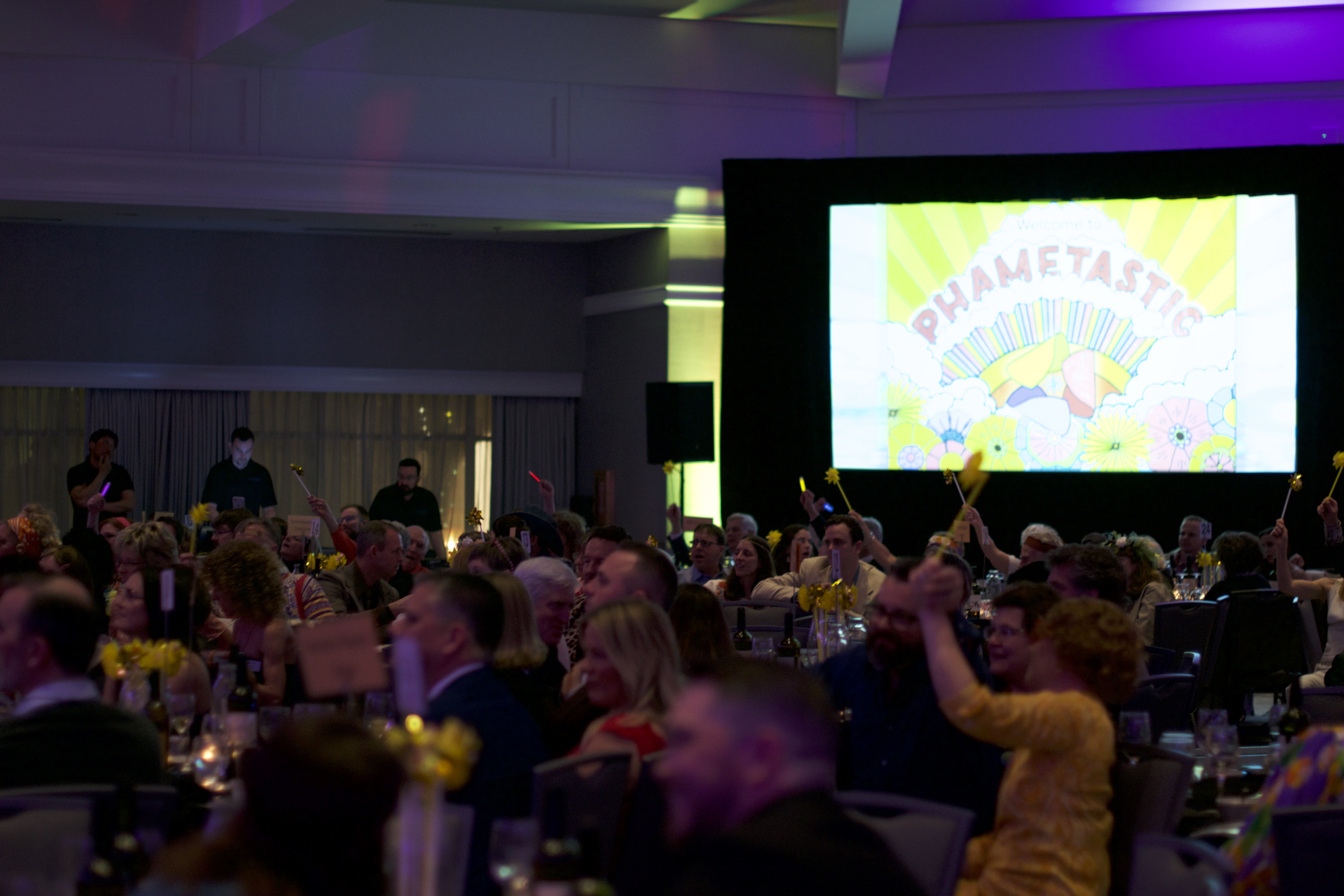
Last night was different. Phametastic was such a lively affair that at times you thought the entire Hilton Hotel vibrated with approval. The annual auction for Phame, an organization that provides art education and performance opportunities for adults living with developmental disabilities, raised spirits as well as funds.
Maybe it was the costumes. The theme of “1970s” sure brought out a slew of attires stashed safely back in the closet for the last 40+ years. Rarely have I seen so many bell bottoms, head bands, glittering disco swag and peace signs in one place since I went to law school. And this from the woman who does an annual pilgrimage to the Oregon Country Fair….
Speaking of which, there was a couple who must have made a wrong turn from their way to the OCF, and were off by a mere 100 years in their style of clothing, and DESERVEDLY won the prize for most creative costume.
Although these folks were close second for my money.
Or maybe these.
And did I mention Polyester?
Maybe it was the music. Having an entire ballroom hum to Al Green or know (and belt out) the lyrics to every single hit of the 1978 charts was pretty uplifting. Even thought they looked as were they all 5 years old at the time….
Maybe it was the fact that Phame’s mission to provide performance opportunities so seamlessly morphed into some amazing entertainment in situ: the iPad orchestra, the rock ensemble strongly assisted by the drummers, the soloists all rocked the room.
Maybe it was the speeches. The MCs had a personal relationship to the school which made their banter heartfelt and insightful. The Executive director was infectious with her enthusiasm and a gravitas that the real princess Leia could only dream of. The auctioneer and her team were rambunctious.
Honestly, though, I think it all came down to the guests. You really had a feeling that there was a passion for a shared cause at each and every table. No reticent employees sent down to represent their bank or other institutions here, waiting for the evening to be over. Rather there were groups who cared and showed that with some serious generosity. Whether they were liable to do so for personal experience of living with or caring for some of the students, or whether they understood the value of providing support for populations that so easily slip through the cracks when the museums, symphony, the opera or other venerable organizations beckon – who knows. Who cares. They were there. They came out and had fun. They could be counted on. As I said, community.
Down to the kind waiter who offered this apparently hungry-looking photographer to slip her a meal. Too bad that I was too busy documenting the memorable affair – the chicken looked good!
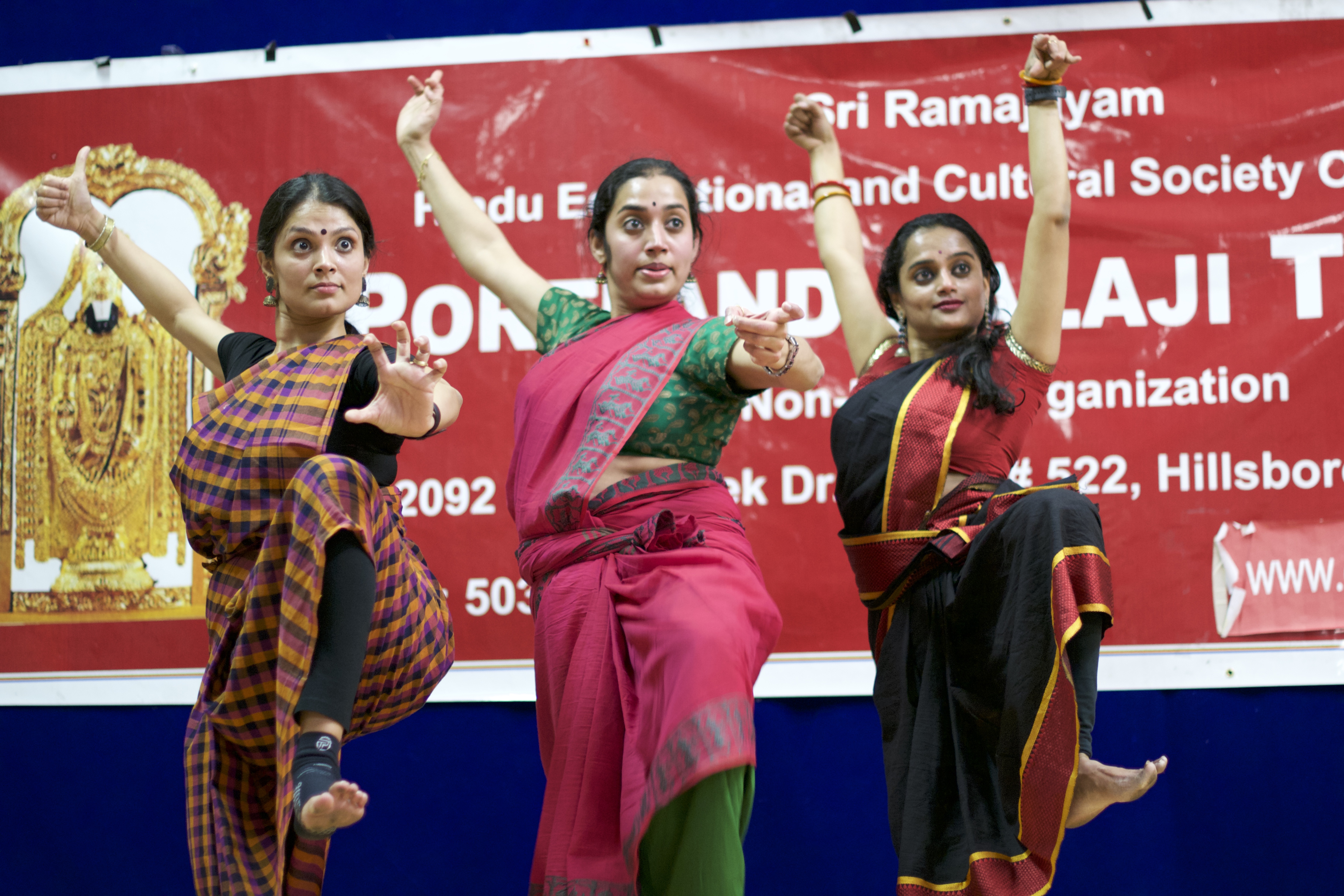
What better way to celebrate March 8th, International Women’ s Day, than by introducing some extraordinary women who have recently moved to the US. I met them this week: Sweta Ravisankar, Sridharini Sridhara and Yashaswini Raghuram are dancers who perform together with a group of women musicians, Lakshmi Sridhar, Anuradha Ganesh, Laya Kashyap and Harini Ganesh.
They will be performing Shakti tomorrow Saturday March 9th and if you have any flexibility on short notice do come out to see it – you’ll be immersed into a different culture by both dance and setting in a small temple in Hillsboro.
The dance that the three will be staging on Saturday is a South Indian classical dance form called “Bharatanatyam.” It is story telling at its best, using every conceivable means to convey meaning: specific steps, sequences of foot movement (nritta), hand movements and facial expressions (abhinaya.)
The dance includes scenes about strong women danced by strong women – their physical stamina had me breathless just watching. One of the scenes depicts a fight between Goddess Durga, an incarnation of the Goddess Parvathi and the demon Mahishasura. Parvathi was the consort of Shiva – and sometimes she appears in the form of the left side of his body. This is a concept expressed in the dance as “ardhanari,” literally translated as half a woman’s body. Two dancers perform as two parts of the same body, requiring strong synchronicity.
Parvathi reincarnated in another strong woman as well: Goddess Meenakshi. She is the presiding deity of the Madhurai Meenakshi temple in Madhurai, India and was a warrior princess who was trained in martial arts and warfare including archery. The bow and arrow movements are perfectly incorporated into the story telling.
Essential part of the bharatanatyam recital are the musicians who sing, play the cymbals, drums and violin. Particularly fascinating for me was hearing rhythmic syllables sung, which are called jathis / solkattus. The person reciting the jathis has to orchestrate it with equivalents beats on the cymbals called “nattuvangam” which is why they are called the nattuvangam artist.
The three dancers have not been in the US for long. Sweta moved from India to California in 2012 and came to PDX in 2015. She holds a master’s degree in Fine Arts and now pursues her PhD at OHSU. How she has time and energy to combine strenuous studies with the devotion to her dancing is a mystery to an old sloth like me. As a Bharatanatyam and Nattuvangam artist with 25+ years of journey in this art form under the tutelage of her gurus, Roja Kannan and Padmini Radhakrishnan in India, she now focusses on choreography, teaching and giving performances as a solo artist, as well as being a member of this terrific trio, Sankalpa. No wonder, she’s been accumulating awards.
Sridharini is a Bharatanatyam dancer from Chennai (India) and moved to Portland in 2014. Trained as a certified accountant she now directs her own dance school Kala Shiksha that intensively trains students in the nuances of the artform. Her pupils must love her – she radiates warmth as well as self-discipline. She is the disciple of Guru Smt. Revathi Ramachandran of the Melattur style and has been under her tutelage for over 20 years. She is also formally trained in Nattuvangam and carnatic music and holds a diploma in Bharathanatiyam. Her international performance history speaks for itself.
Yashaswini is a Bharatanatyam and an Odissi dancer and moved from Bengaluru, India to Dallas, Texas in 2012 and to Portland in 2015. She has been studying Bharatanatyam under Smt. Shubha Dhananjay for the past 18 years and has also been learning Odissi under Smt. Aparupa Chatterjee for the past 5 years in the US. How someone who looks younger than my youngest son could have been dancing for almost 20 years is another mystery to me. Her performance history is extensive, including conducting dance festivals. Her own dance school here in Portland and her work as an assistant director of the Odissi Dance Company, a Texas based non-profit organization, focus on there essential aspects of Indian dance: learning, teaching and creating.
I felt privileged and grateful that they invited me to attend their rehearsal, taking place late in the evening after their full days’ of work. Being in their temple added to the wonder. Nestled in a small industrial setting in Hillsboro it is a modest affair, probably a rescued warehouse, lovingly devoted to Sai Baba of Shirdi.
In parallel to the strong women I’ve introduced so far, here is a strong man – or Indian spiritual master who is regarded by his devotees as a saint, a fakir, a satguru and an incarnation of Lord Shiva and Dattatreya. He was holy to both Hindus and Muslims during and after his lifetime and strongly defied conventions.
Sai Baba displayed both his disdain for the rigid formalism that Hinduism and Islam could fall prey to and his empathy for the poor and diseased.
He also condemned distinctions based on religion or caste and all forms of orthodoxy. His teachings focussed on a moral code of love, forgiveness, helping others, charity, contentment, inner peace. What’s not to like.
Join me for the dance performance tomorrow at 5:30 pm – you will be transported.
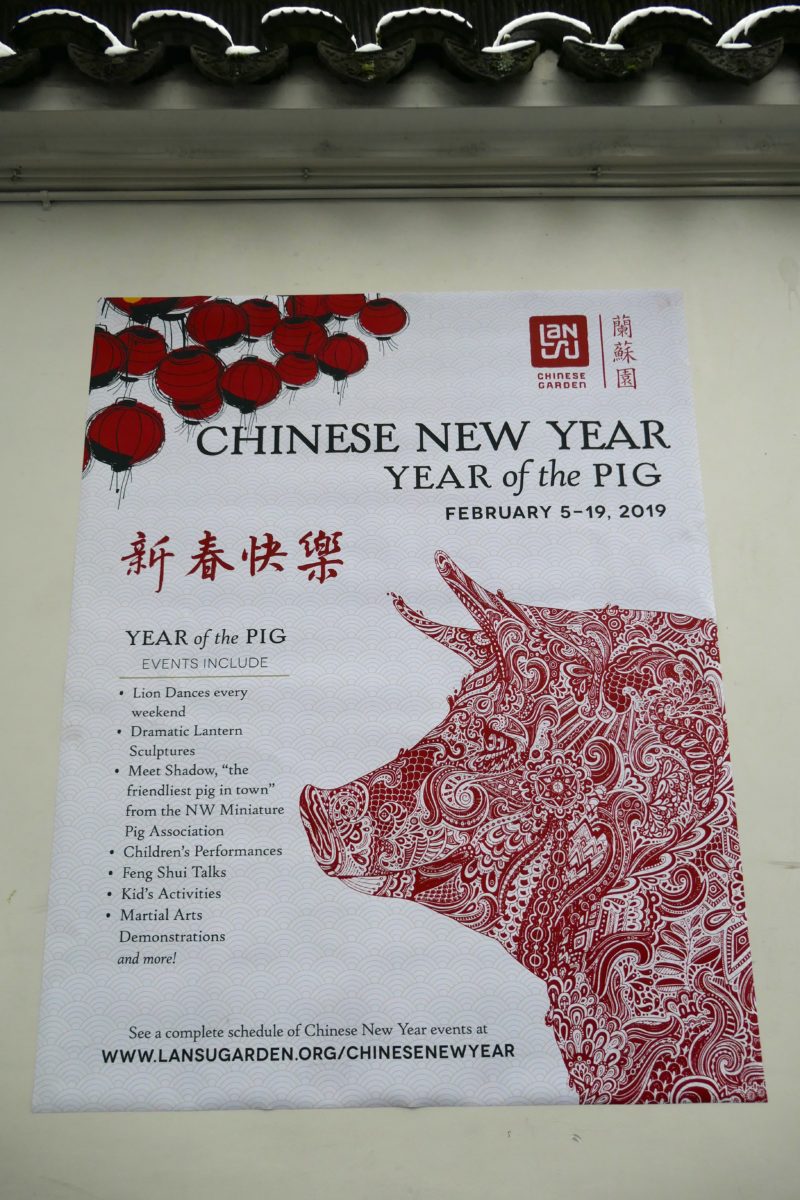
Yesterday was the first day of the Chinese New Year and the Chinese Garden looked particularly festive with red balloons swinging from black branches topped with a bit of snow. Made me think of Snow White, skin white as snow, hair black as ebony and cheeks red as blood… which her birthmother dreamt about while pricking herself accidentally with a needle.
Wrong mythology, wrong continent, wrong calendar. Same appreciation for striking color combinations. And same hopes and dreams for future happiness and wealth, judging by the good luck coins, the fortune couplets, the many small gestures intent on finagling fate’s benevolence.
The garden was in winter bloom and hummingbirds fluttered around ignoring all the action.
The little ones clad in traditional outfits, students of some or another language immersion program, were supposed to sing and dance, alas too close to nap time.
Many an unhappy toddler, a heroic teacher pushing through the program and a phalanx of beaming parents at the end. Just watching the kids run around made my day, though, so happy to see families embracing diverse cultures.
The dragon sat proudly on the water, snow slowly melting off its back.
Someone had fed the lion with some snow, how else would it have gotten into its mouth?
And some clever gift shop manager had guaranteed that there would not be a pig on earth that could not fit under its roof – all Made in China one presumes.
I take that back – here are some that did stay on the mainland.
I could have kicked myself. Here I am friends with one of the most formidable dance critics around, ArtsWatch’s own Martha Ullman West, and yet it did not occur to me to drag her with me to the dance performance I saw last Saturday. Just as well, though, since no matter how learned a tutorial I’d have gotten, it would have been but a drop in the vast sea of my ignorance about dance.
Abhinaya School of Kughpudi Dance
Consequently, my report today is not going to be a performance review, but instead some thoughts on how culture is preserved in an expat community that is growing by leaps and bounds. And ample photographic documentation of my enchantment.
The program I saw, Nrityotsava 2019, was put on by Kalakendra, a 32-year-old Society for the Performing Arts of India here in Portland. The non-profit organization serves on multiple levels: it contributes to the diversity so essential to the vibrancy of our city; it puts on a wide range of programs that promote awareness of and knowledge about the Indian subcontinent, be they music, dance performances or lectures. And, importantly, it provides a platform for the exhibition of local talent – which in turn supports all those dance schools and individual groups to engage in meaningful practice and, significantly, education.
On Saturday evening alone, there were 11 separate groups performing a wide array of dances. The program listed them as ranging from traditional Carnatic pieces, folk dances, contemporary forms of dance to what was described as a first attempt to raise awareness about a modern social issue (pollution) through dance. Those were all words to me, in no way preparing for the experience that followed.
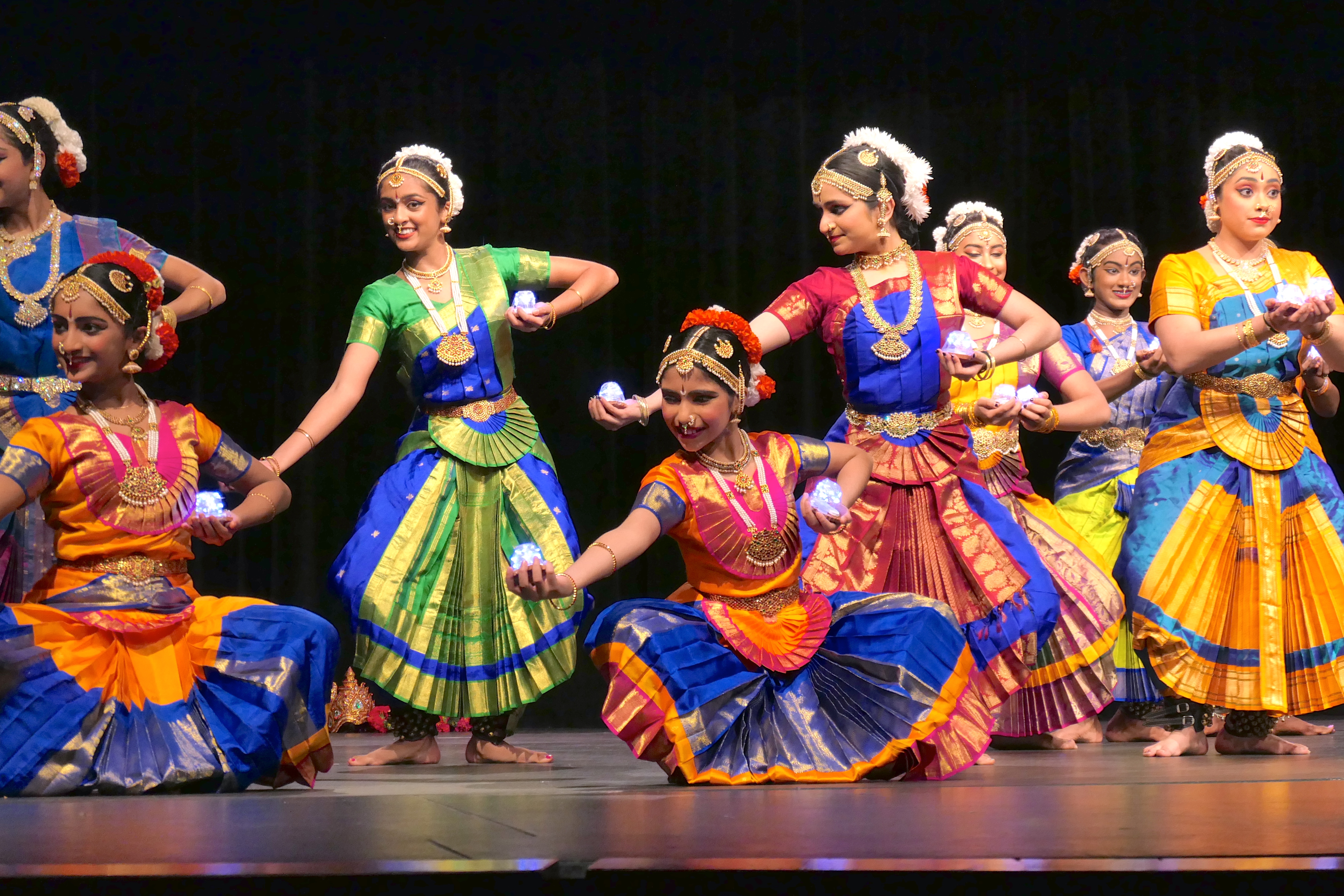
Imagine sitting in a high school auditorium surrounded by a sea of happy, expectant people awaiting the performance of their friends and family members. If you close your eyes you might as well pretend to be on the subcontinent, hearing language(s) that place you far away. Once you open your eyes, you are engulfed in colorful visual displays, costumes, adornments and choreography all vibrant, with movement that ranges from serene to exuberant.
More importantly, the artistic expressions conveyed stories that were so universal that anyone without prior knowledge or insight into the historical, spiritual and literary underpinnings could get them. People like me, in other words. People whose entire knowledge of India consists of hopelessly colonially-colored children books devoured during a childhood in Germany (poor Indian orphan adopted by NGO folks, forever displaced as a stranger, marries Indian doctor, lives a life of service as wife and nurse in Calcutta…) or the adventure stories of Rudyard Kipling (before his anti-Semitism came to light) the films of Mira Nair or the novels of Arundhati Roy, who with a fine acerbic brush paints the complexities, tragedies and ecstasies of life in India.
Saturday’s dance groups differed in a variety of ways, but also had several things in common: their athleticism (the physical demands were making me tired just by watching;) their memory capacity (the number of different steps and sequences were a marvel; add to that a significant repertoire of different hand movements, and also timed and specific facial expressions/eye-movements and you have an extraordinary memory load;) their sheer loveliness, all.
Abhinaya School of Kughpudi Dance
They differed in their age, their amount of expertise, the kind of choreography and music they chose, and the way their movements were culturally specific or more universally communicative. I cannot appropriately describe all of them, but here are my highlights: A group of young mothers who just love to dance (Khamma Ghani Group) performed a Rajasthani folk dance with such exuberance that you wanted to jump in your seat.
A trio of young women (Sankalpa Dance Ensemble) convinced me that their Hymn to Devi exhibits indeed transformational power.
Sankalpa Dance Ensemble
A company (Aura) experimented with a combination of traditional and modern dance and costuming to tell the age old story of the fight between good and evil.
AuraAura
The two artists of Nritya Suhrid were perfection in their presentation of 5 of Vishnu’s incarnations based on the Geetagovinda.
Nirtya SuhridNirtya Suhrid
What won my heart, though, were the children, the many, many girls and occasional boy. I don’t know how many of the more than 5000 Indian families who live in the greater Portland area send their children to one of these dance programs. You obviously have to have talent, a willingness to work hard and be disciplined (although you will have fun, too, and not just on stage: The scene in the Ladies Room was a gaggle of giggling girls 9 years and older applying or repairing each other’s makeup, a sheer delight.)
Nartana School of Khugipudi DanceKalabharati School of DanceKalabharati School of DanceAbhinaya School of Kughpudi DanceAbhinaya School of Kughpudi Dance
The children who are able to participate will learn more than how to dance. They will be exposed to 1000s of years of culture, immersed in the teachings of their religious and/or historical backgrounds, picking up a vocabulary of gestures that are helpful for intra-cultural communication. They also will run around in some of the coolest clothes on earth…. just look at those costumes (none more impressive, and supportive of some stunning choreography, than those of the Kalabharati School of Dance.)
Kalabharati School of DanceKalabharati School of DanceKalabharati School of Dance
And the kids will learn from their elders how to combine traditional knowledge with adaptation to the kind of world they live in – the example on hand was a piece called The Story of Plastic created and performed members of the Nartana School of Kughipudi Dance. The dangers of plastic to our oceans was conveyed in ways funny and eloquent enough to be poignant rather than didactic.
Nartana School of Khugipudi DanceNartana School of Khugipudi DanceNartana School of Khugipudi Dance
There is an obvious intersection of cultures, a cross-fertilization that will strengthen both the bonds to one’s own and the integration into new ones. The bridge between tradition and contemporary thinking has been built here – all these kids have to do is travel across it. Back and forth, mind you, it’s in no way a one-way street.
Smita’s Indian Dance AcademyFolk Jhalak
It was the best three hours I spent in a while. Transported, educated, energized. I only regret that I didn’t purchase more of the samosas during intermission to take home with me….
Folk JhalakAnubhav Natya
(I tried my best to match photos to names – apologies if I erred.)