Browsing Category

Politics

Magnolia Plantation

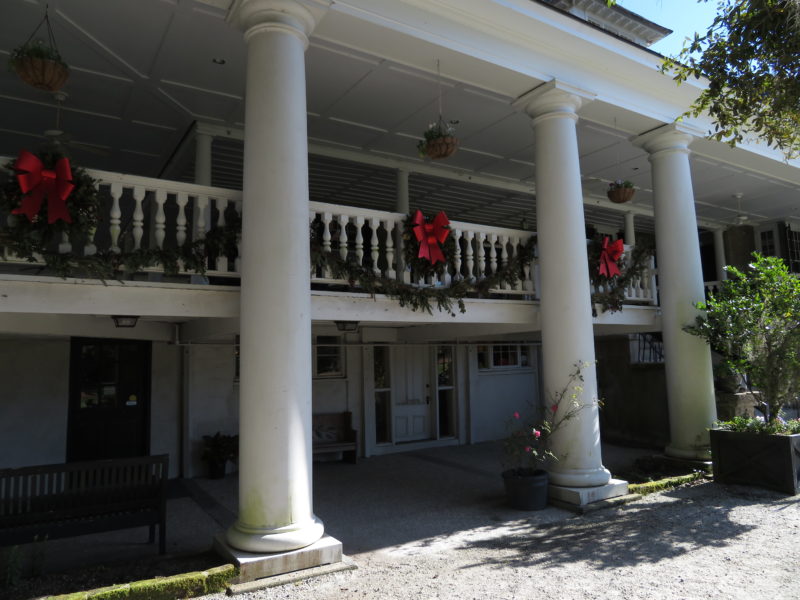
Gone with the Wind was a book that I devoured as a tween, blissfully oblivious to the historic context and fully caught by fantasies of emulating Ms. O’Hara.  Neither Wilkes nor Butlers in plain sight as love interests for this 12-year old, alas. I should have visited Magnolia Plantation then, my ignorance of slavery a shield against conflicting feelings.

The plantation was founded in 1676 by the Drayton family, and continually held and expanded by them, with wealth from slave-produced rice crops. I did not visit the slave cabins, which were in use from early on until 1990 (!) and only have been subject to historic protection for the last 5 years. http://www.magnoliaplantation.com/slaverytofreedom.html

I focused on the gardens which are astonishing, even in winter. Again, the dialectic of suffering and beauty seems a Leitmotiv in my S.C. sojourn. The man who created the gardens at the beginning of the 19th century had unexpectedly fallen into the inheritance of the plantation at age 22; he really wanted to pursue his career as a minister, a devout man. He also saw his Philadelphia bride languish for home and tried to cheer her with the gardens. He was the first to bring azaleas to the country and cultivate camellia Japonica for southern climes. A good guy, in essence, deeply anchored in a love for God and nature – and a slave holder.

The plantation suffered from the losses in the civil war and opened up, thus able to survive, its gardens to the public in the late 18oos. In our century the Audubon Society is also represented, having created a swamp walk of breathtaking beauty, where you practically stumble over the wildlife.


The slaves and their descendants were buried in the swampy woods. 

The Draytons were by marriage related to the Grinkés, an elite Charleston family that produced two of the most remarkable women the South has ever seen. Born among 13 children into a rich, pro-slavery household, their father a Supreme Court Judge, Sarah and Angelina both escaped Charleston around 1820 to become Quakers in Philadelphia and start careers as abolitionist writers, thinkers and lecturers. The older one also became a feminist and tried to test the 15th amendment (allowing men of all races to vote) by trying to vote when she was almost 80 years old. Contrast here, too: the abolitionists welcomed women among their brethren but the moment these started to argue for women’ rights they were told to let go and were actively oppressed.

The 19th amendment to the U.S. Constitution was eventually ratified in 1920, giving women the right to vote after a 72-year struggle. 6 months earlier, the League of Women Voters was founded during the convention of the National American Woman Suffrage Association. A good thing, one might think, but also riddled with complications: it has been argued that the women’ right to vote was needed to counterbalance the rights granted to Black men and that the suffrage movement discriminated strongly against their Black sisters. Link below gives a short summary of the claims: https://www.teenvogue.com/story/womens-suffrage-leaders-left-out-black-women

Harriet Simon brought the LWV to Charleston, standing out among her class as a moderate liberal, and seemingly progressive. She did a lot of good, fighting on the right side in questions of desegregation, but also had a problem admitting Black women into the fold of the League. I think it is important to value what these women accomplished surrounded by overt racism that few of us experience in our own personal lives as sheltered, Northern US Whites or Europeans, accused as traitors to their own race. They showed courage and persistence, despite slow, incremental steps toward more equality.

Should you feel inclined to see her grave, these signs will greet you. The place is filled with birds, confederate flags and inscriptions longing for the past.


Secession

Charleston is located at the Atlantic coast, the latter dotted with small islands, some natural and some man-made to accommodate forts that were intended to protect the city and the commercial trade. Marshlands extend inland, providing perfect conditions to grow rice, and a habitat that accommodates alligators, snakes, all kinds of bugs and birds.

And no, the snake not photographed in the wild, but in the local Aquarium

Fort Sumter was built on a manmade island on top of a sandbar, and it was there that the first shot of the civil war rang, where soldiers from the union were attacked by the confederate forces from Charleston, who laid a three months siege until the unionists surrendered due to impending starvation. Not a single life was lost (except an accidental death), and the troops and officers were sent back to the North on union boats – a stark contrast to the still mind-boggling number of 700 000 or more dead in the war that ensued. (In today’s numbers that would be 12.5 million US dead.)


The National Park Service museum has a simple, effective display of the history of the secession; some facts about slavery, but few details on the horrors other than stunning statistics about child mortality (33 % of all black children died before the age of 10.)

From the museum’s pier you can take a boat tour to the fort and listen to guides give a canned speech, but then also answer your questions in one-on-one conversation.

Much of it centers around the abolitionist cause, the desire to abolish slavery for moral principles or ethical or religious reasons. I have not seen a lot on the issue of economic competitiveness that was so much part and parcel of the conflict, or the other reasons that propelled the seven southern states to secede from the union (this from a Yale open course lecture on secession): So what caused the Civil War? Somebody said “slavery.” Can I hear a “states’ rights?” Can I hear a “conflicting civilizations?” Can I hear “unctuous fury?” Can I hear “fanaticism?” Can I hear “fear?” Can I hear “stupidity?” Can I hear “Goddamn Yankees?”

Jefferson Davis, first and only elected president of the Confederation, pointed to reasons quite contradicting themselves, depending on what time you caught him. Before the war he claimed the South “is confronted by a common foe. The South should, by the instinct of self-preservation, be united. The recent declaration of the candidate and leaders of the Black Republican Party must suffice to convince many who have formerly doubted the purpose to attack the institution of slavery in the states. The undying opposition to slavery in the United States means war upon it, where it is, not where it is not.”

After the war he argued in 1882 that it had nothing to do with slavery whatsoever: “Slavery was in no ways the cause of the conflict but only an incident….“Generally Africans were born the slaves of barbarian masters, untaught in all the useful arts and occupations, reared in heathen darkness, and sold by heathen masters. They were transferred to shores enlightened by the rays of Christianity, put to servitude, trained in the gentle arts of peace and order and civilization. They increased from a few unprofitable savages to millions of efficient Christian laborers. Their servile instincts rendered them contented with their lot, and their patient toil blessed the land of their abode with unmeasured riches. Their strong local and personal attachments secured faithful service. Never was there happier dependents of labor and capital on each other. The tempter came, like the Serpent of Eden, and decoyed them with the magic word, freedom. He put arms in their hands and trained their humble but emotional natures to deeds of violence and bloodshed, and sent them out to devastate their benefactors.”

The link below gives you a detailed and convincing analysis of some of the other factors mentioned above, including an interesting parallel to our times: the conflict between agrarian traditionalists and an urban intellectual class perceived to be foe.http://oyc.yale.edu/history/hist-119/lecture-11

Alas, the parallels don’t stop there – the racism of a plantation-based economy has not only not disappeared, but is re-emerging from its underground retreat.


Another Promise Broken

A lot of people I know no longer read about the tax bill given that it is now a done deal, thoroughly depressing and taking time away from doing something that looks forward towards 2018.

I still think there is one bit to remember, though, that has not been as much in the news as the other regular Greed Over People items that we had to digest. And it will affect Trump’s base.

Parts of the Act that dealt with international issues seems to violate World Trade Organization agreements. The GOP either will have to revise major parts of the bill or face sanctions.  The international system as set up by the bill actually loses the US money and increases the incentive to offshore assets and incomes.

Given that changes need to be made, businesses are understandably worried to plan on a basis that shifts under their feet; and given that the 21% tax cut is not set in stone, in our unstable political environment and with mid terms looming, I would not be surprised if corporations continue to look for cheaper tax rates in other countries rather than investing in our own.

Here is a short and acerbic summary of it all: https://www.thenation.com/article/the-republican-tax-bill-codifies-a-new-gilded-age/

It could also be summarized like this, ( I lost the source for this quote, alas.)


Jobs, then, might again be traveling overseas. I am traveling next week as well, so reports might be intermittent. Wishing each and everyone health, peace for the next year and an unlimited supply of energy to wo/man the barricades!


Moving the Goalpost

Next attempt at sending this:

“Moving the goalposts (or shifting the goalposts) is a metaphor, derived from goal-based sports, that means to change the criterion (goal) of a process or competition while still in progress, in such a way that the new goal offers one side an intentional advantage or disadvantage.

Let’s give it a look – here are the original goals that were to be met to vote for the tax scam :

Well, McCain decided to forgo this vote.  The rest caved. Every single one. Collins is for me the worst of the traitors, because she once got my hope up. As the Maine media point out:

The Maine senator voted for the GOP tax bill earlier in December after securing promises from President Trump and Senate Majority Leader Mitch McConnell (R-KY) that Congress would pass three separate measures she says would mitigate the damage done by the repeal of the individual mandate. (Several studies have found that while the policies might prevent some of the large insurance premium hikes caused by nuking the individual mandate, they would do nothing to fix the large increase in the number of uninsured Americans or the threat of “bare” counties with no insurance options on the individual market.)

Collins has moved the goalposts several times since making these demands—first saying they had to pass before the Senate took its first vote on the tax bill, then saying they had to pass before the final tax bill came back from the conference committee, then saying they had to pass before the end of the year. Now, according to Rep. Mark Meadows (R-NC) and other influential House members, action on Collins’ health care priorities will likely be put off until next year, long after she has to decide whether or not to vote for the tax bill. And now that Republicans no longer need her vote to get the bill across the finish line, it’s unclear whether the health care stabilization policies will be taken up at all.

Collins told TPM on Thursday that the Senate would vote to insert the provisions into the end-of-year spending bill, but refused to answer what she would do if the House voted to strip them out.

She did, however, complain that the media’s treatment of her was “sexist.”

Here is what happens when you play with the goalposts as demonstrated with photographs of random posts:

You cut people off from health insurance.

Infrastructure will crumble even more.

The democratic process will be stopped.

The frenzied feeding for the few will begin.

The future will darken,

The tears will flow.

Hope will wilt.

And all we can do is stand by and document, since we are no longer fairly represented in the process.

Blanket of Fog

Not only is there concerted action to keep the facts of the new tax bill from the public, as some of the links below spell out (articles include conservative authors!)

WATCH: Republican desperately tries to avoid question about GOP’s tax breaks for the ultra-rich

https://www.washingtonpost.com/blogs/right-turn/wp/2017/12/18/the-most-infuriating-falsehoods-about-the-tax-bill-and-those-who-told-them/?utm_term=.fc64afafa79a

The fast summary of this link: At every step of the way the GOP has misrepresented the nature of the bill while individual lawmakers misled voters in insisting they would only vote for a tax plan under certain conditions.

https://www.theatlantic.com/business/archive/2017/12/the-7-myths-of-the-gop-tax-bill/547322/

It is also true that those who vote on this bill claim to not have the foggiest idea what they are voting on or who included items that would benefit them.

CorkerKickback: Corker, the only prior No on the bill,  will personally benefit by millions of $ from the last minute inclusions of deductions for real estate businesses. But it was all fog to him: asked by the Internation Business Tribune he said: “I had like a two-page summary I went through with leadership. I never saw the actual text.” That’s how the fate of millions of people gets decided….

Hillsdale Handout: Senator Toomey is the sole beneficiary of a clause that helps a school that he heavily supports, Hillsdale college. He was not “aware that he his pet project was the only beneficiary of the clause.”

Cornyncharity: Sen. tells that last-minute provision enriching & other GOP lawmakers was added to the tax bill as part of an effort to “cobble together the votes we needed to get this bill passed”

PolarPayoff: Sen Lisa Murkowski’s vote was bought with, among other things, renewed access to arctic drilling. She claims to be unaware of the consequences, not lifting the fog blanket even with the easy move to read the New York Times…. link below.

All we can do is hope that they all get sent packing and on to this road in 2018.


Random Associations to the Republican Tax Bill


Yes, you read that correctly – this week will be devoted to strange associations to this monster of a bill, as they pop into my head. And they are not about low hanging fruit but real consequences for large and vulnerable populations in our country.

One thought that came to mind when reading the analysis of how the bill surreptitiously (or not so surreptitiously) guts healthcare is that people need to eat more fruit to ensure strong immune systems. Not that they will have the money to buy those fruit because climate change has affected the prices – we see a steady increase.

Changes in climate are decimating citrus fruit groves, apple orchards, avocado farms. Factors involved are increased heat; increased chill; fires; floods; increased frequency and strength of storms, to name a few.

https://pursuit.unimelb.edu.au/articles/climate-change-what-it-means-for-fruits

Link below outlines the CA fire damage to orchards.

Back to buying fruit, now more expensive due to climate related shortages: even though the USDA strongly encourages people on food stamps to buy more fruit and vegetables (healthier, though less filling,) the folks who gave us the tax bill also plan to cut food stamps by 20 % over the next ten years.

https://www.huffingtonpost.com/entry/tax-bill-entitlement-programs_us_5a280417e4b02d3bfc371f17.

I guess we will have to resign ourselves to seeing fruit not as the real thing, but in abstract representations: check out these Japanese shelters.

https://www.atlasobscura.com/places/konagai-japan-fruit-shaped-bus-stops

Or visit a banana museum:

https://www.atlasobscura.com/places/international-banana-club-museum

https://www.atlasobscura.com/places/bananenmuseum

Or stay in a fruit shaped guest house at some fancy Asian resort:

https://www.atlasobscura.com/places/banphasawan

And just think how many people will profit from the tax bill, so they can stay at the above resort in Thailand… (the very ones who had the funds to stay there all along.)

Gratefulness

For the week of Thanksgiving I will list some of the things I am deeply grateful for. As per usual, they are all over the map, which is reflective, I believe, of an interesting life rather than a scattered brain. Or so I tell myself.

I’ll start with the folks at Dark Inquiry who are living proof that you can marry arts and politics in ways that matter (one of my own quests). They are models for applied activism, not just for moving something in our heads.

They set out with a project called White Collar Crime Risk Zoneshttps://whitecollar.thenewinquiry.com 

It took the fact that police departments across the US use software to anticipate hot spots of street crime and turned the concept on its head for us to anticipate where white collar crime might occur. The police software is, of course, guided by algorithms that use biased data sets focussed on poor communities and communities of color. Dark Inquiry reappropriates this algorithm applying it to the community at large. If you click the link above, and allow access to your geographical location, the map will provide white crime targets in red. It is funny, cynical, thought-provoking – and based on the systems art of Hans Haacke, who did something along those lines tracking a particular NYC slumlord in the early 70s. Here is the map that came up when I engaged with the website.

Today’s photographs are of some of the PDX sites above in deep red…

The collective has now turned to a practical, political matter – the fact that multitudes in this country cannot put up bail and so linger in jail before their trials. https://bailproject.org/the-approach/

The new app designed by them and offered as rhetorical software, is called Bail Bloc, conceptual art linked to digital activism.If you sign up to the app, a complicated process is started, all out of your sight, not interfering with what you do on the computer, but using its space for complex computations. Your donation of that computing power earns cryptocurrency that is pooled by the collective, exchanged into real money that is donated to the bail project.

The exact details, about the open source process and the collective, can be found here: https://www.newyorker.com/culture/culture-desk/can-a-social-justice-app-be-art?utm_source=Narratively+email+list&utm_campaign=ccb4f74bd3-EMAIL_CAMPAIGN_2017_06_25&utm_medium=email&utm_term=0_f944cd8d3b-ccb4f74bd3-66322689

Full disclosure: If you are like me it will take some time to overcome a hesitancy to sign up for this app, since I have no clue what powers I really support in this process, what entry holes into my computer I offer. But I love – and am grateful for –  the idea that folks are trying to open-source help for those who need it most. I ask myself what is different for me who constantly answers to kick starter projects or some such? Fear of novel concepts like cryptocurrency or just being digitally vulnerable?

Thoughts to be mulled over while preparing the feast.


Der Anschluss

Since Sunday you could not open the US or European newspapers I read and not find some speculative commentary about the  election results in Austria. A 31 year-old and his conservative party ÖVP won, closely followed by the neo-Nazi populist party FPÖ with whom they are in conversation over a coalition/majority government. Babyface Sebastian Kurz led his party into this win by aggressively pushing an agenda that focussed on anti-immigrant sentiment, Islamophobia and the restriction of refugee influx, including the closure of the Balkan routes which are safer escape routes for Syrians than crossing the Mediterranean. (Here is a profile published before the election. http://www.spiegel.de/international/europe/sebastian-kurz-hitting-the-austrian-election-trail-a-1172254.html

Add to that a decidedly anti-Semitic bend, overt racism and an anti-European agenda and you have Heinz-Christian Strache and his minions the FPÖ, now potentially governing with increased power. The FPÖ was already deeply ingrained in communal governments – their work there boasted of the fact that they refused housing for refugees unless the latter demonstrated fluent German, shortened any grants or expenses for cultural organizations that were deemed non-traditional, and established educational regulations that promoted exclusively Christian goals and information. Despite multiple scandals during their reign the people of Austria flocked to give them their vote.

Austrians have demonstrated an affinity for populist “values” before – when Hitler annexed the country in 1938 they were out in force welcoming him, and they ratified the annexation shortly thereafter with more than a 2/3 majority (the official NS version of over 90 % was debunked as falsified.) Much work has been done to show that later exculpatory attempts of historians around the Anschluss, claiming that the Austrians were forced into this mindset, were politically motivated and not true to the facts.

Here is a press photograph of the two women partnered with the respective election winners, doing a victory lap Sunday night – Blondies rule once again.

Attached are two good sources that describe the history in detail, with the Holocaust Museum providing background history.

http://www.independent.co.uk/news/world/europe/anschluss-and-austrias-guilty-conscience-795016.html

https://www.ushmm.org/collections/bibliography/anschluss

What gets to me is the new normal: when the populist Right got elected in 2000, the Israeli government threatened to recall its ambassador. Avraham Burg, the speaker of the Knesset, warned: “It’s very sad that 50 years after the Holocaust, the people of Austria are reluctant to understand the awful tragedy that the Nazi party brought to the world,” said Mr Burg. “We call on the world not to be silent and to strongly condemn the fact that a party which is very right wing and racist is going to be a legitimate part of the parliament in Austria.”https://www.theguardian.com/world/2000/feb/03/austria 

Action, not just words.

And today: we wake up in our own country to the following tidbits: Right-wing twitter accounts associated with Scaramucci (remember him and his 15 seconds of fame?) post the following:

A Halloween costume manufacturer offers the following:

https://www.haaretz.com/world-news/1.817676

And then there is this:

 https://www.adl.org/news/press-releases/us-anti-semitic-incidents-spike-86-percent-so-far-in-2017

The rot refuses to die, no matter how much we want to tear it all down. Having been underground in the dark with optimal conditions for growth it is now an exploding fungus. The pretty surfaces of Innsbruck, one of Austria’s picturesque cities, cover harsher realities.

The monument below was built just after the war by the French, as a memorial to her fallen soldiers. Eventually it acquired the words “Pro Libertate Austriae Mortuis,” to honor all of  the war dead.
Close to the war memorial stands a much smaller memorial in shape of a Menorah for the victims of Kristallnacht, November 9 1938, initiated in 1997 (in a school contest!) The right-leaning Kronenzeitung came out with a complaint, predictably prefacing its concerns about money and questions about ulterior motives with “Nothing against memorials, but —.” The memorial features a menorah design, and a separate sign nearby with the details of the pogrom in Innsbruck. I unfortunately don’t have a photograph.

Art and Politics (2)

Yesterday I mused about museums; today I’m thinking about artists. There is so much written about how artists engage in the political process that it is hard to choose what to highlight. In the end, I’ve decided to focus not so much on the making of art with political content, but the ways artists actually influence politics by entering into the public sphere.

My earliest awareness of artists’s political actions was in the 1960’s and 70’s around the persona of Joseph Beuys who taught and worked close to where I then lived. Among other things he was a co-founder of the Green Party, and his lectures focused on the need for space for creative thought which would help bring about structural change in society. His vision of the artist as a social actor has been enormously influential.

Here are some examples of others following later: As mayor of Tirana, Albania, Edi Rama, a former painter, decided to change the city with color (as well as a huge project of planting new green spaces.) The TED talk below has a short video on the project, and it is amazing. It changed the urban, the social and eventually the political landscape, quite literally. https://www.ted.com/talks/edi_rama_take_back_your_city_with_paint

Then there is Tania Bruguera, who announced that she would run for President of Cuba in 2018. Never mind that you can’t run for that office in Cuba…it is the political gesture of entering the public sphere as an artist to promote change. The link below gives an interesting overview of a life devoted to political rebellion.

http://www.aljazeera.com/indepth/features/2016/10/tania-bruguera-cuban-artist-fights-free-expression-160930124023219.html

An important support network for artists as activist is provided by the Creative Time Summits, annual conventions that gather international artists, writers, philosophers and political activists for thematically structured conferences. Their goal is to promote social change through art activism. Last year they met in D.C. before the election, inviting input to the theme Occupy the Future from citizens and grass root movements working within as well as disrupting the electoral process.  This year they met in Toronto to discuss Of Homelands and Revolutions, with a particular focus on indigenous people leading ongoing movements across continents.

The link gives a programmatic overview http://creativetime.org/summit/toronto-2017/

Here is one of their (timely) projects that caught my attention. It’s called Pledges of Allegiance – a serialized commission of sixteen flags, each created by an acclaimed artist. “We realized we needed a space to resist that was defined not in opposition to a symbol, but in support of one, and so we created a permanent space. The flag seemed an ideal form to build that space around both practically and symbolically,” says Creative Time Artistic Director Nato Thompson. Each flag points to an issue the artist is passionate about, a cause they believe is worth fighting for, and speaks to how we might move forward collectively. Conceived in response to the current political climate, Pledges of Allegiance aims to inspire a sense of community among cultural institutions, and begin articulating the urgent response our political moment demands.   

Pledges of Allegiance officially launched on Flag Day, June 14th. Each month a new flag will be raised on a flagpole atop Creative Time’s headquarters at 59 East 4th Street, and at partner sites nationwide. Here you can see the different flags so far and learn about the contributing artists:

http://creativetime.org/projects/pledgesofallegiance/