Browsing Category

Politics

Their Heirs.

I opened yesterday with the fact that I have only questions and no real answers when it comes to reconciliation between parties where one wronged the other. That has not changed.

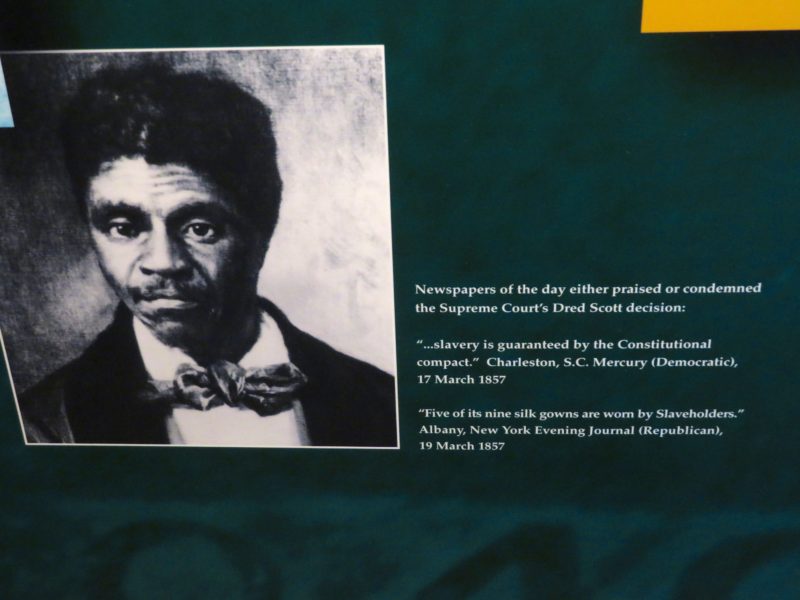
For today I picked a podcast that brings together descendants on both side of the Dred Scott decision, generally seen as the worst decision by any US Supreme Court in history. Dred Scott, a slave, sued for his freedom across all instances, ending up in the Supreme Court, (Dred Scott v. Sandford, 60 U.S. (19 How.) 393 (1857,) which came down in a 7-2 landmark decision on the side of those who considered Blacks inferior: all people of African ancestry — slaves as well as those who were free — could never become citizens of the United States and therefore could not sue in federal court. The court also declared the Missouri Compromise of 1820 (legislation that restricted slaveholding in some territories) as unconstitutional. Well, what would you expect from 9 justices, seven of whom had been appointed by pro-slavery presidents from the South, and of these, five were from slave-holding families.

Scott was bought by the man who had supported him financially and morally throughout the legal proceedings, and then set free. He died 9 months later.

Here is the conversation between Scott’s descendants and those of Chief Justice Taney who wrote the decision. Is this what you consider reconciliation?

https://www.wnycstudios.org/story/american-pendulum-ii-dred-scott/

Let’s add one more statistical bit to question many Americans’ assumptions about how much better things have gotten.

Racist violence in the US has increased by a mind-blowing 45 % in 2017.

https://www.thenation.com/article/trumps-xenophobic-vision-of-america-is-inciting-racist-violence/

No wonder then, that there is actually talk about reissuing the Green-Book….which helped Black motorists to traverse the US as safely as they could, particularly with regard to naming locations where no food or restroom or hotel rooms should be requested. Driving while Black is not a new phenomenon. http://www.history.com/news/the-green-book-the-black-travelers-guide-to-jim-crow-america


Photographs are from South Carolina.


On Reconciliation.

This week is devoted to the topic of reconciliation. I have only questions, no answers when thinking about reconciliation in numerous contexts. In this regard I seem to be in the company of minds smarter than mine and outside of the realm of souls more generous than mine. I will try and present conflicts that are between people, between groups, and within a single person. As far as I can tell, all of the conflicts I picked have a monumental structural component.

Since January 27, last Saturday, was International Holocaust Remembrance Day, I’ll ask if reconciliation between Germans and Jews is possible when antisemitism is not only alive and well, but on the rise in both frequency and intensity of acts that attack and hurt Jews. Let me add right at the start, that antisemitism expressed by Muslim migrants and refugees in Germany is part of the story, but that 90% of the factual crimes are committed by Germans, as government statistics show.

I will report what I read in my daily dose of German news on 1/27.

On this day you found Angela Merkel expound on the shame that Jewish institutions, be they synagogues, kindergartens, community centers or schools in today’s Germany need constant police protection. She warned against rising antisemitism and xenophobia and announced the creation of a bureaucratic office in the new administration that is going to be in charge of these issues. It fell to Charlotte Knobloch, the past president of the Zentralrat der Juden, to point to the fact that the third largest elected party in that administration not only tolerates antisemitism and historical revisionism among its members, but encourages racism, rightwing extremism and populist nationalism.

http://www.zeit.de/gesellschaft/zeitgeschehen/2018-01/holocaust-gedenktag-angela-merkel-antisemitismus-fremdenfeindlichkeit

A commentary in one of the largest daily’s on 1/27 was titled: What happened to us?  It pointed to the fact that from early on Germans lacked the courage to address justice: of the 70.000 concentration camp SS personnel only 1650 received punishment by the courts after the war, often ridiculously small sentences with probation granted. And today’s acceptance of genocide across the world and of hate speech and violence within our own societies indicts us as having learned nothing from the Shoah.

http://www.faz.net/aktuell/politik/auschwitz-befreiung-was-ist-mit-uns-passiert-15416733.html


Also on 1/27 a left-leaning daily interviewed Michel Friedman, member of Merkel’s conservative party, lawyer and TV moderator, who lost large parts of his family in Auschwitz. I found two of his arguments particularly resonant: Most Germans condemned the endpoint,  the final solution, after 1945, but continued to be silent on what happened in the beginning. Millions of Germans were enmeshed in the looting, the destruction of synagogues and stores, the turning a blind eye to deportations. Do we find echoes of that silence in our own times?

Secondly, he argues that we need to educate the next generation to know how to engage in conflict. Rather than being silent in the presence of mental arson, as he calls it, latent or expressed antisemitism and xenophobia, people need to speak up and argue to avoid becoming a collaborator. Verbal sparrings solidify your own orientation, your political point of view, they need to be practiced in schools and at home, acknowledged as valuable tools against conformism.

https://www.taz.de/Archiv-Suche/!5477285&s=holocaust&SuchRahmen=Print/

I can only think of what Adorno wrote in 1959 when trying to point to the difficulty of internalizing the horror associated with German guilt (in my mind a prerequisite for reconciliation.) Loosely translated: You want to leave the past behind: rightfully so, since it is impossible to live under its dark shadow, and because the horror is unending …. wrongfully so, because the past you want to escape is quite alive and well.

Finally here is a new documentary that looks at the relationship between Germans and Jews. It can be seen in full on the web with registration or a small price at iTunes.

Photographs are from last Friday at the Portland Holocaust Memorial which is a strange beast, but obviously visited;  I found freshly picked flowers stuck into the spaces in the wall.

Fleeting Decisions. Lasting Possibilities.

I meant that title: decisions can be reversed; what lasts are the possibilities to choose from.  Or more precisely, what lasts is the fact that there always are more possibilities, as long as we are not risk averse.

The reason this is on my mind has to do with my stumbling over a decades-old, short correspondence with Masha Gessen. Many of you know Gessen as a Russian/American journalist, queer activist and writer who documented the evolving political landscape under Putin’s regime and is highly critical of the Trump presidency.

After having left Russia in 2013 for the second time, likely endangered by being a critical voice in particular for LGTB issues, Gessen now teaches as a visiting professor at Amherst College and contributes regularly in the New Yorker, the NYT, and many other publications and is a recipient of a Guggenheim, an Andrew Carnegie and a Nieman Fellowship.

https://www.theatlantic.com/international/archive/2017/11/a-mafia-state-within-a-totalitarian-society/546848/

As a Russian (the parents emigrated with a young Masha) and a Jew, Gessen tackled issues of (not)belonging since a young age. As someone who had inherited genes predisposing of serious cancer, a decision to take preventative measures to fight the disease was on order some 14 years ago, given that many relatives had died of the scourge. Here we were two complete strangers and yet writing about the pro’s and con’s of preventative ovary removal, something I championed, something Gessen, who also already had children) declined, until just recently when it became unavoidable.

I have, I believe, managed to avoid pronouns up until this point because Masha Gessen, who used to be a woman, is now in transition to becoming a man. And rarely have I read a more eloquent and thoughtful description of the tackling of choices  – from emigration to medical decisions to sex change – than in a recent article by him in the New York Review of Books.

The way he seeks out the world as an expanding universe that might hold a promise of belonging when one is open for change stands in stark contrast to what I believe underlies the populist, nativist movements of our time. I have written about it here last October, when discussing Heinrich Mann’s Der Untertan in the context of the German elections. (Germany, by the way, STILL has no government since the parties seem to be unable to form workable coalitions.)

If you look at it closely, populist movements are against anything that represents pluralism – the coexistence of multiple options. Diversity is not only not desired, it is actively feared. To have too many options is seen as overwhelming; there is a longing for simplicity, redux, a singular structure that is preferred to the complexities of gender, nationality, culture and political movements.

Unfortunately such preference is not only voiced by those who lost status due to an increase in societal diversity and might regain it, but also by many who will be hurt if such a revisionist dream becomes once again reality. Clarity and structural regimentation are seen as antidotes to the chaos of an evolving world where national, cultural and gender boundaries are but in flux.

I hope the fact that so many fought for so long and so hard to implement changes means they won’t easily yield to the other half that wants to return to the old ways, (good old ways only in their imagination, if you ask me.) To have people like Gessen model the courage to radically reinvent ourselves gives me hope.

Photographs are of some of the many paths one could choose.


Fleeting Anguish. Lasting Hope.

Yesterday I marched through downtown Portland to the river with many people who I don’t usually meet. The Indigenous Women’s March was called by Native Americans from several tribes, women of color and their supporters on the 1 year anniversary of 45’s inauguration.

The march began with moving testimony from women who had been at Standing Rock and suffered severe psychological and physical injury from what happened to them there during the raids. There were also even more harrowing reports of those whose sisters/mothers/daughters had disappeared or been murdered throughout the country. There were voices talking about the fears raised by our recent government’s intentions, and the lasting pain of having been forcefully removed from their lands. Anguish all around, tears certainly in my eyes.

At the river all joined into a ceremony that combined traditional spiritual and progressive political elements.

After that there was traditional music, drumming, singing and dancing which truly lifted the spirits, despite the haunting sound of the conches and the eagle whistles. Hope was the strongest emotion then, hope that the future will be carried by those who resist, and that it will be a future where disparate groups find a way to work with each other.


Many generations attended, including a whole gaggle of raging grandmas, who were a spirited bunch.

And of course there were plenty of signs that pointed us in the appropriate direction:


This week I am pairing a poem/piece of writing with each posting, so I thought for today this would fit:

Cold Peace

Germany has seen a major storm yesterday, coincidentally named Friederike, with hurricane strengt fury.  Snow, ice and winds up to 200 kpm throttled traffic, closed every single train service and delayed planes. People died and got injured, and the recovery will be slow.

I had planned to write about Germany because an article caught my eye that talked about a student exchange between the former East and West of Germany.The general idea of student exchange among different nations is of course to overcome stereotypes, learn to know and hopefully like your neighbors, and have first hand impressions of historical and political differences and similarities.

An exchange then, within the same country, is unusual, unless that country has been artificially divided for decades. As it turns out, the exchange used to work perfectly fine, with a lot of East German students living in West Germany and fewer but still many West German students doing the reverse. Not so in the last three years, however. The program has basically folded.

Why? Many kids from the East do not like to be treated in the West as backwards, potential yokels, or aligned with Neonazis. Or they are aligned with Neonazis and do not want to live somewhere where that is still taboo. A full quarter of the West German youth of the teenage age range now has a migrant background; they fear that they will actually not be safe if going to school in East German states where anti-foreigner sentiment runs unbridled.

There is fear and there is an decidedly conscious sense of “other” on both sides.

The NYT, by the way, had in their recent 2018 travel recommendations mentioned “Germany’s Western states,” and nothing about the East. The latest facts bear out a warning for those who look different (reported in TAZ.de) – and I am just giving two examples.

Two days before New Year’s 19 people were injured and 14 made homeless during arson of a house of Roma families in Plauen, Saxony. The DA reports that neighbors attacked the fire brigrade and yelled insults, including “let them burn” and Sieg Heil.

A refuge shelter was stormed by people who beat up the residents. Guard personell was passively looking on, according to witness reports in Cottbus.

It makes me sick to my stomach. Just as much as the latest reports from Poland, immediately adjacent to the Easter provinces:

.

Photographs from the spring feeling here this week, nature being impervious to the crap going on in the world and blissfully sporting 56 degrees in mid January……

Duck cum Fit

· with some goose bumps thrown in ·

In so may words: They are ducking their responsibility.

http://nymag.com/daily/intelligencer/2018/01/ryan-hopes-to-avert-shutdown-by-funding-chip-cutting-taxes.html

They are complicit by sticking their head in the sand, or the mud, as the case may be.


http://www.cnn.com/2018/01/16/politics/cory-booker-kirstjen-nielsen/index.html

They are continuously, remorselessly pursuing a course to undermine DACA and escort the dreamers out of this country.


https://www.washingtonpost.com/local/immigration/trump-administration-appeals-judges-order-that-daca-must-remain-for-now/2018/01/16/41a8c960-f6e8-11e7-beb6-c8d48830c54d_story.html?utm_term=.f22842a53d74

After all, it’s all water off a duck’s back.


They are preening for the next affair, conveniently tolerated by their evangelical base – and hush money is a good way to launder money as well….

https://slate.com/news-and-politics/2018/01/did-donald-trump-pay-porn-star-stormy-daniels-to-keep-quiet-about-an-affair.html

Let’s hope it all ends with a splash landing.

https://www.politico.com/story/2018/01/17/republicans-mueller-midterms-russia-probe-341592

Then again, a stable genius might also be able to walk (away) on water….

Sparks of Fire

A bit of fire represented by sunlit shrubbery all photographed yesterday might counterbalance Monday’s water and Tuesday’s ashes, I thought. Well, the colors of fire.

For the written bit I’ll focus on the fury, however. More specifically, the fury we find in current music that is reacting to the age of Trump.  The link below is a thoughtful and comprehensive take on contemporary protest music, describing musicians we all know, and also several many of us might not be familiar with.

https://www.theatlantic.com/entertainment/archive/2018/01/trump-protest-music-one-year-dorian-lynskey/550268/

The article is an interview with the U.K. music critic Dorian Lynskey who wrote a book, 33 Revolutions Per Minute: A History of Protest Songs in 2011 and now talks about the boom in music explicitly protesting against the current state of affairs. He claims that Trump elicited more protest music than previous political figures because he is so detested and so much the focus of what is going on. Only wars have been able to generate more protest music than despicable public figures.

Lynskey points out that protest music had already seen an upswing around the evolution of the Black Lives Matter movement and the increasing polarization that people were willing to risk, in the entertainment business, under Trump. An example is Eminem’s freestyle—if you’re a fan of Trump and you’re a fan of me, I’m drawing a line, which side are you on? People are willing to lose parts of the audience (unless they are country music singers who stay silent. And of course there is Ted Nugent…) Many of the ideas expressed in current protest music are not just dealing with the ugliness of Trump and his minions, but about the ideas of America. The songs tackle how we are going backwards due to greed and hunger for power, how so many feel powerless and in mourning.

Here is Lynskey’s take on what the music actually accomplishes – a take I very much liked.

Protest songs make people feel not alone. If we were looking at a situation where no artists were doing songs about Trump and nobody was talking about opposition to him, you would notice the absence. It would be painful. On a macro scale—a global or online scale—it serves the purpose it served in civil-rights demonstrations, where you’d be walking along singing freedom songs. This is where I think preaching to the converted is underrated. It’s fine to cement beliefs to inspire people to act on them.

There are also cases where they can turn somebody on to a particular fact or a certain way of looking. I learned a huge amount from Public Enemy as a white, suburban, English teenager. A large part of the reason many people know about Kent State as they do is because the [Crosby, Stills, Nash, and Young] song “Ohio” brings it to people who are not necessarily researching the Nixon era.

Among the many examples the author gives for music clips, one of my favorite musicians is Kendrik Lamar. Many of my readers might not be familiar with that style of music but it is worth some exploration.  https://www.youtube.com/watch?v=NLZRYQMLDW4&feature=player_embedded  

Same is true for a Tribe called Quest. Stretch yourself and leave the comfort zone, listen to the words – even if the use of 4 letter ones remind you of the one they’re directed against.


A Smidgen of Black

Yesterday the US celebrated Martin Luther King Day, with the usual platitudes, the usual wagging fingers from sources that otherwise spew racist sentiments quite frequently, and a president who played golf.  There were also, of course, some smart articles that reminded us what the day is all about, what someone who fought in a civil rights movement with the strongest commitment and who paid with his life for it, stands for.

I selected two things as important reminders to keep an eye on during the struggle for social and political change. One is the fact that institutions are easily influenced by their leaders and one wonders how much they are impervious to change. For that I picked the blackmail letter that the FBI sent to MLK in 1964, demanding that he commit suicide unless he wanted them to publicize his extramarital affair.  Yale historian Beverly Gage found the original in the national archives and commented:

When the Rev. Dr. Martin Luther King Jr. received this letter, nearly 50 years ago, he quietly informed friends that someone wanted him to kill himself — and he thought he knew who that someone was. Despite its half-baked prose, self-conscious amateurism and other attempts at misdirection, King was certain the letter had come from the F.B.I. Its infamous director, J. Edgar Hoover, made no secret of his desire to see King discredited. A little more than a decade later, the Senate’s Church Committee on intelligence overreach confirmed King’s suspicion.

The article below discusses the details.


“King, There Is Only One Thing Left For You To Do.”

The second thing we should take to heart, is a fact that King himself pointed to: racism, poverty, militarism and materialism are all intertwined.  An attack on one needs to include a rejection of the other factors as well, if we want lasting, structural change. Here is a smart, short essay on the topic in the Paris Review.

Martin Luther King’s Radical Anti-Capitalism


Drops of Water

Wish I could just relish the beauty of little drops of water. Water is on my mind because of the crisis in Puerto Rico, however. They don’t have time to waste there over a discussion of the beauty of water – all that counts is the absence of it, the horrifying, shameful, sickening lack of it.

Two articles make my point better than I could, the first one written by a homegrown young man who is really making a mark on the world as a writer and reporter. Proud to know him.

http://nymag.com/daily/intelligencer/2017/12/hurricane-maria-man-made-disaster.html

I visited El Yunque in 2012, together with about 12 million other people on that very day. None of whom will this spring be a tourist in Puerto Rico, depriving the island of income now needed more than ever. All of whom will recognize too late what our unwillingness to help with the disaster relief implies: try and find a hospital that is not short on infusion bags during the current influenza wave…. or  a cancer ward not short on chemo infusions.

All that pales, of course, in comparison to what the people of Puerto Rico go through, without end in sight.

https://www.dailykos.com/stories/2018/1/14/1730774/-Water-is-life-Puerto-Rico-potable-water-and-El-Yunque

Drops of water just like little drops of help won’t make the difference – there needs to be systemic, structural change.


A Walk on the Beach

The price you pay for traveling with your mother – or the adventures you experience, depending on perspective – is guaranteed to include visits to art museums, cemeteries, botanic gardens, explorations of graffiti  and the beach. And the occasional detour, if your mother is Frau Heuer.

The beaches around Charleston are diverse, and pretty empty during the winter. I presume during the  summer they are a zoo.

Beach towns vary. There are upscale neighborhoods (Isle of Palm), where the degree of wealth can be inferred from the car models rather than expressions of taste.

There are rather seedy neighborhoods (Folly Beach), which reminded me of spring break scenarios, minus the drunken crowds, given that it was December.


And then there are nature trails leading to somewhat hidden beaches, good for long walks and conversations;

the topic this time centering around race, as you’d predict. We would laugh around tidbits like this one:

In Search of the Black Confederate Unicorn

and think through issues of reconciliation (a topic I plan to explore in more depth at some future point here – I think it would be interesting to look at the various ways across time and places that people tried to come to terms with prior injustice.) For now, let this link with a conversation between the descendants of Dredd Scott and those of the other side be food for thought:

https://www.wnyc.org/story/american-pendulum-ii-dred-scott/

And speaking of food: the nice thing about traveling with your mother is that there is always a good meal guarantied.

With the appropriate drinks  

mystery deserts, refusal of  pumpkin spice

and strangely named waiters…