Browsing Category

Politics

Encounter in a Parking Lot

Today I will report on one of those “You ok? No, I’m not.” encounters.

During my recent foray to San Francisco I was hanging out at the parking lot of COIT Tower, while the film crew did some “B-roll” footage, recording scenes that can later be used in a documentary as background information, providing a sense of place.

Next to me, with both of us staring across the water at Alcatraz, was a middle-aged woman whose face was swollen from crying. (One of the reasons why there is no portrait today.)

I couldn’t help but ask if she was ok and the mere question elicited a torrent of revelations. A union rep, she had come to San Francisco from West Virginia 3 days earlier after her sister suddenly fell ill. A day later her sister died. Vicky had buried her father in law in February and lost her son, recently released from prison, to an overdose death in March.

She had come up to the tower to look at the social realist murals painted by students of Diego Rivera (quite a few women artists among them) in the early 1930s, radical political work that she had always wanted to see (Photographs below). But she was glued to the view of the prison, as was I, for far more personal reasons in her case than mine. Having sought distraction, she was right back at the central loss of this year, of her life, that of a child to opioids.

*

Post-release opioid overdose mortality is at an all-time high and the leading cause of death for people released from jail or prison. There are many factors that contribute. I will try and summarize the current science, details can be found here.

Chronic pain, HIV and trauma, all prevalent among people who experienced incarceration, are linked to opioid use. So is the increased suicidality among the recently released, with a large number of overdoses being assumed to be intentional. The risk is increased by other factors: incarceration disrupted social networks, broke up families, increased poverty, interrupted health care access and led to stigma upon re-entry (something even more so experienced by Blacks than Whites, when looking at failed employment attempts and housing needs.) Re-entry into the community also often lays bare underlying psychiatric disorders and addiction problems that were partially contained while medicated in prison but also exacerbated by incarceration itself.

Solitary use is a risk factor for dying of an overdose as well. The majority of people who inject opioids after release from incarceration do so on their own and avoid social settings where help could be provided by someone near by, or where counteragents like Naxolone are available. People crave solitude after having no privacy whatsoever for every minute in prison. Then there is the loss of tolerance because of prison-induced abstinence over longer periods of time. People who used drugs before imprisonment and tolerated high doses, will die when they go back to those doses after periods of abstinence, because of dangerous levels of respiratory depression.

Generally there is little to no guaranteed access for post-release users to opioid use medication, given the pretense that people leave prison “clean.”

There are clear policy lessons implied. The lack of available Opioid Antagonist Therapy post-release needs to be remedied, first and foremost. Many of the people with addiction problems should not be in prisons in the first place, which increases trauma and health-related issues that lead to an increased risk of self-medication/regulation through further use. Treatment programs are the way to go (and, incidentally, cheaper than incarceration to society at large.) It would save a lot of families a lot of pain.

With this said, here is a classic.
Bay Area Visions

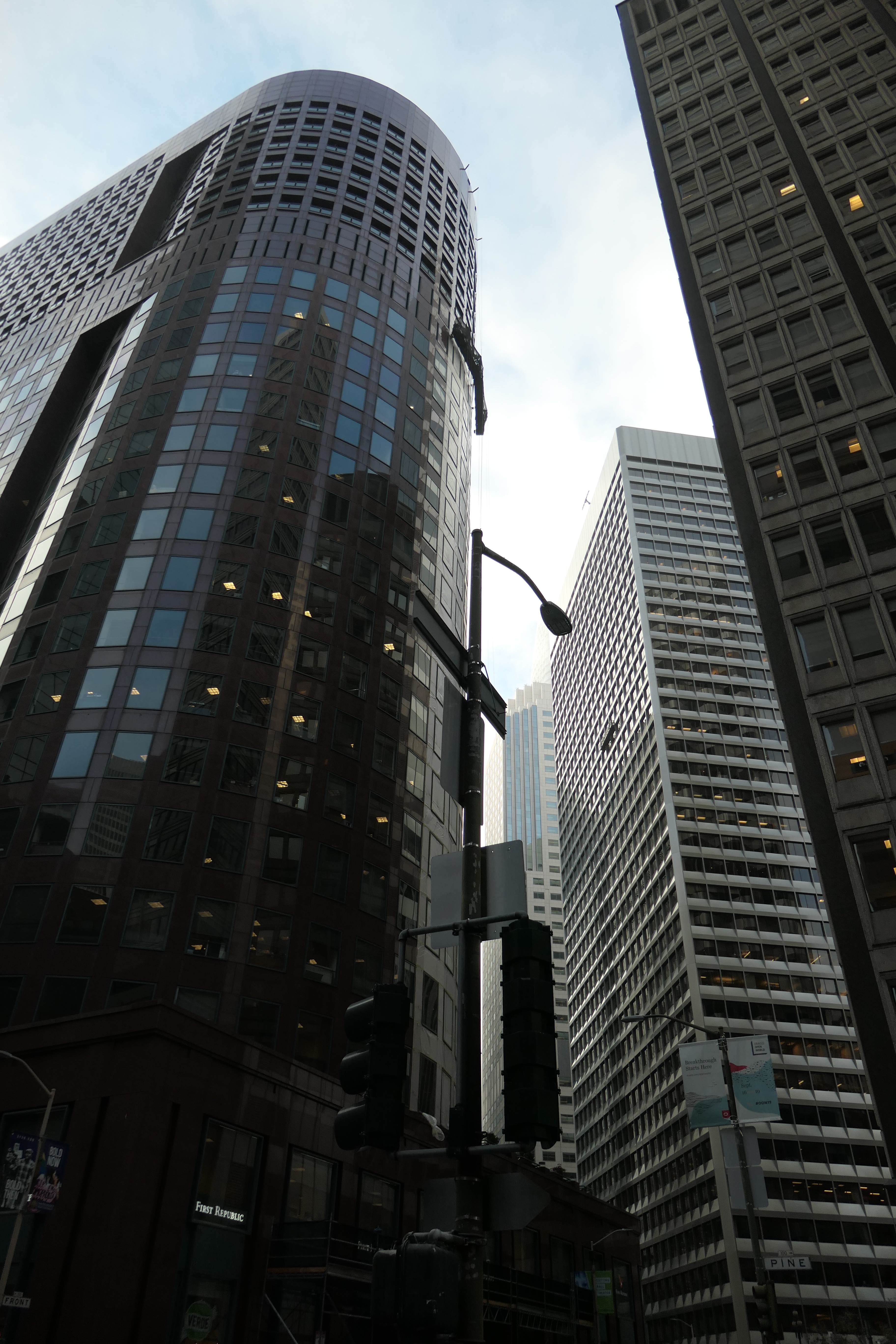
Today I thought it would be fun to juxtapose the looming architecture of San Francisco’s Financial District with an extraordinary building I visited in Berkeley.

Here is a sampling of banks, consumer palaces, office towers and other oppressively imposing structures.

The Microsoft Building

Even the reflections echoed the massiveness.

And here, in contrast, is the 10 year-old David Brower Center, a beautiful green building that is home to the environmental movement and its allies.


It was named in honor of David Brower, an extraordinary rock climber and pioneer of the environmental movement – he founded Friends of the Earth and later the League of Conservation Voters – who was the first executive director of the Sierra Club. Many different organizations share the space.

The lobby branches into the light-filled Hazel Wolf Gallery devoted to art of advocacy, which currently shows The National Geographic Photo Ark led by photographer Joel Sartore.

*

The Necessity team was there to interview two lawyers from the Climate Defense Project who represent climate activists and also work as legal observers during demonstrations and other actions. Executive director Kelsey Skaggs and co-founder Alice Cherry are both Harvard alumnae and the 2018 Echoing Green Fellows of Harvard’s Public Service Venture Funds (PSVF) which provides seed funding for emerging leaders who are tackling the world’s most pressing issues.

Kelsey Skaggs
Alice Cherry

Among other things, the attorneys focus on the necessity defense, a legal argument used by people accused of acts of civil disobedience. It states that when all legal and political means are exhausted it might be necessary to engage in non-violent illegal action to prevent irreversible harm. You need to offer proof that harm was imminent, that the harm you inflicted does not exceed the harm that is potentially prevented, and you have to be able to show that all other attempts to stop the harm within our legal framework were futile.

Alice Cherry and Kelsey Skaggs in discussion with film director Jan Haaken

Here is a more knowledgeable and detailed description of the argument written by Kelsey Skaggs.

Given the threats that resource extraction entails for our climate, and the continuing inability to address industrial assaults on the environment within the usual frameworks of our law, this is the true vision, alluded to in today’s title.

Music today by John Prine, you can read about him here.

Necessity

We should reframe the old adage “It takes a village to raise a child.” A more urgent summons is needed during a time when the 2019 UN Climate Change Summit failed to deliver and scientific predictions of how fast we are approaching a point of no return are growing more dire by the day.

How about: “It takes alliances to save a planet.”

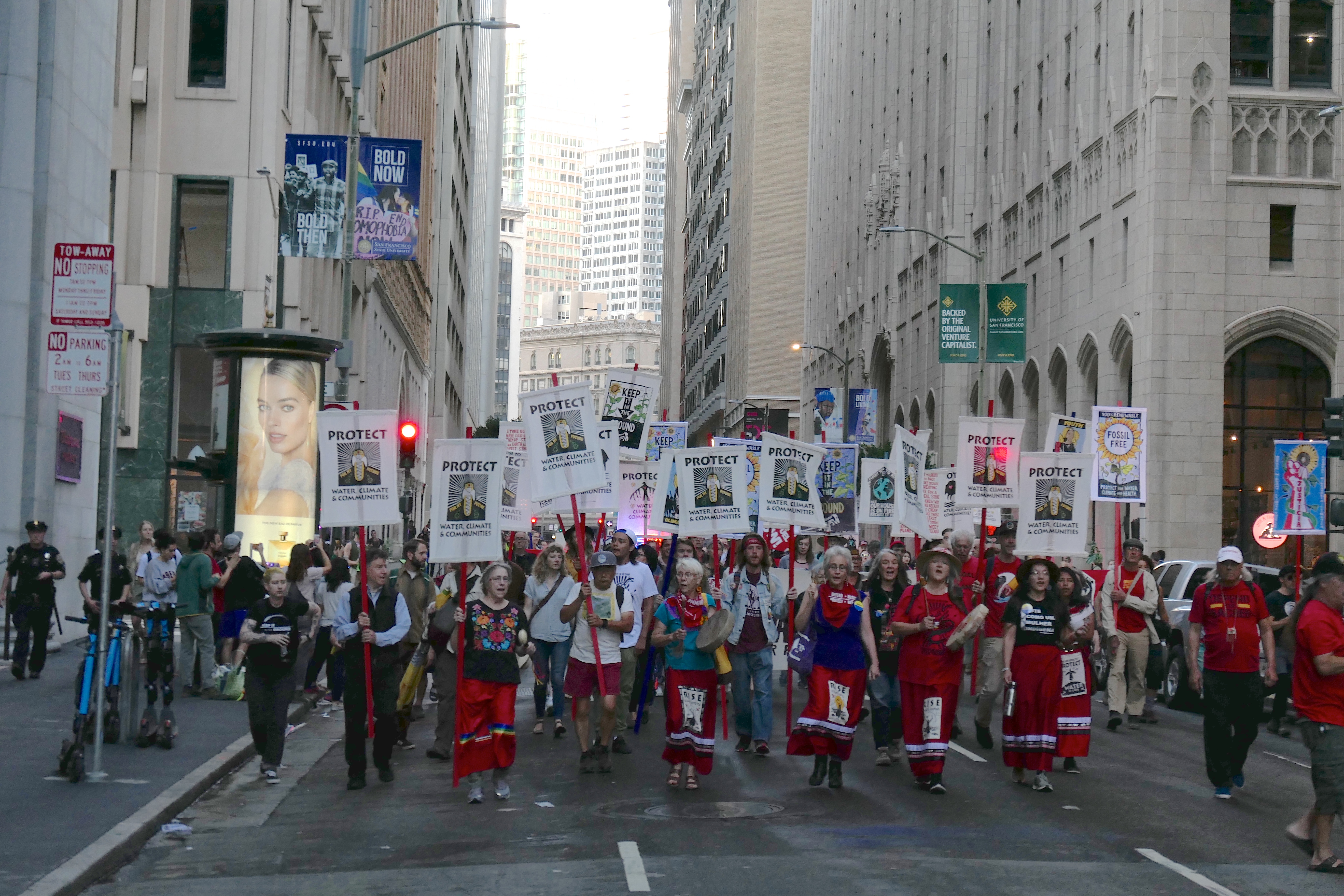
Banners at the 9/25/2019 San Francisco Bay Area Strike for Climate Justice

There are those who deny the dangers (or the very existence) of the climate emergency, those who ignore it and those who are giving in to helpless passivity in the face of it.

Then there are those who are determined to raise awareness about the crisis, change, at a minimum, our behavior, or, more urgently, our whole system of relating to nature and each other. They are forging alliances across a whole spectrum of organizations and participants, setting aside differences in ideology and strategic approaches, and join forces to rescue this planet in whatever fashion is still possible. By necessity.

The documentary film project Necessity is in the process of following and interviewing several of the diverse groups and activists participating nationally in the fight for climate justice. (I am involved with the production photography of the series.)

Director Jan Haaken, Cinematographers Peter Menchini and Anna Rosa, Neshma Friend Camera Assist, and Sound Recordist Edmundo Torres, at 6 am walking to the meeting point.

This week we attended the Strike for Climate Justice! in San Francisco, called for by the Climate Justice SF Coalition, and organized by 350.org and Extinction Rebellion SF Bay. The attached website informs about the various alliances for the event; a look at the endorsements tells its own story of bridge building.

Endorsed by: 350.org, 350 Silicon Valley, Amazon Watch, Brasil Solidarity Network, Center for Biological Diversity, Code Pink, Democratic Socialists of America (San Francisco Chapter),​ Friends of the Earth, Global Exchange, Interfaith Climate Action Network, No Coal in Oakland, Rainforest Action Network, Sunflower Alliance, Sunrise Movement Bay Area and Sunrise Project.

The diversity of participants, apparent on paper, became so much more impressive when seen in action, people supporting each other during an event that was stunning in its dimensions. Here is a visual sampling, just to give you a sense of the range in age, politics, and approaches. Organizations and individuals alike were fully immersed in the proceedings, sharing a common goal.

Folks from XRSFBay
Sage Lighting Purification

Strongly represented were those protesting the Brazilian crimes against the rainforest.

Maria De Lime Dorsey from the Brazil Solidarity Network
Interviewing Shahid Buttar, a San Francisco attorney who is launching a primary challenge to Nancy Pelosi
Interview with one of the representatives of Idle No More SF Bay a group of Native Americans and their allies

*

Before the strike on Wednesday, activists stopped traffic for 3-5 minutes on several intersections in the financial district on Monday. They handed out leaflets informing the public about the planned actions. Drivers’ reactions ranged from smiles and thumbs up to frustrated honking and aggressive approaches to break the line closing the road. This kind of civil disobedience was tolerated by the police who were visibly present but did not engage.

Interview with Lisa Fithian, representing the National XR
And the indispensable Heather from the local chapter.

*

Wednesday’s acts of peaceful civil disobedience directed against multinational banks who play a role in earth’s destruction, on the other hand, led to immediate arrests and/or citations. We cannot have people hindering Wells Fargo employees from entering their building after lunch by blocking the doorways….or have banners unrolled from the rooftops informing about the issues, can we? Paddy wagons were at the ready for the seven arrested, as were legal observers from the National Lawyers Guild to assist those who were in need. I will write about new approaches in defending acts of civil disobedience around climate justice with a necessity defense in more detail at a later point.

Police Helicopters circling
Someone more agile and courageous than I, covering the roof action. Kelly Johnson is a remarkable photographer. You can see her footage here.

*

I cannot begin to imagine the amount of planning, preparation, organizing, sheer work and herding cats that must have gone into the choreography of what unfolded on the streets in the heart of the financial district on Market and Montgomery St. They all did a remarkable job, with veteran art organizer David Solnit being instrumental.

David Solnit, the North American Arts Organizer for 350.org

A lot of different art forms were utilized. They ranged from painting murals on the street – with tools, templates and colors all provided,

Final Stretch of Murals – Photos by Mary Spadaro

to clowns,

to music,

to dance,

to fun and games,

to an amazing silent mime group, The Red Rebel Brigade, who were stunning in their synchronized movement, emotive power – and tolerance of heat in those costumes on a late September day approaching temperatures in the 90s.

*

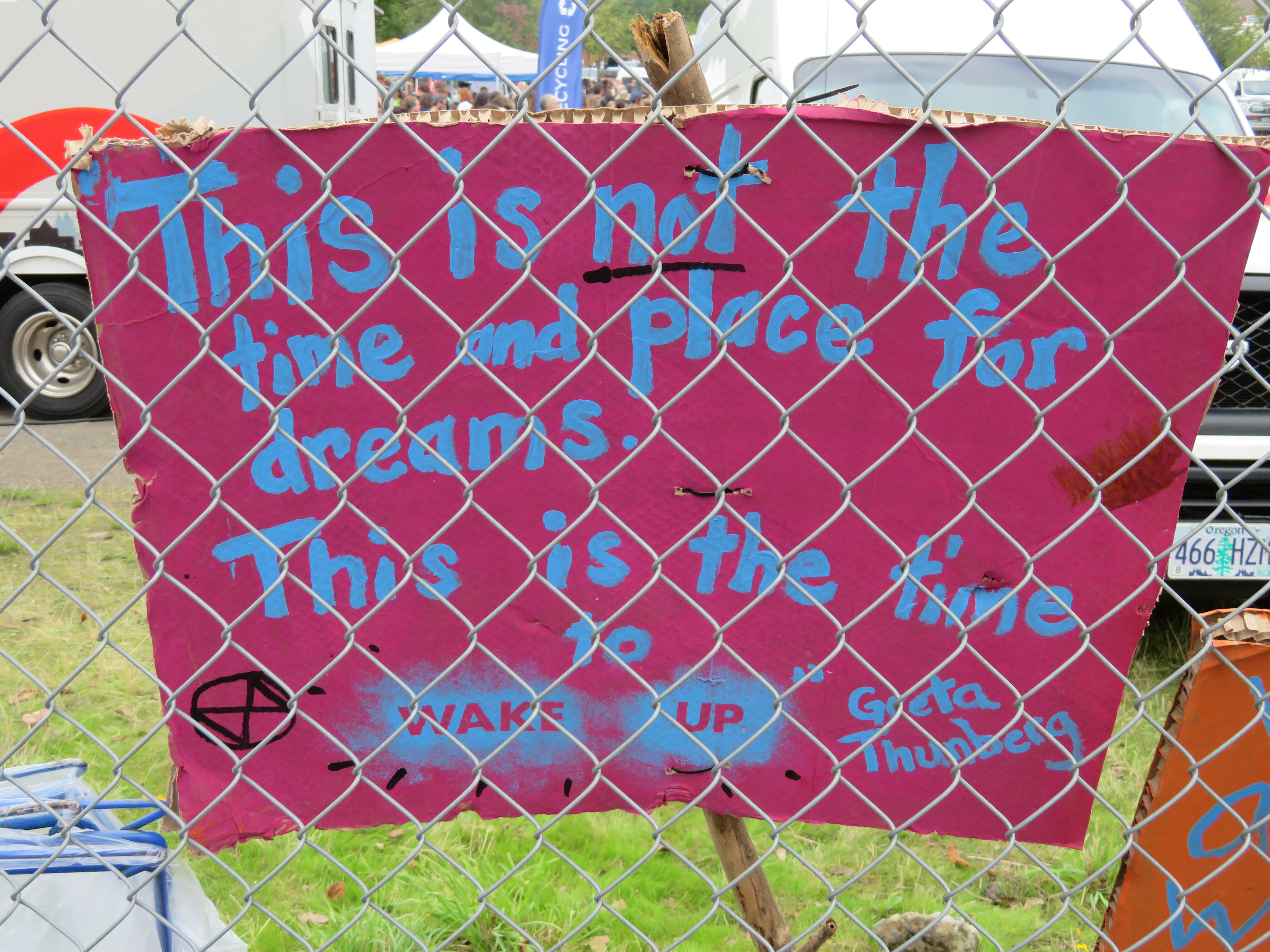
The theatrics were matched by the passion of many of the individual signs carried in one fashion or another by individuals.

*

The festive atmosphere of a block party on steroids helped instill a sense of solidarity and community. It raised the hope that there will be enough momentum to wake up the numbers of people needed to create the mass movement necessary to hit the brakes on our ruination of the planet. Organizing it must have been hard. The harder work lies still in front of us. A necessity, if we want to preserve a future for our children and grandchildren. Knowing we are doing it for them, and are not alone in this struggle, will ease the way.

PDX Friday

Telling the stories in pictures today (and a link to OPB’s summary of the climate rally.)

So many youths participated, so much energy, such urgency.

There were places to meet and places to play:

There were plenty of relevant signs, covering a wide array of topics:

Plenty of people:

A lot of colors….

And one no-drama llama:

And the nurses, after tending to an endangered bee, were in dire need of refreshments…

Grateful for all who came out, all who gave support in other ways, all who are no longer looking away.

Global Climate Strike

Today is the start day of the Global Climate Strike week. We don’t know how big it is going to be, but my prediction is: massive! Here are some known statistics:

Globally, 72 trade unions and federations are supporting the climate strike, with unions in Quebec and Italy taking formal strike action to join the youth school strikers. In the U.S., workers in major tech companies like Amazon, Facebook, and Microsoft are walking out of work to demand their companies take real action on climate change.

6,300 websites, including Kickstarter, Tumblr, and Tor will be green-screening their sites and directing visitors to the climate strike website as part of the Digital Climate Strike.

Globally, over 2,500 businesses are supporting the strikes —from those going all out, like Patagonia and Lush, with poster-making areas in their stores or closing their doors for the day completely, to others allowing workers to walk out for a short period to join the strike.

In the United States, a monumental mobilisation will see over 1,000 protests across the country, taking #StrikeWithUs outside of the major cities to every corner of the nation. New York public schools have given permission for all 1.1 million students to skip classes! More than 1,240 actions will be held in Europe across seven countries. There will be mobilisations in every country in Latin America, including countries that have not participated in climate action before such as Cuba and Venezuela! From Brazilright up to Mexico, there will be protests: A massive march in the south of Brazil against the proposal of the biggest coal mine in the country.

Here are some pictures of what this Friday so far looked around the world.

https://www.theguardian.com/environment/gallery/2019/sep/20/global-climate-strike-millions-protest-worldwide-in-pictures

In Berlin 230.000 are in the streets, below that is Hamburg. Performance artists stand on ice blocks to demonstrate the world’s potential fate.

Here is the FridaysforFuture Map that shows events near you. For us in PDX, the demonstrations begin at City Hall in the morning and will then march over the Hawthorne bridge down to OMSI where there will be events all afternoon until 5 PM – Meet me there! You will join scientists, artists, and, of course, the youths who are leading the way.

I will also be involved with documenting some climate change actions in CA, part of next week. Expect some interesting postings, even if irregularly sent.

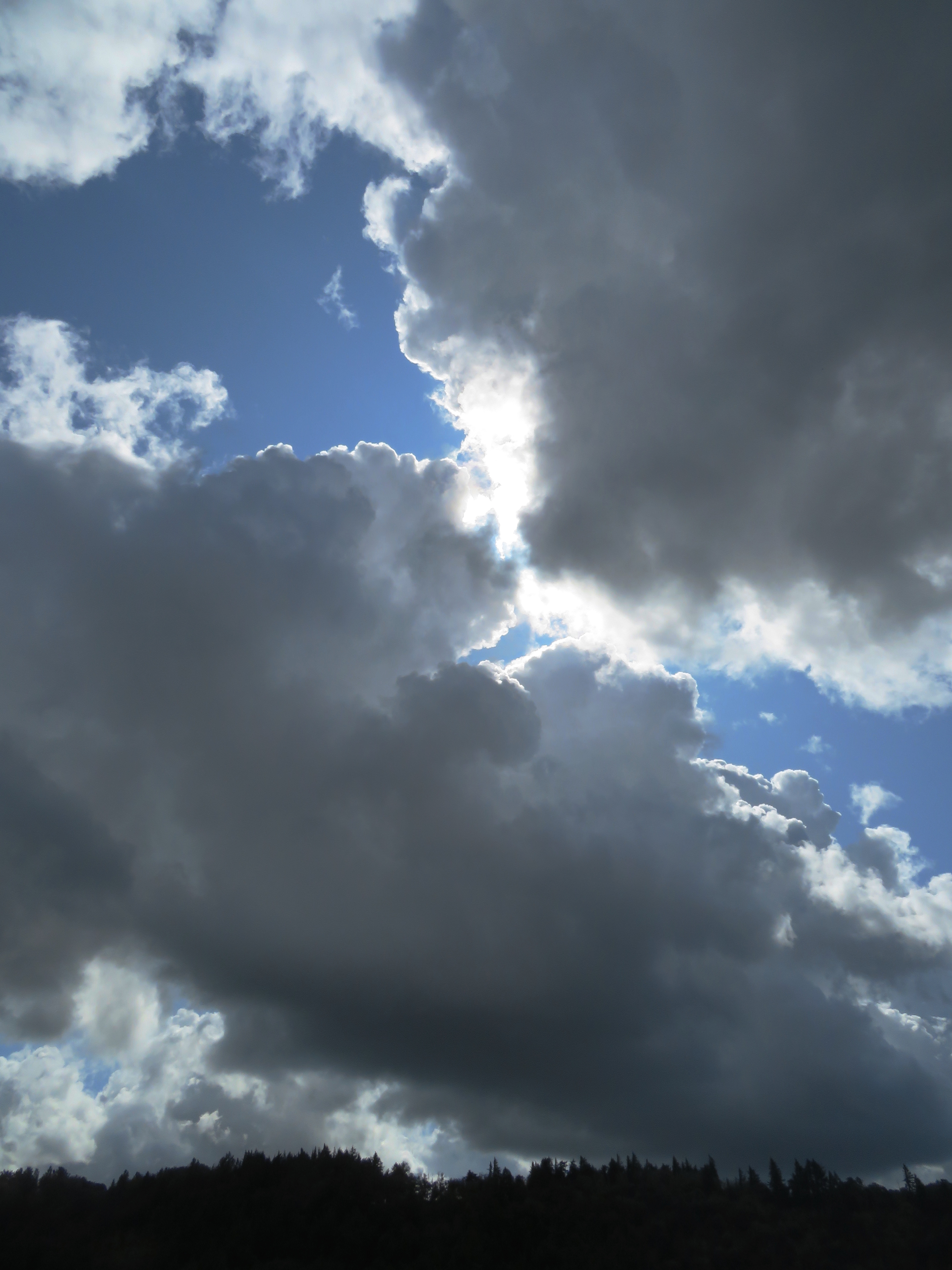
Photographs today from threatening skies, hung over us all week when they weren’t already pouring down….

Two pieces of music based on climate data…..

https://www.co2.earth/global-warming-music-for-string-quartet

https://vimeo.com/127083533

In Flight

I have few words of my own to offer today, so that there is more time to read the words in the attached link.

https://www.newyorker.com/magazine/2019/08/19/the-fight-to-redefine-racism

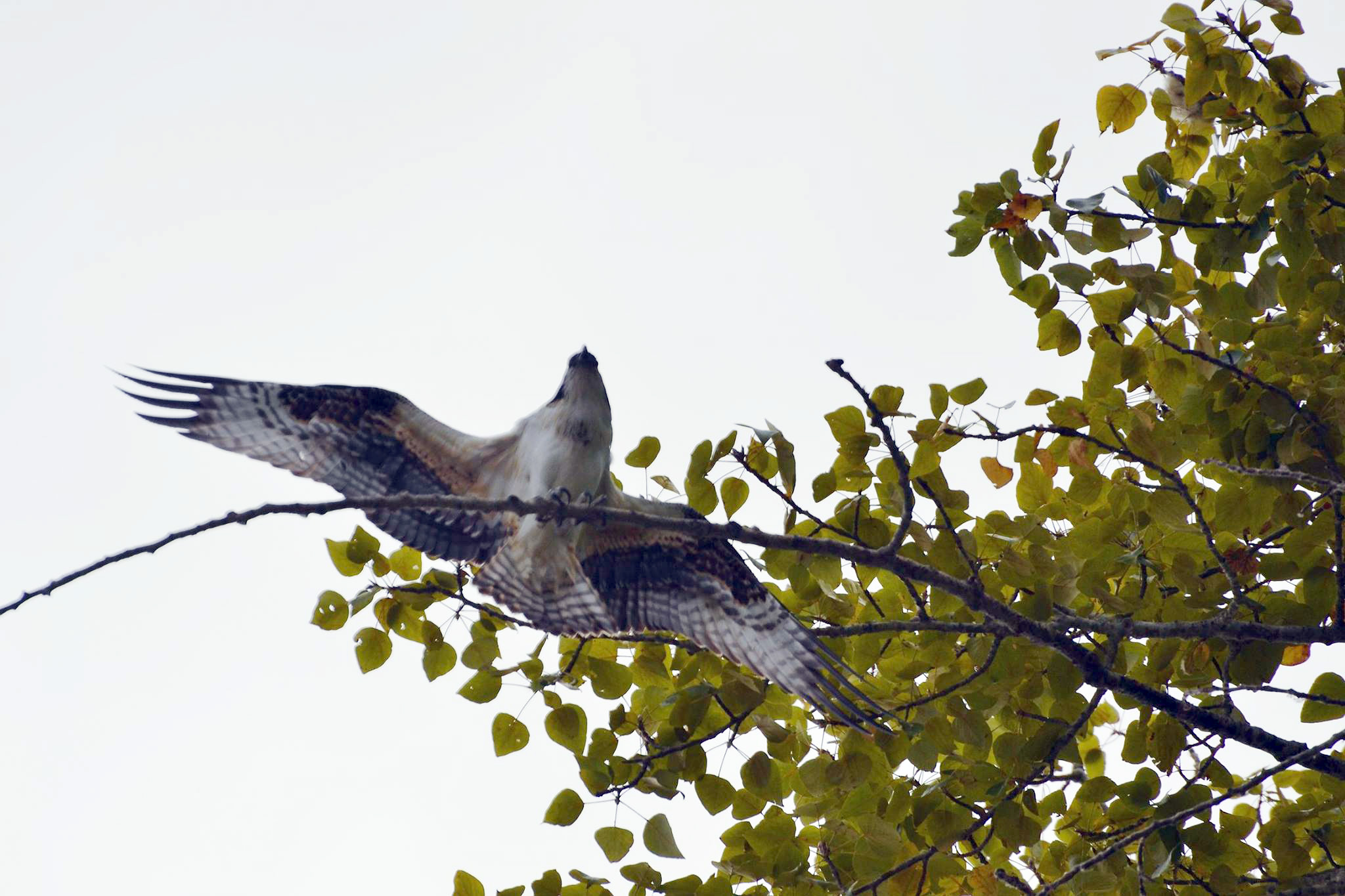
If the photographs of ospreys seem unconnected – well, they are mostly captured in flight and I will be flying too, reading Kendi en route to the East Coast. Ibram X. Kendi is Professor of History and International Relations and the Founding Director of the Antiracist Research and Policy Center at American University in Washington, DC. His newest book just came out: How to Be an Antiracist. His previous book, STAMPED FROM THE BEGINNING: THE DEFINITIVE HISTORY OF RACIST IDEAS IN AMERICA, won the 2016 National Book Award for Nonfiction.

It will be the usual, then, the occasional Art on the Road report, but no regular posts until I return from my travels. And speaking of which: here is a proposal by the German Green Party to ban domestic flights by the year 2035. In a country the size of Germany that is conceivable, if trains pick up the slack. Not so much here, when you consider what it would take to visit anywhere in the country….

In any case – I’m off. Just think: you’re getting a break!

Music offers a couple of selections for Labor Day!

The chickens will come home to roost

On my way home in the car from a terrific but exhausting weekend at Maryhill Museum (more on that to come later this week) I heard an interview with Christine Lagarde, leader of the IMF until recently.

When asked about what had possibly confounded her in all her years in leadership positions, she answered, “A study that showed that 90% of the 189 membership countries of the International Monetary Fund had legal and/or constitutional restrictions, discriminating against women.”

Here is more on that. We are talking about issues concerning inheritance, or custody of children, or being allowed to own businesses. Some countries forbid women from doing specific jobs, 59 countries have no laws against sexual harassment in the workplace and there are 18 countries where women can be legally prevented from working. And this is only a partial list!

And here is the link to the interview.

Time for change(s,) no clucking allowed.

Wake-Up Call

My Work is Loving the World

Mary Oliver

My work is loving the world.
Here the sunflowers, there the hummingbird – 
equal seekers of sweetness.
Here the quickening yeast; there the blue plums.
Here the clam deep in the speckled sand.

Are my boots old? Is my coat torn?
Am I no longer young and still not half-perfect? Let me
keep my mind on what matters,
which is my work,

which is mostly standing still and learning to be astonished.
The phoebe, the delphinium.
The sheep in the pasture, and the pasture.
Which is mostly rejoicing, since all ingredients are here,

Which is gratitude, to be given a mind and a heart
and these body-clothes,
a mouth with which to give shouts of joy
to the moth and the wren, to the sleepy dug-up clam,
telling them all, over and over, how it is
that we live forever.
 

This is the first poem in Mary Oliver‘s collection Thirst, titled, “The Messenger.

I encountered it at a writing workshop for houseless vendors at StreetRoots this week. Mary Oliver had been previously introduced to me by the workshop leader who continually excels in expanding my horizons and I took to this poem in no time. Hey, gratitude for nature! Up my alley. Loving the world? A familiar task. Mouth shouting joy – my readers are my witness!

And then a participant pointed out, with anguish bordering on rage, that it was not their job to love the world. A world that mistreated them, rejected them, punished them, tortured them, deprived them and excluded them. A world where safety was non-existent, food unreliable, pain untreated. Where admiration of nature was not exactly high on the list when you could but fear the elements. Where the very idea of living forever is blacked out by the worry about living for another day.

You know that feeling when heat creeps up your neck, into your cheeks, the blushing that interferes with breathing? That was me: caught in my bubble of middle-class existence, originally not even tangentially aware how gratitude of the kind the poet references is linked to privilege. The privilege to have time to notice, room to appreciate, means to express and capacity to love nature within my safe surroundings.

I am not saying that homelessness precludes gratitude. On the contrary, I am often floored when seeing the generosity of spirit expressed by the folks I’ve gotten to know. I am more concerned with the demand characteristic or the taking for granted in my own head that the world is to be loved.

Mary Oliver’s work might have been to love the world. (She died this January – a remembrance from the New Yorker is in the link.) My work right now is to become more aware of how automatically we apply standards that seem self-evident to us – gratitude for nature! – but which are wholly inappropriate for those whose very existence is under attack. And then my work is to fight the causes for the differences in standard. Actually: the work of all of us. 38.000 houseless people in our city deserve that.

Photographs today are from another habitable building making room for another luxury hotel in downtown Portland.

Music today is from an interesting cross-over album Now and Then Music from the Great Depression(s) 2010/1929 ( to which we might add 2020, I gather.)

Place Holder (2)

Someone else’s words, again, for your weekend reading. Written by Rebecca Solnit in April, I wish the essay had more circulation.

I value Solnit as a feminist thinker and writer; usually her pieces, which she seems to churn out by the minute, are tightly structured and argued with heady measure. This one seems like passion took over and the language erupts, at times almost like stream of thought. An interesting experience.


I’ll be back with more reports from the Exquisite Gorge project on Monday!

Music to day by another strong woman, Louise Farrenc (1804- 1875) Following her marriage, she interrupted her studies to play concerts with her husband, the flautist Aristide Farrenc. Despite her brilliance as a performer and composer, she was paid less than her male counterparts for nearly a decade. Only after the triumphant premiere of her Nonet for wind and strings – in which the violinist Joseph Joachim took part -did she demand and receive equal pay.

Photographs are from Portland State University’s Walk of the Heroines honoring women.

Place Holder

Let’s face it: I am on overload. There are 4 more artists to interview and write about before the grand finale of the Exquisite Gorge project in 2 weeks. No matter how much I enjoy the project – and I do, it has been intellectually satisfying beyond my expectations – these pieces are long and require a lot of informational reading on my part, as you might have guessed if you followed the accumulation.

So I am copping out just a little bit: depending on where I am in the process I will let others speak for YDP.

Today, then, I leave you to words that are magical, in more than one sense of the word, and deeply moving. Obviously not my words. One of the most powerful pieces of writing I’ve come across in a long time.

http://nymag.com/intelligencer/2019/08/the-black-art-of-escape.html

Photographs are of from the East Fork Lewis River in WA, including Lucia Falls. (Rivers play a role in the linked story.)