I’ve been on the road so much that regular blogging has fallen behind. Part of that was access to the net, but part of it was also the need to work through the many impressions and emotions triggered by being here.

Yesterday the highest court in the country ruled NOT to prohibit the NPD, the neo-Nazi party called national democratic party. In a 298 page long verdict the court declared that all of the accusations against the party where true – its closeness to the NS philosophy, its attempts to destroy democratic processes and structures, its disrespect for human rights and its active attempts to pursue its national socialistic goals. However, the party was deemed ineffective, not likely to succeed in its pursuits of NS goals, its membership too sparse to be a true danger. Thus it can continue to exist – as can now multiple neonazi smaller organizations that have not – yet – succeeded in undermining the republic.

Also yesterday, a major figure of a rising populist party, the Alternative for Deutschland or AfD, criticized the Holocaust Memorial in Berlin with the words that Germans were the “only people in the world who planted a memorial of disgrace in the heart of their capital”. People reacted with dismay, disgust and multiple editorials to Hoecke’s speech, worried about the use of Nazi language and attempts to minimize the suffering the Nazi’s had wrought.
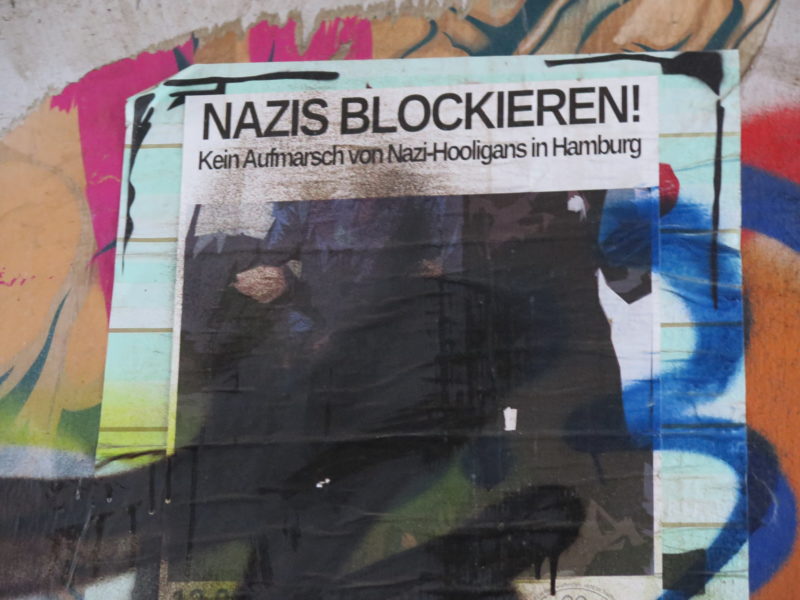
Also yesterday, Maier, a German judge from Saxony, declared that the “guilt cult” (Schuldkult) had to end, arguing for an end to commemorating the holocaust. “I declare it done with, as of now.” Requests for commentary were not answered by his employer, the German ministers for Justice. Luckily, you find lots of opposing public voices, and tons of street art from the other side of the spectrum.

Memory is preserved with markers, memorials, and the stumbling stones that are ubiquitous – naming those killed and deported in front of the buildings that used to be their homes.

Long before the Nazis, Jews were given tiny plots in public cemeteries to bury their dead. When you come to these plots you find grave after grave narrowly spaced, as here in the town of Giessen.


Here is a memorial (and empty lot) for the largest synagogue in Northern Germany, defiled and destroyed by the Nazis.


Here is a marker for the last functioning medical office that still tended to Jews in the Third Reich in Hamburg until it, too, was closed.


And here is a Jewish school in Hamburg – under permanent police protection – they sit in the little barrack in front of it. (About 3000 Jews live in Hamburg, the school has some 160 students. There were 17.000 in 1933 according to the census.)


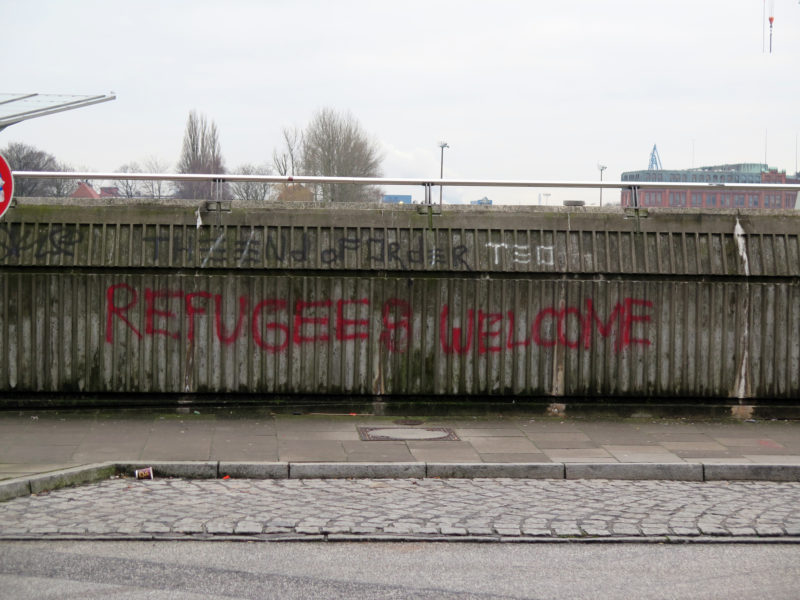

 Refugees, even in smaller numbers, still need housing, work, financial support and schooling in language and culture. I am truly astonished how many average citizens of Hamburg are involved in volunteering and donating to all of these aspects of integration. I visited a donation station and was impressed. I heard from friends how many of their immediate surround is and has been involved for years now in teaching German, helping in soup kitchens and the like.








 The link below brings you to Ursula LeGuin’s latest blog, a long, thought-provoking reflection on the election.








 I felt that one had better die fighting against injustice than to die like a dog or rat in a trap. I had already determined to sell my life as dearly as possible if attacked. I felt if I could take one lyncher with me, this would even up the score a little bit.


 Wikipedia tells me: “Gaines has been a MacArthur Foundationfellow, awarded the National Humanities Medal, and inducted into the French Ordre des Arts et des Lettres (Order of Arts and Letters) as a Chevalier.