Now the bricks lay on Grand Street
Where the neon madmen climb
They all fall there so perfectly
It all seems so well timed

Now the bricks lay on Grand Street
Where the neon madmen climb
They all fall there so perfectly
It all seems so well timed

“There is a cult of ignorance in the United States, and there has always been. The strain of anti-intellectualism has been a constant thread winding its way through our political and cultural life, nurtured by the false notion that democracy means that ‘my ignorance is just as good as your knowledge.”
― Isaac Asimov

What’s wrong with phrenology and divination? Let’s shred the lab reports and turn to intuition!
– Your’s Truly (paraphrasing certain political candidates.)
We’ve got ballots flying around, being counted by hand, arriving by truck and in God knows whose custody.
– David Axelrodt

Never mind voter suppression, re-districting efforts, hanging chads, closed voting stations and potential cyber manipulations from foreign powers.
– Your’s Truly
A national political campaign is better than the best circus ever heard of, with a mass baptism and a couple of hangings thrown in.
-H. L. Mencken

Orange-haired clowns need not apply.
– Your’s Truly
All politicians should have 3 hats – one to throw into the ring, one to talk through, and one to pull rabbits out of if elected.
– Carl Sandburg

All of them preferably without a logo about making America great again.
– Your’s Truly
This week we’ll keep it short – I’ll be sending a “postcard” each day, as if on vacation (I wish….) Any associations to current politics are, of course, purely accidental.
Men think highly of those who rise rapidly in the world; whereas nothing rises quicker than dust, straw, and feathers. – – Lord Byron


We’ll end this week on a positive note: people with big brains and big money care and give us some constructive ideas.
The link leads you to a talk by Stefan Norgaard, Stanford University Tom Ford Fellow in Philanthropy at the Ford Foundation. (Thanks, F.X., for sending this!)
Here is the upshot for a fast read:
“What can philanthropy do to ensure to equitable development models for major large sporting events and arenas benefit everyone? Here are some possible courses of action:
Major sporting events can ignite a city’s spirit and civic capacity, can lead to a sense of citywide pride, and can certainly help to increase tourism and economic stimulus. But major sporting events and projects only benefit everyone when they are deliberately designed to do so. If we change the approach to development, large sporting events like the Olympics can reduce, rather than drive, inequality.”


Does the name Belo Monte sound familiar? Let me guess: not. I certainly knew nothing about this dam construction project until I started to read up on graft and the interrelations between Brazilian politics and (inter)national construction companies.
The dam, with a price tag of more than 10 billion dollars, has been built in Brazil’s second largest state, Pará, and is rerouting the Xingu river. Its construction (the third largest of its kind in the world) destroyed the local ecology and made fishing in the Amazon areas practically impossible, thus voiding the local, self-sufficient economy. Ten thousands of people were forced to relocate in cheaply and quickly built satellite townships, which are already falling apart. There are no jobs, and there is no public transit that could bring people to where the jobs are. A few schools and hospital were built, but fewer than promised, and too little too late. Crime rates and drug abuse have risen to astronomic proportions.


The energy and the profits from the dam are not staying in the region – the electricity is used to fabricate aluminium for car manufacturers – our way of life in the fast lane is based on flooding of the rain forest, and the abuse of Indigenous peoples’ rights. There were laws, from the 1980s, that were used by the lower courts to try and stop or delay the destruction. However, court decisions are now regularly overturned by the high court with suspensão de segurança, a claim of danger to national interests if the industry is not allowed to proceed. That clause was kept on the books from the times of the military dictatorship. How can this happen? Political parties in Brazil get their income primarily from industrial donations. These mega projects are ideal to cement the quid pro quo.
Why mentioning this with regard to the Olympics? Guess which firms built the infrastructure used for the games…..
(Here is Part 1 of many parts of a documentary film on the project – alas in German)

“The images of Team Refugee at the Olympics offers a glimmer of hope in a gloomy summer.” When I read these words by Isobel Harbinson, a London based writer and curator, I had an instantaneously cynical reaction; “Woman, what are you thinking?” Yes, Thomas Bach, president of the IOC put up some $2 million last summer with the help of mostly European national Olympic committees to make this happen. Yes, a 10 member strong team, culled from 1000 applicants, walked the opening in Rio and is now competing.
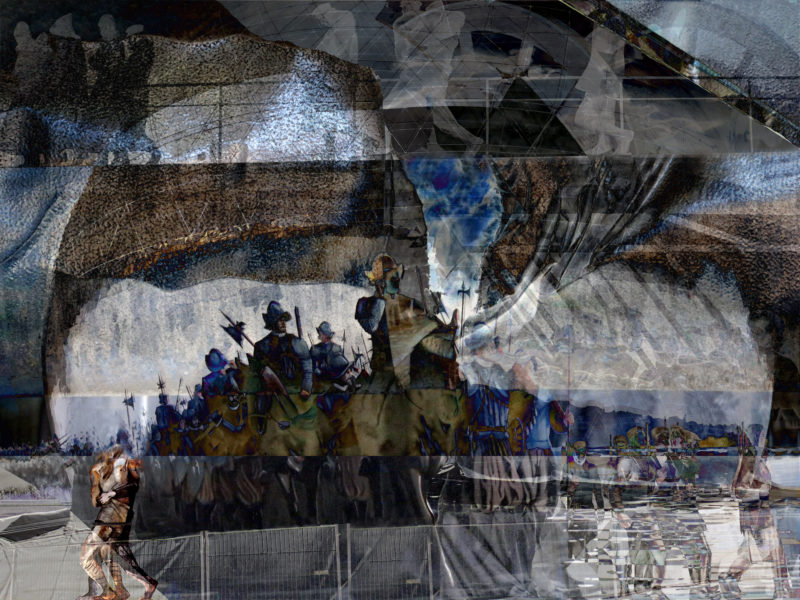
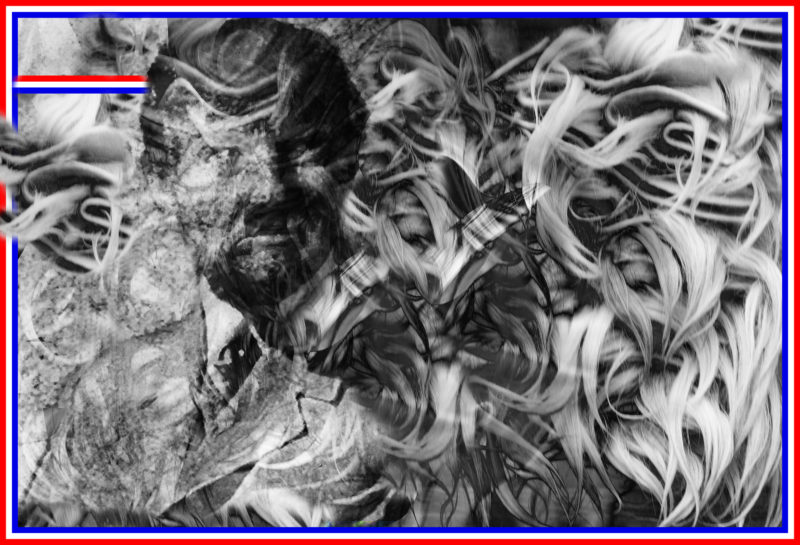
What glimmer of hope, though? That the refugee crisis can be solved by looking at these athletes, each and every one with a tragic history of loss and displacement? That hearts will be softened by seeing them compete? That the political and economic forces behind the wars will stop when seeing a united melange of nationalities? Syria, South Sudan, Ethiopia and the Democratic Republic of Congo are for a short time represented. Haven’t we always had double standards for high performing athletes and the refugee we fear and loathe next door? (In fact today’s head montage, from my Refugees’ Dreams series tackled that point – the soccer players are the ones that have a chance of penetrating Fortress Europe.)
I finished reading Harbinson’s article and was again wondering:”Woman, what are you thinking?” But now addressed at myself. There is need for optimism in this world, a need to see a chance for change in small events, a need for people like her who can still dream, not old curmudgeons like me who feel so thoroughly disillusioned. Here is a link to her writing – judge for yourself. https://frieze.com/article/more-game And here another positive voice: http://www.theatlantic.com/international/archive/2016/08/refugee-olympic-team-rio/494969/
The Refugees’ Dreams series, by the way, will see the light of day in February 2017, at the Cameraworks Gallery in town. I am thrilled that my attempts to show their suffering and the commonalities between “us and them,” the longing for peace, safety, a home, will be exhibited in a solo show that has enough room for many of the montages.


I mistakenly sent this draft out before finishing it on Sunday. Maybe it’s the heat that makes me so incompetent a n d cranky. Add to that reading about nasty viruses here to stay. Add to that selected phrases on the history of the virus penned in the World Health Organization’s report – in its entirety here:
http://www.portal.pmnch.org/emergencies/zika-virus/articles/one-year-outbreak/en/
And I quote: “One year into the Zika outbreak: how an obscure disease became a global health emergency.” One year? That thing has been around – documented – since 1947. True outbreaks, when hopping from Africa to Micronesia and then French Polynesia, occurred around 2013/14, with 70% of the population of some islands infected. Guillain-Barré syndrome, a debilitating neurological disorder caused by the – now probably mutated virus – already documented. (Microcephaly, the birth defect, also found in retrospective research – nobody associated it with Zika at the times.) But now it hits countries we travel to or live in….it reached Brazil in 2014 with the World Sprint championship canoe races.
Late 2014 we have an explosion of cases all across Brazil. Within a year, the virus had been detected in nearly every country or territory infested with Aedes aegypti, the principal mosquito species that transmits Zika, dengue, and chikungunya. People’s lack of immunity and the behavior of the day-feeding, water breeding mosquito contribute. And I quote: “The mosquitos flourish in the litter, open ditches, clogged drains, containers for water storage, old tyre dumps, and crowded flimsy dwellings typically seen in urban and periurban areas where population growth has outstripped the capacity to construct essential infrastructure, like piped water and sanitation.” Population growth outstripped capacity for infrastructure? Hello? What about lack of funding and political will for emptying shantytowns and building safe environments?
Ok, let’s be fair. After the report prominently mentions that caring for a child with microcephaly costs $10,000.000 for a lifetime it acknowledges that in most countries this burden falls on the poor who have no access to healthcare in the first place and need to store water in containers, the ideal breeding grounds for mosquitos.

And here we see it in Puerto Rico and Florida, http://www.nbcnews.com/storyline/zika-virus-outbreak/u-s-declares-health-emergency-puerto-rico-due-zika-virus-n630131 – states, incidentally, that rely economically on a tourist industry. Any bets on travel plan changes?