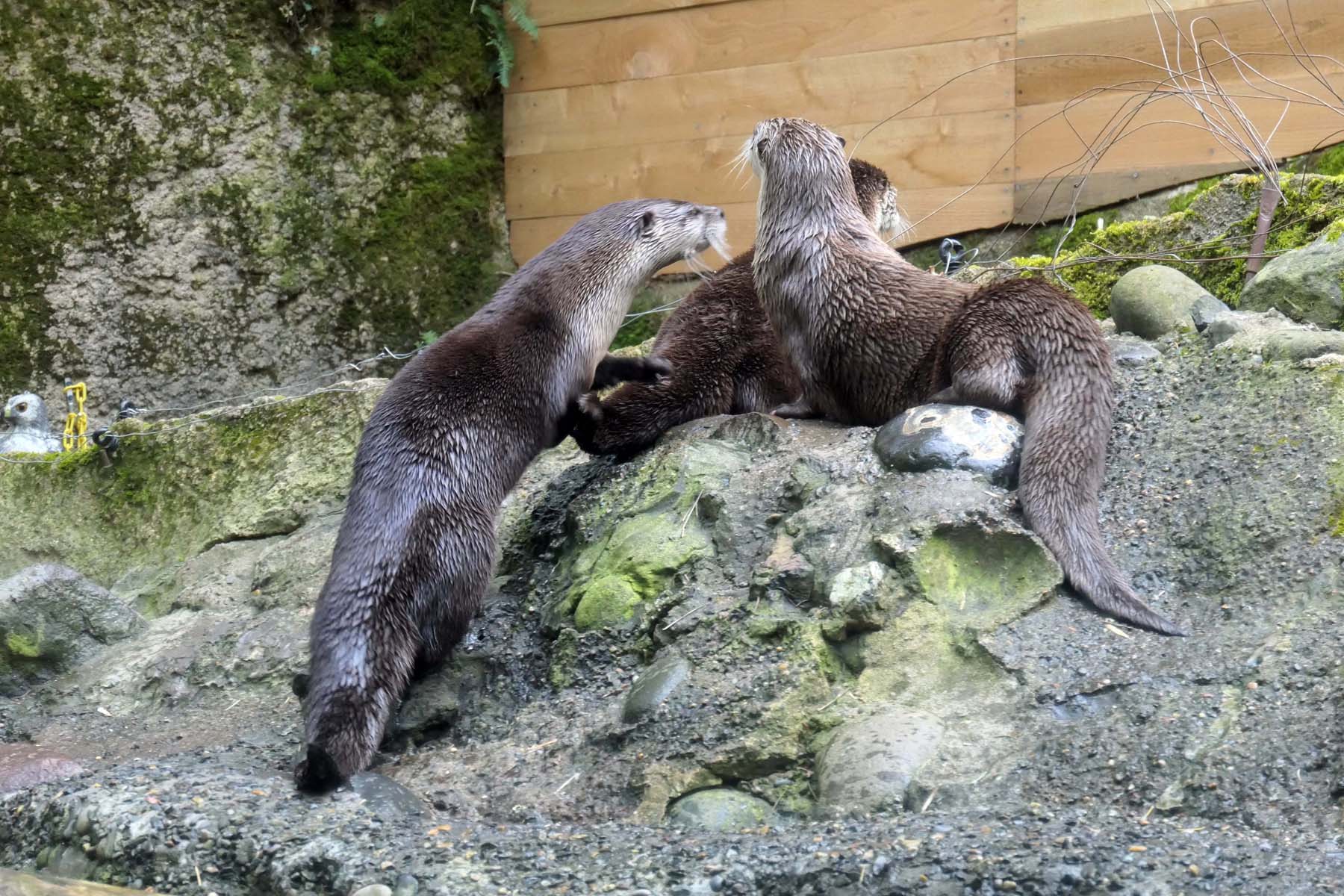
I think we missed it twice in 40 years, our annual pilgrimage to a zoo on “ZooDay.” It is a commemoration of our first date ever at the Bronx zoo in NYC, all those centuries ago. Since we misremembered the original date by about 2 weeks when we first went back, we decided to add two weeks to the calendar every year and so it has been rotating through all seasons. This year it was cold, like all of this interminably rainy spring.


Traditionally a pilgrimage is defined as a journey, “often into an unknown or foreign place, where a person goes in search of new or expanded meaning about their self, others, nature, or a higher good, through the experience. It can lead to a personal transformation, after which the pilgrim returns to their daily life,” tells me my trusted Wikipedia. What we are doing at the zoo is not exactly a pilgrimage, but a celebration of a journey together – plenty of unknown places encountered there as well, and, yes, personal transformation.


I sometimes wonder why we stick to it (the zoo date, not the marriage!) Zoos elicit mixed feelings – how can you not feel for living beings put into cages? Then again, some species only escape extinction because zoos these days enable them to live and, with luck, procreate. And certainly zoos have an important educational function, allowing kids cut off from nature to experience first glimpses of awe when seeing something beyond a two-dimensional screen. At least that was what I thought, before reading some more on it.


There is quite a bit of smart writing around the controversy of zoos’ legitimacy these days. Here is a list of zoo-related books that cover a wide array of topics. Many argue that zoos should be abandoned. The most fascinating, for me at least, is a recent book called Zoo Studies, an interdisciplinary collection that examines zoos from historical, philosophical, social, and cultural perspectives, edited by Tracy McDonald and Daniel Vandersommers. And here is a fun paper, What’s new at the zoo?, that looks at the last decade of research results around zoo-related issues, including whether animals have human-like emotions and should be afforded the rights of people.
(The New York York Court of Appeals, by the way, ruled this week that animals are not persons in the legal sense, and therefor can be denied fundamental human rights, like not being illegally imprisoned in zoos. The advocacy group who sued on behalf of an elephant interestingly used the legal construct of habeas corpus, in vain. (Funny how the Supreme Court decided that corporations are persons, for even longer than Citizens United, when our closest biological relatives are not, but that is a story for another day.)


There are many articles around claiming that science has “proven” that animals have emotions (happiness, sadness, fear, etc.), even complex emotions (shame, for example), like humans. One that caught my eye was a study about pigs that were deemed optimistic. The pigs were conditioned to two different sounds that signaled either something positive (food) or something unpleasant. They quickly learned to approach the good and avoid the bad. They were then put in differing environments – the lucky pigs got room to roam, and stimulating interactive toys. The control group pigs were in small cages with one non-interactive toy. Next they were presented with a novel sound, and, surprise, the stimulated pigs approached it, the other ones avoided it. Conclusion by the research team: good “mood” or stimulation fosters “optimism” in their research participants. They’ll approach in hopes the goodies will come.


I have a beef with that pork interpretation: Let’s start with Occam’s razor which is basically a scientific principle that says you should always prefer simpler explanations over complicated ones (parsimony). Why is this? The answer has several parts, but at the least, you should put into your theory only things that are truly demanded by the evidence, and no more.
The notion of pig optimism tramples that principle. First, let’s be clear that the evidence that’s at issue is nothing more than a behavior of approach or avoidance. That’s all. Where is the evidence here that in any way speaks to the pigs’ mood or emotions much less complex emotions?

How should we think about these pigs? One of the classic principles of behavior is Thorndike’s Law of Effect which basically means if you do something and it has a good result, you keep at it. If you do something and it turns out badly, you’ll stop. This principle explains many bits of human behavior but it also explains the behavior of a range of other animals, including organisms as simple as sea slugs. And that is all the theory you need for the pigs.


In the enriched environment the pigs saw novel objects, approached them, found them to be not harmful and in some way useful. That encouraged a habit of approaching novel objects. They learned to generalize broadly, in contrast to the control group who was provided only with a narrow gradient of experience. The pig did not have to develop a world view of the sort we might call optimism, the pig did not have to develop any feelings about this, and the pig didn’t need any brain sophistication to follow the Law of Effect. I say again: extraordinarily simple organism follow that law, with no implications for what they feel or believe.


Is it possible that pigs have feelings? Yes, I suppose. But if this behavior counts as evidence, then we lose any hope of figuring out which animals are complex enough to feel emotions and which are not. Here is a really interesting overview of the issues, anthropomorphism included, by Philipp Ball, a science writer.


And on a completely unrelated topic, involving a pig that elicits complex emotions rather than having them: the highest German Court just decided this week that a 13th century stone relief of a huge sow suckling identifiably Jewish people, with a Rabbi lifting the pig’s tail and staring into her anus, can remain in place above a famous church door. Jewish plaintiffs had gone to court to have the anti-Semitic sculpture removed, unsuccessfully. The BGH ruled that the church in Wittenberg (where Martin Luther – a rabid anti-Semite himself – once preached) had done enough to transform the sculpture into a “memorial,” by adding a bronze baseplate and a nearby display with an explanatory text. The sculpture is known as Juden Sau, Jewish Sow, a derogatory term for Jewish people used then and now by anti-Semitic Germans. For much longer than since the first ever zoo was ever established in 1793 in France….


Of course, not a single photograph of a pig. At least it’s the title of today’s music – the beautiful sound track for a movie I still have not seen but am told I have to…Pig.