I do get a kick out of visiting art exhibits with my octogenarian painter friend – sometimes grumpy, often funny, never boring and always, always good for some revelations about art. Yesterday we did have a blast again, wandering through the halls of the Portland Art Museum, exploring its newest exhibit: the map is not the territory.

The exhibit, celebrating, in the widest sense, regional art, was put on by the new (2017) PAM curator of Northwest art, Grace Kook-Anderson. Despite some occasional misgivings, I was sold on her vision after finishing the rounds of exhibition halls. There was enough substance that it was easy to put aside what my friend sometimes calls “the exploitation of human tragedy for the production of trendy conceptual art.” The curatorial display decisions were strong, some individual art works truly stood out, and the whole of it radiated cohesion. It taught, and it moved.

A detailed description of Kook-Anderson’s curatorial philosophy and the coming together of a group of diverse and diversely talented artists can be found in an in-depth review by Laurel Reed Pavic here: https://www.orartswatch.org/the-map-is-not-the-territory-whose-border-is-it/
——————————————
It is a mystery to me how a curator can make limited choices when there is an abundance of good work to choose from. I’ve talked about that previously here:
https://www.orartswatch.org/art-on-the-road-au-naturel-astoria/
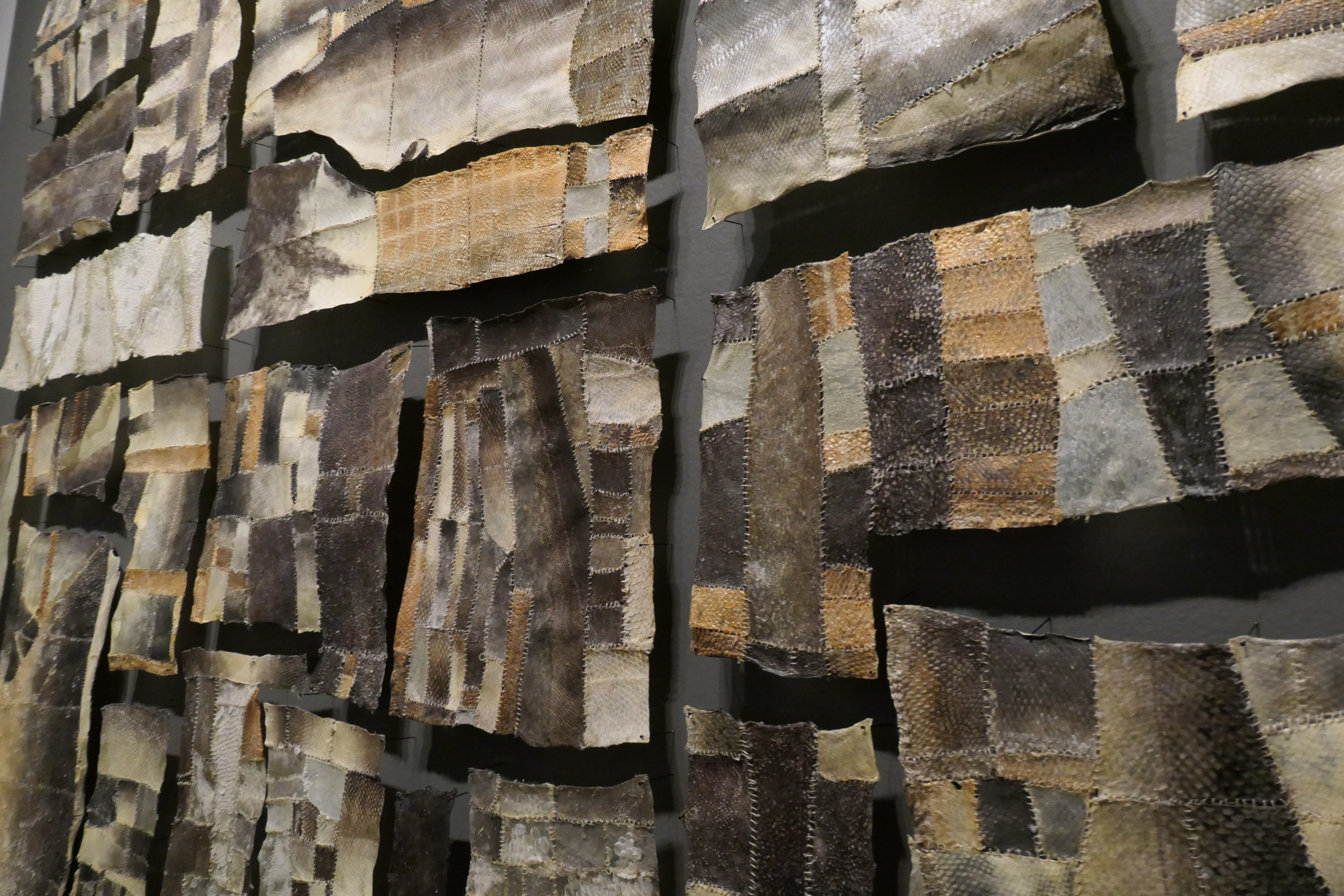
Mistaken cramming is often the result – none of that at this show. The works had space to breathe and the range of mediums used did not interfere with each other. I found the juxtaposition of natural materials (fish skins, wood, etc.)

Fish skin and artificial sinew
(Background installation)
and/or concrete natural forms with man-made or even machine-made abstractions thought-provoking. Weight was given to artistic expressions of native American peoples’ losses, strengths, collective memory and contemporary struggle – a fitting decision given centuries of willful ignorance or suppression.

Moccasins, beer case cardboard, thread, synthetic twine, glass bead, letter beads, faux fur, denim. cotton fabric, 1920s bedroom chairs, wool blankets, acrylic knit blankets, assorted mixed media and found photo works.
—————————
The first of my favorite two pieces was Annette Bellamy’s Moving Mountains. The work is luminous and suggests that defying gravity is possible, after all. The contrast of seemingly heavy stones and boulders (stoneware, presumably hollow) and a sense of ascending lightness proved nothing but up-lifting. The lines from which the individual objects are suspended become part of the installation, suggesting falling rain at the same time that optically there is a sense of upward motion. The shadows seem to shift as something existing independently. The installation moved me, deeply, although I suspect that was not the “moving” referenced in the title.


Stoneware, UV resistant line, steel pins, epoxy.
The second work, slipstream (by the light of the moon) was a gouache/ink drawing on black clayboard by Mary Ann Peters. It, too, had a mesmerizing quality, inviting thoughts about watery surfaces. Funnily enough, it reminded me of one of those Rohrschach inkblot tests used by clinicians of yore as a psychodiagnostic tool – long debunked. Peters’ projective plane seemed to contain the mirror images displayed in those test stimuli, but of course, on closer inspection, defied that expectation. Smartly done, thought provoking.

Gouache/Ink on black clayboard.
This was also the artist who apparently suggested the title of the exhibition, derived from Alfred Korzybski’s major publication: Science and Sanity: An Introduction to Non-Aristotelian Systems and General Semantics (1948.) The actual quote is longer: “The map is not the landscape, but if the map is similar to the structure of the landscape, it is useful“ which suggests a bit more than the general assumption that he referred only to the essential distinction between an object and its representation—or, more broadly, between our beliefs and the underlying reality.

Korzybski was trained as an engineer in Poland; he later developed a theory called General Semantics (GS) that he taught and wrote about here in the US. He had quite a bit of a following, many science fiction writers among them, and reached something akin to cult status mid-century. Most notably, he is considered linked to Scientology and in fact long passages of Dianetics by L. Ron Hubbard borrow from GS and the conceptual road-map laid out in Science and Sanity. Among early GS critics in the field of psychology and linguistics was Martin Gardner, who wrote a flaming rebuke in Fads and Fallacies In the Name of Science (1952.) More recent criticism has come from both Noam Chomsky and later Steven Pinker. In fact the latter’s book The Language Instinct (1994) has a whole chapter debunking Korzybski and his predecessors Sapir and Whorf.

Alginate plaster, acrylic, construction adhesive, gourd sherds.
Ok, enough of a detour – I’ll take off my cognitive-psychologist-hat and put back on the one devoted to art. If the map is not the territory then the quote is not a mirror of an underlying dead-end theory. It is instead a suitable guide for what this thoughtful exhibit references: regional issues, across time, tackled by inquisitive artists and a curator with vision, making borders apparent and inviting us to examine the history of the land.

Music today in honor of maps: Kaija Saariaho’s Circle Map: https://www.youtube.com/watch?v=OPnNZydMYEI
Photographs are from the exhibit – many more works to be seen there, I had limited space, obviously.