 August 11, 2025
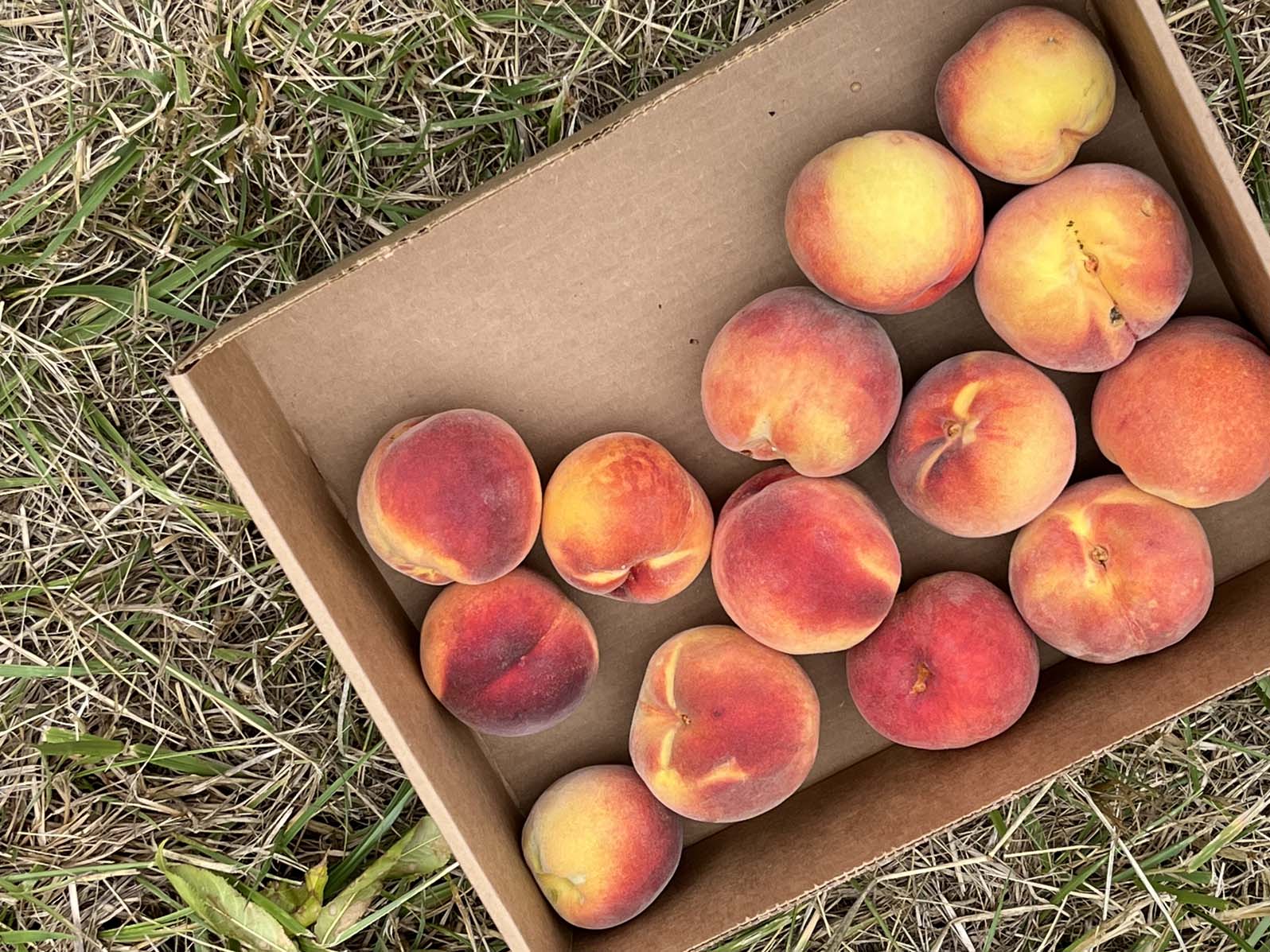
Last week I went peach picking. To reach the orchards you had to drive some miles across dusty dirt roads, arriving at a little farm stand in the shadow of a gargantuan oak tree. Acres and acres of peach trees, bending over from the weight of the fruit, to the point of boughs breaking off. A spectacular abundance.

iPhone pictures today – I did not want to be encumbered by camera while picking fruit.


I was the only one there, surrounded by the buzzing of hundreds of wasps and bees, all feasting. Was thinking about how these fruit are depicted in art, which paintings I remembered. Rachel Ruysch came to mind, her glorious still lifes, probably triggered by the fact that she has a major retrospective now traveling in the U.S. (will open August 23, 2025 at the Museum of Fine Art in Boston) and smart people writing about her life and career. This 17th century painter was more successful in paid commission at the time than many of her more famous contemporaries, Rembrandt van Rijn, Vermeer, Frans Hals and other titans of the Golden Age.
She was, however, not as free to pick her subjects as her male counterparts, constrained to painting flowers and fruit by fiat of her elders and other men in her life. Managed, though, to smuggle in the occasional reminder of the vagaries and dangers of life, in the form of sneaky salamanders, bees ready to sting, all kinds of eerily realistic creepy crawlies. And yet forgotten for the longest time, as so many other women artists.
Telling women what they can and cannot do: why would that remind me of the news that our Secretary of Defense, Peter Hegseth, reposted a preacher’s cry for the revocation of the 19th Amendment? Women should NOT be allowed to vote, was the demand. We have long known about Hegseth’s ties to Peter Wilson who advocates for a Christian nation and the need for women to be submissive to men, “head of household” in particular. According to Hegseth, women are obviously not welcome in the military, either. He has fired them left and right, all the while instituting weekly Christian prayer meetings at the Pentagon. But I digress.
If you look at Ruysch’s paintings, the peaches express hints of their extreme vulnerability, these fruits prone to bruises, splits, mold infestations like few others. Here is one she painted at the age of 19 (!): they are showing little scars and brown discoloration already.

Rachel Ruysch Peaches, grapes and plums with a dragonfly, snail, caterpillar, butterfly and other insects on a stone ledge (1683)

Rachel Ruysch Flowers in a Glass Vase, with Insects and Peaches, on a Marble Tabletop (1701)
In both paintings, she documents peach leaf curl and leaf rust; the trees are extremely susceptible to blight, which often leads to diseased fruit, rotting when still connected. At the orchard, the views of decaying fruit, on the trees and above all, or should we say below – on the ground, were upsetting. So much food gone to waste.


Some of the ones that had fallen were still perfectly intact, good for canning if not eaten fresh. I wondered, of course, if the help that used to pick these orchards in time, has disappeared for fear of deportation. A quick look at the statistics confirmed some suspicions: we have a significant shortage of peaches in the stores this year (down almost 25% from the average year), due to a combination of adverse weather conditions, labor availability and shortages, increased production costs, and economic disruptions, each intensifying the pressure on peach production in key regions such as Georgia, South Carolina, and California’s Central Valley. So could they not allow gleaners in, at least, collecting for the food bank?
***
When I perused painting of peaches, the depictions were, overall, divided. Many show the glory of the fruit on the trees or the voluptuous, velvety globules completely intact.

Wittregde Worthington Peaches (1894)


William Vareika Still Life of Peaches (1867)


Auguste Renoir Still Life with Peaches (1881)

Some reveal canning habits that seem to put the whole fruit with pit inside into the mason jars. Seems strange given the high cyanide content of those pits.

Claude Monet Jar of Peaches (1886)
Others acknowledge reality: peaches bruise all too easily.

Henri Matisse Peaches (1945)


Paul Gauguin Still Life with Peaches (1889)

And then there is Cézanne, always to be counted on when longing for transformation of a natural object into something altogether different, luminous from the inside, abstracted to its essence.

Paul Cézanne Still Life with Apples and Peaches (1905)
Compare this to D.H. Lawrence’s poem below.
The Peach
Would you like to throw a stone at me?
Here, take all that’s left of my peach.
Blood-red, deep:
Heaven knows how it came to pass.
Somebody’s pound of flesh rendered up.
Wrinkled with secrets
And hard with the intention to keep them.
Why, from silvery peach-bloom,
From that shallow-silvery wine-glass on a short stem
This rolling, dropping, heavy globule?
I am thinking, of course, of the peach before I ate it.
Why so velvety, why so voluptuous heavy?
Why hanging with such inordinate weight?
Why so indented?
Why the groove?
Why the lovely, bivalve roundnesses?
Why the ripple down the sphere?
Why the suggestion of incision?
Why was not my peach round and finished like a billiard ball?
It would have been if man had made it.
Though I’ve eaten it now.
But it wasn’t round and finished like a billiard ball;
And because I say so, you would like to throw something at me.
Here, you can have my peach stone.
by D.H. Lawrence, from his Birds, Beasts and Flowers collection of 1923.

In this modernist (almost) prose poem, he insist on describing the perceived features of the single fruit in verisimilitude, demanding that we ignore man’s desire to make everything perfect, without nooks and crannies, slightly misshapen, indented and heavy – let’s take the peach as is, not round and unblemished.
I wonder if there was the temptation to read slight sexualized connotation into these lines, if it weren’t for the name and thus the reputation of their author. I also ask myself why did I remember and pick this poem from an acknowledged misogynist, a man full of rage and struggle, linked to a hard life full of poverty, illness and persecution by those who did not want his truth telling and revolutionary upheaval of literature to succeed?
Here’s why. He was curious about the world and courageous, traits I value above all. His travel writing speaks volumes to openness to the new, the different, to search and exploration, a keen observer if there ever was one. And the poem itself has that wonderful sense of defiance – “Hey, wanna throw a pit at me? I’ll even provide one, but it won’t change my mind that the imperfect wins over perfection any old day! Let nature rule.”
All of this, and more, I wish for the newest member added to the family, the day after the peach picking excursion. May he be curious and courageous, open and flexible, perceptive and defiant when called for, in a life that will not all be peaches and cream in this world of climate change, wars and the rise of authoritarianism. May he enjoy music (which I listened to on the day he was born) by a composer who shares his birth date.
István Szelényi‘s Sonatina is full of energy, resolves discordances always with an element of surprise, is full of humor and deadly serious at the same time. Good things to be developed in a new life as well, don’t you think? Welcome to this world, little A.


Ken Hochfeld
So tender and beautiful as a peach!
Sara Lee Silberman
What a wonderful, interesting posting! As per usual.
And what a welcome and wise, good wishes for “little A!”
Sad indeed to see all the waste/unpicked, spoiled peaches. And can’t help wondering what was made with all the delicious ones you brought home!