 August 14, 2025
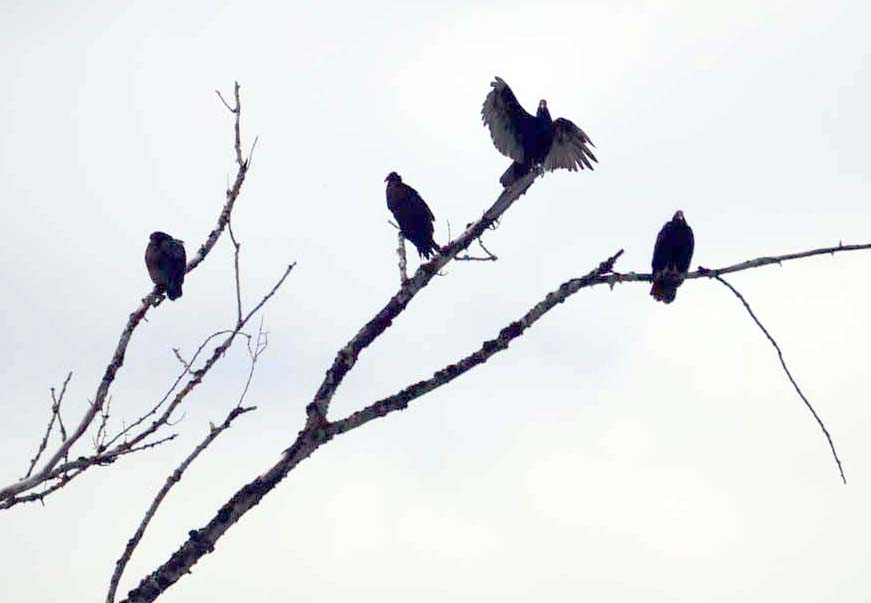
You know how it is, one thing leads to another. This time it started with the birds, so many of them, different ones. The vultures dominated, though, hanging out in the trees along the Columbia river among the bald eagles and ospreys, all ready to swoop down, all eerily quiet.


Then I saw the object of their concentration, or, more likely, their desire. A beached sturgeon, still fresh, no visible wounds other than a torn fin. A spectacular specimen. Perhaps killed by the ever surging water temperatures and dropping water levels – that warming was one of the causes for the recent die-off of sturgeons in our waters, both in 2015 and 2019. Sturgeons can get to be up to 100 years old, but they only spawn every 8-12 years, so their populations are extremely vulnerable at this point, despite many efforts by states, fisheries and environmental organizations to protect them.

In any case, I had just read a book review that started with the phrase “a beached sturgeon of ungodly proportions,” a phrase I found enticing. What followed had me rush to put my name on the library wait list (54 holds on 3 copies – what are you thinking, Multnomah County library?) for The Hounding, a debut novel by Xenobe Purvis. Set in 18th century England, it describes the fate of five sisters who are accused to be witches or worse, having caused a “season of strangeness,” claimed to transform themselves into dogs, now hunted by their neighbors. They try to save that fish, to no avail, and a man eventually kills it by violently stomping on the sturgeon’s head.

Apparently – again, I have yet to read it – many literary examples of sisters are invoked, from Pride and Prejudice, Mansfield Park to Hester Prynne. The main theme, though, seems to be the traditional one: the way society treats women, assigns them magical powers for which they are subsequently prosecuted, harms them by clinging to beliefs of malevolent witchcraft. And this brings me to a book about a different group of siblings that I just finished, The Sisters, by Jonas Hassen Khemiri.

It is a long, complicated novel, with constant shifts in time and several narrators, one of whom, the single male and potential half-brother to Ina, Evelyn and Anastasia, increasingly reveals himself to be quite the unreliable chronicler of the tale. Set in our own time, across Sweden, Tunisia and the U.S., its plot – if there is one, really – is also driven by superstitious beliefs in the supernatural. The sisters themselves believe that their family was cursed, and this guides their lives and decision making. The novel ropes us into deeply detailed worlds, both of behaviors and emotional interiors; it also makes it very clear that self-fulfilling prophecies interact with structural characteristics of misogynistic, patriarchal societies, exponentially affecting outcomes for women.

The book was not expressly plot-driven. I was more reminded of Susan Sontag’s adage that novels are education of feelings – they help us to escape the ever narrowing versions of ourselves, tied to habits in thinking and interactions. It certainly reminded me of how sibling relationships are fundamental to our existence, but their mechanisms are much more easily discerned when you observe other sibling relationships from the outside. In this case, the author managed to make each one of them increasingly more sympathetic, despite some being closer to me, the reader, in personality than the others. He also showed the futile or destructive power of competition, when they could have helped each other all along. But the novel’s real success lies in the ability to convey how potentially neutral or positive life outcomes can be thrown into disarray by the persistence of false beliefs, no matter how rational you try to be. Let that sink in.

***
I have one sister who I admire, and we love each other deeply, despite being very different from each other, but I also feel sisterly bonds to several of my friends. I thought this was described best in Adrienne Rich’s poetry. In the first poem, she alludes to a shared history (siblings are, after all the ones who know you longest and suffered the same family dynamics, even if in different roles), but does that allow you to claim true knowledge of the sibling? Is the stranger she uses as comparison really a travel acquaintance, or another version of the sister, or is it the poet herself, claiming we are unknowable even to ourselves in the end? Too complicated for my heat-addled brain.


Much more decipherable, then, and a hymn to sisterhood whether by biological bond or not, is this for me:
“Women”
My three sisters are sitting
on rocks of black obsidian.
For the first time, in this light, I can see who they are.
My first sister is sewing her costume for the procession.
She is going as the Transparent lady
and all her nerves will be visible.
My second sister is also sewing,
at the seam over her heart which has never healed entirely,
At last, she hopes, this tightness in her chest will ease.
My third sister is gazing
at a dark-red crust spreading westward far out on the sea.
Her stockings are torn but she is beautiful.


Here are three sisters sitting at the water’s edge, (no sturgeon in sight, alas,) on rocks of black obsidian. Obsidian is, of course, sharp volcanic glass formed by quickly cooling molten lava, used since the Stone age for weapons, daggers, spears and knives included, but also as ornaments. In the realm of supernatural beliefs, it is associated with healing, protecting us from negative influences. “Its reflective properties are thought to help us recognize false beliefs we may have about ourselves so they can be released.” (Ref.) Hmm.
So, here they sit, on top of those symbols of mostly violent destruction, and yet healing dominates associations. Stitching together a costume that reveals rather than masks you, vulnerabilities and all, being true to yourself, in public no less.
Stitching the scars of your broken heart, sewing as reparative action, such a familiar trope for women’s duties, but now these women mend themselves.
The third sister has gone far beyond: she can leave the torn stockings as they are, seeing the scab from her wounds drift off towards the horizon, self-generated skin a strong enough renewal. She might have fallen, but picked herself up. She might have been violated, but wounds will heal.

And given how most women I know see themselves reflected in one or the other of “our” sisters depicted here (on the mirror surface of the obsidian and in the hurt), this poem is a gift of encouragement and manifesting, with no further need for belief in talismans or other mystical powers. We might be fumbling towards repair, but we do have the power to heal ourselves.
Then again, being able to turn yourself into a dog on occasion, hunting with the pack of your sisters, might be quite the thrill, no?
I’ll report more when I’ve read The Hounding.

Music today is a phenomenal collaboration: Sisters doing it for themselves….


Sara Lee Silberman
Having no sisters, I treasure both the female friends who seem to approximate them and those bonds and reflections on those relationships such as you have provided here.
Lou
My sturgeon heart weeps for my fellow fish. Eons lie dead on the sand. This blog needs to be shared with all humans while we destroy our mother planet.