 September 8, 2025
Want to walk with me? Meet me about 30 miles east of San Francisco, at the Alamo Oaks Trail, a small hilly enclave in the middle of suburban developments of the city of Danville, CA.

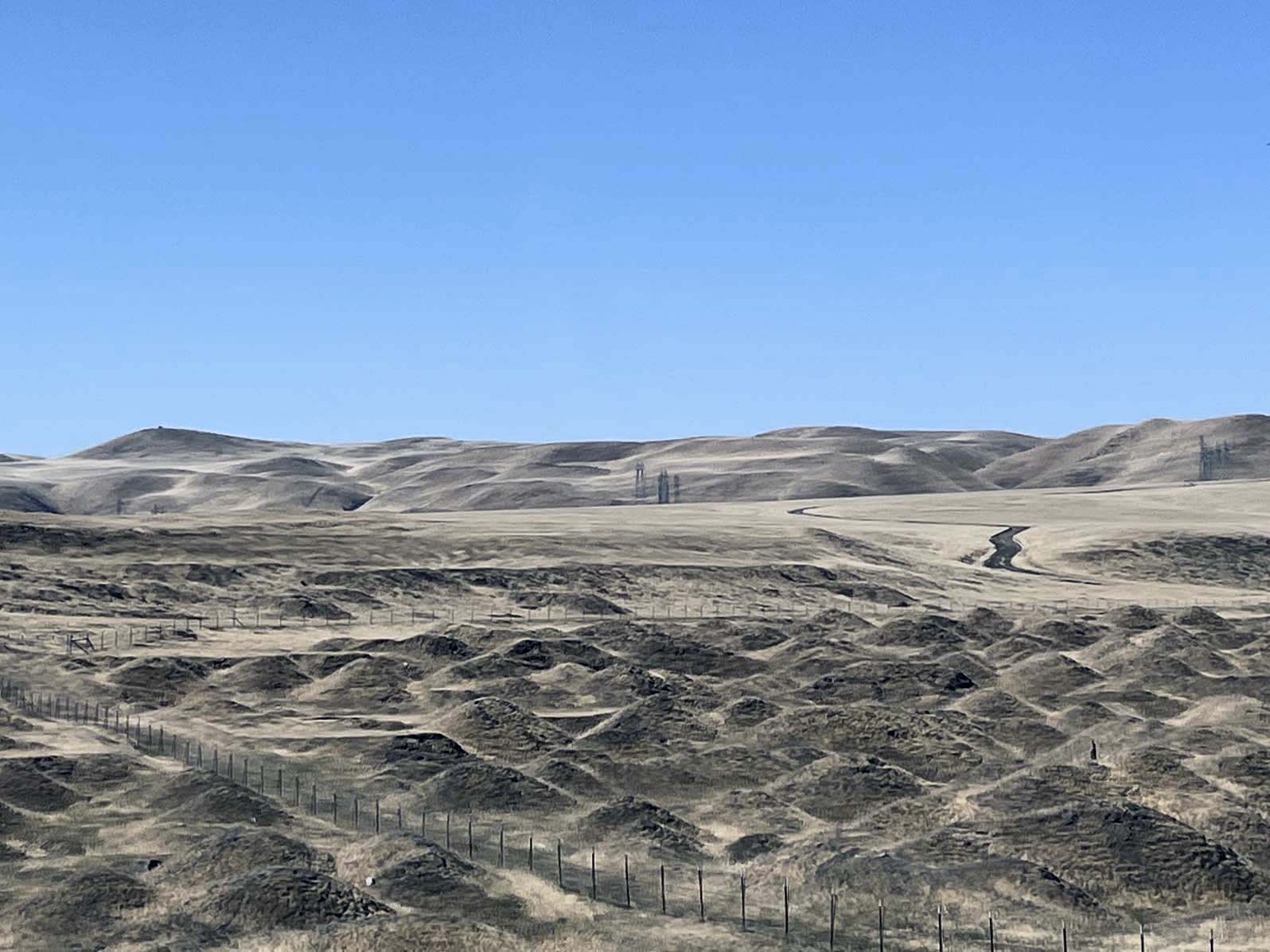
The hills are conscientiously tended to for fire prevention, grass mowed to a stubble, dry branches piled up for removal. It still has a feel of open nature, not manicured park, though, enhanced by the fact that I seemed to be the only soul around hiking the steep slopes.


The cracked grey dirt on the path visually mirrored the cracked grey bark of the oak trees, no bird song around other than the occasional chittering acorn woodpecker, calling for company.


Dust everywhere. Even though the oak leaves looked green from afar, they were coated with it, oak galls dropping left and right.


Brought me back to the images along the Interstate Highway on our drives, going south from Portland, going north back home all the way from SoCal.

Dust plumes whipped up by the wind, and more so by tractors and other farming equipment.

Which led to thinking about agriculture and the tragedy of all those 2.5 million people ruined and displaced by the 1930s dust bowl, following the late 1920s crash and subsequent Great Depression. At the time, poor farming techniques caused the soil to erode. A seven year drought starting in 1931, together with the erosion, led to desert-like conditions, unfit for growing food or keeping animal stock alive. When the winds came the dust was carried away in huge clouds, sickening people and depleting the once fertile grasslands.

Archival image showing dust storms in OK

Climate change brings, of course, increasing droughts but also increasing flooding events that make farming just as impossible. I urge you to read in-depth reporting on what farm families face these days, in the mid-West and increasingly California as well. Pro-Publica has a two part series that reveals how much farming should change, given the current and future conditions, but is stuck in a senseless place of doing the same old, no-longer-working thing, due to federal farm policies. (Part 1/ Part 2) The shortest summary: subsidies, including federalized crop insurance, are keeping farmers on land that is no longer productive. Programs that could help to pull out destitute farmland from production are cut by the Trump administration.

It is not the only problem farmers face (or berry-pickers and meatpacking workers — often immigrants employed exploitatively and with unsafe conditions, with workplace protections varying from state to state, never mind the current rash of ICE deportation.) Farmers continually loose access to markets as large companies buy up smaller, locally run grocery stores. (The following statistics are culled from an in-depth, devastating article in High Country News.) Four grocery giants – Walmart, Albertsons Companies, Kroger Companies and Costco – now control most of the markets, even if they run under diverse store names, which gives them power not just over consumers, but producers as well.

Farmers’ Markets are a desperate counter weight to these monopolies, but there are way too few to make a real dent (California has only 2, Oregon 5.9 per 100 000 people.)

In terms of production, 78% of the market share is held by 6% of U.S. farms, with ever larger scale production driving out family farmers. 1.8 million small farms constitute the remaining 22 %, many of them on the brink of ruin now with the tariffs. Farm bankruptcies already swelled under the first Trump administration, things are worse now. Up to 30% of Arkansa farmers are facing bankruptcy this year if not rescued by emergency funds (and they voted overwhelmingly Republican.) Expanding tax subsidies, of course, benefits not all equally.


Subsidies, once introduced to ease the pain during the Great Depression, now lead to overproduction and discourage innovation in farming practices.
Approximately one-third of U.S. farms receive regular subsidies, with larger farms benefiting more significantly. The top 10% of subsidy recipients receive about two-thirds of total farm subsidies, in direct payments, crop insurance and loans, often favoring large agribusinesses over smaller farms. They also contribute to environmental issues, as large-scale farming often relies on monoculture practices that can harm ecosystems. 30 billion $$ spent, but no talk of welfare queens….

With the new congressional bill, environmentally destructive overproduction of a few major food commodities, combined with stubbornly high and rising hunger rates, particularly among children, will be intensified and prolonged.
As reported by MOTHER JONES: “The consequences promise to be devastating for the economy, the environment, and public health. The BBB slashes food aid for poor people while showering cash on already lavishly subsidized farmers, mainly corn and soybean producers…. The new law slashes $185.9 billion from SNAP over the next 10 years, a 20 percent reduction. While low-income people got kicked in the teeth, large-scale commodity farmers cashed in from Trump’s bill. Driven largely by billions of dollars of annual incentives for all-out production embedded in decades of farm bills, farmers in the upper Midwest have maximized corn and soybean production in ways that have pushed this vital growing region to its ecological limits. Soil is rapidly eroding away there, and pollution from agrichemicals fouls drinking-water sources and feeds harmful algae blooms from the Great Lakes to the Gulf of Mexico. The rapidly warming climate makes both problems worse.“
Not yet taken into account is the fact that even monopolist producers are starting to feel the pain of Trump policies. Just as the soybean harvest begins, there are no orders – zip – from one of the largest clients: China. They account for 25% of all soybean sales and more than half all soybean exports.

***
There is much heartbreaking, perceptive poetry written about the displacement of farmers, and the yearning for a return to the land that they were driven from through a combination of climate, governmental actions and the results of ruthless capitalism. The land calls, in Hughes’ poem below, despite the evident hardship, promising the freedom of a migratory bird in flight, in contrast to the caged one, mired in poverty. (Best read in conjunction with his poem Let America be America again. It also compelled me to offer one of the two musical choices today, a wonderful rendition of I know why the caged bird sings by Buckshot Le Fonque, reciting Maya Angelou’s poem of the same name.)

By Langston Hughes

Smoke from 21 wild fires in the vicinity of Dunsmuir lining the horizon.

View of Mt. Shasta.
I was equally drawn to more modern allusions to the hardships of the dust bowl, by Steven Leyva, a poet new to me. Very much attracted by his determination to stay hopeful under the veneer of his play with language, encapsulating the vagaries of defense against what this world has in store for us, including existential threat.
What You Need to Survive Vernon, OK
Sheer luck. Dumb-as-a-hammer-
without-the-handle luck. Two-yolks-
in-the-egg luck. The fourth leaf on
the clover isn’t enough. Leave the rabbit’s
feet alone. Beginner’s luck. One
bounce of the Plinko chip into the bonus.
The universe’s casual lagniappe. Crossing-
the-platform-and-catching-the-other-train luck.
Even-better-when-late luck. Onion-ring-
in-the-fries luck. The penny’s street resumé.
Hard worn, back-country luck. The creek unrisen.
The anti-Lazarus creek. The-glint-against-
the-barrel luck. Luck to see the sniper asleep.
Oil-derricks-never-went-dry luck. All-sevens-
and-a-pineapple luck. Good fortune to defy the odds
of hypertension or hair loss. Arm of the lucky cat
scratching the air forever. Unambitious Icarus Jones—
boy was lucky as a broken wishbone. Oh to match his lack
of fear, his letterman swagger [All State, Triple Jump Champ],
his young, gifted, and Black luck. A palm itching, money-on-
the-way luck. An ear burning, willing-to-fry-anyone-
who’s-talking-shit-around-the-way luck. An ace in the hole type.
A rueful magnanimity toward what is out of control.
An ease with being at ease while the state becomes the dust bowl.
BY STEVEN LEYVA

And here is Woody Guthrie with the Dustbowl Blues.


Kristie S
We just don’t seem to learn from our mistakes, do we? My research for “River Stories” exposed the back story of the 1930’s Columbia River Irrigation Project – which brought much needed employment on the heels of the Depression (building Grand Coulee Dam) and water to land as arid as what you focus on in this piece. But farmers were heavily subsidized to come to the area. It was very challenging for the hard-working farmers to survive in this naturally arid desert, but the subsidies made it possible and survive they did. Meanwhile, these momentous projects permanently flooded the homeland and burial grounds of Native cultures who had occupied the land for thousands of years and all but wiped out their existence.
Sara Lee Silberman
As always, SUPERB photos and – alas – troubling, important commentary.