 December 8, 2025
It was a cold, frosty day. As always on our drive on I 5 South to California, we looked for something new to explore.


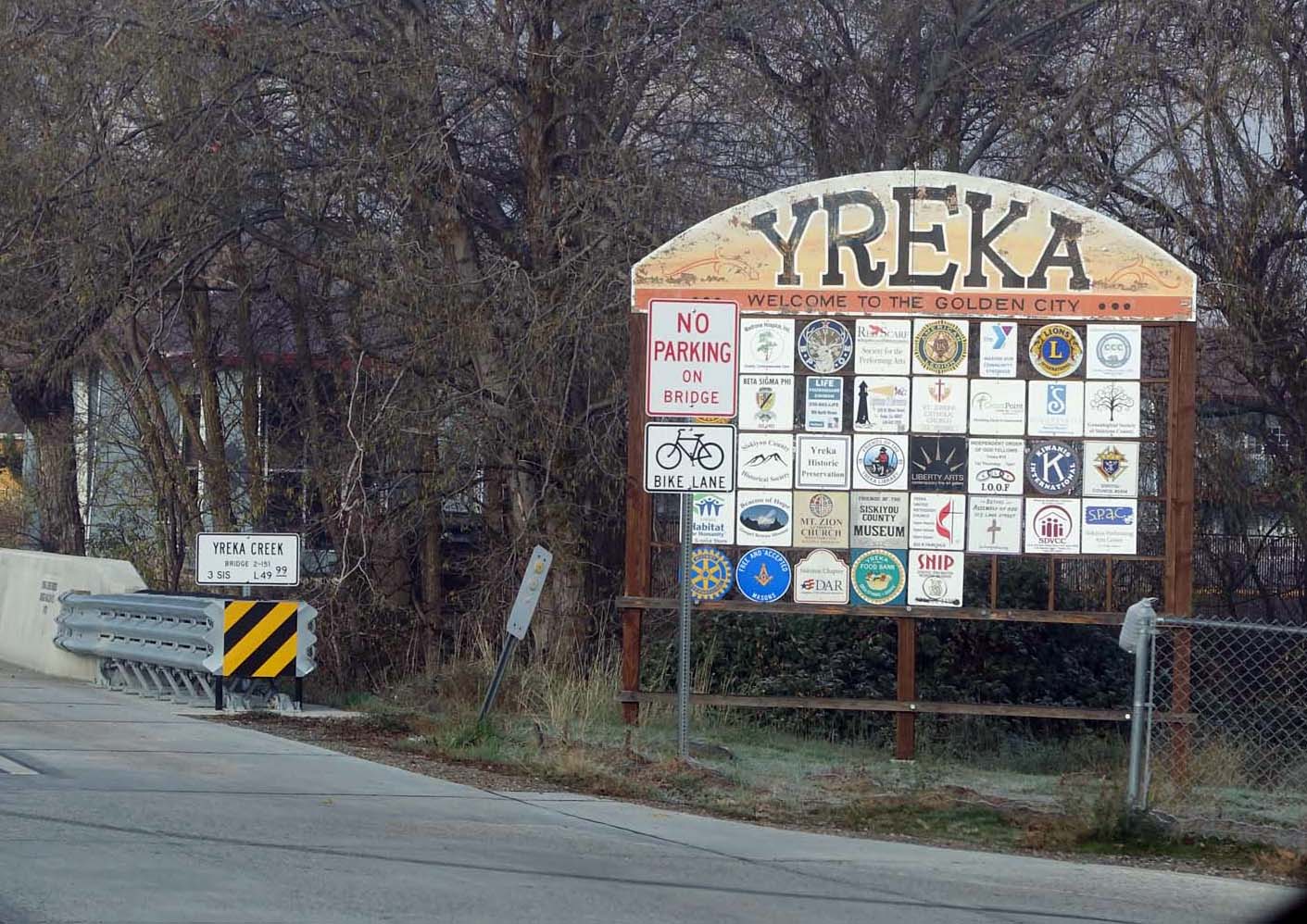
This time we picked the small town of Yreka, known for its 19th century gold rush, preserved historic buildings and a park that promised historical mining tools and structures.

The travel brochures praise the town for its quaint main drag with many historic buildings still intact, and the beauty of the surrounding Siskiyou mountains. (They are a coastal subrange of the Klamath mountains, which get significant precipitation from the ocean and early snow. It was the land of many different tribal nations with a common language spoken, Athapaskan, also known as Dene.)


“Greenhorn” Park, criss-crossed by diverse hiking trails, offered views onto the mountains across a spacious reservoir; lots of old-growth trees and a few pieces of old mining machinery, a smithy next to a fabulous playground – clearly a good place for local and tourist families to enjoy and take a break from highway driving.

It proudly presents the history of the gold rush, starting in the 1850s, when people arrived upon the news that gold could be found here as well, not just further south.


Rush is an appropriate word – between March of 1851 when the first serious gold was discovered and May of that year, some 2000 hopeful men erected tent camps, shanties, and a few rough cabins on the flats near the Scott river. By August it was 5000, with wooden buildings starting to be constructed on what is today called Miner Street. A year later the California legislature created Siskiyou County. The town was called Yreka. Some say it was adopting the Indian name for Mt. Shasta, White Mountain. Mark Twain had a different theory: place had acquired its mysterious name ”when in its first days it much needed a name” through an accident. There was a bakeshop with a canvas sign which had not yet been put up but had been painted and stretched to dry in such a way that the word BAKERY, all but the B, showed through and was reversed. A stranger read it wrong end first, YREKA, and supposed that that was the name of the camp. The campers were satisfied with it and adopted it.
(Turns out, YrekaBakery existed at the time and advertised its palindromic name. Twain was too good a satirist, likely, to let that fact fly by unused….)

On this quiet, early Sunday morning, the town itself was deserted, but for an aimlessly wandering older woman who screamed her cold misery out into the world. Quaint bordered on somewhat run down – and that was before I read up on the history, and the current status of this hamlet of some 7000 people. The main block of businesses and shops quickly gave way to neighborhoods showing lots of signs of distress.


The statistics are one thing – crime rates are higher than in 90.6% of U.S. cities. Median household income in Yreka is 25% lower than the national average. Unemployment is 33% higher than national average. The poverty rate is 50% higher than the national average. There is no real industry, work can be found mostly in healthcare, education and retail. Poverty-adjacent drug use and houselessness are soaring. Just this year, a large encampment of over a hundred unhoused people, consolidated on a hill visible from the town center, was bulldozed, because the town- people had enough of the garbage and disorder they associated with the camp. The result? Dispersement into the adjacent forests, since no housing alternatives are offered, exponentially increasing the forest fire risks.

As a traveling visitor you can’t really know all the facts. Yet there are consistent reports of law suits, including some class action ones, directed at the Sheriff, his office and the county administration, with accusations of insidious racism and persecution of minorities in the region.

Chinese miners came to Yreka early and, across the span of a century saw multiple fires devastate their parts of town. Nowadays, Asian Americans, particularly the Hmong community in Siskiyou County (who came to the U.S. as refugees after fighting alongside the U.S. military in the Vietnam War,) had to fight against ordinances that deprived thousands of them of basic water for survival, hygiene, and wildfire defense. The Sheriff’s prohibition of water trucks carrying over 100 gallons to travel to the areas where these farmers live, was eventually repealed in Court. For now, the crisis that degraded their health, resulted in the loss of livestock and gardens, left people unable to fend off wildfires, and forced many to leave their homes, has been ameliorated.

Today, the Asian American community members’ major class action lawsuit against Siskiyou County officials and the Siskiyou Sheriff’s Department for their sweeping racial persecution campaign is still pending. “In this case, Chang v. Siskiyou County, community members and their attorneys at the ACLU Foundation of Northern California, Asian Law Caucus, and Covington & Burling LLP detailed how county officials restrict people’s right to water and execute unlawful traffic stops, search and seizure practices, and property liens in a blatant effort to isolate residents of Asian descent and drive them out of the region.”
***
This part of Northern California is known for a movement to secede from the state and create a new one, the State of Jefferson (they are joined by parts of southern Oregon.) Folks feel not represented as rural communities and want to have independence – or, as they put it, their liberty and freedom back, currently “withheld” by the folks further South. They claim their taxes are funneled into large population centers and not used for their own needs (the reality is that Sacramento spends far more money on these rural regions than they take in.)

By their own accounts – here is a short documentary that really represents the type of people fighting for a new state – they want to go back to earlier times which they felt were better, and they stress the importance of blood and soil – their words, not mine – as a source of power.

They claim it is all about liberty and representation – but there might be something more insidious underneath: “a barely concealed desire to carve an ethnostate out of the only part of California where whites still constitute a majority, and not just a conservative strain of politic. Today, almost every county north of Sacramento has passed a resolution in favor of joining the State of Jefferson. From Mendocino to Alturas, neon Xs glow in bar windows and billboards exhort passersby to join: Jefferson, the 51st state. (Ref.) (The double x on their flag refers to being double crossed by the state governments in Sacramento, CA and Salem, OR.)
The years of Covid pandemic mask protocols and an influx of non-White workers have stoked the passions – and hardened minds against being told by outsiders who supposedly don’t share their values – faith, family, patriotism – what they can and cannot do, much of it centered around gun issues as well. According to observers, violence is now publicly threatened and representatives of the movement regularly appear on the Alex Jones podcasts and the like. There is a Cottonwood militia movement that claims to have trained over 1000 people so far, and is claimed to be linked to the newly elected, far-right Shasta County Board of Supervisors as well as several of the Sheriffs.

Legally, the creation of a new state is all but impossible. The state from whom you wish to secede has to agree, and then congress has to approve the establishment of the new one. Beyond the legality issues, though, I find it scary to contemplate the motives that lie underneath, and the networking that is going on among all of these far right, white supremacist organizations to do both, get their candidates into state offices and prepare for more violent modes of action when they deem the time has come. Militias in Shasta County are open about their association with, among others, the Proud Boys, and to the Bundy family, of fame for their radical actions in Oregon a few years ago.

Walking along the deserted Miner St. in Yreka, you wouldn’t know. Shop windows and saloons offered touristy kitsch and libations, all closed, of course, on a Sunday morning. Maybe they were all preparing for a birthday party…

We drove on, as always struck by the beauty of the American West, and the incomprehensible sentiments that lie underneath so much of what we see at the surface, divisions that fester with hatred, including the fear or despising of true equality for all humans of all races and origins

To stick with the theme (while insisting on diversity): Music today is by Bob Dylan about the Union’s Sundown….and by Fela Kuti about Independence, and about nationalist leaders by Burning Spear.


Sara Lee Silberman
Interesting! And of course disturbing.