 November 23, 2026

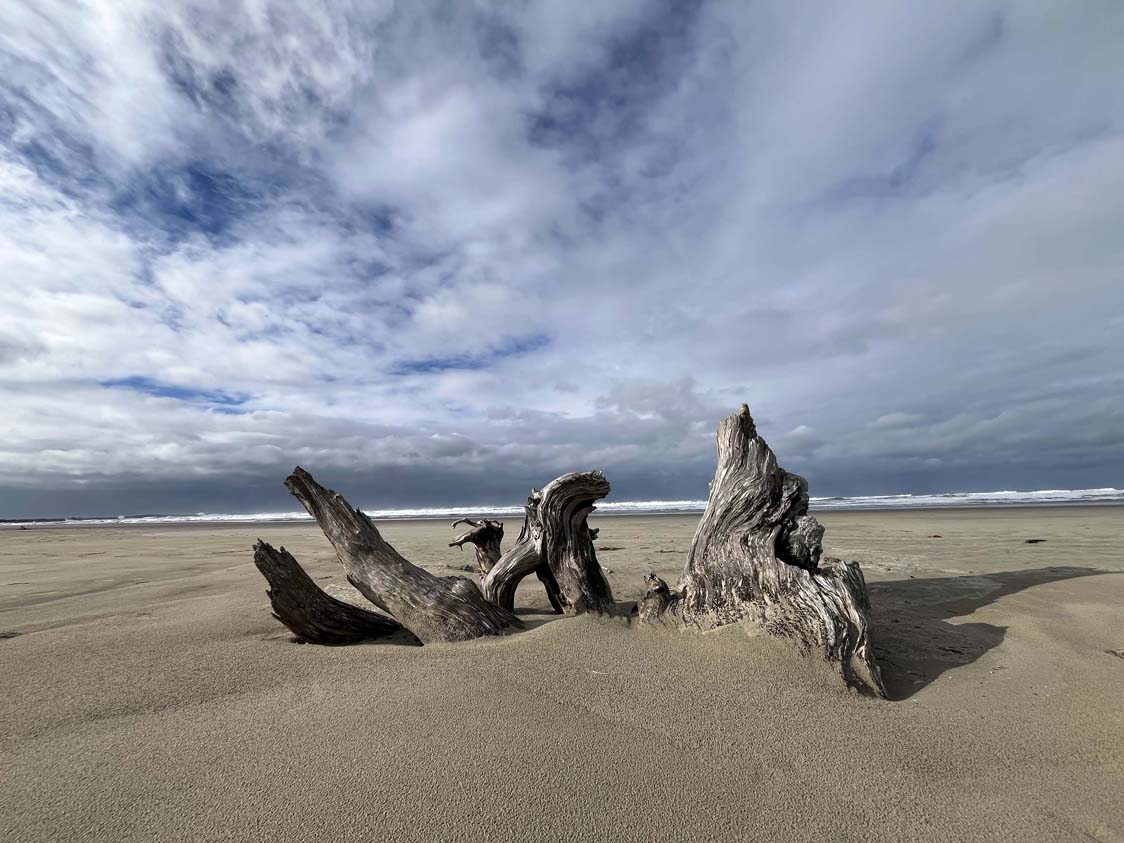
Last week’s beaches were as empty as can be.

The scenery reminded me of Qing Dynasty ink paintings, even though they were situated in more mountainous regions.

Yao Kuang Famous Scenes of Yandang Mountains, Qing dynasty, 17th–century (Excerpt)


We were careful to walk only during low tide, given the current intense wave action. And even then, before the King Tide and storm system predicted for the Thanksgiving days, the surf was remarkable.


Even the birds felt they had to escape….


Foam flew through the air, hard to capture, unless close to the rocks. Pelicans and cormorants smart enough to settle on high.


It was overwhelmingly beautiful, awe-inspiring and also, truth be told, quite scary. If this was low tide, what would high tide be?
The predictions are full of warnings: this week will see a lot of flooding up and down the Pacific coast, with travel restrictions and mandatory evacuations. Experts fear that regions never before under water will see their first immersions. Others, like several places in Humboldt county, King Salmon and Fields Landing among them, saw devastating flooding already in January and are now asked to prepare for worse.
In the meantime COP31, the UN Climate Change talks in Türkiye, collapsed last week. The summit was an absolute failure.
The talks were hosted by Turkey and Australia, with the United States, the largest historical climate polluter, refusing to even attend. Major petroleum producers such as Saudi Arabia and Russia lobbied against mentioning fossil fuels. The EU and other countries rightly rejected any final agreement that would be held hostage to the petrol industry. “It is unconscionable that we would have a climate act that makes no reference to fossil fuel, no reference to transitioning away from fossil fuels.”
Having no agreement on the next steps in the fight against climate change comes at a time when “climate change compounds this year’s super El Niño, causing severe droughts in Fiji and Bolivia, extreme flooding in the western US, and wildfires in Southeast Asia, and putting millions of additional people at risk of hunger or famine.”

***
Where are the protectors in a world racing towards some form of self-destruction? Thinking about this, on the beach no less, reminded me of Hilda Doolittle’s poems, centered around the ocean and existential concerns. Ezra Pound (during their broken engagement) submitted her poem “Hermes of the Ways” to Poetry in 1913, “by H.D., Imagiste”, which more or less started the Imagist movement.
The poem appeals to Hermes as a protector, needed during perilous journeys and choices to be made at crossroads. The narrator clearly manages to escape the danger of the ocean and crosses over to land, however stunted in its current growth.

Hermes was the Greek God of travelers as well as a messenger. He was believed to be able to see in three directions at once, three-faced, to assess what was coming down at the crossroads, guarding those he chose to protect. He was also able to navigate between the world of the living and the dead.

Where is he when we need him at our very own cross roads now?

Hermes of the Ways
THE hard sand breaks,
and the grains of it
are clear as wine.
Far off over the leagues of it,
the wind,
playing on the wide shore,
piles little ridges,
and the great waves
break over it.
But more than the many-foamed ways
of the sea,
I know him
of the triple path-ways,
Hermes,
who awaits.
Dubious,
facing three ways,
welcoming wayfarers,
he whom the sea-orchard
shelters from the west,
from the east
weathers sea-wind;
fronts the great dunes.
Wind rushes
over the dunes,
and the coarse, salt-crusted grass
answers.
Heu,
it whips round my ankles!
II
Small is
this white stream,
flowing below ground
from the poplar-shaded hill,
but the water is sweet.
Apples on the small trees
are hard,
too small,
too late ripened
by a desperate sun
that struggles through sea-mist.
The boughs of the trees
are twisted
by many bafflings;
twisted are
the small-leafed boughs.
But the shadow of them
is not the shadow of the mast head
nor of the torn sails.
Hermes, Hermes,
the great sea foamed,
gnashed its teeth about me;
but you have waited,
were sea-grass tangles with
shore-grass.
by H.D.

Music today is dated to the second or third century, an Orphic hymn addressing Hermes. Beautiful traditional instruments and Greek recitation. “Friend of mankind, friend to mortals in need, who relieves us from our troubles….”
Yup, come on by. As quick as you can!

Those are sea lions in the surf.


Sara Lee Silberman
“Overwhelmingly beautiful” may not be a strong enough description of those photos. Thank you for them.
And here’s hoping the storms do no serious damage to you, yours, or your holiday plans….