
In May 1947, Poetry – A magazine of verse published a poem by Clara Brussel (1921 – 1983). She was an accomplished translator of German authors (under her married name of Clara Winston), including Thomas Mann, Hanna Arendt, Herman Hesse and Franz Kafka. The young woman nonetheless continued to write poems, something she had started in high school in New York City, before attending Brooklyn College. Much of her work was affected by the horrors of a world at war, the plight of displaced refugees (including some of the authors she translated) and the role of women in societies that went through major upheaval.

An instrument to be sold, its accidental survival incomprehensible, compared to the children who perished in a country destroyed by war. Real and empty at the same time, an “unstrung husk,” per chance leading to barter that might help survival during famine. Completely divorced from its musical function, a symbol for extreme anguish and senseless fate.
Much to think through. Today’s poem, however, only came to mind because I was introduced to how guitars are made. The recent ArtsWatch road trip provided me with the unusual opportunity to learn how string instruments are build and how that craft is affected by modern economic and scientific, as well as traditional educational factors.


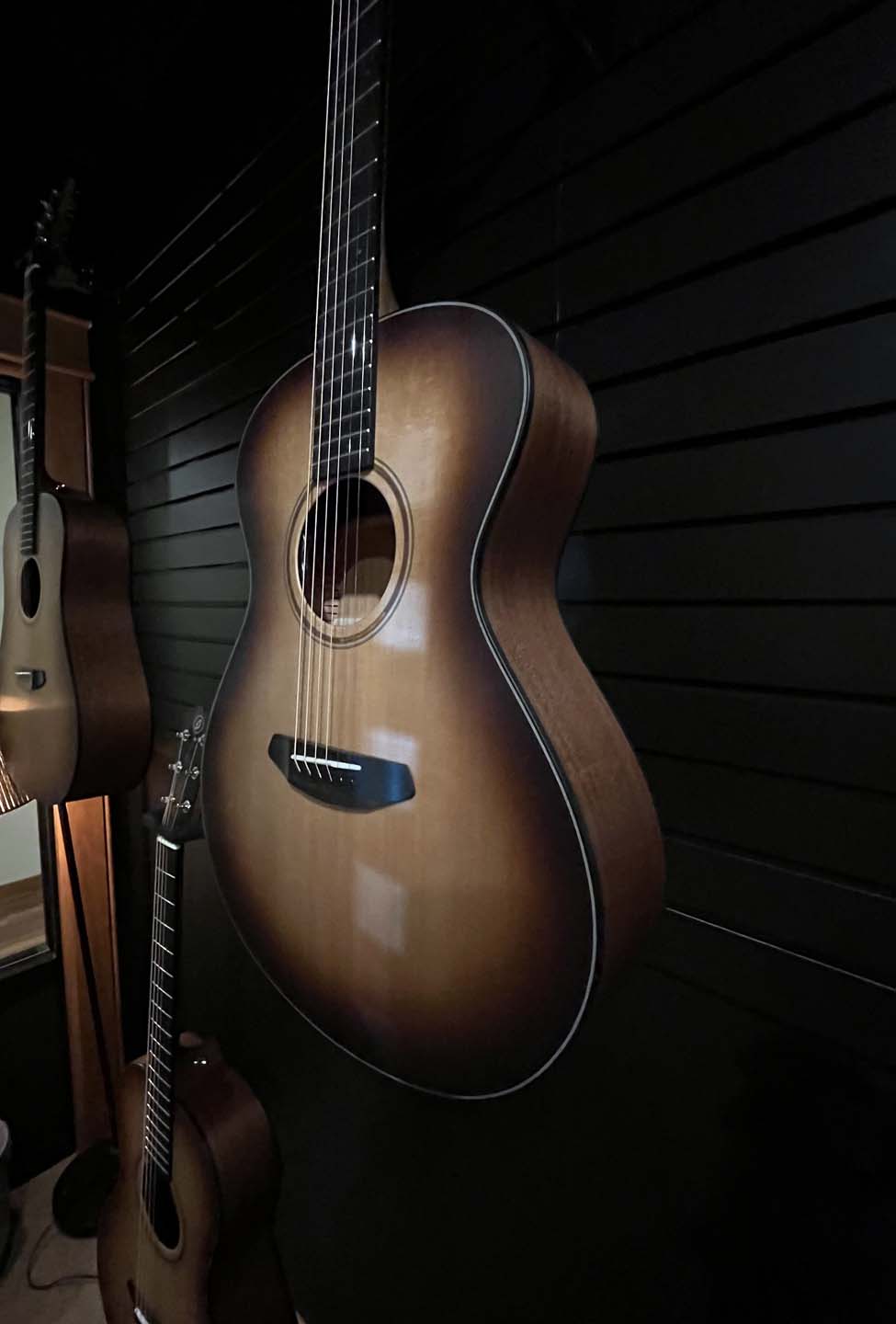
No anguish or any other negative sentiment on view during a visit to Breedlove, a company in Bend, OR, that makes its guitars by hand for the most part. Through the 30 years of its existence, the company has changed ownership a few times, with each new owner bringing improvements and different focus to the process. (You can learn about their history here.)

Mother of pearl and abalone inlay hand placed on necks.

Their instruments come in various versions, from root to artisan to collector series, and range in prices from about $3000 to 5-figure numbers, if you have personalized desires. Dreadnoughts, concert and concert cutaway guitars use different tone woods, top finishes, and custom-made inlays of abalone or mother of pearl for the necks. All instruments can be equipped to work with electronic amplifiers.


Breedlove guitars are known for their sound optimization, with each instrument’s top and back hand-tuned dependent on the unique properties of the selected woods, giving each an individual sound.


Some technological advances like CNC (Computer Numerical Control), a machining process that uses programmed commands to precisely cut and shape guitar bodies, help create parts of the instruments. But it is the hand work of the luthiers, who put it all together and work on the hand-tuning and finishing.


These skills are learned through years of apprenticeship and practical application, with many a botched instrument discarded until you reach perfection. It takes patience, passion, an eye for geometry and an ear for sound, never mind dexterity, to become a successful luthier. Hats off to those who make it.


To keep up with a competitive world, pricing has to be balanced between the quality you achieve and the time it takes to produce a sufficient number of guitars to bring to market. Not an easy task when much of the market is saturated with cheaper imports that use way more production line techniques and computerized processes.

***
Guitars and their relatives, the gittern and the lute, have been around for a long time. One of the oldest predecessors of the guitar is the tanbur, believed to have originated in Mesopotamia over 4,000 years ago. The first guitar as we know them today emerged during the 19th century, built by Antonio Torres. Contemporary concert guitars use nylon strings, blues and rock guitars use steel strings, but it is the form of the body, the hollow, and the shape of the neck that affect the overall sound we associate with guitars.

15 years ago, the Metropolitan Museum had a fascinating show of guitars and their makers, work that dated back to renaissance Italy and progressed to 20th century America.

They looked like art objects, rather than instruments and remind me of art: painters certainly have been fascinated by string instruments and depicted them through the ages.

Johannes Vermeer Woman with a Lute (1662)

Bartolomeo Veneto Lady Playing Lute (active 1502 – 1546)

Frans Hals Buffon playing Lute

Pablo Picasso The Old Guitarist (1903)
So why are guitars so popular? The best speculation I read came from here:
For “immediacy” is why a guitar is a folk instrument, i.e. the instrument of folks. The guitar is lightweight, cheap, easy to play. Anyone — and I would like to stress anyone — with two hands and the inclination can spend an afternoon learning three major chords (A D E is a good combo or D A G) and be then well equipped to instantly rock scores of songs from “Back in Black” to “You Are My Sunshine.” (Like the old ‘70s fanzine said: “This is a chord, this is another, this is a third. Now form a band.”) This is not so with the piano, nor the drums, the flute, the fiddle. Flung over the heart or across the back, the guitar is good for anywhere and any occasion. The guitar is a folk instrument because it is an easy extension of our bodies, and therefore an easy expression of our humanity. The guitar — and all its predecessors and incarnations: the bouzouki, the saz, the oud, the guitarrón — represents the parts of us that are spontaneous, angry, lazy, joyous, raw, unsophisticated and unadorned. The only other instrument that surpasses the guitar in capturing this immediacy is the voice. Which is the final reason why the guitar is not just a folk instrument but the folk instrument — it’s an easy companion to singing.

Let’s sing the praise of the guitar and listen to music by guitarists who mastered a bit more than three cords….

