Browsing Tag

Clark College Foundation

Circus meets the Culinary arts: A tasty Treat.

The weather gods were grumpy on Monday. No amount of pleading stopped the wind and pouring rain. They relented on Tuesday, a good thing, since it was the second and last day for the circus in town, slated for an outside performance. Not only that. It enabled the students of the McClaskey Culinary Institute at Clark College to shine and show off what they learned during the two-year career program in culinary management.

Alex Zavala Contreras

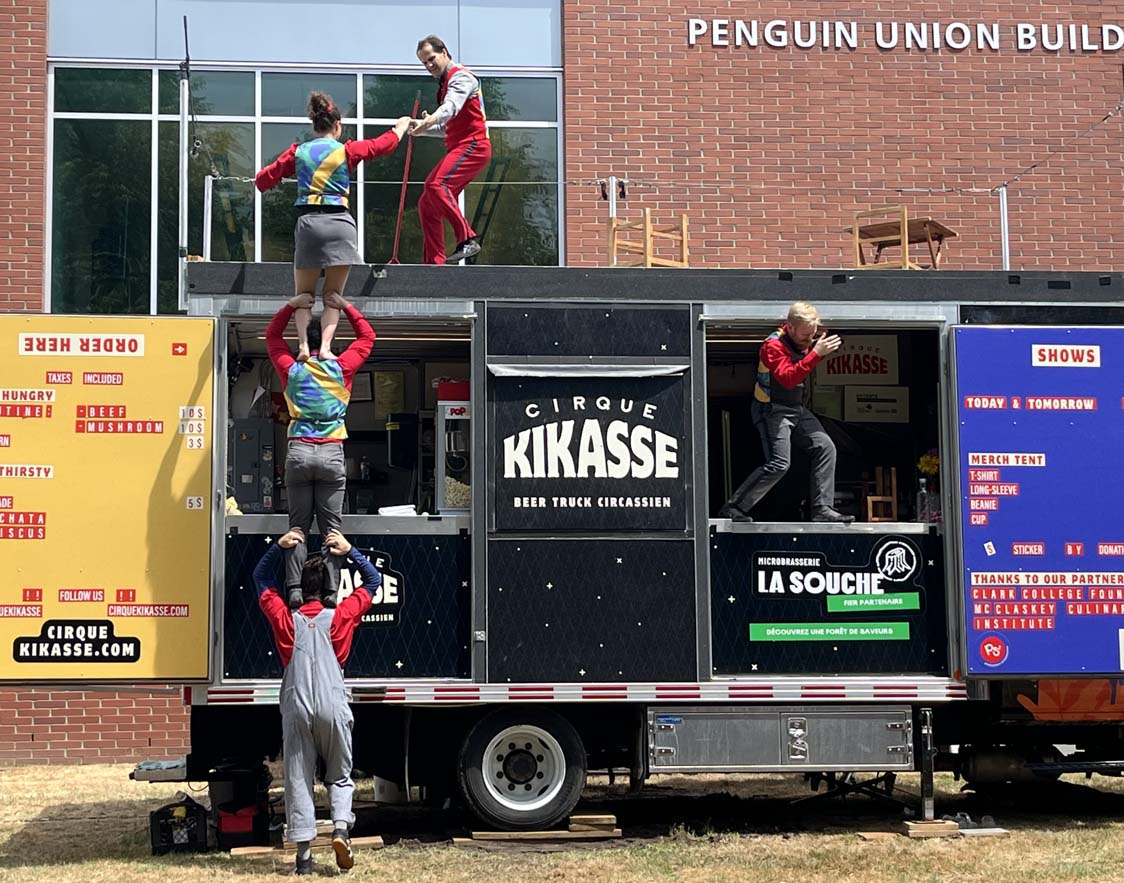
All this was made possible by an extraordinary collaboration organized and nurtured by the Clark College Foundation. Ruth Wikler, the foundation’s inaugural Director of Arts Programming, Partnerships, & Philanthropy, has extensive roots in the circus world. She invited Cirque Kikasse, based in Quebec, to bring their unusual mode of operations to the Pacific Northwest. The small band of highly talented acrobats works out of a food truck, which serves its original function before and after the show. It transforms, with the help of a few props and a trampoline, quickly and seamlessly into a stage for an energetic repertoire of juggling and acrobatics, in, under and on top of the truck.

For the first time in its history, the circus was joined by students training in the culinary arts. They developed the dishes and drinks to be served, and tended to the lines of hungry spectators, eager to grab a bite before the show. Chef Earl Frederick, the Director of the McClaskey Institute, and Service Lead Lucy Winslow were on hand to supervise and cheer on their charges.

Chef Earl Frederick

Lucy Winslow

The poutine, filled with either beef or mushrooms, was a hit, and the special drink (the usual beer for which the truck is known not served to campus students) was visually enticing – the capstone project of graduating student Alex Zavala Contreras. I should have tried it all, but had my hands full with the camera…

Alex Zavala Contreras

Students at the Clark College program have benefitted from a transformative gift by Tod and Maxine McClaskey that revamped the facilities and allows learning in state-of-the-art teaching and dining spaces, serving food to people on campus as well. The interdisciplinary encounter of these students with the arts is a next step up in reaching out to the community. By all reports, the collaboration was very much appreciated by participants from all sides.

I have always strongly believed that student participation in interdisciplinary settings opens minds and activates curiosity about the world that eventually feeds back into motivating a deeper learning of one’s own discipline. It brings people together as well, strengthening community. And in this case it made the artists quite happy, getting a break from working the bar/windows before a physically challenging performance.

***

Cirque Kikasse was founded by Hugo Ouellet-Côté and William Poliquin-Simms who have both decades of circus acrobatics and management under their belt. The idea of a self-contained truck that can travel across North America and provides entertainment and services for people’s festivities, parties, events of any kind, is both brilliant and pragmatic.

You don’t have to erect tents, schlepp endless structural parts, rent trucks etc. to be able to perform. You can feed people or ply them with special brands of beer even when the weather is so bad that you are unable to perform.

Should I get clothes matching my car?

William Poliquin-Simms

Hugo Ouellet-Côté

But the curiosity of that kind of “stage” should not draw our attention away from the actual performances. The 5 members of the crew who I was able to observe, were accomplished in their interactions. The show has assigned characters to the acrobats which require some acting, a funny story line here or there. It is choreographed to grab your attention for any one of the artists, when the others need a breather, or time to set up. There are occasions when pauses are filled with jokes, somewhat muted ones last Tuesday clearly geared to the audience – I assume some more political fireworks are in the repertoire when appropriate.

Left to Right: Hugo Ouellet-Côté, William Poliquin-Simms, Antoine Morin, Jérémie Saint-Jean, Adèle Saint-Martin. (I hope I got the names right!)

Of course the physical skills, the bravura when it comes to balancing acts 35 ft in the air on towers of rickety chairs tall, outshone whatever pleasure was derived from the contextual actions, slap-stick or the considerable showmanship during set – up of the actual acrobatics. They know what they are doing, and they are doing it very, very well.

It was not just my heart – that of a veteran circus goer – beating faster, as it turns out. The audience around me was rapt, and you could basically hear the communal intake, holding and then releasing of breaths when some particularly risky feat up in the air was safely accomplished. Some people had never seen a live circus before, as I overheard. Kids were already practicing their climbing skills, ready to join…

Antoine Morin 35 ft in the air.

There is something magical and unique about outdoors live performances (free ones at that – thank you Clark College Foundation!), when spectators are not confined into seats, able to shift vantage points, able to congregate with large groups of friends and enjoy their food.

I think I felt that doubly so given my own longing to experience live performances of any kind. Since the pandemic I have not been able to visit concerts, theater, or any other event with a large public inside, and have missed it deeply. It is simply different to see something in the moment and feel the connection to the emotions or reactions around you, than to watch even the best footage alone on a screen.

Jérémie Saint-Jean

Adèle Saint-Martin

I have written about circus before – its function, its promise, its idiosyncratic role as an art form. This week a different thought was prominent when I saw these artists push their physicality to extreme borders. Perhaps it was triggered by the ongoing discourse about physical power and masculinity in this country. Or by the fact that it is explicitly linked to military prowess by those in the administration concerned with and enthused by war. (Which is absurd, isn’t it, when war fare no longer depends on personal combat, but the ability to steer a drone or maneuver a jet…)

Physical strength and agility in the context of (imagined) masculinity is often associated with power – with dominance, prerogative, supremacy. The physical power that I observed in Tuesday’s circus performance – by both men and woman, no less – had none of those characteristics. It was tied to joy, the sheer joy of pushing boundaries, pulling some impressive tricks out of the hat comprised of all of those muscles, sinews, bones and brains tuned into precise and timed movements.

Flexibility ruled, not rigidity.

Coöperation made the feats possible, lightyears away from competition, so often found in the (sports) arena where we usually get to watch physical prowess.

What a difference. What a relief. What a treat!

Let’s hope they return soon, to better weather for the entirety of their stay.

“As real as it gets.”

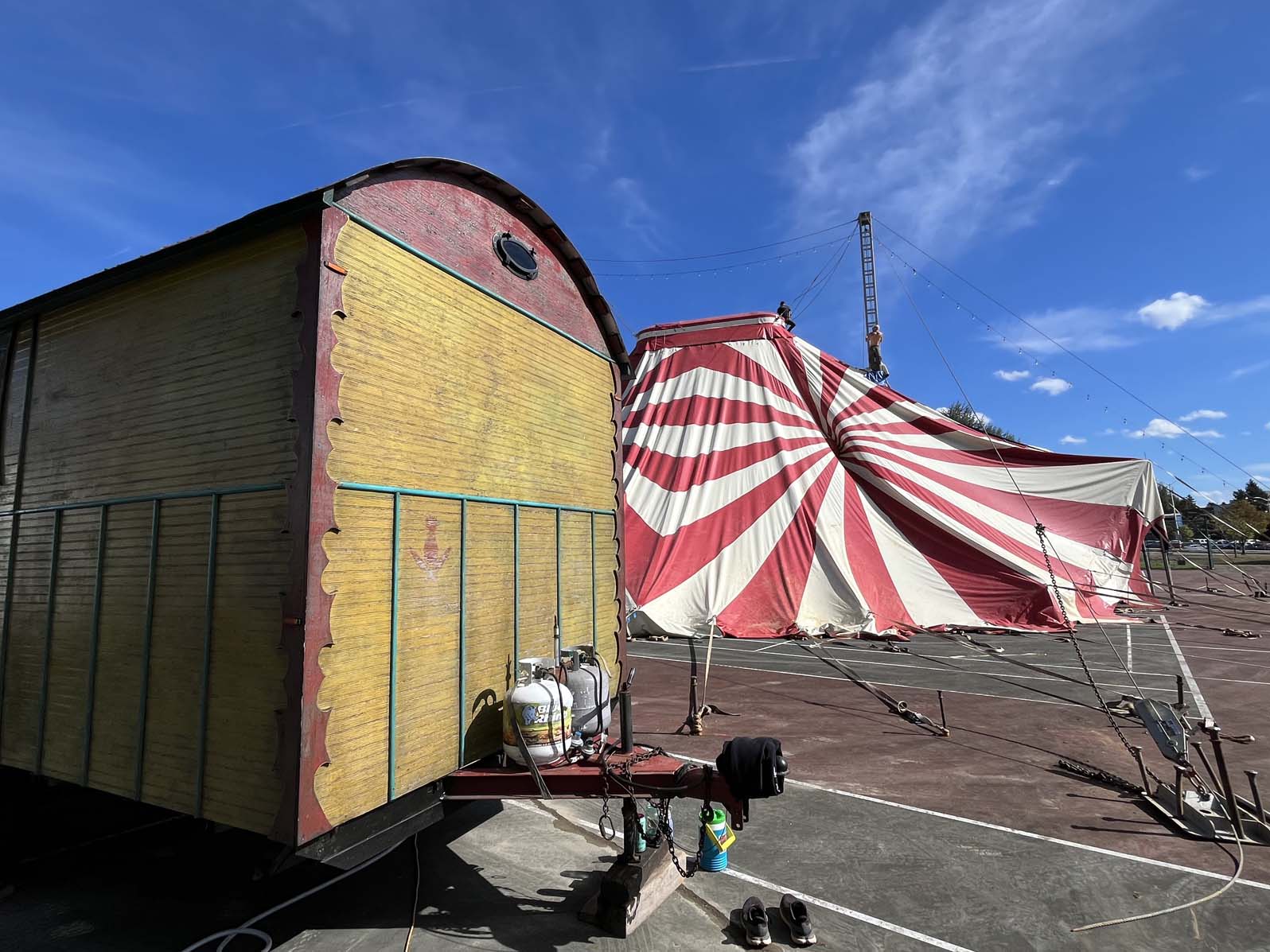
“As real as it gets!” were the words of Ruth Wikler, Clark College Foundation’s Director of Arts Programming, Partnerships and Philanthropy, when we mused about the differences between shallow Artificial Intelligence-created entertainment, called art by some, and what surrounds us when we actually experience a performance. A conversation brought on by standing on tennis courts generously provided by the facility folks at Clark College in Vancouver, WA, before refurbishing the courts. Yesterday morning it was the site of a large circus tent in the process of being erected, by invitation of the Clark College Foundation.

Pitching the big top tent.

In an era where access to higher education gets increasingly difficult, often for economic reasons, philanthropy-oriented foundations play an ever more important role. Clark College Foundation, an independent, self-governed nonprofit that partners with Clark College to improve higher education access, student success, and community engagement, distributed $1.8 million in scholarships, special awards, and financial support to hundreds of students in the 2024-2025 school year alone. The Foundation contributed $5.1 million in total support to the college that same year. In the process, the foundation brings a variety of engaging cultural events to town for the rest of us. Wikler, founder of Boom Arts and from 2019 – 2023 Director of Programming, Circus Arts at TOHU, has been innovative and creative in her new role, able to capitalize on an extensive net of connections she has made in the national and international art world to draw top notch performers to Vancouver.

Blaze Birge and Ruth Wikler in conversation.

This summer, the foundation presented Arts&Clark, a series of amazing performances at the Vancouver Arts&Music Festival. This week, they brought the circus to town. A unique one, at that – AI, eat your heart out!

Flynn Creek Circus has been touring the country for more than 20 years, a small, independent, self-contained organization with artists living on site and the entire ensemble helping with all chores, from providing pre-tour support, generating lighting, costumes, music and props, pitching and pulling down the tents, postering and advertising the show, staffing the ticket office or ushering pre-show.

Importantly, the circus seeks out rural areas and is focussed on next generations – both in terms of programming but also educating the artists of the future: the circus supports Circus Mentors Inc., which experientially engages rural youth in the arts, particularly physical arts; the circus also has an apprenticeship program which promotes mentorship relationships between new artists and seasoned professionals.

Clark College Foundation, together with Clark College Athletics, attempts to raise the next generations as well, fundraising for Clark College Athletics Scholarships with this circus visit. A portion of each ticket, and all proceeds from opening night, support this cause, helping promising athletes from across our region to participate in higher education. The college offers both transfer degrees and vocational degrees – and circus has a long history of vocational education. Circus is, of course, a fitting venue in the most direct way for this cause – all artists there are athletes (some have arrived from professional sports), training rigorously and working as a team to deliver safe shows many times week.

Blaze Birge and David Jones, founders of Flynn Creek Circus.

The founders, Blaze Birge and David Jones, had impressive solo and partnered artistic engagements to show for before they built this traditional circus community. The many awards presented to them do not just recognize exceptional physical or theatric skills, however. Flynn Creek Circus is also recognized in the larger community for its history of combining physical acts with narratives that echo the treasure trove of collective human wisdom, from myth to fairytales. Binding physical artistry into story telling, sometimes funny, sometimes gut-wrenchingly emotional, creates a shared world between performers and audience: a specific physical world and one of shared feelings, something AI is simply unable to generate, being located outside that present universe.

I imagine living the life of traditional wayfarers for more than two decades cannot always be easy. There is hard physical labor inside and outside of the top tent, unpredictability in sales and income (and depending on it to stay independent,) there are likely not always friendly social encounters as experienced by all seasonal travelers. Age gets to your body, with acts likely to have to be retired at some point. Responsibilities add up, for the collective and gear alike. Yet this duo shows nothing but passion for maintaining the traveling circus tradition, feeding our need for story telling, and investing in education for the physical arts as well as all the technical and managerial issues associated with it. They frequently serve as jurors in circus competitions, are contributing members to the American Circus Alliance and
engage in multiple nonprofit projects to support performing arts in the U.S.

It is as real as it gets.

Of course, it is not just the relationship between audience and artists. The interplay between the performers onstage, the collaboration, the in-the-moment reaction to risk or needs is utterly absent from artificial intelligence which has no agency in any given moment. Intelligence, or having a skill set is not enough – you need to be curious, and leaning into anticipatory sensitivity, if you don’t want to risk your life/health or that of you partners during dangerous maneuvers, something still unique to humans, as far as I can tell.

Again, as real as it gets.

I had a chance to photograph the pitching of the tent and talk to the founders just 2 days before the performances start. It brought back thoughts from many years ago, when I was writing about a different circus world, in Montreal, Canada and reminisced back to the small traveling circuses of my child hood in Germany. I figured I’m allowed to repeat them here, since they feel as fresh and as applicable as then, particularly since Flynn Creek Circus is in some ways so similar in set up to the 195Os self contained wandering shows visiting my rural village. Here it is breathing 21st century energy into a great American tradition: the traveling tented circus. No need for animals to put on a great show. Coming together under the big top still makes for a terrific night out, now perhaps more than ever, since we are so increasingly isolated from group experiences.

From my own childhood experience:

There was a clown or two, some jugglers, and high wire and trapeze acts that went to the core of the experience: a shared range of emotions between members of the audience and the performers. There was distributed anticipatory anxiety, moments of collective breath holding and then exuberant relief by one and all when once again the laws of nature were seemingly defied, or at least nature’s wrath held at bay. 

There was an immediacy to the experience, and a connectivity, that for me defines this discipline in contrast to many other endeavors in the performing arts: not just skill acquired over years of practice, a sense of the possible, a tackling of the impossible (all of which can be said for musicians, actors and dancers as well who personally interact at least in theory with the audience before them)  – but an element of elective risk taking that in the moment is understood by both acrobat and audience to entail danger, to depend on the confidence and skill or strength of the performer and which is open to, potentially catastrophic, failure.

It does not matter if the connection is made because you admire the daring, or long for the physical prowess or marvel at the creativity of the act. It does not matter, although perhaps plays a role, that circus comes to you – at least during its traditional history and these days when performed in public spaces. What matters is that a bond is established between acrobats and audience, where at any given moment our knowledge of what is norm for a human body, and what is pushing it to the extreme, allows us to connect to those who challenge those norms in front of our very eyes, making us an accomplice to triumph or failure. Circus at its truest conjures empathy between humans who share physical boundaries and an emotional economy, both now challenged. 

Circus has come a long way since I sat trembling in the village bleachers. Like any other art form it is struggling to evolve in ways that are meaningful and evocative and to secure autonomy in a world that has made culture a commodity. I certainly got glimpses of the possibility of something radical, utopian, critical and emancipatory in contemporary circus – all that we demand from art. 

Inside the tent.


You have a chance to see all of this unfold in this week’s performances of The Bridge, a tale of wolf and man inspired by nordic folklore and fairy tale characters.

Tickets start at $23 and some performances are geared towards kids, others are adults only, Oct 2-5 at Clark College Tennis Courts, Corner of Fort Vancouver Way & E. McLoughlin, Vancouver, WA 9866. (Clark College Purple Parking Lot is close and convenient.) Wheelchair accessible.

Do yourself, your family and friends a favor and secure those tickets!

In addition to the Jones duo, there is a large cast of diverse artists, apprentices and support staff.

Jesse Patterson as the Red Countess.
Cory Blackthe Puppy
Nick Hardenthe Emperor
Jessica Perry Millerthe Star
Rylan Rydenourthe Troll
Jeremy Cifoniethe Ferry Man
Jacy Jonesthe Raven
Katie RussoWolf in Sheep Clothing
Shem Biggiethe Wolf
David Jonesthe Goat
Blaze Birgethe Goat’s Shadow
Richie AldereteBunnyboy
Ilana Rosethe Witch
Donna Lukinthe Mushroom
Dave Wagarthe Lantern
Rachel Birgethe Sheep Lady
Bodhie Devriesthe Wolf
Maya DeLocheTent Assistant
Laurie WulfekhuleCostumes
Esther de MontefloresMarketing Research