Browsing Tag

Horatio Hung-Yan Law

The Unknown City.

“Marco Polo describes a bridge, stone by stone.
‘But which is the stone that supports the bridge?’ Kublai Khan asks.
‘The bridge is not supported by one stone or another,’ Marco answers, ‘but by the line of the arch that they form.’
Kublai Khan remains silent, reflecting. Then he adds: ‘Why do you speak to me of the stones? It is only the arch that matters to me.’
Polo answers: ‘Without stones there is no arch.”

― Italo Calvino, Invisible Cities

***

I should have known better and visited The Unknown City group exhibition at PLACE earlier. Now there are only a few days left for you local readers to decide if you agree or disagree with my assessment that the show is well worth exploring. Three days, to be precise, it closes this Friday afternoon, June 12th, with a reception. A quick shout-out then (not a formal review), to lure you into action!

The concept, developed by organizer and curator Horatio Law, is an interesting one. Take some 40 or so local photographers (split into two randomly assigned groups), all over 60 years of age, allot them a 3-6 ft wall space and ask them to display work that relates to the theme of subjective visions of Portland, OR. I had seen the work of the first group, some 4 weeks ago, on line. Decided I could not write about it since I am friends with several of the participants, friendly with others, not entirely objective. Looks like nobody else did either, maybe we are all too chicken to step on toes in a closely knit community?

On this rainy Monday, however, a dear friend, who had recently returned to Portland after a 7 year absence, and I decided it would be fun to look at captures of her former home turf. For this second group as well, I knew about 50% of the contributors, some closely. Others were completely new to me, despite the small local community. I threw caution into the wind because this show really deserves some attention.

PDX yard vistas by Barbara Gilson

The rules were simple: fit into the given space and pin prints to the wall. Artist decides how many, in what format or size, colored or black&white, carefully printed, or close to photocopies or postcards. The enormous variability along many dimensions can either be fun, or distracting. As it turns out, the curation worked well visually, without becoming too busy.

Lucy Capehart

As is always true in group shows, some work draws your attention, some leaves you cold, some is a real discovery, some entices (or bores) with familiarity. My reactions to the displays were mainly driven by two perspectives: did I like the photographs in and of themselves (yes, in many, many instances.) Did I think they sufficiently connected to the claimed inspiration for this exhibition, Italo Calvino’s book Invisible Cities? Here the pool got much smaller. From the introduction of the exhibition:

Calvino’s novel puts the explorer Marco Polo and the isolated Kublai Khan into a room, with the former telling stories to the latter, who is starved to learn about the world. Many cities are evoked, Anastasia, Despina, Diomera, Dorothea, Fedora, Isidora, and Zora – all in reality describing Polo’s beloved hometown Venice. The conversations are structured in a complicated interactive pattern related to memory and desire, allowing the author to delve into the psychology of how these two functions shape each other and are intertwined in our understanding and depiction of the world.

The chapters contain overall place and object – specific descriptions for each of these imaginary cities. The person(s) involved were predominantly the traveler, the observer, in his particular relation to what he saw.

Ken Hochfeld with a caption for his Leaning series: “At sunrise everything is luminous but not clear.” -Norman Maclean

I had expected to see place-specific photographs, then, something that was identifiably related to Portland, or could have been, although not necessarily prototypical landmarks. How did objects or, more predominantly, portraits of persons that could have come from anywhere, unless identifiable local favorites, fit the bill? Some of those were among the strongest photographic work, as it turns out, and so unsurprisingly offered for display. But the link was missing for me.

Phil Harris

Then again, I could go back and be reminded of Marco Polo’s admonishment contained in the Calvino quote at the beginning of this column:

The bridge is not supported by one stone or another,’ Marco answers, ‘but by the line of the arch that they form.’
Kublai Khan remains silent, reflecting. Then he adds: ‘Why do you speak to me of the stones? It is only the arch that matters to me.’
Polo answers: ‘Without stones there is no arch
.”

Brian Foulkes – one of the longtime chroniclers of the city, whose work I’ve known for over 30 years and admire for its hints of melancholy and humor, often within the same piece.

The work on the walls at PLACE does form an arch, an accumulation of many stones projecting diversity of both, the city itself and the perspectives taken by these many astute and sensitive observers. And they certainly depict change and growth, in this regard echoing something Calvino or his mouthpiece Polo strongly value. In another chapter (4) on cities and memory, the town Zora is introduced, a town that cannot be forgotten because it stays static for memorization. Polo concludes:

But in vain I set out to visit the city: forced to remain motionless and always the same, in order to be more easily remembered, Zora has languished, disintegrated, disappeared. The earth has forgotten her.

No such fate in store for our Portland, and no mandate for memorization either, given that we can rely on so many photographers preserving the reality, quirks and evolution of the city.

Jim Lomasson

Obviously I am just showing a few samples – looking at the whole bodies of work (and in full sizes) is much more revelatory. Recommended! You have until Friday…

Kim Stafford

PLACE: 735 NW 18th Ave Portland 97209

Closing reception June 12th, 2026 4-7 pm.
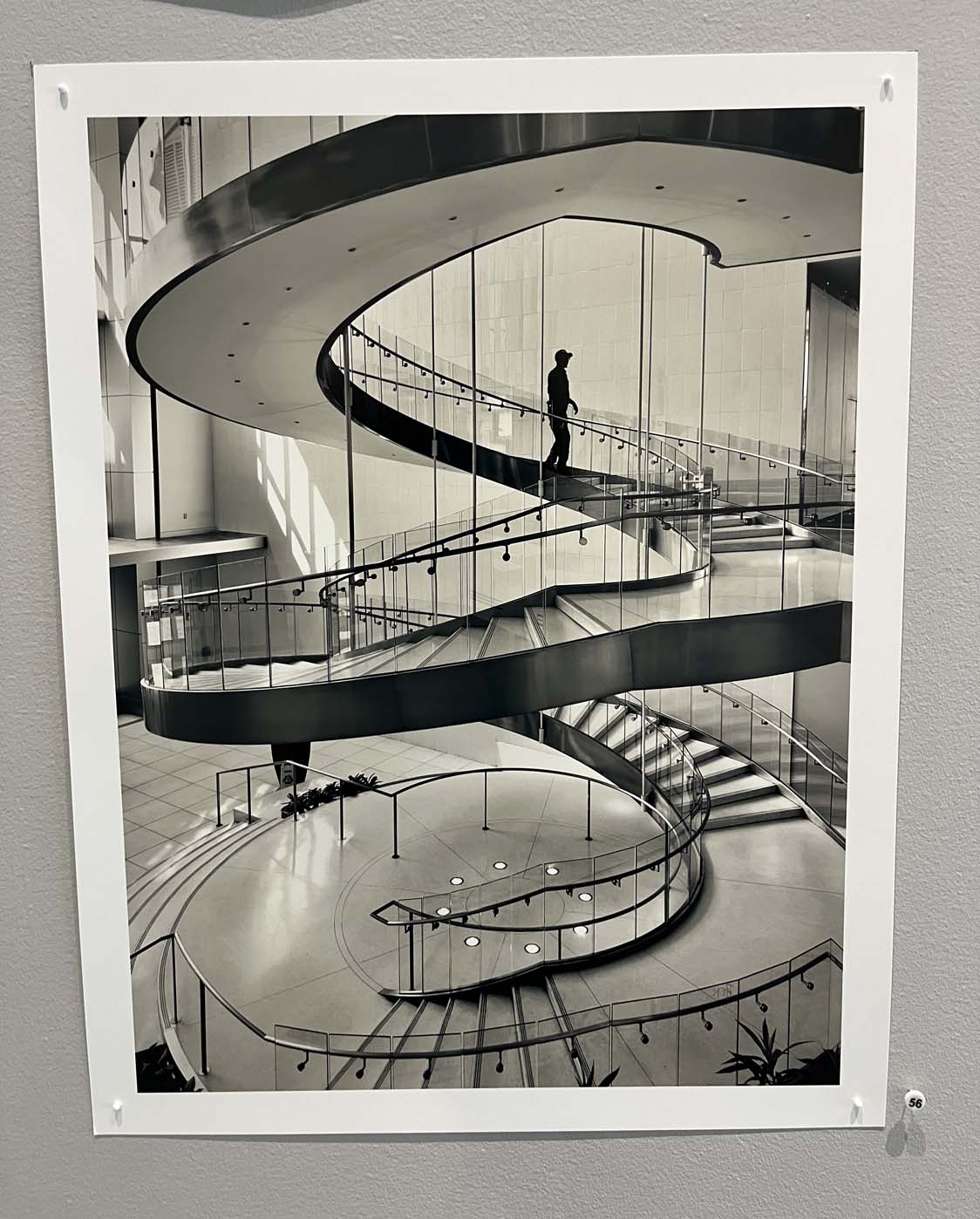
Lloyd Center Journal

· A Photographic Project by Horatio Hung-Yan Law ·

“I see my buildings as pieces of cities, and in my designs, I try to make them into responsible and contributing citizens.” – César Pelli, Argentine-American architect (1926–2019).

About a century ago, a young man with a vision started buying parcels of land on Portland’s East side. His plan for a large commercial hub away from downtown was realized some 40 years later, when he had become a loaded southern Californian oil company executive with the means to hire the best architects of the day. Ralph B. Lloyd (1875–1953) did not live to see the opening of the mall that bears his name, in August 1960. By that time it was touted the largest mall in the U.S., designed by John Graham Jr, architect of Seattle’s famed Space Needle, as one of the first in a string of commercial centers his firm became known for.

Lloyd Center, with its open air plan, anchor stores and various attractions, including a famous ice rink, soon became a landmark of the city. Lloyd and his architects understood the lure of free and ample parking. Enough spots for 800 cars materialized. So did the customers. In the 1990s the mall was enclosed and provided with a food court. Even though that separated the complex from the previously open connection to the neighborhood, it remained more than just a place to shop. The entire complex served as a “contributing citizen” reminiscent of Pelli’s formulation. Walking groups of all ages used the space in rainy season. People found shelter from summer heat in the air-conditioned passages. Kids experienced their first taste of freedom when dropped off at the movies or the game rooms. Students hung out, and the ice rink provided endless opportunities to marvel or just people watch. Importantly, it was a community space that reflected economic and racial diversity, so sorely missed by many of us in other parts of the city.

Between the advent of E-commerce, the Covid epidemic, and changes in the overall economy, things went into a downward spiral eventually. Anchor stores left, gang-related crime and the number of houseless congregating around the neighborhood rose, and we are now at a point where the mall will be closed for good by the beginning of August.

The current owners of the center, Urban Renaissance Group and KKR Real Estate Finance Trust Inc., plan to demolish all of it and divide the 29.3 acres into 14 parcels to be sold for mixed-use redevelopment. ZGF architects offered an urban renewal proposal, and a Master plan was approved by city’s Design Commission on March 5th, 2026. Strong opposition by neighborhood groups, including the Save Lloyd Ice Coalition, and the Save Lloyd Campaign in partnership with the Northeast Coalition of Neighborhoods, ignored by the Design Commission, have now led to appeals of this decision. The City Council is scheduled to hear arguments against efforts to replace the mall on Wednesday, June 24 at 9:45 a.m., deciding on approval, modification, or opposition to the proposal entirely.

***

Impending loss of the familiar spurs melancholy for some, curiosity for others. The increasingly abandoned Lloyd Center drew photographer and public art and installation artist Horatio Hung-Yan Law for repeat visits. They turned into a months-long project of poignant documentation of a communal space under the threat of an uncertain fate. The photographic voyage is currently on exhibit at PLACE in NW Portland. Run, don’t walk, to catch this show before it closes on May 1,2026.

Tomes have been written about the lure of ruins and abandoned or decaying industrial and commercial space for photographers. Lucky for us, Law does not yield to the temptation to accentuate morbid aspects of decline. Instead, he provides a portrait of a place that still occasionally vibrates, still has moments of beauty, still conveys a sense of the original optimism of builders trying to integrate structural elegance and airiness into dens of commerce. Add to that choice of positive depiction a clever way to display his photographic harvest: the images on the wall are sequenced in various fashions that echo the feelings of walking through a Mall. There is no unifying style, color and black&white happily co-reside, sizes are all over the map, prints refuse to be rigidly aligned. Some walls are dedicated to architectural themes, others hint at subjective moments that roused emotions in the photographer. Busy views are counterbalanced by quiet glimpses. Law’s capture of the space mirrors both aspects that were emphasized by the original designs (as well as the plans for redevelopment), namely activation AND lingering.

The artist is surely familiar to ArtsWatch readers for his Urban Studies series, portraits of Portland’s neighborhoods taken with his iPhone on daily walks. These images are picked up by chance and a discerning eye, linked only by the fact that they were spotted during ambulation. Almost always interesting takes by our flaneur-in-residence. I had also reported on his curatorial prowess with works by contemporary Asian-American artists at the Portland China Town Museum, where he served as Artist Residency Director. (He will soon again curate a community assemblage, Portland as seen by photographers over age 65. The line-up of 40 participants is a veritable who’s who of the photographic community’s éminences grises, in this case more referring to hair color than actual hidden powers, I presume. Running for 6 weeks again at PLACE which generously donates its space, it promises to be a gang buster event starting at the beginning of May.)

This was the first time I saw an entire body of work exhibited by the artist, again with terrific moxie to break the rules. Simply pinned to walls, repeat motifs with slight, but important modulations. If he can continue to stay safely away from the cliff edge of vaulting into technicolor overdrive, the work could be meaningfully gathered into a book that many of us, I believe, would cherish as a memento of times coming to a close.

***

“At the heart of capitalism is creative destruction.” – Harvard economist Joseph Schumpeter.

You’ve probably walked by this sculpture near Lloyd Center a hundred times. Larry Kirkland’s 1991 stack of money on an ionic column in a fountain is titled Capitalism. If you ever read the inscriptions on some 25 of those coins, you likely agree that their outstanding feature is a competition for triteness. Samples:”Business without profit, is not business anymore than a pickle is a candy.” “Never invest in anything that eats or needs repairing.””That money talks, I’ll not deny, I heard it once. It said: “Goodbye”. I rest my case.

An alternative would have been to include some of Schumpeter’s wisdoms, his theory of creative destruction. It describes the process where new innovations replace outdated systems. Whatever you think about capitalism, insights on business cycles, entrepreneurship, and capitalist development need to be considered for modern economics. Or city planning, for that matter, if you want keep your foot in the world as is, rather than what we wished it to be.

I understand the nostalgia, the love for places that served a meaningful role in the community. I also believe we must look forwards, with the contemporary needs for affordable housing and more green spaces overwhelming. Infill of central spaces, linked to public transportation, is paramount in my opinion, IF we can guarantee that the needs of the populace are filled, and not neglected at its expense. Building housing and parks on former parking lots and store fronts sounds like the right move to me. The question is, of course, if the manifold promises and allusions to neighborhood improvement found in the development plan (downloadable here) approved by the Design Committee, are nothing but.

Are there fixed requirements of x units of this or that? Did I miss them, perusing the documents in front of City Council? Are there development laws I am not familiar with? In the plan outlines on policy for Housing Diversity (Policy 2.LD-4), at least, we read: “Encourage development of new housing, especially in Central Lloyd and on the Irvington and Sullivan’s Gulch edges to foster a sense of community and support efficient provision of residential amenities and services.” (My bolding.) A discussion of required features of any redevelopment of Lloyd Center should be paramount during the appeal process in front of Portland City Council.

Then again, we are not facing the erection of a data processing center, or a warehouse to be used as concentration camp on these 29 acres. I guess there’s always something that could be worse.

Or something to be grateful for: in this case that we have Horatio Law’s splendid documentation of a Portland landmark that can serve as a memento to mid-century architectural citizenship.